
In the realm of personal finance and wealth management, the ability to calculate a percentage is more than just a basic mathematical skill—it is the fundamental language of money. Whether you are determining the interest rate on a high-yield savings account, calculating the tax implications of a stock sale, or setting a monthly budget, percentages are the primary metric used to measure growth, loss, and stability.
Understanding how to figure out a percentage of a number allows an individual to move beyond guesswork and into a position of strategic financial control. By mastering these calculations, you gain the clarity needed to compare investment opportunities, manage debt effectively, and ultimately optimize your net worth.

The Fundamental Formula: Why Percentages are the Language of Money
At its core, a percentage is a way to express a number as a fraction of 100. The word “percent” literally stems from the Latin per centum, meaning “by the hundred.” In the financial world, this allows us to standardize different values so they can be compared easily, regardless of the scale of the investment.
The Basic Equation: Part, Whole, and Percentage
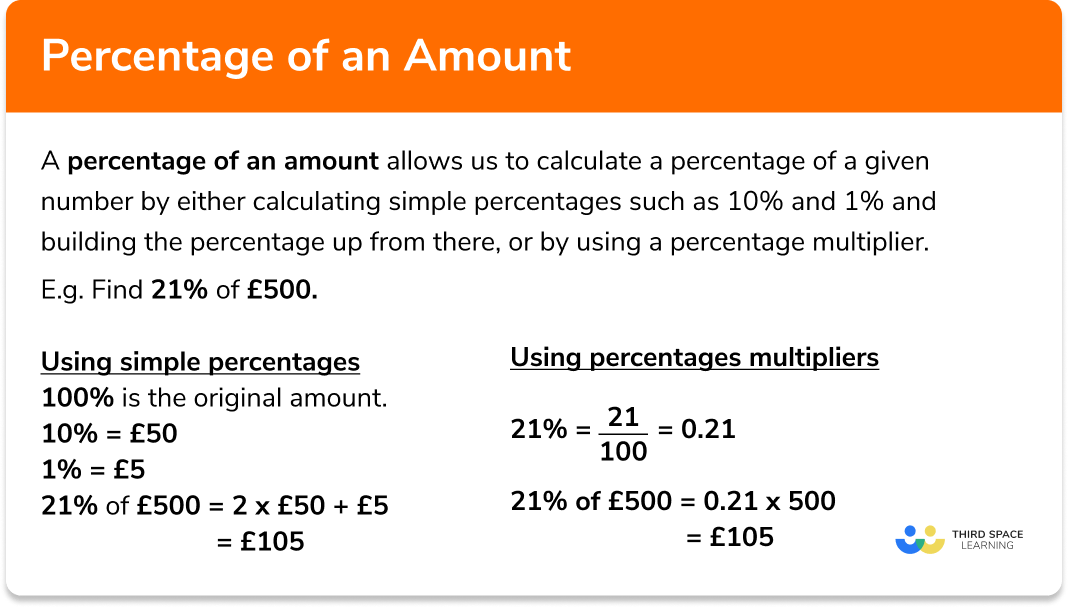
To figure out the percentage of a number, you essentially need to perform a simple multiplication. The standard formula is:
Value = (Percentage / 100) × Total Amount
For example, if you want to find 15% of $4,000 (perhaps for a business expense or a down payment), you would divide 15 by 100 to get 0.15, and then multiply that by 4,000. The result is $600.
Understanding this relationship is the first step toward financial literacy. When you see a “5% return on investment,” you are looking at a ratio. Knowing how to quickly translate that ratio into a dollar amount allows you to visualize the actual impact on your bank account.
Decimal Conversions: The Shortcut to Faster Calculations
In professional finance settings, mental math is a valuable asset. The fastest way to calculate percentages without a calculator is to convert the percentage into a decimal.
- To find 10% of any number, simply move the decimal point one place to the left.
- To find 1% of any number, move the decimal point two places to the left.
If you are looking at a $1,200 investment and want to find a 12% return, you can find 10% ($120) and 1% ($12). Adding 10% plus 1% plus 1% ($120 + $12 + $12) gives you $144. Developing this “number sense” is crucial for making split-second decisions during business negotiations or while evaluating market shifts.
Personal Finance Applications: Budgeting and Savings
Budgeting is perhaps the most practical application of percentage calculations in daily life. Most modern financial frameworks rely on percentage-based allocations rather than fixed dollar amounts because percentages scale as your income grows.
The 50/30/20 Rule: Dividing Your Income
A popular financial strategy is the 50/30/20 rule. This dictates that 50% of your after-tax income should go to “Needs,” 30% to “Wants,” and 20% to “Savings and Debt Repayment.”
To apply this, you must first calculate the percentage of your total monthly take-home pay. If your monthly income is $6,500:
- Needs (50%): $6,500 × 0.50 = $3,250
- Wants (30%): $6,500 × 0.30 = $1,950
- Savings (20%): $6,500 × 0.20 = $1,300
By using percentages to define your budget, you ensure that your lifestyle doesn’t experience “lifestyle creep” as your salary increases. Your savings will always grow proportionally with your income.
Calculating Sales Tax and Gratuity
While these may seem like minor expenses, they are the most frequent percentage calculations we perform. In a professional context, such as a business lunch or purchasing office equipment, knowing the final cost inclusive of tax is vital for bookkeeping.
If you are purchasing a $2,500 laptop for your consultancy and the local sales tax is 8.5%, you calculate the tax by multiplying $2,500 by 0.085 ($212.50). The total cost is $2,712.50. Mastering these small calculations prevents “budget leakage,” where small, unaccounted-for percentages add up to significant annual losses.
Investing and Wealth Building: Measuring Growth
In the world of investing, percentages are the only way to measure the efficiency of your capital. A $1,000 profit is impressive if you invested $2,000 (a 50% return), but it is negligible if you invested $1,000,000 (a 0.1% return).
Calculating Return on Investment (ROI)
The ROI formula is the holy grail of financial analysis. It allows you to determine how much money you have made or lost relative to the amount you invested. The formula is:
ROI = [(Current Value – Original Value) / Original Value] × 100
Suppose you bought shares of a tech company for $5,000 and sold them a year later for $6,200.
- Subtract the original cost from the current value: $6,200 – $5,000 = $1,200.
- Divide that gain by the original cost: $1,200 / $5,000 = 0.24.
- Multiply by 100 to get the percentage: 24%.
A 24% ROI is an objective indicator of success, allowing you to compare that investment’s performance against the S&P 500 or a high-yield savings account.
The Impact of Compound Interest and Annual Percentage Yield (APY)
When saving money, you will often see interest rates expressed as APY. This percentage reflects the total amount of interest you earn in a year, including the effect of compounding.
Compound interest is when you earn interest on both your initial principal and the interest that has already accumulated. To understand the future value of an investment, you use the compound interest formula, which is essentially a series of percentage increases applied over time. For a wealth builder, even a 1% difference in APY can result in tens of thousands of dollars in difference over a 30-year period. Understanding how to calculate these percentages helps you choose the right financial instruments for long-term growth.
Debt Management: Navigating Interest Rates and Credit
Percentages are a double-edged sword. While they build wealth in investments, they can erode wealth when applied to debt. Understanding the percentage cost of borrowing is the only way to avoid the “debt trap.”
Understanding APR and Monthly Interest Charges
The Annual Percentage Rate (APR) represents the yearly cost of borrowing money. However, most credit card companies calculate interest daily. To understand how much a balance is actually costing you, you must break down that annual percentage.
If you carry a $5,000 balance on a credit card with a 24% APR:
- Divide the APR by 12 to get the monthly rate: 24% / 12 = 2%.
- Calculate 2% of your balance: $5,000 × 0.02 = $100.
This means you are paying $100 every month just in interest, without even touching the original $5,000 principal. When you see your debt in terms of percentage-based costs, it provides a much stronger incentive to prioritize high-interest debt repayment.
Debt-to-Income Ratio: Your Financial Health Score
Lenders use the Debt-to-Income (DTI) ratio to determine your creditworthiness. This is the percentage of your gross monthly income that goes toward paying debts.
DTI = (Total Monthly Debt Payments / Gross Monthly Income) × 100
If your monthly debt payments (mortgage, car loan, student loans) total $2,000 and your gross income is $6,000, your DTI is 33%. Most lenders look for a DTI of 36% or less. Knowing how to calculate this percentage yourself allows you to audit your own financial health before applying for a mortgage or a business loan.
Professional Tools for Financial Calculations
While mental math and manual formulas are essential for understanding the logic behind the numbers, professional financial management often requires the precision of technology.
Leveraging Excel and Google Sheets for Automation
In a business or high-level personal finance environment, spreadsheets are the standard tool for percentage calculations. They allow you to handle large datasets and perform complex “what-if” scenarios.
- To calculate a percentage in Excel, you simply use the formula
=A1*B1, where A1 is the total and B1 is the percentage (formatted as a percentage or a decimal). - To find a percentage increase between two years of revenue, you would use
=(NewValue - OldValue) / OldValue.
Automating these calculations ensures accuracy and allows for real-time tracking of financial goals, such as monitoring the percentage of your portfolio allocated to a specific asset class.

Online Financial Calculators for Complex Scenarios
For more complex financial tasks, such as calculating the percentage-based impact of inflation or determining the “break-even” point of a business venture, specialized online calculators are invaluable.
Tools like mortgage amortization calculators or retirement planners use underlying percentage formulas to project your financial future. However, these tools are only as good as the data you input. By understanding how to figure out a percentage of a number manually, you can verify the outputs of these digital tools and ensure that your financial strategy is built on a solid foundation of mathematical truth.
In conclusion, mastering percentages is not merely a schoolhouse exercise; it is the cornerstone of professional financial management. From the simple task of calculating a tip to the complex analysis of investment ROIs and debt ratios, percentages provide the clarity needed to navigate the modern economy. By integrating these calculations into your daily financial life, you move from being a passive observer of your money to being an active, informed architect of your wealth.
aViewFromTheCave is a participant in the Amazon Services LLC Associates Program, an affiliate advertising program designed to provide a means for sites to earn advertising fees by advertising and linking to Amazon.com. Amazon, the Amazon logo, AmazonSupply, and the AmazonSupply logo are trademarks of Amazon.com, Inc. or its affiliates. As an Amazon Associate we earn affiliate commissions from qualifying purchases.