
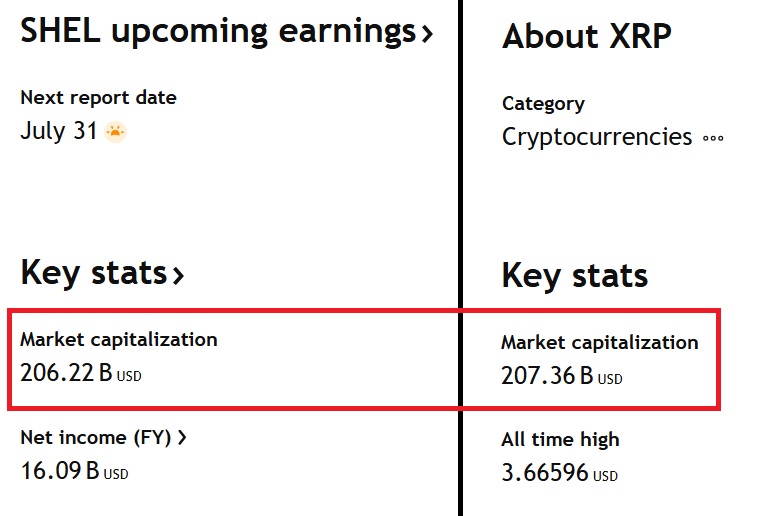
The cryptocurrency market is a dynamic landscape where digital assets vie for investor attention and capital. Among the myriad of digital currencies, XRP consistently stands out with a remarkably high market capitalization, often placing it among the top five cryptocurrencies by this metric. For investors and financial observers, understanding the factors contributing to XRP’s significant market cap is crucial for informed decision-making and comprehending the broader cryptocurrency ecosystem. This article delves into the financial underpinnings that explain XRP’s prominent market valuation.
Deciphering Cryptocurrency Market Capitalization
Market capitalization, or “market cap,” is a fundamental metric in financial markets, representing the total dollar value of all outstanding shares of a public company. In the context of cryptocurrencies, market cap is calculated by multiplying the current price of a single coin by the total number of coins in circulation. For example, if XRP trades at $0.50 and there are 50 billion XRP coins in circulation, its market cap would be $25 billion.

A high market cap in cryptocurrency often signifies several things to investors:
- Liquidity: Larger market cap assets typically have higher trading volumes, making it easier for investors to buy and sell without significantly impacting the price. This appeals to institutional investors seeking to deploy substantial capital.
- Investor Confidence: A high market cap can be interpreted as a sign of broader investor confidence and belief in the asset’s long-term viability and utility. It suggests a significant amount of capital has already been invested, creating a psychological anchor.
- Stability (Relative): While crypto markets are inherently volatile, assets with higher market caps tend to exhibit somewhat less extreme price swings compared to smaller, more speculative coins, though this is not a guarantee.
- Visibility and Trust: Being a top-tier cryptocurrency by market cap naturally increases its visibility, drawing more attention from potential investors, analysts, and financial media, further solidifying its perceived legitimacy.
For XRP, its consistently high market cap points to a complex interplay of financial strategies, market positioning, institutional interest, and investor sentiment.
Core Financial Drivers of XRP’s Valuation
Several key factors contribute to XRP’s substantial market capitalization, distinguishing it from many other digital assets. These drivers often stem from its unique design and its issuer’s strategic focus on the financial services industry.
Early Mover Advantage and Brand Recognition
XRP, originally released in 2012, is one of the oldest cryptocurrencies. This early entry into the market afforded it significant first-mover advantage, establishing its presence and fostering brand recognition long before the broader crypto boom. For investors, longevity can imply a degree of resilience and a tested infrastructure, which can be a comforting factor when allocating capital in a nascent market. The sheer duration of its existence has allowed it to build a robust financial ecosystem around its use cases, cultivating a significant base of loyal investors and users.
Strategic Focus on Cross-Border Payments and Institutional Adoption
Unlike many cryptocurrencies focused on decentralized applications or store-of-value propositions, XRP was specifically designed by Ripple (the company associated with XRP) to facilitate fast, low-cost, and reliable cross-border payments for financial institutions. Ripple’s suite of products, such as RippleNet, leverages XRP as a bridge currency for its On-Demand Liquidity (ODL) service.
- Cost Efficiency: Traditional cross-border payments are often slow and expensive, involving multiple intermediaries. XRP offers the potential for significant cost reductions by eliminating these layers and settling transactions in seconds. For financial institutions, this translates directly into operational savings, a compelling financial incentive.
- Speed and Scalability: The XRP Ledger boasts high transaction throughput and near-instant settlement times (3-5 seconds), which are critical requirements for large-scale financial operations. This technical capability directly translates into a perceived utility for high-volume financial transactions, appealing to institutions that value efficiency.
- Partnerships: Ripple has historically forged partnerships with numerous financial institutions globally, ranging from banks to payment providers. While not all partners explicitly use XRP in their operations, the association with established financial players lends credibility and suggests potential future adoption, fueling investor speculation about XRP’s long-term utility and value within the traditional financial system. These partnerships, even if limited to software licensing, signal institutional confidence in Ripple’s broader vision, indirectly benefiting XRP’s market perception.
Investors often value assets that have clear, real-world utility and an addressable market. XRP’s deep integration attempts with the existing financial infrastructure provide a tangible use case that differentiates it from purely speculative assets, thus underpinning its market cap.
The Influence of Supply Dynamics and Escrow Strategy
The supply and distribution model of XRP plays a critical role in its market capitalization. Ripple owns a significant portion of the total XRP supply (100 billion), and its management of this supply profoundly influences market perception and, consequently, its valuation.
Controlled Release through Escrow
Ripple has placed a large portion of its XRP holdings (around 50 billion XRP) into a series of cryptographically-secured escrow accounts. This strategy involves releasing 1 billion XRP from escrow each month, with any unused portion being returned to escrow for later release. This mechanism serves several important financial purposes:
- Predictability and Transparency: The escrow mechanism introduces a degree of predictability to the supply side of XRP, reducing the risk of sudden, large dumps of XRP onto the market by Ripple. This transparency can foster investor confidence, as it mitigates concerns about uncontrolled inflation from the issuer.
- Scarcity Management: By committing to a controlled release schedule, Ripple signals a long-term strategy for managing the circulating supply. While the total supply is fixed, the gradual introduction of new XRP into circulation attempts to balance demand with supply, which can be supportive of price in the long run if demand grows.
- Funding Ripple’s Operations: The released XRP is primarily used by Ripple to fund its operations, invest in the XRP ecosystem, and incentivize partners. This indirectly contributes to XRP’s market cap by supporting the growth and development of the network that uses XRP.
The careful management of XRP’s supply, particularly through the escrow, is a sophisticated financial strategy designed to create a sense of controlled supply, which is a key factor in asset valuation. It suggests a responsible issuer committed to the long-term health of the asset’s market.
Regulatory Landscape and Investor Sentiment
The regulatory environment is an increasingly significant factor in the valuation of cryptocurrencies, and XRP’s market cap has been particularly influenced by legal developments.
The SEC Lawsuit and its Financial Implications
A pivotal event impacting XRP’s market cap was the lawsuit filed by the U.S. Securities and Exchange Commission (SEC) in December 2020, alleging that XRP is an unregistered security. This lawsuit introduced immense uncertainty and volatility to XRP’s price, causing many exchanges to delist it and institutional investors to shy away.
- Risk Premium: The lawsuit immediately imposed a “regulatory risk premium” on XRP’s price. Investors demanded higher potential returns to compensate for the elevated legal uncertainty, which suppressed its market cap relative to what it might have been without the legal overhang.
- Partial Legal Victory: Subsequent partial court rulings, particularly the July 2023 decision that XRP itself is not a security when sold to retail investors on exchanges (while institutional sales might be), significantly reduced this regulatory risk. This clarity led to a sharp increase in XRP’s price and a substantial boost to its market cap, as exchanges relisted it and investor confidence surged. This demonstrated the immense financial power of regulatory clarity.
- Future Implications: The ongoing legal battles continue to shape investor sentiment. A definitive positive resolution could further de-risk XRP for institutional investors and potentially unlock significant capital inflows, further driving its market cap. Conversely, an adverse ruling could have the opposite effect.
The SEC lawsuit highlighted how regulatory developments directly impact investor confidence, market access, and ultimately, an asset’s market capitalization. XRP’s ability to maintain a high market cap despite significant regulatory headwinds underscores the resilience of its investor base and the perceived long-term value by a segment of the market.
Market Dynamics and Investor Perception
Beyond fundamental utility and supply mechanics, market dynamics and investor perception play a substantial role in cryptocurrency market capitalization, and XRP is no exception.
Network Effect and Community Strength
XRP benefits from a strong network effect and a dedicated global community often referred to as the “XRP Army.” This community actively promotes XRP, defends it against criticism, and advocates for its adoption. For an asset reliant on market perception, a strong, engaged community can:
- Drive Demand: Enthusiastic communities can generate buzz and interest, attracting new investors and increasing trading volume.
- Support Price during Downturns: A loyal investor base may be less likely to panic sell during market corrections, providing a degree of price stability.
- Influence Narrative: The community helps shape the narrative around XRP’s utility and future potential, which can be critical in influencing broader market sentiment.
While not a direct financial metric, the strength of the community directly impacts investor sentiment and trading activity, which are key components of market valuation.

Speculation and Market Hype
Like all cryptocurrencies, XRP is subject to market speculation. Hype cycles, driven by news, social media trends, and broader market exuberance, can lead to rapid price appreciation and corresponding increases in market cap. Investors often buy into XRP with the expectation of future price gains, driven by its potential to disrupt traditional finance or positive regulatory outcomes. This speculative demand, while sometimes decoupled from immediate utility, is a powerful force in crypto markets and contributes significantly to the market capitalization of major assets like XRP.
In conclusion, XRP’s high market capitalization is not attributable to a single factor but rather a confluence of its historical advantage, its clear and strategic utility within the cross-border payments sector, sophisticated supply management through escrow, the intense scrutiny and subsequent clarity from its regulatory battles, and the pervasive forces of market speculation and community support. For investors, understanding these interconnected financial drivers is essential to grasp XRP’s enduring position as a top-tier digital asset.
aViewFromTheCave is a participant in the Amazon Services LLC Associates Program, an affiliate advertising program designed to provide a means for sites to earn advertising fees by advertising and linking to Amazon.com. Amazon, the Amazon logo, AmazonSupply, and the AmazonSupply logo are trademarks of Amazon.com, Inc. or its affiliates. As an Amazon Associate we earn affiliate commissions from qualifying purchases.