
In the ever-evolving landscape of technology and finance, understanding fundamental mathematical concepts can be surprisingly empowering. While the term “logarithm” might conjure up images of complex equations from high school math class, its inverse, the exponential function, is a cornerstone of many digital tools, financial models, and even the very growth of brands online. If you’ve ever wondered, “what’s the inverse of log?”, you’ve stumbled upon a concept that bridges the gap between abstract mathematics and the tangible world of tech, brand building, and personal finance.
Logarithms and their inverses, exponential functions, are not just academic curiosities; they are the silent engines driving innovation, informing investment strategies, and shaping how we perceive success in the digital age. This article will demystify the inverse of the logarithm, explore its profound implications across technology, branding, and money, and reveal why understanding this relationship is crucial for anyone navigating our modern world.

The Mathematical Foundation: From Logarithms to Exponentials
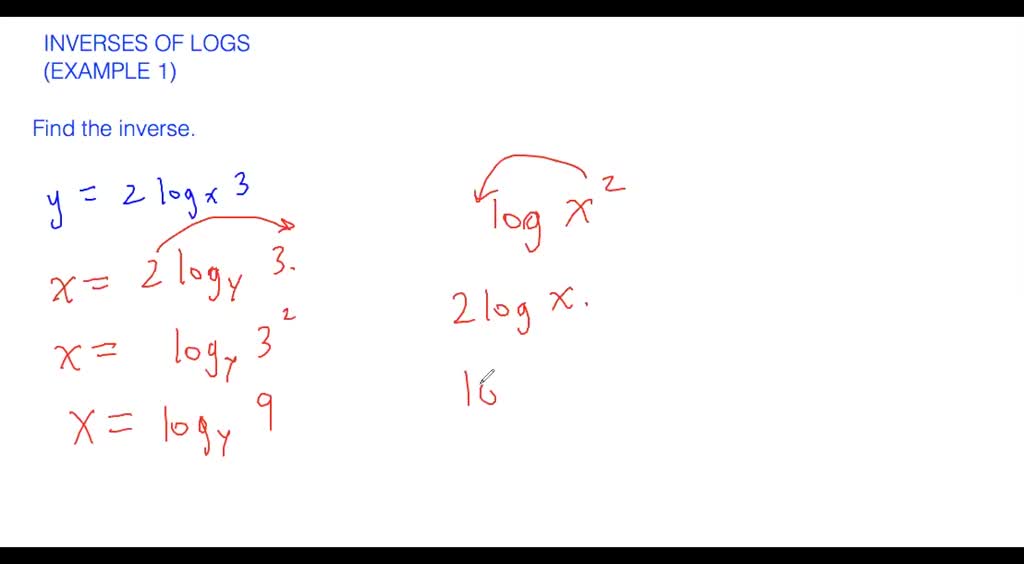
At its core, a logarithm is a mathematical function that answers the question: “To what power must a base be raised to produce a given number?” For instance, the logarithm of 100 to the base 10 is 2, because 10 raised to the power of 2 equals 100. We write this as $log_{10}(100) = 2$.
The inverse of a logarithm is the exponential function. If the logarithm asks “what’s the exponent?”, the exponential function does the opposite: it takes a base and an exponent and tells you what number you get when you raise that base to that power. So, if $log_{b}(x) = y$, then the inverse relationship is $b^y = x$.
Let’s break this down with a common example: the natural logarithm. The natural logarithm uses the mathematical constant e (approximately 2.71828) as its base. It’s often written as $ln(x)$. If $ln(x) = y$, then the inverse exponential function is $e^y = x$.
Understanding the Relationship: A Two-Way Street
Think of logarithms and exponentials as two sides of the same coin, or as a key and its lock.
- Logarithm: Given a base and a result, find the exponent.
- Example: If you have 100, and your base is 10, what’s the exponent to get 100? The answer is 2. ($log_{10}(100) = 2$)
- Exponential Function: Given a base and an exponent, find the result.
- Example: If your base is 10 and your exponent is 2, what’s the result? The answer is 100. ($10^2 = 100$)
This inverse relationship is fundamental. One function undoes the operation of the other. This “undoing” property is what makes them so powerful and applicable across various fields.
Exponential Growth in Tech: Fueling Digital Advancement
The concept of exponential growth, the direct result of the inverse of logarithms, is incredibly prevalent in the technology sector. From the processing power of our devices to the vastness of the internet, exponential trends are the driving force behind much of what we consider modern innovation.
Moore’s Law and the Exponential Leap in Computing Power
Perhaps the most famous example of exponential growth in tech is Moore’s Law. This observation, originally made by Gordon Moore, co-founder of Intel, states that the number of transistors on a microchip roughly doubles every two years. While not a strict mathematical law, it has served as an incredibly accurate prediction and a driving force for the semiconductor industry for decades.
- What it means: Every couple of years, our computers and smartphones become significantly more powerful, capable of processing more data, running more complex software, and handling more demanding applications. This isn’t linear growth; it’s exponential. A doubling every two years means the progress isn’t a steady climb, but an accelerating curve.
- The impact: This relentless increase in computing power has paved the way for advancements like:
- Artificial Intelligence (AI) and Machine Learning: Sophisticated AI models require immense computational resources to train and operate. The exponential growth in processing power has made the development and deployment of AI tools, from chatbots to image generators, a reality.
- Big Data Analytics: The ability to store, process, and analyze massive datasets is directly tied to advancements in computing power. This fuels insights in everything from scientific research to personalized marketing.
- Cloud Computing: Scalable and powerful cloud infrastructure relies on the ability to provision and manage vast numbers of processors, made possible by the continuous exponential improvement in hardware.
- Immersive Technologies: Virtual Reality (VR) and Augmented Reality (AR) demand high processing speeds and graphical capabilities, which are only achievable due to the exponential leaps in chip technology.
The Internet’s Exponential Reach and Data Explosion
The internet itself has experienced exponential growth. The number of internet users, websites, and the sheer volume of data generated online have all followed exponential trajectories.
- Network Effects: The value of a network often increases exponentially with the number of its users. The more people on a social media platform, the more valuable it becomes to each individual user due to increased connectivity and content. This is a form of exponential growth driven by user adoption.
- Data Generation: Every click, every search, every upload contributes to an ever-expanding universe of data. This exponential data explosion presents both opportunities and challenges, requiring sophisticated tools and algorithms (often powered by exponential computing growth) to manage and extract value.
- App and Software Development: The proliferation of mobile apps and software solutions mirrors this exponential growth. Developers can now create and distribute sophisticated applications at an unprecedented scale, thanks to the underlying exponential advancements in hardware and software development tools.
Understanding the inverse of the logarithm, the exponential function, helps us appreciate the forces driving these rapid technological advancements. It’s not just about building better gadgets; it’s about enabling entirely new paradigms of computing, communication, and intelligence.
Exponential Brand Growth: From Niche to Global Dominance
In the realm of brand strategy and marketing, the principles of exponential growth are not just observed; they are actively pursued. Brands that achieve viral reach, widespread adoption, and sustained market leadership often do so through strategies that leverage exponential scaling.
Virality and Network Effects: The Exponential Spread of Brand Awareness
The concept of virality is inherently exponential. A piece of content, a product feature, or a brand message that “goes viral” spreads from person to person at an accelerating rate.

- Social Media Amplification: Platforms like TikTok, Instagram, and X (formerly Twitter) are designed to facilitate rapid sharing. When a compelling piece of content is shared, it reaches a small initial audience, who then share it with their networks, who in turn share it further. This cascading effect, if successful, can lead to exponential increases in reach and brand awareness.
- Word-of-Mouth Marketing: While traditional word-of-mouth is linear, in the digital age, it can become exponentially powerful. A positive customer experience can be shared with hundreds or thousands of people instantly through reviews, social media posts, and direct messages.
- Community Building: Brands that foster strong online communities tap into exponential growth. Engaged community members become brand advocates, actively promoting the brand and attracting new users. The growth of the community itself can be exponential, as each new member potentially brings in several more.
Product-Market Fit and Scalability: The Exponential Revenue Curve
Achieving strong product-market fit is a prerequisite for exponential growth in revenue and customer base. Once a product or service truly resonates with a significant market, its adoption can accelerate dramatically.
- Subscription Models: Many successful tech companies, from SaaS providers to streaming services, rely on subscription models. As more users subscribe, the recurring revenue grows. If user acquisition accelerates due to strong product-market fit and effective marketing, the revenue curve becomes exponential.
- Networked Products: Products that become more valuable as more people use them (like marketplaces or communication tools) exhibit inherent exponential growth potential. As users flock to a platform, it becomes more attractive to new users, creating a virtuous cycle.
- Data-Driven Marketing: Analyzing user data allows brands to understand their audience better and tailor marketing messages. This can lead to more effective campaigns that drive higher conversion rates and, consequently, more exponential growth in customer acquisition. The insights derived from analyzing exponentially growing data can, in turn, fuel exponential brand growth.
Building a Sustainable Brand: Beyond the Initial Exponential Burst
While initial exponential growth is exciting, sustainable brand success requires more than just viral moments. It involves building a robust corporate identity, a strong reputation, and a loyal customer base that can weather market shifts.
- Consistent Messaging: Maintaining a consistent brand message across all touchpoints is crucial. This builds trust and reinforces brand recognition, which can lead to sustained, albeit perhaps less explosive, growth over time.
- Customer Experience: A superior customer experience is key to retention and positive word-of-mouth, which can feed into further exponential adoption.
- Brand Storytelling: Compelling narratives help connect with consumers on an emotional level, fostering loyalty and creating a brand that people want to be associated with. This emotional connection can be a powerful, long-term driver of growth that complements initial viral spikes.
The inverse of the logarithm, the exponential function, helps us understand not only how brands can achieve rapid scaling but also the underlying mechanisms – virality, network effects, and product-market fit – that enable such explosive growth.
Exponential Returns in Money: Investing and Financial Growth
The concept of exponential growth is perhaps most directly and powerfully felt in the world of personal finance and investing. The principle of compounding, where earnings generate further earnings, is a prime example of exponential returns.
The Magic of Compounding: Where Your Money Grows Exponentially
Compound interest is the process where interest is earned on both the initial principal and the accumulated interest from previous periods. This is the inverse of the logarithmic concept applied to financial growth.
- The Formula: The future value (FV) of an investment with compound interest is calculated as: $FV = P(1 + r/n)^{nt}$, where:
- P = Principal investment amount
- r = Annual interest rate (as a decimal)
- n = Number of times that interest is compounded per year
- t = Number of years the money is invested or borrowed for
- The Power of Time: The exponent ‘$nt$’ in the formula highlights the exponential nature of compounding. Over time, the effect of interest on interest becomes increasingly significant. Even small amounts invested early can grow into substantial sums due to the power of compounding over decades.
- Investing for the Long Term: This principle underscores the importance of long-term investing. The earlier you start investing, the more time your money has to benefit from exponential growth. Retirement planning, for instance, heavily relies on the ability of investments to compound over many years.
Exponential Income Streams and Side Hustles
Beyond traditional investments, the digital age offers numerous avenues for generating income that can also exhibit exponential characteristics.
- Online Courses and Digital Products: Once created, digital products like e-books, online courses, or software templates can be sold repeatedly with minimal additional cost of goods sold. If marketing efforts are successful and a product gains traction, sales can grow exponentially without a proportional increase in effort.
- Affiliate Marketing and Content Creation: Successful bloggers, YouTubers, and social media influencers can generate income through affiliate marketing or advertising revenue. As their audience grows exponentially, so too can their income, driven by a consistent stream of views and engagement.
- Scalable Business Models: Entrepreneurship often focuses on building businesses with scalable models. This means the business can handle a significant increase in customers or demand without a proportional increase in costs. This scalability is the engine for exponential revenue and profit growth.
Financial Tools and Algorithmic Trading: Leveraging Exponential Power
The financial industry itself utilizes sophisticated tools and algorithms, many of which are underpinned by mathematical principles including exponential functions.
- Algorithmic Trading: High-frequency trading firms and hedge funds use complex algorithms that often incorporate predictive models and analyze vast datasets. These algorithms can identify and exploit tiny price discrepancies, executing trades at lightning speed. The potential for rapid, exponential gains (and losses) is inherent in this domain.
- Financial Modeling: When forecasting future financial performance, analysts use models that often incorporate exponential growth assumptions for revenue, market share, or other key metrics. Understanding these assumptions is critical to interpreting financial projections.
- Risk Management: While not always directly about growth, sophisticated risk management strategies in finance often involve understanding the probability distributions of asset returns, which can be modeled using functions that relate to exponential behavior.
The inverse of the logarithm – the exponential function – is the bedrock of financial growth. Whether through the steady march of compound interest or the rapid acceleration of successful online ventures, understanding how to harness exponential returns is a key to financial prosperity.
Conclusion: Embracing the Exponential Future
The question, “what’s the inverse of log?” might seem like a niche mathematical inquiry, but its answer, the exponential function, is a powerful concept that shapes our world in profound ways. From the ever-increasing power of our technology to the rapid ascent of successful brands and the substantial growth of our investments, exponential trends are not just observable; they are the very fabric of progress.
By understanding the inverse relationship between logarithms and exponentials, we gain a deeper appreciation for:
- Technological Innovation: The relentless pace of advancements in computing, AI, and connectivity.
- Brand Building: The mechanisms behind viral marketing, network effects, and scalable business models.
- Financial Prosperity: The power of compounding, the potential of online income streams, and the sophisticated tools used in modern finance.
As we continue to navigate an increasingly digital and interconnected world, recognizing and understanding exponential growth will be a crucial skill. It’s about looking beyond linear progression and embracing the accelerating power that drives innovation, builds empires, and secures financial futures. The inverse of the logarithm isn’t just a mathematical concept; it’s the key to unlocking the future.
aViewFromTheCave is a participant in the Amazon Services LLC Associates Program, an affiliate advertising program designed to provide a means for sites to earn advertising fees by advertising and linking to Amazon.com. Amazon, the Amazon logo, AmazonSupply, and the AmazonSupply logo are trademarks of Amazon.com, Inc. or its affiliates. As an Amazon Associate we earn affiliate commissions from qualifying purchases.