
Establishing an Individual Retirement Account (IRA) is a cornerstone of a sound financial future, offering significant tax advantages and a disciplined approach to saving for retirement. However, the sheer number of providers and account types can make the initial decision of “where to open an IRA” feel overwhelming. This guide dissects the critical factors and top contenders to help you make an informed choice that aligns with your financial goals and investment style.
Understanding IRA Basics Before You Choose a Provider
Before evaluating specific platforms, a foundational understanding of different IRA types is essential. Your choice of IRA will significantly influence your tax benefits, contribution limits, and even your eligibility.

Traditional vs. Roth IRA
The primary distinction lies in when you receive your tax break.
- Traditional IRA: Contributions are often tax-deductible in the year they are made, reducing your taxable income now. Growth is tax-deferred until retirement, when withdrawals are taxed as ordinary income. This type is generally attractive if you expect to be in a lower tax bracket in retirement than you are today.
- Roth IRA: Contributions are made with after-tax dollars, meaning there’s no upfront tax deduction. However, qualified withdrawals in retirement are entirely tax-free. This option is often favored by those who expect to be in a higher tax bracket in retirement or want to ensure tax-free income streams later in life. Income limitations apply to contributing directly to a Roth IRA.
SEP and SIMPLE IRAs for Small Businesses
Beyond personal IRAs, there are options tailored for small business owners and self-employed individuals:
- SEP IRA (Simplified Employee Pension): An excellent choice for self-employed individuals and small business owners, allowing for much higher contribution limits than Traditional or Roth IRAs. Contributions are made by the employer (even if that’s you), are tax-deductible, and grow tax-deferred. Employees generally cannot contribute to a SEP IRA.
- SIMPLE IRA (Savings Incentive Match Plan for Employees): Designed for small businesses with 100 or fewer employees, offering an easy-to-administer retirement plan. It involves both employee contributions and mandatory employer contributions (either a matching contribution or a non-elective contribution), with tax-deferred growth.
Contribution Limits and Eligibility
Each IRA type comes with specific annual contribution limits set by the IRS, which can be adjusted for inflation. For instance, individuals under age 50 can contribute a certain amount, while those age 50 and over are often allowed “catch-up” contributions. Eligibility for traditional IRA deductions can be phased out if you or your spouse are covered by a retirement plan at work and your income exceeds certain thresholds. Roth IRA direct contributions also have income phase-out ranges. Understanding these limits and eligibility rules is crucial to avoid penalties and maximize your retirement savings.
Key Factors to Consider When Selecting an IRA Provider
Choosing the right IRA provider is a long-term decision. The platform you select will be your partner in wealth accumulation, so thorough consideration of several factors is paramount.
Investment Options and Diversity
A provider’s investment offerings dictate how you can grow your wealth. Look for a wide range of options, including:
- Stocks and ETFs: Individual stocks and exchange-traded funds (ETFs) offer flexibility and diversification.
- Mutual Funds: Actively or passively managed funds that pool money from multiple investors to invest in a diversified portfolio. Ensure the provider offers a robust selection of low-cost index funds and target-date funds.
- Bonds: Government, corporate, or municipal bonds can add stability to a portfolio.
- Certificates of Deposit (CDs): A low-risk option for a portion of your cash.
- Alternative Investments (e.g., real estate, private equity): While less common for standard IRAs, self-directed IRAs may offer access to these. Most investors will focus on traditional securities.
Ensure the provider offers access to the specific asset classes you intend to invest in and provides sufficient diversification options to build a resilient portfolio.
Fees and Commissions
Fees can significantly erode your returns over time. Be diligent in understanding all potential costs:
- Trading Commissions: Fees charged for buying or selling stocks, ETFs, or options. Many major brokers now offer commission-free trading for most online stock and ETF trades.
- Expense Ratios: Fees associated with mutual funds and ETFs, expressed as a percentage of your investment. Opt for funds with low expense ratios, especially for passive index funds.
- Account Maintenance Fees: Some providers charge annual fees for IRAs, though these are becoming less common, especially for accounts above a certain balance.
- Transfer-out Fees: Fees charged if you decide to move your IRA to another provider.
- Advisory Fees: If you opt for managed portfolios (e.g., robo-advisors or full-service brokers), you’ll pay a percentage of your assets under management (AUM).
Prioritize providers with transparent, low-fee structures.
User Experience and Platform Functionality
The platform’s usability impacts your ability to manage your investments effectively. Consider:
- Website and Mobile App: Is it intuitive, easy to navigate, and reliable? Can you access all necessary functions on both desktop and mobile?
- Trading Tools: For active investors, advanced charting, research tools, and order types are crucial.
- Reporting and Statements: Are statements clear and concise? Can you easily track your portfolio performance and tax documents?
- Automated Investing: Does the platform offer features like automatic contributions, rebalancing, or dividend reinvestment?
Customer Service and Educational Resources
Good customer support is invaluable when you have questions or encounter issues. Assess:
- Availability: Is support available via phone, chat, or email, and during what hours?
- Responsiveness: How quickly and effectively do they resolve queries?
- Educational Materials: Does the provider offer articles, webinars, tutorials, or financial planning tools to help you become a more informed investor? This is particularly important for beginners.
Account Minimums
Some providers require a minimum initial deposit to open an account or to access certain features. While many now offer $0 minimums for IRAs, some may have higher thresholds for mutual funds or actively managed portfolios. Choose a provider whose minimums align with your current savings capacity.
Top Contenders: A Look at Popular IRA Providers
The landscape of IRA providers is diverse, each catering to different investor needs and preferences.
Robo-Advisors
Robo-advisors leverage algorithms to build and manage diversified portfolios based on your risk tolerance and financial goals. They are ideal for beginners or those who prefer a hands-off approach.
- Pros: Very low management fees (typically 0.25% to 0.50% of AUM), automated rebalancing, diversified portfolios, low account minimums. They simplify investing significantly.
- Cons: Less control over individual investment choices, limited human interaction, may not suit complex financial situations or highly active traders.
- Examples: Vanguard Digital Advisor, Fidelity Go, Schwab Intelligent Portfolios, Betterment, Wealthfront.
Discount Brokerages
These platforms offer a wide array of investment products and tools for self-directed investors. They’re suitable for those who want more control over their investments and are comfortable making their own decisions.
- Pros: Extensive selection of stocks, ETFs, mutual funds, and bonds. Many offer commission-free trading for most online stocks and ETFs. Robust research tools, educational content, and often multiple account types.
- Cons: Requires more effort and knowledge from the investor to manage their portfolio effectively. The sheer volume of options can be overwhelming for new investors.
- Examples: Fidelity, Charles Schwab, Vanguard, E*TRADE, TD Ameritrade (now part of Schwab).
Full-Service Brokerages
Full-service brokerages provide personalized financial advice, wealth management, and comprehensive financial planning alongside investment products. They are best for individuals with complex financial situations or those who prefer a dedicated financial advisor.
- Pros: Personalized guidance, holistic financial planning, access to a wide range of products including some not available elsewhere, potential for deeper relationships with advisors.
- Cons: Significantly higher fees, typically a percentage of AUM (often 1% or more) plus potential commissions and other charges. May have higher account minimums.
- Examples: Merrill Lynch, Edward Jones, Morgan Stanley.
Niche Providers/Specialty Firms
Some providers cater to specific investment needs.
- Mutual Fund Companies: If you primarily want to invest in a specific family of mutual funds (e.g., American Funds, T. Rowe Price), you might open an IRA directly with them.
- Self-Directed IRA Custodians: These allow you to invest in alternative assets like real estate, private equity, or cryptocurrencies within an IRA, though they come with unique complexities and risks.
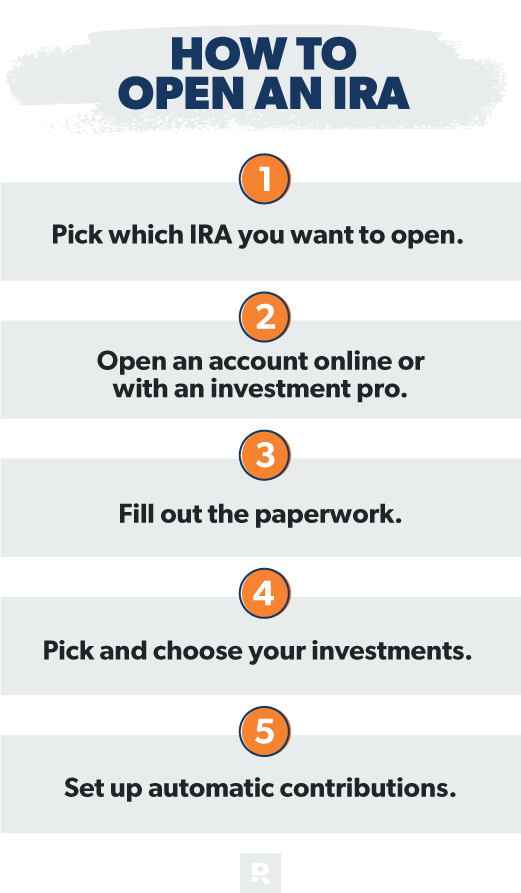
The Step-by-Step Process of Opening Your IRA
Once you’ve done your research and identified a suitable provider, the actual process of opening an IRA is straightforward.
Determine Your IRA Type
Revisit the Traditional vs. Roth vs. SEP/SIMPLE decision. Consider your current income, expected future tax bracket, and eligibility rules. If unsure, many providers offer tools or advisors to help you decide.
Research and Compare Providers
Use the factors discussed above (fees, investment options, user experience, customer service) to narrow down your choices. Read reviews, compare fee schedules, and explore their platforms.
Gather Necessary Information
Before you start the application, have the following ready:
- Social Security Number (SSN) or Individual Taxpayer Identification Number (ITIN).
- Bank Account Information: Routing and account numbers for funding your IRA.
- Employer Information: If applicable, details about your employer.
- Beneficiary Information: Names, birth dates, and SSNs of primary and contingent beneficiaries.
Complete the Online Application
Most providers offer a fully online application process that takes 10-20 minutes. You’ll typically answer questions about your identity, contact information, employment, and investment objectives/risk tolerance.
Fund Your Account
After your application is approved, you’ll need to fund your IRA. Common methods include:
- Electronic Funds Transfer (EFT): Linking your bank account for direct transfers.
- Rollover: Transferring funds from an existing 401(k), 403(b), or another IRA.
- Check or Wire Transfer: Less common for initial funding but available.
- Automatic Contributions: Set up recurring transfers to consistently contribute to your IRA.
Managing Your IRA for Long-Term Growth
Opening an IRA is just the beginning. Effective management is crucial for maximizing its potential.
Regular Contributions and Dollar-Cost Averaging
Consistent contributions, ideally on a regular schedule (e.g., monthly), are vital. This practice of dollar-cost averaging helps reduce the risk of investing a lump sum at a market peak by spreading your investments over time.
Portfolio Rebalancing
Over time, your portfolio’s asset allocation can drift due to market performance. Rebalancing involves adjusting your portfolio back to your target asset allocation (e.g., if stocks have outperformed, you might sell some stocks and buy more bonds to restore your desired ratio). This helps manage risk and maintains your investment strategy. Many robo-advisors automate this process.
Reviewing Performance and Adjusting Strategy
Periodically review your IRA’s performance against your goals. As your life circumstances change (e.g., marriage, children, new job, nearing retirement), your risk tolerance and investment objectives may evolve. Be prepared to adjust your investment strategy or asset allocation accordingly.

Understanding Required Minimum Distributions (RMDs)
Once you reach a certain age (currently 73, though subject to change by legislation), you generally must begin taking Required Minimum Distributions (RMDs) from Traditional, SEP, and SIMPLE IRAs (Roth IRAs do not have RMDs for the original owner). Familiarize yourself with these rules to avoid penalties as you approach retirement.
Choosing where to open your IRA is a significant step towards securing your financial future. By carefully considering your personal circumstances, understanding the various IRA types, evaluating providers based on key criteria, and committing to ongoing management, you can establish a robust retirement savings vehicle designed for long-term growth.
aViewFromTheCave is a participant in the Amazon Services LLC Associates Program, an affiliate advertising program designed to provide a means for sites to earn advertising fees by advertising and linking to Amazon.com. Amazon, the Amazon logo, AmazonSupply, and the AmazonSupply logo are trademarks of Amazon.com, Inc. or its affiliates. As an Amazon Associate we earn affiliate commissions from qualifying purchases.