
Navigating the landscape of retirement savings can often feel like deciphering a complex financial code. Among the various vehicles available, the Traditional Individual Retirement Account (IRA) stands out as a cornerstone for many Americans seeking to build a secure financial future. It offers unique tax advantages and a flexible framework for long-term growth. However, for those new to investing or retirement planning, the practical steps of “how do I contribute to a traditional IRA?” might seem daunting. This comprehensive guide aims to demystify the process, providing clear, actionable insights into not just contributing, but understanding the mechanics, benefits, and strategic considerations that come with a Traditional IRA.

At its heart, contributing to a Traditional IRA is a powerful commitment to your future self. It’s more than just putting money into an account; it’s engaging with a system designed to encourage consistent saving and leverage the power of tax-deferred growth. Whether you’re just starting your career or nearing retirement, understanding the nuances of IRA contributions can significantly impact your financial well-being. From eligibility requirements and contribution limits to the critical deadlines and tax implications, we’ll break down everything you need to know to confidently contribute to your Traditional IRA and pave the way for a comfortable retirement.
Understanding the Traditional IRA: A Foundation for Retirement
Before diving into the “how,” it’s crucial to grasp the “what” and “why” of a Traditional IRA. This foundational understanding will empower you to make informed decisions about your retirement strategy.
What is a Traditional IRA?
A Traditional IRA is a personal savings plan that allows individuals to set aside money for retirement, with contributions often being tax-deductible in the year they are made. The investments within the IRA grow tax-deferred, meaning you don’t pay taxes on earnings or gains until you withdraw the money in retirement. This deferral of taxes allows your money to compound more aggressively over time. When you eventually take distributions in retirement, those withdrawals are typically taxed as ordinary income. It’s distinct from a 401(k) (which is employer-sponsored) and a Roth IRA (which offers tax-free withdrawals in retirement after certain conditions are met). The Traditional IRA’s primary appeal lies in its potential for upfront tax deductions and tax-deferred growth, making it a powerful tool for reducing your current taxable income while simultaneously building a retirement nest egg. It provides flexibility in investment choices, allowing you to select from a wide array of stocks, bonds, mutual funds, ETFs, and other assets, depending on the custodian.
Key Benefits of a Traditional IRA
The Traditional IRA offers several compelling advantages that make it a popular choice for retirement savers. The most significant benefit is the potential for tax-deductible contributions. For many individuals, contributions can be deducted from their taxable income in the year they are made, leading to an immediate reduction in their tax bill. This immediate tax savings can be substantial, especially for those in higher tax brackets. Secondly, all earnings and growth within the Traditional IRA are tax-deferred. This means you don’t pay capital gains tax or income tax on dividends or interest each year. Instead, your investments can grow unhindered by annual taxation, allowing the power of compounding to work its magic more effectively. This deferral continues until you begin taking distributions in retirement, typically after age 59½. Thirdly, Traditional IRAs offer immense flexibility in investment choices. Unlike some employer-sponsored plans that might have a limited menu, an IRA generally allows you to invest in a broad spectrum of assets, from individual stocks and bonds to mutual funds, exchange-traded funds (ETFs), and real estate investment trusts (REITs), tailoring your portfolio to your risk tolerance and financial goals. Lastly, IRAs are portable; they belong to you, regardless of employer changes, providing continuity in your retirement planning.
Who Can Contribute? Eligibility Requirements
Contributing to a Traditional IRA is accessible to a broad range of individuals, but there are a few key eligibility criteria to keep in mind. The primary requirement is that you must have “earned income” during the tax year for which you are contributing. Earned income includes wages, salaries, commissions, tips, bonuses, and net earnings from self-employment. Investment income, rental income, pension or annuity income, or deferred compensation are generally not considered earned income for IRA contribution purposes. There is no age limit for contributing to a Traditional IRA, provided you have earned income. This is a significant change from previous rules, meaning individuals working past traditional retirement age can continue to contribute. Even if you are covered by a retirement plan at work (like a 401(k) or 403(b)), you can still contribute to a Traditional IRA. However, being covered by a workplace plan and having an adjusted gross income (AGI) above certain thresholds can impact the deductibility of your Traditional IRA contributions. It’s crucial to understand these income limitations, as they determine whether your contributions will be fully deductible, partially deductible, or non-deductible. We will delve deeper into deductibility later, but for now, remember that earned income is the fundamental prerequisite.
The Mechanics of Contribution: Step-by-Step Guide
Once you understand what a Traditional IRA is and if you’re eligible, the next logical step is to learn the practicalities of making contributions. This section breaks down the process from opening an account to understanding different contribution methods.
Opening a Traditional IRA Account
The first step to contributing is to open a Traditional IRA account. This is typically done through a financial institution such as a bank, brokerage firm, or mutual fund company. Online brokerages have made this process incredibly straightforward, often allowing you to open an account in minutes from your computer or smartphone. When choosing a custodian, consider factors like investment options, fees (e.g., maintenance fees, trading commissions), customer service, and ease of use. You’ll typically need to provide personal information such as your Social Security number, address, date of birth, and employment details. You might also be asked to link a bank account for easy electronic fund transfers. Once the account is open and funded (even with a minimal initial deposit), you can begin making contributions. It’s a good practice to review the investment choices offered by the custodian and understand their fee structure before committing, as these can impact your long-term returns. Many providers offer educational resources and tools to help you get started with investing once your IRA is established.
Types of Contributions: Cash vs. In-Kind
When it comes to contributing to a Traditional IRA, the most common method is with cash. This involves transferring money directly from your bank account (checking or savings) into your IRA. You can do this via electronic funds transfer (EFT), wire transfer, or by mailing a check. Cash contributions are generally the simplest and most straightforward. However, it’s also possible to make “in-kind” contributions, though this is less common and often more complex. An in-kind contribution involves transferring securities (like stocks, bonds, or mutual funds you already own in a taxable brokerage account) directly into your IRA account, rather than selling them for cash and then contributing the cash. While this might seem appealing to avoid selling appreciated assets, it’s crucial to understand the tax implications. When you make an in-kind contribution, the fair market value of the securities on the date of transfer is considered your contribution amount. If the securities have appreciated since you acquired them, you may still owe capital gains tax on that appreciation in your taxable account, even though you’re transferring them to a tax-advantaged account. It’s generally advisable to consult with a tax professional before making an in-kind contribution to fully understand the tax consequences. For most people, cash contributions are the preferred and simpler method.
Setting Up Regular Contributions
Consistency is key to effective retirement savings, and setting up regular contributions is one of the most powerful strategies. Many financial institutions allow you to automate contributions from your checking or savings account directly into your Traditional IRA on a weekly, bi-weekly, or monthly basis. This “set it and forget it” approach ensures that you consistently save without having to manually initiate a transfer each time. Automating contributions helps you adhere to your savings goals, takes advantage of dollar-cost averaging (investing a fixed amount regularly, regardless of market fluctuations, which can reduce average cost over time), and prevents procrastination. Even small, regular contributions can accumulate significantly over decades, thanks to the power of compounding. For example, contributing $100 per month might seem small, but over 30 years, that’s $36,000 in contributions, potentially growing much larger with investment returns. Consider your budget and choose an amount you can comfortably contribute regularly without straining your finances. You can always adjust the amount as your income or financial situation changes.
One-Time Lump Sum Contributions
While regular contributions are highly effective, you also have the option to make one-time lump sum contributions to your Traditional IRA. This is particularly useful if you receive a bonus, a tax refund, an inheritance, or have extra savings at the end of the year. Many people prefer to fund their IRA with a lump sum at the beginning of the year, or right before the tax deadline, to maximize the time their investments have to grow within the tax-deferred account. The flexibility to make lump sum contributions allows you to fully utilize your annual contribution limit even if regular contributions aren’t feasible throughout the year. For instance, if you didn’t contribute monthly but received a large bonus in December, you could make a single contribution to cover your entire annual limit before the tax deadline. It’s important to remember that whether you contribute regularly or via lump sum, the total amount contributed in a given tax year cannot exceed the annual limits set by the IRS. Both methods are valid ways to fund your Traditional IRA, and the best approach often depends on your personal financial habits and cash flow.
Contribution Limits and Deadlines: Staying Compliant
Adhering to IRS rules regarding contribution limits and deadlines is crucial to ensure your Traditional IRA contributions are valid and maximize your tax benefits.
Annual Contribution Limits
The IRS sets specific limits on how much you can contribute to all your IRAs (Traditional and Roth combined) each year. These limits are adjusted periodically for inflation. For example, in 2023 and 2024, the annual contribution limit for individuals is $6,500 and $7,000, respectively. These limits apply to the total amount you contribute across all your IRA accounts. If you have both a Traditional and a Roth IRA, the combined contributions to both cannot exceed this annual limit. It’s vital to stay within these limits to avoid potential penalties. If you accidentally overcontribute, you generally have until the tax filing deadline (including extensions) to remove the excess contribution and any earnings attributable to it to avoid a 6% excise tax per year on the excess amount. Financial institutions typically have systems in place to flag potential overcontributions, but ultimately, the responsibility lies with the individual to ensure compliance. Knowing the current year’s limit is the first step in planning your contributions.
Catch-Up Contributions for Older Savers
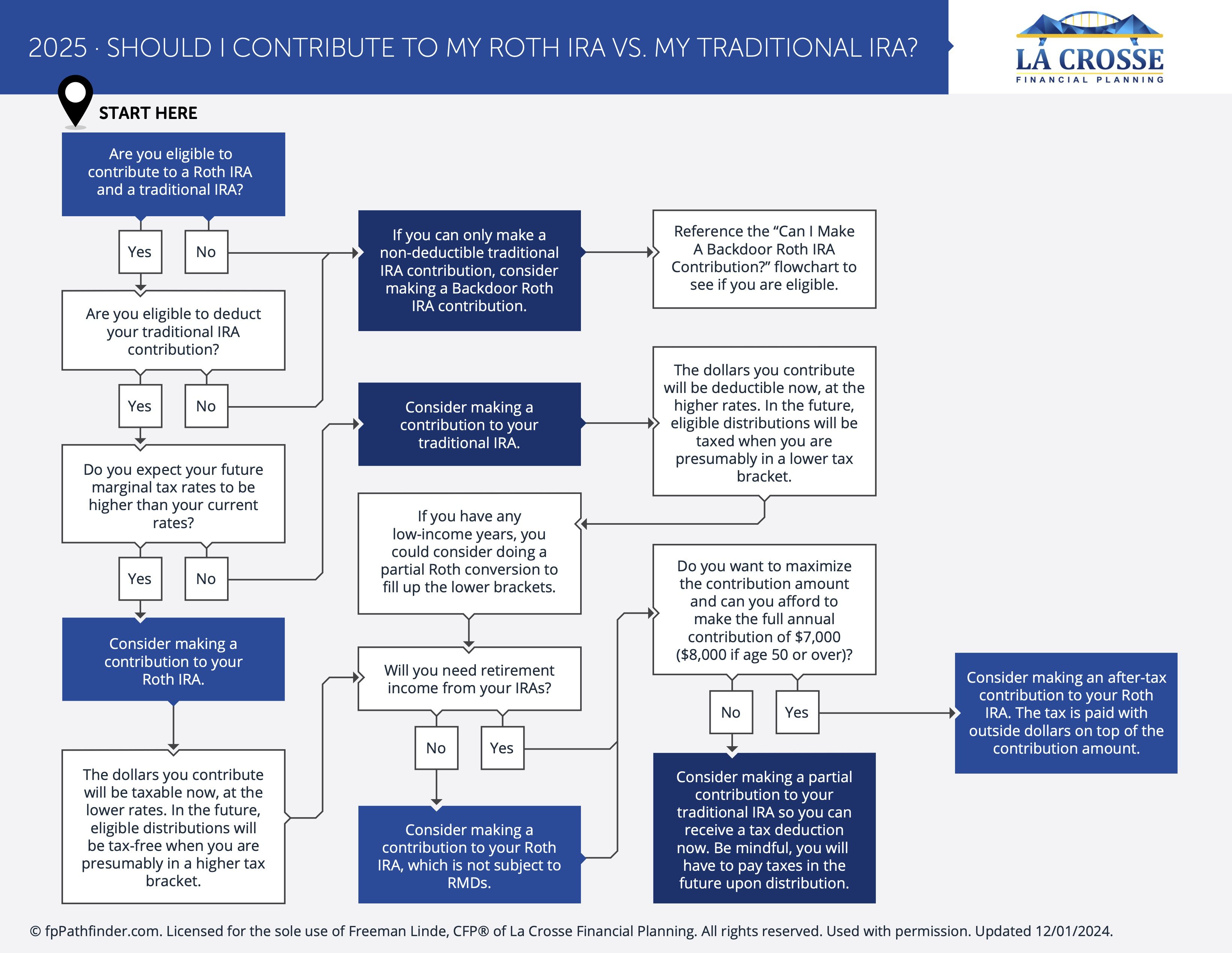
Recognizing that individuals nearing retirement may have less time to save or may wish to accelerate their savings, the IRS offers “catch-up contributions” for those aged 50 and over. This provision allows individuals who have reached age 50 by the end of the tax year to contribute an additional amount above the standard annual limit. For example, in 2023 and 2024, the catch-up contribution limit is an additional $1,000. This means if you are 50 or older, your total annual contribution limit would be $7,500 in 2023 ($6,500 standard + $1,000 catch-up) and $8,000 in 2024 ($7,000 standard + $1,000 catch-up). This extra contribution opportunity is a significant advantage for those who started saving later in life or wish to bolster their retirement funds as they approach their golden years. It can provide a substantial boost to an IRA portfolio, especially when combined with tax-deferred growth.
Contribution Deadlines: Tax Day is Key
One of the most common misconceptions about IRA contributions revolves around the deadline. While many financial actions must be completed by December 31st of a given year, IRA contributions are unique. You can contribute to a Traditional IRA for a given tax year up until the tax filing deadline for that year, excluding extensions. This typically means April 15th of the following year. For instance, contributions for the 2023 tax year can be made anytime between January 1, 2023, and April 15, 2024. This flexibility gives individuals several months into the new calendar year to make their previous year’s contributions, which can be particularly useful for those who need to review their income and deductions after the year ends to determine the optimal contribution amount. When making a contribution early in the new year, it is absolutely critical to specify to your custodian which tax year the contribution is for. Otherwise, it may automatically be applied to the current year, potentially causing issues with your contribution limits and tax reporting.
Spousal IRA Contributions
For married couples where one spouse earns little or no income, the “spousal IRA” rule provides an excellent opportunity to save for retirement. If one spouse earns enough taxable compensation, they can contribute to an IRA on behalf of their non-working or lower-earning spouse, even if that spouse doesn’t have earned income. The combined contributions for both spouses cannot exceed the total earned income of the working spouse for that year. Each spouse can contribute up to the maximum annual limit (plus catch-up contributions if applicable), meaning a couple could potentially contribute double the individual limit to their respective IRAs. For example, if one spouse earns $50,000 and the other earns $0, the working spouse can contribute $7,000 to their own Traditional IRA and an additional $7,000 to their non-working spouse’s Traditional IRA for 2024, provided their combined earned income is at least $14,000. This is a powerful tool for couples to maximize their retirement savings, leveraging the tax advantages of Traditional IRAs for both individuals, even if only one is actively employed.
Tax Implications and Deductibility: Maximizing Your Savings
The tax benefits are a primary driver for choosing a Traditional IRA. Understanding how contributions are treated for tax purposes is vital for optimizing your financial plan.
Understanding Tax Deductibility
The ability to deduct Traditional IRA contributions from your taxable income is one of its most attractive features. When contributions are deductible, they reduce your adjusted gross income (AGI), which can lower your current year’s income tax liability. This immediate tax savings can be substantial, especially for those in higher tax brackets. However, not all Traditional IRA contributions are fully deductible. The deductibility of your contributions depends primarily on two factors: whether you (or your spouse, if married) are covered by a retirement plan at work (like a 401(k) or 403(b)), and your modified adjusted gross income (MAGI). If neither you nor your spouse is covered by a workplace retirement plan, your Traditional IRA contributions are always fully deductible, regardless of your income. This is a straightforward benefit. The complexity arises when you or your spouse are covered by a workplace plan.
The Modified Adjusted Gross Income (MAGI) Threshold
When you (or your spouse) are covered by a retirement plan at work, the deductibility of your Traditional IRA contributions becomes subject to income limitations based on your Modified Adjusted Gross Income (MAGI). The IRS sets specific MAGI ranges each year. If your MAGI falls below a certain threshold, your contributions may be fully deductible. If it falls within a phase-out range, your deduction will be partial. If your MAGI exceeds the upper limit of the phase-out range, your Traditional IRA contributions will be entirely non-deductible. These income thresholds are different for single filers, married filing jointly, and married filing separately. For example, in 2024, if you are covered by a workplace plan, the deduction begins to phase out for single filers with MAGI between $79,000 and $89,000, and for married filing jointly between $126,000 and $146,000. If your spouse is covered by a workplace plan but you are not, there’s a different, higher MAGI phase-out range for your Traditional IRA deduction. It’s essential to consult the most current IRS publications or a tax professional to determine the exact MAGI limits for your filing status and situation.
Taxable vs. Non-Deductible Contributions
Given the MAGI thresholds, it’s possible to make Traditional IRA contributions that are either fully deductible, partially deductible, or entirely non-deductible. If your contributions are non-deductible, it means you don’t receive an upfront tax break. However, the money still grows tax-deferred, and the non-deductible portion will not be taxed again when you withdraw it in retirement (only the earnings will be taxed). This brings us to a crucial concept: tracking your basis. When you make non-deductible Traditional IRA contributions, you establish a “basis” in your IRA. This basis represents the after-tax money you’ve contributed. The IRS requires you to keep records of these non-deductible contributions using Form 8606, “Nondeductible IRAs.” This form is filed with your tax return each year you make a non-deductible contribution and also when you take distributions from your IRA. Properly tracking your basis ensures that you are not taxed twice on the same money (once when you earn it and once when you withdraw it from the IRA). Failing to track non-deductible contributions can lead to paying unnecessary taxes in retirement, so meticulous record-keeping is paramount.
The Role of Form 8606
As mentioned, Form 8606, “Nondeductible IRAs,” is the cornerstone for managing non-deductible Traditional IRA contributions. This form serves two primary purposes. First, you must file Form 8606 for any year you make a non-deductible contribution to a Traditional IRA, even if you don’t have to file a tax return for that year. This form helps the IRS track your cumulative basis in your IRAs. Second, you use Form 8606 in the year you take distributions from any of your Traditional, SEP, or SIMPLE IRAs if you have ever made non-deductible contributions. The form helps calculate the taxable and non-taxable portions of your distributions based on your total IRA balances and your basis. This “pro-rata” rule means that each distribution is considered to be partly from your deductible contributions/earnings and partly from your non-deductible contributions, based on the ratio of your basis to your total IRA balance. Understanding and correctly completing Form 8606 is crucial for accurately reporting your IRA activity and avoiding overpayment of taxes in retirement. If you anticipate making non-deductible contributions or have questions about tracking your basis, consulting a qualified tax advisor is highly recommended.
Beyond Contributions: Managing and Growing Your IRA
Making contributions is just the beginning. To truly leverage the power of a Traditional IRA, you need to actively manage your investments and understand the long-term implications.
Investment Options Within an IRA
One of the significant advantages of a Traditional IRA compared to some employer-sponsored plans is the vast array of investment options available. Once you’ve contributed cash to your IRA, that money sits in a cash account until you decide how to invest it. You’re not limited to a pre-selected list of mutual funds. Through a brokerage firm, you can typically invest in:
- Stocks: Individual shares of publicly traded companies.
- Bonds: Debt securities issued by governments or corporations.
- Mutual Funds: Professionally managed portfolios of stocks, bonds, or other investments.
- Exchange-Traded Funds (ETFs): Similar to mutual funds but trade like stocks on an exchange.
- Certificates of Deposit (CDs): Savings certificates offering a fixed interest rate for a specified period.
- Real Estate Investment Trusts (REITs): Companies that own, operate, or finance income-producing real estate.
Your choice of investments should align with your risk tolerance, time horizon until retirement, and overall financial goals. It’s often advisable to diversify your portfolio across different asset classes to mitigate risk and capture growth opportunities. Many brokerage platforms offer tools, research, and even robo-advisors to help you select appropriate investments for your IRA.
Rollovers and Transfers
Traditional IRAs also serve as excellent vehicles for consolidating retirement funds from previous employers. If you leave a job, you typically have options for your old 401(k) or other employer-sponsored retirement plan: you can leave it with the old employer, cash it out (often incurring significant taxes and penalties), or roll it over into a new employer’s plan or an IRA. Rolling over an old 401(k) into a Traditional IRA (often called a “direct rollover”) is a common and often advantageous choice. This allows your funds to continue growing tax-deferred, gives you greater control over investment choices, and simplifies your financial life by consolidating accounts. Similarly, you can transfer an existing IRA from one custodian to another without incurring taxes or penalties. This is useful if you find a new provider with better fees, more suitable investment options, or improved customer service. Both rollovers and transfers are non-taxable events, provided they are done correctly. Always choose a “direct rollover” where the funds move directly from the old plan to the new IRA custodian to avoid inadvertently having the money sent to you personally, which could trigger withholding or tax implications if not redeposited promptly.
Understanding Distributions and Penalties
While the focus is on contributing, it’s essential to understand the rules around taking money out of your Traditional IRA. In general, distributions from a Traditional IRA are taxed as ordinary income in the year they are withdrawn. If your contributions were tax-deductible, the entire amount withdrawn (contributions + earnings) is taxable. If you made non-deductible contributions, only the earnings portion is taxable, and your non-deductible basis is returned tax-free, as tracked by Form 8606. The “retirement age” for penalty-free withdrawals is typically 59½. If you withdraw funds before this age, the distribution is generally subject to a 10% early withdrawal penalty, in addition to being taxed as ordinary income. However, there are several exceptions to this penalty, such as for qualified higher education expenses, first-time home purchases (up to $10,000), unreimbursed medical expenses, substantially equal periodic payments, and disability. Additionally, once you reach age 73 (changed from 72 for those turning 72 after Dec 31, 2022, by the SECURE Act 2.0), you must begin taking Required Minimum Distributions (RMDs) from your Traditional IRA. Failing to take RMDs can result in a steep 25% (or 10% if corrected in time) excise tax on the amount not withdrawn.

The Power of Compounding: Long-Term Growth
Finally, while the immediate tax benefits and flexibility of a Traditional IRA are significant, its most powerful feature for long-term wealth accumulation is the magic of compounding. By allowing your investments to grow tax-deferred for decades, you’re not only earning returns on your initial contributions but also on the accumulated earnings themselves. This exponential growth, free from annual tax drag, means your money can multiply much faster than in a taxable account. For example, if you contribute $7,000 annually for 30 years and earn an average annual return of 7%, your account could grow to over $700,000, with only $210,000 having been contributed by you. The earlier you start contributing and the more consistently you invest, the greater the impact of compounding. Time is your greatest asset in retirement planning, and the Traditional IRA provides a robust framework to harness this power, transforming modest contributions into substantial wealth over the long haul.
Contributing to a Traditional IRA is a fundamental step in taking control of your financial future. It’s an accessible, tax-advantaged vehicle that, when utilized consistently and strategically, can provide a robust foundation for a comfortable retirement. By understanding the eligibility, mechanics of contribution, annual limits, tax implications, and the importance of ongoing investment management, you are well-equipped to maximize the benefits of this powerful savings tool. Remember, consistency, adherence to deadlines, and informed investment choices are key. If in doubt, seeking advice from a qualified financial advisor or tax professional can provide personalized guidance tailored to your unique financial situation. Start today, and watch your retirement dreams take shape.
aViewFromTheCave is a participant in the Amazon Services LLC Associates Program, an affiliate advertising program designed to provide a means for sites to earn advertising fees by advertising and linking to Amazon.com. Amazon, the Amazon logo, AmazonSupply, and the AmazonSupply logo are trademarks of Amazon.com, Inc. or its affiliates. As an Amazon Associate we earn affiliate commissions from qualifying purchases.