
The stock market is often depicted in popular culture as a chaotic floor filled with shouting traders and flickering screens, or perhaps as a complex mathematical enigma reserved only for the elite. In reality, the stock market is one of the most accessible and powerful tools for wealth creation ever devised. At its core, it is a sophisticated marketplace where ownership in public companies is bought and sold. Understanding how this system operates is the first step for any individual looking to secure their financial future, navigate the complexities of personal finance, and participate in the growth of the global economy.

The Fundamental Mechanics: From Initial Public Offerings to Secondary Markets
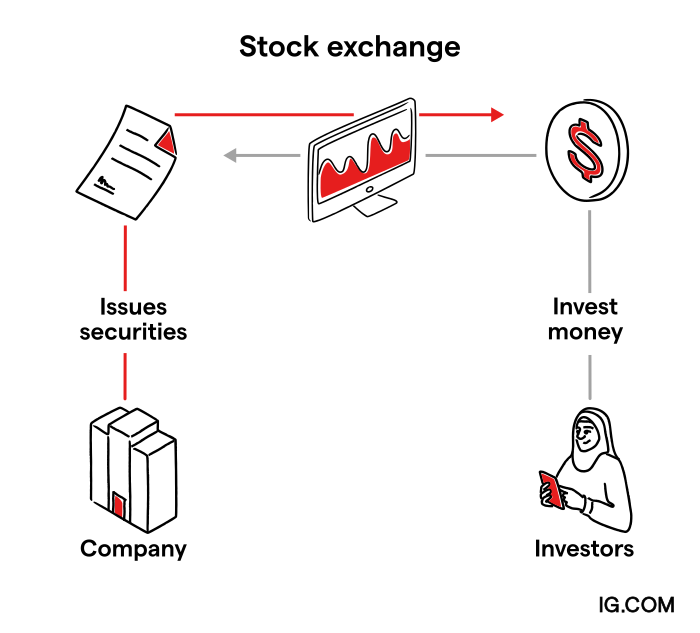
To understand how the stock market works, one must first understand what a “stock” actually represents. When a company wants to grow—perhaps to build new factories, develop a new product line, or expand into international markets—it needs capital. One way to raise this capital is by issuing shares of stock. Each share represents a fractional unit of ownership in the company.
The Birth of a Public Company: Understanding the IPO
The journey of a stock begins with the Initial Public Offering, or IPO. Before an IPO, a company is considered “private,” owned by its founders, early employees, and perhaps venture capitalists. When the company decides to “go public,” it works with investment banks to determine a price and the number of shares to be issued.
During the IPO, the company sells these shares to a group of initial investors, usually large institutional players like pension funds or hedge funds. This occurs in what is known as the Primary Market. This is the only time the company itself receives the money from the sale of the shares. Once the IPO is complete, the shares begin trading among the general public.
The Secondary Market: Where the Daily Action Happens
The vast majority of what we refer to as “stock market activity” takes place in the Secondary Market. When you use a brokerage app to buy ten shares of a tech giant, you are not buying them from the company itself; you are buying them from another investor who has decided to sell.
The secondary market provides “liquidity,” which is the ease with which an asset can be converted into cash. Without a secondary market, you might buy a piece of a company but find yourself unable to sell it later because you cannot find a buyer. The stock market solves this by centralizing thousands of buyers and sellers in one virtual location.
The Role of Stock Exchanges: NYSE vs. NASDAQ
Stock exchanges are the physical or virtual infrastructure where these trades happen. In the United States, the two most prominent exchanges are the New York Stock Exchange (NYSE) and the NASDAQ.
The NYSE, located on Wall Street, is the world’s largest exchange and historically operated through a “floor trading” system where human specialists facilitated trades. The NASDAQ, conversely, was the world’s first electronic exchange. While the physical distinctions have largely vanished—almost all trading is now digital—the exchanges still serve as the official record-keepers and regulators of the stocks listed on their platforms.
How Prices are Determined: The Dance of Supply and Demand
The most common question investors ask is: Why did the price go up or down? At its most basic level, the stock market functions on the laws of supply and demand. If more people want to buy a stock (demand) than sell it (supply), the price rises. If more people are looking to exit a position than enter one, the price falls. However, the factors that influence this supply and demand are multifaceted.
Market Capitalization and Share Valuation
Before judging if a stock is “expensive” or “cheap,” an investor must look at its market capitalization. This is calculated by multiplying the current share price by the total number of outstanding shares. A company with a $100 share price and 1 million shares is worth $100 million. A company with a $10 share price but 1 billion shares is worth $10 billion.
Investors use various metrics, such as the Price-to-Earnings (P/E) ratio, to determine if the current market price accurately reflects the company’s underlying value. If a company is expected to grow rapidly, investors are often willing to pay a premium today for the promise of future profits.
The Influence of Corporate Earnings and Economic Indicators
Corporate earnings reports are the “pulse” of the stock market. Every quarter, public companies must release detailed financial statements showing their revenue, expenses, and net profit. If a company reports higher profits than analysts expected, the stock price typically rises.
Beyond individual company performance, broader economic indicators play a massive role. Interest rates set by the Federal Reserve are a primary driver. When interest rates are low, borrowing is cheap, companies can grow faster, and investors often move money out of “safe” assets like bonds and into stocks. Conversely, high interest rates can dampen economic activity and make stocks less attractive relative to fixed-income investments.

Sentiment, Speculation, and Investor Psychology
While financial data is critical, the stock market is also a reflection of human psychology. Market sentiment—the overall “mood” of investors—can drive prices far away from a company’s fundamental value in the short term.
“Greed” can lead to market bubbles, where prices skyrocket due to a Fear Of Missing Out (FOMO), as seen during the dot-com era or more recent “meme stock” crazes. On the other hand, “fear” can lead to market crashes, where panicked investors sell their holdings regardless of the company’s health. This is why legendary investor Benjamin Graham famously said, “In the short run, the market is a voting machine, but in the long run, it is a weighing machine.”
Participating in the Market: Tools and Strategies for Success
In the modern era, the barriers to entry for the stock market have virtually disappeared. Anyone with a smartphone and a few dollars can become a shareholder in the world’s largest corporations. However, participation requires a strategic approach to manage risk and maximize returns.
Brokerage Accounts: Your Gateway to the Exchange
To buy stocks, an individual must open a brokerage account. Modern digital brokerages offer commission-free trading, making it cost-effective to invest even small amounts. When an investor places an “order,” the broker routes that request to the exchange.
There are two primary types of orders:
- Market Orders: These execute immediately at the current best available price.
- Limit Orders: These only execute if the stock reaches a specific price set by the investor. This provides more control over the entry and exit points.
Diversification and Asset Allocation: Managing Risk
The cardinal rule of personal finance is: Do not put all your eggs in one basket. If you invest all your money in a single company and that company fails, you lose everything. Diversification involves spreading investments across different sectors (tech, healthcare, energy), different company sizes (large-cap vs. small-cap), and even different geographic regions.
Asset allocation is the broader strategy of balancing stocks with other types of investments, such as bonds, real estate, or cash. Generally, younger investors can afford to have a higher percentage of stocks because they have more time to recover from market downturns. As an individual nears retirement, they typically shift toward more stable, income-producing assets.
Active vs. Passive Investing: Picking Stocks vs. Index Funds
There are two main philosophies in market participation. Active investing involves researching individual companies, analyzing balance sheets, and trying to “beat the market” by buying undervalued stocks.
Passive investing acknowledges that consistently beating the market is extremely difficult. Instead, passive investors buy Index Funds or Exchange-Traded Funds (ETFs). These funds track a specific basket of stocks, such as the S&P 500 (the 500 largest public companies in the U.S.). By buying an S&P 500 index fund, you are essentially betting on the continued growth of the American economy as a whole, rather than the success of a single business.
Regulation and Security: Protecting the Investor
Because the stock market involves trillions of dollars and the savings of millions of people, it is one of the most heavily regulated environments in the world. This oversight ensures that the market remains fair, transparent, and orderly.
The SEC and Regulatory Oversight
In the United States, the Securities and Exchange Commission (SEC) is the primary watchdog. Its mission is to protect investors and maintain fair markets. The SEC requires public companies to disclose meaningful financial and other information to the public, providing a common pool of knowledge that all investors can use to judge for themselves whether a company’s securities are a good investment. It also prosecutes “insider trading,” which occurs when someone trades based on non-public, material information, giving them an unfair advantage.
Clearing Houses and Order Execution
Behind the scenes of every trade is a complex network of clearing houses. When you click “buy,” a clearing house ensures that the buyer actually has the funds and the seller actually has the shares. This process, known as settlement, ensures that the transfer of ownership is legally binding and secure. Most stocks now settle on a “T+1” basis, meaning the transaction is officially finalized one business day after the trade.
Conclusion: Building Wealth Through Long-Term Market Participation
The stock market is not a “get-rich-quick” scheme, nor is it a gambling hall for those who understand its mechanics. It is a engine of compounding interest. By allowing individuals to own pieces of productive enterprises, the market provides a pathway to outpace inflation and build genuine wealth over decades.
While the daily fluctuations of the market can be intimidating, history has shown that the long-term trend of the diversified stock market is upward. By understanding how shares are issued, how prices are set by the intersection of value and emotion, and how to utilize modern tools for diversification, an investor transforms from a passive observer into a participant in global progress. Whether through individual stock selection or the steady accumulation of index funds, the stock market remains the most vital tool in the modern financial toolkit for achieving long-term financial independence.
aViewFromTheCave is a participant in the Amazon Services LLC Associates Program, an affiliate advertising program designed to provide a means for sites to earn advertising fees by advertising and linking to Amazon.com. Amazon, the Amazon logo, AmazonSupply, and the AmazonSupply logo are trademarks of Amazon.com, Inc. or its affiliates. As an Amazon Associate we earn affiliate commissions from qualifying purchases.