
Tax season, for many, evokes a sense of dread, often compounded by the perceived expense and complexity of filing. The thought of paying an accountant or shelling out for pricey tax software can add an extra layer of financial burden, especially when money is tight. However, a significant portion of taxpayers can actually file their federal (and often state) taxes completely free of charge. Leveraging these free options isn’t just about saving a few dollars; it’s about empowering individuals to take control of their personal finances, maximize their potential refunds, and navigate the tax landscape with greater confidence.

This comprehensive guide will demystify the process, illuminating the various pathways available to file your taxes for free. We’ll delve into who qualifies, the key platforms and programs to consider, and essential strategies to ensure a smooth, cost-effective tax filing experience. By understanding these options, you can transform tax season from a dreaded obligation into an opportunity for financial savvy.
The Financial Imperative of Free Tax Filing
In an economic climate where every dollar counts, avoiding unnecessary expenses on something as fundamental as tax preparation is a smart financial move. For many, the concept of “free tax filing” seems too good to be true, yet it’s a reality backed by federal initiatives and competitive offerings from commercial providers. Understanding why and how to access these services is crucial for sound personal finance management.
Maximizing Your Refund and Minimizing Costs
The primary benefit of free tax filing is, unequivocally, the cost savings. Whether you’re an individual earning minimum wage, a family managing a tight budget, or even a small business owner with a straightforward return, those preparation fees can accumulate. A basic tax return filing might cost anywhere from $50 to $200, depending on its complexity and the chosen service. For someone expecting a $300 refund, losing $100 to filing fees effectively cuts their return by a third. By eliminating this expense, you directly increase your net refund or reduce your tax liability, putting more money back into your pocket where it belongs. This saved money can then be allocated to savings, debt repayment, investments, or other essential expenses, directly contributing to your financial well-being.
Understanding the Eligibility Landscape for Free Filing
While the goal is to file for free, not everyone qualifies for every free program. Eligibility typically hinges on factors such as Adjusted Gross Income (AGI), age, and the complexity of your tax situation.
- Income Thresholds: The most common determinant is income. Many free services, especially those endorsed by the IRS, target taxpayers below a certain AGI. These thresholds are updated annually, so it’s vital to check the current year’s guidelines.
- Tax Complexity: Simple tax situations, such as those involving W-2 income, standard deductions, and basic credits (like the Earned Income Tax Credit or Child Tax Credit), are often eligible for free commercial software editions. More complex scenarios, involving itemized deductions, capital gains, rental income, or business expenses, might push you into paid tiers, even if your income is low.
- Age and Disability: Certain programs, like Tax Counseling for the Elderly (TCE), specifically cater to older adults, while others offer specialized assistance for individuals with disabilities.
Familiarizing yourself with these criteria upfront will help you navigate directly to the free option that best suits your individual circumstances, saving you time and preventing frustration.
Unpacking the Primary Avenues for Free Federal Tax Filing
The IRS itself spearheads several initiatives designed to ensure that eligible taxpayers can file their federal income tax returns without incurring any costs. These programs are often the most reliable starting points for those seeking free assistance.
IRS Free File Program: The Cornerstone Solution
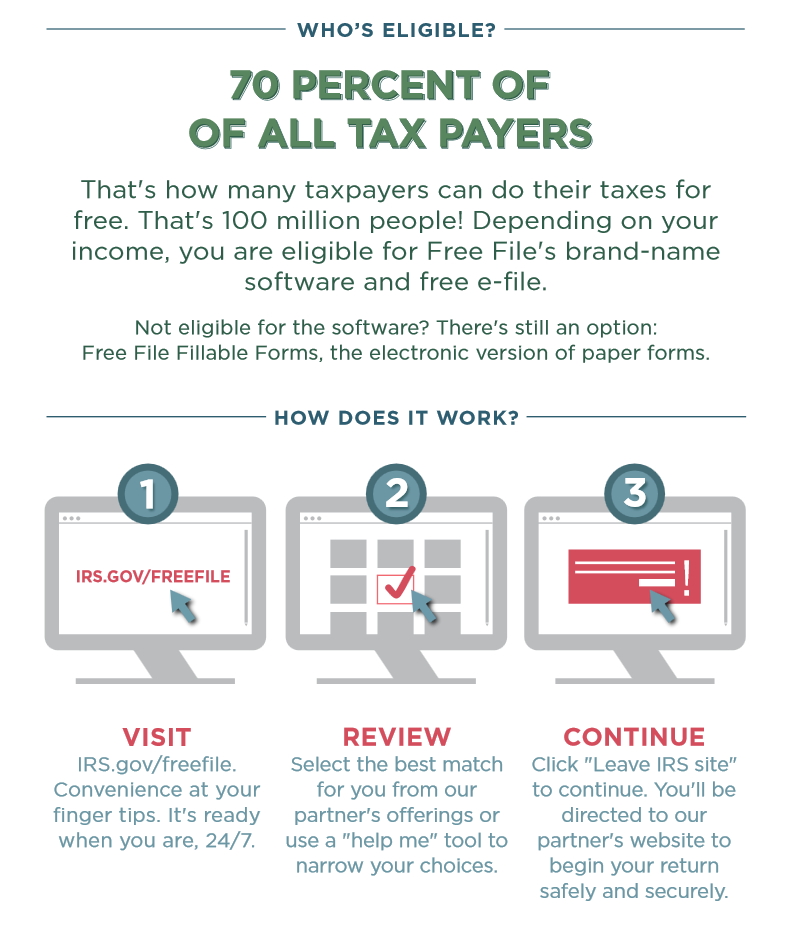
The IRS Free File program is perhaps the most widely recognized federal offering. It’s a partnership between the IRS and various tax preparation software companies that agree to offer their products for free to taxpayers who meet specific AGI requirements.
- How it Works: The IRS doesn’t develop the software itself but provides a gateway on its website (irs.gov/freefile) to participating providers. If your AGI is below the annual threshold (which is typically around $79,000 for tax year 2023), you can choose from a list of commercial software brands that will guide you through the filing process at no cost. Each provider may have slightly different eligibility criteria (e.g., age, state of residence), so it’s worth checking a few options.
- Benefits: It provides access to high-quality, professional-grade software that would otherwise come with a fee. It also supports both federal and often free state tax filing for eligible users.
- Key Consideration: You must access the software through the IRS Free File website. Going directly to a company’s website might bypass the free offer and lead you to paid versions.
Direct File: The IRS’s New Venture
For the 2024 tax season (for tax year 2023 returns), the IRS launched a pilot program called “Direct File” in a limited number of states. This innovative program allows eligible taxpayers to file their federal tax returns directly with the IRS for free, using a mobile-friendly, web-based service.
- Pilot Scope: In its initial phase, Direct File is available in select states (e.g., Arizona, California, Florida, Massachusetts, Nevada, New Hampshire, New York, South Dakota, Tennessee, Texas, Washington, Wyoming).
- Eligibility: It caters to taxpayers with simpler tax situations, typically those reporting W-2 income, Social Security benefits, unemployment compensation, and claiming standard deductions and certain common credits like the Earned Income Tax Credit or Child Tax Credit. It does not support complex returns with itemized deductions, business income, or capital gains.
- Future Potential: While currently limited, Direct File represents a significant step towards a more streamlined, government-provided free filing option for a broader range of taxpayers in the future. It’s a key development to watch in the realm of financial tools for tax preparation.
VITA and TCE Programs: In-Person Assistance for Qualifying Taxpayers
For those who prefer in-person assistance, or who might not be comfortable navigating software, the IRS sponsors two invaluable programs staffed by certified volunteers:
- Volunteer Income Tax Assistance (VITA): This program offers free tax help to people who generally make $64,000 or less, persons with disabilities, and limited English-speaking taxpayers who need assistance in preparing their own tax returns. Volunteers are trained to help with basic, non-business returns.
- Tax Counseling for the Elderly (TCE): Specifically designed for taxpayers aged 60 and older, the TCE program specializes in questions about pensions and retirement-related issues unique to seniors. Many TCE sites are run by the AARP Foundation Tax-Aide program.
Both VITA and TCE sites are typically located in community centers, libraries, schools, and other convenient locations. They offer peace of mind through direct interaction with knowledgeable volunteers and ensure accuracy without any cost.
Exploring Commercial Software Providers with Free Tiers
Beyond the direct IRS partnerships, several well-known commercial tax software companies offer free versions of their products. These are often the first choice for many taxpayers, providing user-friendly interfaces and robust features for simpler returns.
TurboTax Free Edition: For Simple Returns
TurboTax is one of the most recognized names in tax preparation. Their Free Edition caters specifically to taxpayers with straightforward tax situations.
- Eligibility: Typically covers those filing Form 1040, claiming the standard deduction, and with income from W-2s, unemployment, or limited interest/dividend income. It also supports claiming the Earned Income Tax Credit and Child Tax Credit.
- Limitations: Once your tax situation becomes more complex – for instance, if you need to itemize deductions, report self-employment income (Form Schedule C), or deal with investments – you will likely be prompted to upgrade to a paid version.
- User Experience: Known for its intuitive, step-by-step guidance, making tax filing feel less daunting even for novices.
H&R Block Free Online: A Comparable Alternative
H&R Block, another industry giant, offers a comparable free online product that competes directly with TurboTax’s free edition.
- Eligibility: Similar to TurboTax, it targets taxpayers with simple returns, W-2 income, standard deductions, and common credits.
- Features: Often includes free federal and basic state tax filing, as well as access to their “Ask a Tax Pro” service for basic questions (though more in-depth assistance might be an upsell).
- Ease of Use: Provides a clear, guided experience, often with tools to import W-2s and previous year’s tax data, simplifying the process.
Cash App Taxes (formerly Credit Karma Tax): A Free-First Approach
Cash App Taxes stands out by offering genuinely free federal and state tax filing for a wider range of tax situations than many other “free” editions.
- Broader Scope: Unlike competitors, Cash App Taxes supports many common forms and schedules that usually trigger an upgrade elsewhere, including Schedule C (profit or loss from business), Schedule D (capital gains and losses), and itemized deductions (Schedule A).
- Completely Free: Their model is genuinely free for both federal and state filing for covered situations, without the upsell pressure seen in other basic free versions.
- Integration: Being part of the Cash App ecosystem, it offers seamless integration for users already utilizing Cash App for banking or payments.
- Key Consideration: While broad, it doesn’t cover all situations (e.g., multi-state filing, foreign earned income, certain less common forms). Always review their supported forms list to ensure it meets your needs.
Beyond Federal: Tackling Free State Tax Filing
While federal taxes often take center stage, state income taxes are a reality for most Americans. Successfully filing your state taxes for free is an equally important component of a truly cost-free tax season.
State-Specific Free Filing Programs
Many states have their own initiatives and partnerships to provide free tax filing options. These often mirror the federal IRS Free File program, with state revenue departments partnering with software providers to offer free state filing to eligible residents.
- Check Your State’s Department of Revenue: The best first step is to visit your state’s official tax website (e.g., “California Franchise Tax Board” or “New York State Department of Taxation and Finance”). Look for sections on “free filing” or “electronic filing.”
- Direct State Filing Portals: Some states offer their own direct filing portals, allowing residents to file state returns directly through a government-run website. These are usually free but might require manual data entry.
Leveraging Federal Software for State Returns
Often, the same software you use for free federal filing can also help with your state return, sometimes for free, sometimes at a reduced cost.
- IRS Free File Program Providers: Many of the commercial software companies participating in the IRS Free File program offer free state tax filing as part of the deal, provided you meet their specific AGI and other criteria. This is why starting with the IRS Free File portal is often recommended.
- Commercial Free Tiers: Companies like H&R Block and TurboTax often include free state filing within their basic free editions, again, contingent on the simplicity of your return. Cash App Taxes is particularly strong here, often providing free state filing for scenarios that other providers charge for.
- “Piggybacking”: When you file your federal return using a software, it populates much of the information needed for your state return, making the state filing process much quicker, even if you do end up paying a small fee for it. Always double-check if the “free” federal offer extends to your state before committing.
Best Practices for a Smooth, Free Tax Filing Experience
Filing taxes for free is achievable, but a little preparation and careful attention can make the process significantly smoother and reduce the likelihood of errors or delays.
Gathering Your Documents Proactively
The golden rule of tax season is organization. Before you even open your chosen free filing platform, ensure you have all necessary documents at hand.
- Income Documents: W-2s (from employers), 1099-NEC (nonemployee compensation), 1099-K (third-party payment network transactions), 1099-INT (interest), 1099-DIV (dividends), 1099-G (government payments like unemployment), Schedule K-1s (from partnerships/S-corps), Social Security benefits statements (SSA-1099).
- Deductions & Credits: Forms 1098 (mortgage interest), property tax statements, charitable contribution records, student loan interest statements (1098-E), tuition statements (1098-T), child care expenses, medical expense records.
- Identification: Your Social Security Number (SSN) or Individual Taxpayer Identification Number (ITIN) and those of your spouse and dependents.
- Prior Year’s AGI: You’ll need this for e-filing authentication.
Having these organized in advance prevents frantic searches and ensures you don’t miss out on eligible deductions or credits.
Understanding Your Tax Situation
While free software guides you, having a basic understanding of your own tax situation empowers you to make informed decisions.
- Standard vs. Itemized Deductions: Know which you’ll likely take. For most simple filers, the standard deduction is more beneficial.
- Common Credits: Be aware of credits you might qualify for, such as the Earned Income Tax Credit (EITC), Child Tax Credit (CTC), Education Credits, or Premium Tax Credit (for marketplace insurance).
- Life Changes: Did you get married, divorced, have a child, buy a house, or change jobs? These events significantly impact your taxes.
This understanding helps you select the right free software or program and ensures you accurately input information.
Double-Checking for Accuracy and Completeness
Even with user-friendly software, human error is the most common cause of tax filing issues.
- Review All Entries: Before submitting, meticulously review all sections of your return. Does your income match your W-2s? Are your deductions correctly entered?
- Check for Typos: A single misplaced digit in an SSN or income amount can cause significant delays or rejections.
- Review Software’s Summary: Most software provides a summary before final submission. Read through it carefully.
- Seek Help When Unsure: If using VITA/TCE, ask volunteers to explain anything unclear. If using software, utilize their help sections or forums.
The Importance of E-Filing and Direct Deposit
Once you’ve ensured accuracy, opt for electronic filing (e-file) and direct deposit for your refund.
- E-Filing: It’s faster, more secure, and significantly reduces the chance of errors compared to paper filing. The IRS processes e-filed returns much more quickly.
- Direct Deposit: This is the quickest way to receive your refund. Funds are typically deposited directly into your bank account within 21 days (or even faster) of the IRS accepting your return. Avoid refund checks, which can be delayed or lost in the mail.
What to Watch Out For: Avoiding Hidden Costs and Complexities
While the goal is free filing, some commercial providers can be quite adept at upselling. Being vigilant is key to truly keeping your tax preparation at zero cost.
Upgrades and Add-ons: The “Free” Trap
Many commercial “free” editions are designed to handle only the simplest of tax situations. The moment you enter something slightly more complex, you might be prompted to upgrade to a paid version.
- Scenario Triggers: Common triggers for upgrades include reporting self-employment income (even a small side hustle), needing to itemize deductions, claiming certain uncommon tax credits, or dealing with investment income beyond basic interest.
- State Filing Fees: Be wary of free federal offers that then charge for state filing. Always clarify upfront if both federal and state are included in the free tier for your specific situation.
- Audit Protection/Expert Review: Commercial software often offers optional add-ons like audit protection or direct access to a tax professional for a fee. While these might be valuable for some, they are not necessary for filing and are usually where the “free” experience ends. Be firm in declining these if you want to remain at zero cost.
Limitations of Free Editions
Understand the boundaries of truly free software. If your tax situation involves:
- Multiple states (e.g., you lived in one state but worked in another).
- Foreign earned income.
- Complex investment portfolios with multiple transactions (though basic stock sales might be covered by some “free-first” providers).
- Business expenses requiring detailed depreciation schedules.
- Less common tax forms or specific tax situations (e.g., expatriate taxes),
…you may find that free software simply won’t suffice. In these cases, it’s often more cost-effective to pay for a higher-tier software or consult with a professional, rather than trying to force a complex return into a basic free product and risking errors.
Scam Awareness and Data Security
Whenever you’re dealing with sensitive financial information online, vigilance against scams is paramount.
- Official Sources Only: Always use official IRS resources (irs.gov/freefile) or direct links from reputable software providers. Be wary of emails or pop-ups promising free filing that lead to unfamiliar sites.
- Secure Connections: Ensure the website you’re using has “https://” in the URL and a padlock icon, indicating a secure connection.
- Phishing Attempts: The IRS will never initiate contact with you via email, text message, or social media to request personal or financial information. Any such communication is a scam.
- Strong Passwords: Use unique, strong passwords for your tax filing accounts and enable multi-factor authentication if available.
By staying alert, you can protect your financial data while taking advantage of free filing options.
Filing your taxes for free is not a myth; it’s an accessible reality for millions of Americans. By strategically utilizing programs like IRS Free File, VITA/TCE, or by selecting commercial software with robust free tiers, you can eliminate a common financial burden from your annual checklist. Taking control of your tax preparation through these no-cost avenues is a tangible step towards smarter personal finance, ensuring that every dollar you’ve earned stays where it belongs: with you. Embrace the opportunity to file free, reduce your financial stress, and empower yourself with greater tax literacy.
aViewFromTheCave is a participant in the Amazon Services LLC Associates Program, an affiliate advertising program designed to provide a means for sites to earn advertising fees by advertising and linking to Amazon.com. Amazon, the Amazon logo, AmazonSupply, and the AmazonSupply logo are trademarks of Amazon.com, Inc. or its affiliates. As an Amazon Associate we earn affiliate commissions from qualifying purchases.