
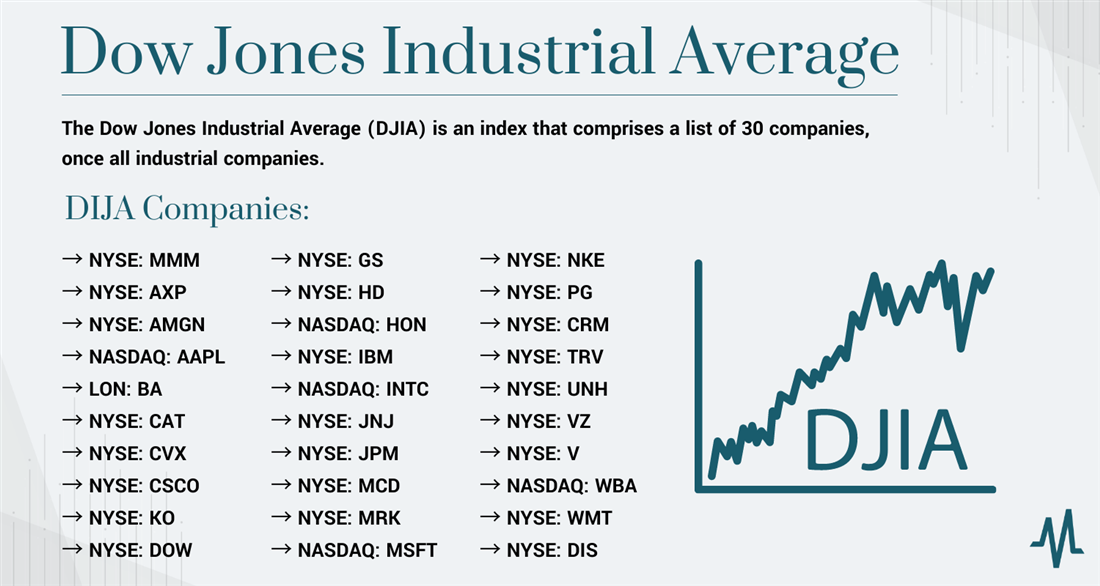
The Dow Jones Industrial Average (DJIA), often simply referred to as “the Dow,” stands as one of the most widely recognized and frequently cited stock market indices in the world. For over a century, it has served as a critical barometer for the health of the U.S. economy and a quick reference for the performance of the stock market. Unlike broader indices such as the S&P 500, the Dow comprises only 30 large, publicly owned companies based in the United States. These companies are selected to represent various sectors of the U.S. economy, embodying the stability and leadership of American industry. Understanding the Dow, its components, and its significance is crucial for any investor seeking to comprehend market dynamics and build informed investment strategies.
Understanding the Dow Jones Industrial Average (DJIA)
Established in 1896 by Charles Dow, editor of The Wall Street Journal and co-founder of Dow Jones & Company, the DJIA originally tracked 12 industrial companies. It has evolved significantly over the decades, expanding to 30 components in 1928, and shifting its focus from purely “industrial” to a broader representation of leading American enterprises. Despite its name, the index is no longer confined to heavy industry but includes companies from technology, healthcare, finance, consumer goods, and other diverse sectors.
A Brief History and Calculation
Initially, the Dow was a simple arithmetic average of its component stock prices. However, as stock splits, mergers, and other corporate actions began to distort this simple average, a more sophisticated calculation method was introduced. Today, the DJIA is a price-weighted index, meaning stocks with higher prices have a greater influence on the index’s value than lower-priced stocks. This characteristic distinguishes it from market-capitalization-weighted indices, where larger companies by market value exert a greater impact.
The Dow Divisor
To maintain the historical continuity of the index amidst changes in its components, stock splits, or dividend payouts, a “Dow Divisor” is used. This divisor is adjusted whenever a component stock has a split or when companies are added or removed from the index. The sum of the prices of the 30 stocks is divided by this ever-changing divisor, ensuring that the index’s value accurately reflects actual market movements rather than artificial fluctuations caused by corporate actions or index adjustments. This unique methodology means that a one-dollar change in the price of a high-priced stock will have a much larger impact on the Dow’s total points than a one-dollar change in a lower-priced stock.
The Selection Criteria for Dow Components
The decision to include or remove a company from the Dow Jones Industrial Average is not made by a strict set of quantitative rules but rather by the editors of The Wall Street Journal. This committee considers several factors, aiming for companies that represent a significant portion of the U.S. economy and are highly regarded within their respective industries. Key criteria include:
- Reputation and Sustained Growth: Companies must have an excellent reputation, demonstrate sustained growth, and be of interest to a large number of investors.
- Sector Representation: The committee strives to ensure the index reflects the current state of the U.S. economy, diversifying across key sectors without over-representing any one industry.
- Leadership Position: Component companies are typically large, established “blue-chip” firms that are leaders in their industry and have a history of generating significant earnings.
- Market Capitalization: While not a primary selection criterion due to the price-weighted nature, Dow companies are invariably among the largest and most stable publicly traded entities.
Changes to the Dow are relatively infrequent, typically occurring only when a company’s market relevance significantly diminishes, or an acquisition or merger changes its fundamental nature, or when a new company better represents a growing sector of the economy.
The Current 30 Dow Jones Industrial Stocks
As of its most recent updates, the 30 companies that comprise the Dow Jones Industrial Average span a wide array of sectors, from technology and finance to healthcare and consumer goods. Here is a comprehensive list of these influential corporations:
3M (MMM)
A diversified technology company that produces a wide range of products, including adhesives, abrasives, laminates, passive fire protection, personal protective equipment, optical films, and medical products.
Amazon.com Inc. (AMZN)
An e-commerce giant and cloud computing leader. Amazon’s inclusion reflects the growing importance of online retail and digital services in the modern economy.
Amgen Inc. (AMGN)
A leading biotechnology company focused on human therapeutics, specializing in areas like oncology, inflammation, bone health, and cardiovascular disease.
Apple Inc. (AAPL)
The global technology powerhouse known for its consumer electronics (iPhone, iPad, Mac), software, and online services. Its presence underscores the dominance of tech in everyday life.
Boeing Co. (BA)
A multinational corporation that designs, manufactures, and sells airplanes, rotorcraft, rockets, satellites, telecommunications equipment, and missiles worldwide. A key player in aerospace and defense.
Caterpillar Inc. (CAT)
The world’s largest manufacturer of construction and mining equipment, diesel and natural gas engines, industrial gas turbines, and diesel-electric locomotives.
Chevron Corp. (CVX)
One of the world’s leading integrated energy companies, involved in every aspect of the oil and natural gas industry, including exploration, production, refining, marketing, and chemical manufacturing.
Cisco Systems Inc. (CSCO)
A global technology conglomerate that develops, manufactures, and sells networking hardware, software, telecommunications equipment, and other high-technology services and products.
Coca-Cola Co. (KO)
The iconic beverage company, a global leader in non-alcoholic ready-to-drink beverages. Its widespread brand recognition makes it a staple in consumer staples.
Walt Disney Co. (DIS)
A multinational entertainment and media conglomerate known for its theme parks, media networks (ESPN, ABC), studio entertainment, and direct-to-consumer streaming services (Disney+).
Dow Inc. (DOW)
A materials science company focused on packaging, infrastructure, and consumer care. It was spun off from DowDuPont.

Goldman Sachs Group Inc. (GS)
A leading global investment banking, securities, and investment management firm, providing a wide range of financial services to a substantial and diversified client base.
Home Depot Inc. (HD)
The largest home improvement retailer in the United States, providing tools, construction products, and services. Reflects strength in housing and consumer spending.
Honeywell International Inc. (HON)
A diversified technology and manufacturing company serving customers worldwide with aerospace products and services, control technologies for buildings and industry, and performance materials.
International Business Machines Corp. (IBM)
A legacy technology and consulting company focusing on enterprise IT, including cloud computing, artificial intelligence, and quantum computing.
Intel Corp. (INTC)
A global leader in semiconductor manufacturing, providing processors for computers, data centers, and various other devices.
Johnson & Johnson (JNJ)
A global healthcare giant that develops and manufactures pharmaceutical, medical devices, and consumer health products.
JPMorgan Chase & Co. (JPM)
A global financial services firm and one of the largest banks in the United States, offering investment banking, financial services, asset management, and commercial banking.
McDonald’s Corp. (MCD)
The world’s largest chain of fast-food restaurants, a dominant force in the global quick-service restaurant industry.
Merck & Co. Inc. (MRK)
A global pharmaceutical company that discovers, develops, manufactures, and markets a broad range of innovative medicines and vaccines.
Microsoft Corp. (MSFT)
A technology behemoth renowned for its software (Windows, Office), cloud services (Azure), gaming (Xbox), and hardware. Another cornerstone of the modern tech landscape.
Nike Inc. (NKE)
The world’s largest supplier of athletic shoes and apparel and a major manufacturer of sports equipment. A global leader in consumer discretionary.
Procter & Gamble Co. (PG)
A multinational consumer goods corporation that manufactures a wide range of products including cleaning agents, personal care products, and pet foods.
Salesforce Inc. (CRM)
A leading provider of customer relationship management (CRM) software and cloud-based services. Its inclusion highlights the shift towards enterprise cloud solutions.
Travelers Companies Inc. (TRV)
An insurance company that provides a variety of commercial and personal property and casualty insurance products and services.
UnitedHealth Group Inc. (UNH)
A diversified healthcare company providing health care products and insurance services. The largest healthcare company by revenue globally.
Verizon Communications Inc. (VZ)
One of the largest telecommunications companies in the world, offering wireless communications, broadband, and other communication services.
Visa Inc. (V)
A global payments technology company facilitating electronic funds transfers throughout the world, primarily through Visa-branded credit and debit cards.
Walmart Inc. (WMT)
The world’s largest company by revenue, a multinational retail corporation operating a chain of hypermarkets, discount department stores, and grocery stores.
Why the DJIA Remains Relevant to Investors
Despite criticisms regarding its narrow scope and price-weighted methodology, the DJIA maintains significant relevance for investors for several reasons:
- Historical Significance: It has over a century of data, providing a long-term perspective on market trends and economic cycles.
- Blue-Chip Representation: The 30 companies are generally considered “blue-chip” stocks—large, well-established, financially sound companies with a history of stable earnings and dividend payments. They often serve as foundational holdings in diversified portfolios.
- Market Sentiment Indicator: The Dow offers a quick and easily digestible snapshot of overall market sentiment, particularly for large-cap U.S. equities. Its movements are closely watched by media and investors alike as an indicator of broader market direction.
- Economic Bellwether: Given the diverse nature of its components, the Dow can provide insights into the general health of the U.S. economy. Strong performance by Dow components often correlates with robust economic activity.
For investors seeking exposure to a basket of leading American companies without delving into extensive research on individual stocks, investing in exchange-traded funds (ETFs) or mutual funds that track the DJIA offers a convenient approach.

Critiques and Considerations for Investors
While the Dow’s prominence is undeniable, it also faces several criticisms that investors should consider:
- Limited Scope: With only 30 stocks, the DJIA is not a comprehensive representation of the entire U.S. stock market. It excludes thousands of other publicly traded companies, including many mid-cap and small-cap firms, and emerging industries.
- Price-Weighted Bias: The price-weighted methodology means that a company with a higher stock price will influence the index more, regardless of its overall market capitalization. This can distort the true economic impact of individual companies on the broader market. For example, a $1 move in a $400 stock has a greater impact than a $1 move in a $100 stock, even if the latter company has a much larger market cap.
- Subjective Selection: The discretionary selection process by The Wall Street Journal editors can be seen as less transparent and systematic compared to indices that follow strict rules (like the S&P 500).
- Divisor Adjustments: While necessary for continuity, the frequent adjustments to the Dow Divisor can make it difficult for an average investor to intuitively understand the index’s calculation.
Despite these limitations, the Dow Jones Industrial Average remains a valuable tool for understanding a specific, yet crucial, segment of the market. For investors focused on large, established, and influential American corporations, the Dow provides a concise and enduring reference point. It serves as a testament to the enduring power and adaptability of leading U.S. businesses, offering a glimpse into the economic forces that shape global markets.
aViewFromTheCave is a participant in the Amazon Services LLC Associates Program, an affiliate advertising program designed to provide a means for sites to earn advertising fees by advertising and linking to Amazon.com. Amazon, the Amazon logo, AmazonSupply, and the AmazonSupply logo are trademarks of Amazon.com, Inc. or its affiliates. As an Amazon Associate we earn affiliate commissions from qualifying purchases.