
Understanding the core financial infrastructure behind a major tax preparation service like H&R Block reveals much about modern business finance and the intricate partnerships that facilitate consumer financial products. While H&R Block is widely recognized for its tax expertise, it is not a bank itself. Therefore, its ability to offer services like refund advances, direct deposit of refunds, and its branded debit card relies heavily on strategic alliances with federally insured financial institutions. These banking relationships are central to H&R Block’s operational model, enabling it to bridge the gap between tax preparation and the direct disbursement of funds to millions of taxpayers annually.
The Crucial Role of Banking Partnerships in Tax Services
For a company like H&R Block, banking partners are not merely vendors; they are integral components of its service delivery and product offerings. These relationships extend far beyond basic corporate banking needs, diving deep into the realm of consumer finance. Without robust banking support, H&R Block would be unable to provide many of the convenient financial solutions that attract and retain its customer base.
Facilitating Refund Disbursals
One of the most critical functions served by H&R Block’s banking partners is the efficient and secure disbursement of tax refunds. When a taxpayer opts for a refund transfer service, H&R Block acts as an intermediary. The Internal Revenue Service (IRS) deposits the refund into an account held by H&R Block’s partner bank. From there, the bank deducts any applicable tax preparation fees and then disperses the remaining refund to the taxpayer, typically via direct deposit to their personal bank account, a check, or loading it onto a prepaid debit card like the H&R Block Emerald Card. This system streamlines the process for consumers, allowing them to pay tax preparation fees directly from their refund without out-of-pocket expenses at the time of service.
Supporting Financial Products: Refund Advances and Emerald Card
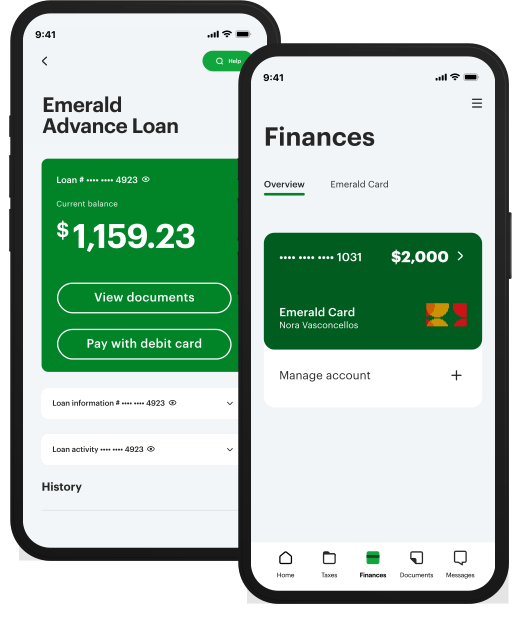
Beyond basic refund transfers, H&R Block leverages its banking relationships to offer specialized financial products. Refund advance loans, for instance, are short-term loans provided to customers awaiting their tax refunds. These are not issued by H&R Block itself, but by its banking partners, using the anticipated refund as collateral. This allows taxpayers to access a portion of their refund much sooner than the IRS would typically disburse it, providing immediate liquidity. Similarly, the H&R Block Emerald Card, a prepaid reloadable debit card, is issued by a partner bank, providing a convenient and accessible banking solution for individuals who may not have traditional bank accounts or prefer a prepaid option for managing their funds. These products are foundational to H&R Block’s value proposition, offering financial flexibility rooted in robust banking infrastructure.
Key Banking Partners for H&R Block
Over the years, H&R Block has partnered with various financial institutions to support its extensive range of services. These partnerships are dynamic, evolving based on regulatory changes, technological advancements, and strategic business objectives. However, certain banks have maintained prominent roles in facilitating H&R Block’s financial offerings.
Axos Bank: A Primary Relationship
In recent years, Axos Bank has emerged as a significant partner for H&R Block. Axos Bank, an FDIC-insured national bank operating entirely online, plays a crucial role in funding many of H&R Block’s financial products. Specifically, Axos Bank is known to be the issuer of the popular “Refund Advance” loans that H&R Block offers to eligible clients. This partnership highlights the growing trend of established companies collaborating with digital-first banks to deliver financial services more efficiently and at scale. Axos Bank’s infrastructure and expertise in online banking align well with the digital transformation efforts within the tax preparation industry. This collaboration enables seamless processing of loan applications and disbursements, providing a quick financial bridge for taxpayers.
Metabank, N.A. (now Pathward): A Historical and Ongoing Partner
Metabank, N.A., which rebranded to Pathward, N.A. in 2022, has a long-standing history as a key banking partner for H&R Block. Pathward (formerly Metabank) specializes in providing banking-as-a-service solutions for various fintech companies and service providers, making it a natural fit for H&R Block’s needs. Pathward has historically been, and continues to be, the issuer of the H&R Block Emerald Card. As a leading issuer of prepaid debit cards and provider of refund advance loans, Pathward’s role has been instrumental in enabling H&R Block to offer accessible and secure financial products to a broad segment of the population, including the underbanked. Their deep experience in processing high volumes of transactions and managing prepaid card programs makes them an indispensable ally in H&R Block’s financial ecosystem.
Other Potential Partnerships and Payment Processors
While Axos Bank and Pathward stand out as primary partners for consumer-facing financial products, it’s important to recognize that H&R Block’s operational finance might involve other institutions. Like any large corporation, H&R Block would engage with various commercial banks for its corporate treasury functions, payroll, and general business banking needs. Furthermore, payment processors and other financial technology companies might be involved in the backend for fee collection, fraud prevention, and other ancillary services. The landscape of financial partnerships for a company of H&R Block’s scale is often complex and multi-faceted, adapting to the specific needs of different product lines and geographical markets.
Beyond the Primary Bank: Understanding H&R Block’s Financial Ecosystem

To fully appreciate “what bank H&R Block uses,” one must look beyond a single entity and understand the broader financial ecosystem that allows H&R Block to operate its diverse service offerings. This involves a carefully choreographed interplay between the tax preparer, its banking partners, and the federal government.
The Mechanics of Tax Refund Transfers
When a client chooses H&R Block’s “Refund Transfer” service, they are essentially authorizing their tax refund to be routed through a temporary bank account established by H&R Block’s banking partner. The IRS, upon processing the tax return, electronically deposits the refund into this account. From this account, H&R Block’s agreed-upon fees are automatically deducted. The remaining balance is then electronically disbursed to the client’s chosen destination—be it their personal bank account, a check, or loaded onto an H&R Block Emerald Card. This seamless process eliminates the need for clients to pay upfront for tax preparation services, which is a significant convenience and a key competitive advantage for H&R Block.
How Refund Advance Loans Work
The Refund Advance loan is a prime example of H&R Block leveraging its banking relationships to offer a high-demand financial product. When a client applies for a Refund Advance, H&R Block does not directly lend the money. Instead, it facilitates the application process with its banking partner, primarily Axos Bank. The bank evaluates the client’s eligibility based on criteria that include their anticipated tax refund amount, creditworthiness (though often with less stringent requirements than traditional loans, as the refund serves as collateral), and other factors. If approved, the loan funds are typically disbursed rapidly, often within hours or days, directly onto an H&R Block Emerald Card or into the client’s bank account. When the actual tax refund from the IRS is issued, it is directed to the partner bank to repay the advance, ensuring a streamlined repayment process without direct action from the borrower.
The Emerald Card and Prepaid Debit Solutions
The H&R Block Emerald Card, issued by Pathward, N.A. (formerly Metabank), functions as a reloadable prepaid Mastercard or Visa debit card. It serves multiple purposes within H&R Block’s financial offerings. Clients can choose to have their tax refund, including any Refund Advance, loaded onto the Emerald Card. This provides immediate access to funds, particularly beneficial for individuals without traditional bank accounts. Beyond tax refunds, the Emerald Card can be used for everyday purchases, bill payments, and ATM withdrawals, much like a standard debit card. It can also be reloaded with funds from other sources, such as payroll direct deposits, making it a viable alternative to traditional checking accounts for many users. The banking partnership ensures the card’s compliance with banking regulations, provides FDIC insurance for deposited funds, and supports the necessary payment network infrastructure.
Implications for Consumers and Business Operations
The banking partnerships H&R Block maintains have profound implications, both for its vast customer base and for the financial integrity and operational efficiency of the company itself. These relationships are foundational to how H&R Block delivers value and navigates the complex financial regulatory landscape.
Trust, Security, and Compliance
Partnering with federally insured banks like Axos Bank and Pathward (Metabank) is paramount for H&R Block to instill trust and ensure the security of customer funds. These banks are subject to stringent regulations from agencies like the FDIC, the Office of the Comptroller of the Currency (OCC), and the Consumer Financial Protection Bureau (CFPB). This regulatory oversight means that customer funds are protected (up to FDIC limits), and financial products adhere to consumer protection laws. For H&R Block, these partnerships offload the immense compliance burden associated with banking operations, allowing them to focus on their core tax preparation services while leveraging their partners’ expertise in financial regulations and security protocols.
Streamlining Financial Transactions
The seamless integration with banking partners allows H&R Block to process millions of financial transactions swiftly and efficiently each tax season. From direct deposits of refunds to the funding and repayment of advance loans, these partnerships enable an infrastructure that can handle immense transactional volume. This efficiency is critical not only for customer satisfaction but also for H&R Block’s operational costs and ability to maintain a competitive edge in a fast-paced market. Without these streamlined processes, the logistical challenge of disbursing refunds and managing financial products would be exponentially greater.
Expanding Access to Financial Services
One of the significant societal impacts of H&R Block’s banking relationships is the expansion of access to financial services. Products like the Emerald Card and Refund Advance loans cater to individuals who may be unbanked or underbanked, providing them with safe, regulated avenues to manage their money and access short-term credit. By leveraging the banking infrastructure of its partners, H&R Block plays a role in financial inclusion, offering convenient solutions that might otherwise be unavailable or difficult to access through traditional banking channels. This broadens the reach of essential financial tools to a demographic that often faces barriers to mainstream financial services.

The Future of Financial Partnerships in Tax Preparation
The landscape of financial services is continually evolving, driven by technological innovation and changing consumer expectations. For H&R Block, its banking partnerships will remain a critical element of its strategy. We can anticipate continued innovation in how these partnerships function, potentially exploring areas such as real-time payments, enhanced digital wallet features, and more personalized financial advisory services integrated with tax preparation. As fintech continues to grow, the boundaries between traditional financial institutions and service providers like H&R Block will likely blur further, leading to more integrated and comprehensive financial solutions for consumers. The core principle, however, will endure: H&R Block will continue to rely on robust, compliant banking partners to deliver its array of financial products and services, ensuring security, efficiency, and accessibility for its millions of clients.
aViewFromTheCave is a participant in the Amazon Services LLC Associates Program, an affiliate advertising program designed to provide a means for sites to earn advertising fees by advertising and linking to Amazon.com. Amazon, the Amazon logo, AmazonSupply, and the AmazonSupply logo are trademarks of Amazon.com, Inc. or its affiliates. As an Amazon Associate we earn affiliate commissions from qualifying purchases.