
Seeing a sea of red across your brokerage dashboard can be an unsettling experience. Whether you are a seasoned institutional investor or a retail trader just starting your journey, the question “Why is the stock market down today?” is one that demands a multifaceted answer. Stock prices do not move in a vacuum; they are the result of a complex interplay between macroeconomic data, corporate performance, geopolitical stability, and investor psychology.
Understanding the mechanics behind a market downturn is essential for maintaining a long-term perspective. Rather than reacting with panic, informed investors look for the underlying catalysts to determine if a dip is a temporary correction or the start of a broader structural shift. This article explores the primary drivers of market volatility and provides a framework for understanding why equity prices fluctuate in the modern financial landscape.
The Macroeconomic Landscape: Interest Rates and Inflation
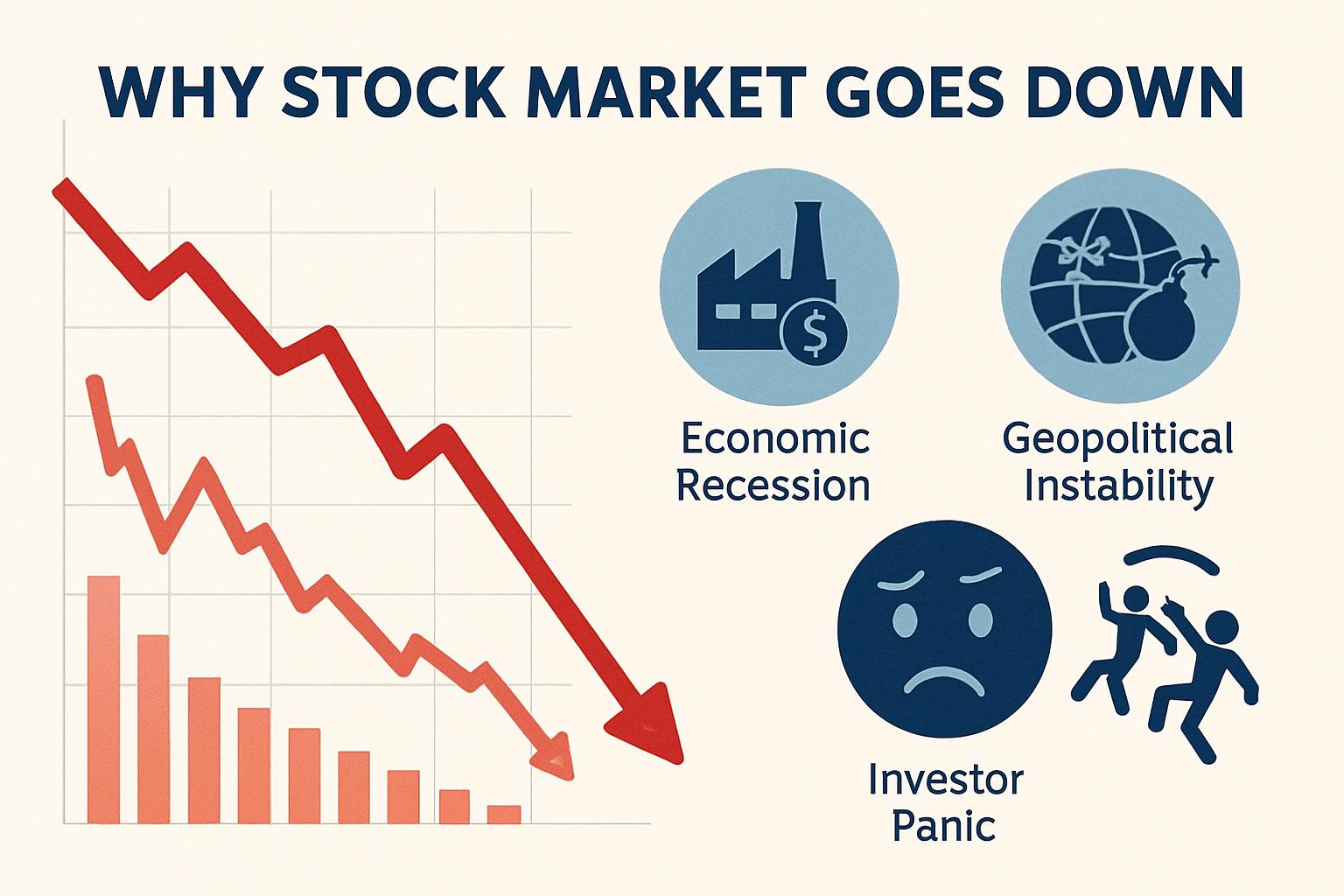
The most frequent catalyst for broad market declines in the current era is the shifting macroeconomic environment, specifically regarding monetary policy and inflationary pressures. Central banks, such as the Federal Reserve in the United States, act as the primary architects of the economic climate, and their decisions regarding interest rates have a direct impact on stock valuations.
The Role of the Federal Reserve and Interest Rates
Stock markets generally dislike high interest rates. When the Federal Reserve adopts a “hawkish” stance—meaning they intend to raise or maintain high rates to combat inflation—stocks often sell off. There are two primary reasons for this. First, higher interest rates increase the cost of borrowing for corporations. When it becomes more expensive to finance operations or fund expansion, projected future earnings decrease.
Second, interest rates serve as the “discount rate” in financial modeling. When rates rise, the present value of future cash flows diminishes. This is particularly punishing for growth stocks and technology companies that are valued based on earnings expected years into the future. Consequently, any hint of a “higher for longer” interest rate environment can cause an immediate downward shift in market indices.
Inflationary Pressures and Consumer Sentiment
Inflation acts as a silent tax on both consumers and corporations. When the Consumer Price Index (CPI) or Personal Consumption Expenditures (PCE) reports come in higher than expected, it signals to the market that the economy is “overheating.” High inflation erodes profit margins because companies must pay more for raw materials and labor. While some companies can pass these costs on to consumers, many cannot do so without seeing a drop in demand.
Furthermore, persistent inflation suggests that the central bank will have to remain aggressive with rate hikes, creating a feedback loop of market anxiety. Today’s downturn could very well be a reaction to a specific piece of economic data that suggests the fight against inflation is far from over.
Corporate Fundamentals and the Earnings Cycle
While the “macro” picture sets the stage, individual corporate performance provides the script. We are often in or approaching “earnings season,” a period when public companies report their quarterly financial results. These reports are often the catalyst for significant swings in the market.
Earnings Misses and Lowered Guidance
Stock prices are largely built on expectations. Even if a company reports a profit, its stock price may drop if that profit was lower than what analysts predicted (an “earnings miss”). However, often more important than the past quarter’s performance is the “guidance”—the company’s forecast for the coming months.
If a bellwether company—such as a major tech giant or a massive retail conglomerate—lowers its future guidance due to weakening consumer demand or rising costs, it can drag down the entire sector. Investors often view these individual reports as a “canary in the coal mine” for the broader economy, leading to a widespread sell-off.
Sector-Specific Contractions
Sometimes, the market is down not because of a systemic failure, but because of a specific “rotation.” If the technology sector is overvalued, investors might sell off their tech holdings to move into “defensive” sectors like utilities or healthcare. If the tech sector makes up a significant portion of an index like the S&P 500 or the Nasdaq 100, the overall index will appear to be “down” even if other parts of the market are performing well. Understanding which sectors are leading the decline can provide clarity on whether the drop is a healthy market rebalancing or a sign of deeper trouble.
Geopolitical Instability and Global Uncertainty
The global economy is more interconnected than ever before. Events occurring thousands of miles away can have an immediate impact on the New York Stock Exchange or the FTSE 100. Geopolitical tension is a major source of “market noise” that can lead to sudden, sharp declines.
Conflict and Supply Chain Disruptions
War and diplomatic conflict often lead to uncertainty, and markets thrive on certainty. If a conflict breaks out in a region critical to energy production (like the Middle East) or semiconductor manufacturing (like East Asia), the market reacts by pricing in the risk of supply chain disruptions.
A spike in oil prices, for instance, acts as an immediate drag on the global economy, increasing transportation costs for nearly every good produced. When investors see geopolitical risks rising, they often move into “safe-haven” assets like gold or government bonds, selling off their riskier equity positions in the process.
Regulatory Changes and Trade Policy
Changes in government policy can also trigger a downturn. New regulations on big tech, changes in corporate tax law, or the imposition of trade tariffs can alter the profitability landscape for entire industries. If the market perceives a new policy as “anti-business,” stock prices will adjust downward to reflect the new reality of operating in a more restrictive environment.
Market Mechanics and Investor Psychology
Not every market decline is rooted in fundamental economic shifts. Sometimes, the way the market is structured—combined with the complexities of human emotion—can create downward pressure.
The Impact of Algorithmic Trading
In the modern era, a significant portion of stock market volume is driven by high-frequency trading (HFT) and algorithms. These systems are programmed to sell when certain technical levels are breached. For example, if a major index falls below its 200-day moving average, it can trigger a wave of automated selling. This can lead to a “cascade effect,” where the initial drop triggers more selling, causing the price to fall even further regardless of the underlying business fundamentals.
Fear, Greed, and the VIX
Investor psychology plays a massive role in daily price action. The CBOE Volatility Index (VIX), often called the “Fear Gauge,” measures the market’s expectation of near-term volatility. When the VIX spikes, it indicates that investors are nervous.
Fear is a more powerful motivator than greed in the short term. When investors see a decline starting, the “loss aversion” instinct kicks in, leading many to sell their positions to “lock in” what gains they have left or to prevent further losses. This collective behavior can turn a minor dip into a significant intraday slide.
How to Respond: A Framework for Personal Finance
When the market is down, the most important thing an investor can do is remain disciplined. While it is tempting to check your portfolio every ten minutes, short-term fluctuations are a natural part of the investing lifecycle.
Avoiding the Trap of Emotional Selling
The history of the stock market is a story of long-term growth punctuated by short-term declines. Investors who sell during a “down day” often miss the recovery that follows. Financial success in the stock market is frequently less about picking the “right” stock and more about the “time in the market.” Emotional selling turns a paper loss into a realized loss, often at the exact moment when prices are most attractive for buyers.
Dollar-Cost Averaging as a Strategy
For those with a long-term horizon, a down market can actually be an opportunity. Through a strategy known as dollar-cost averaging, you invest a fixed amount of money at regular intervals, regardless of the share price. When the market is down, your fixed investment buys more shares. Over time, this lowers your average cost per share and positions you for greater gains when the market inevitably recovers.
Reassessing Risk Tolerance
A significant market drop is a “stress test” for your investment strategy. If today’s decline is causing you significant personal distress or keeping you up at night, it may be a sign that your portfolio is too heavily weighted toward high-risk assets. Use these moments not to panic, but to evaluate whether your asset allocation—the mix of stocks, bonds, and cash—truly aligns with your risk tolerance and financial goals.
Conclusion
The stock market being down today is rarely the result of a single factor. It is usually a confluence of interest rate expectations, corporate earnings health, geopolitical shifts, and the technical mechanics of the market itself. While “red days” are a test of an investor’s resolve, they are also a reminder of the inherent risks—and the ultimate rewards—of participating in the global economy. By understanding the “why” behind the numbers, you can move away from reactive trading and toward a proactive, informed financial future.
aViewFromTheCave is a participant in the Amazon Services LLC Associates Program, an affiliate advertising program designed to provide a means for sites to earn advertising fees by advertising and linking to Amazon.com. Amazon, the Amazon logo, AmazonSupply, and the AmazonSupply logo are trademarks of Amazon.com, Inc. or its affiliates. As an Amazon Associate we earn affiliate commissions from qualifying purchases.