
The eventual death of the Sun is often framed as a biological or astronomical catastrophe—an inevitable expiration date for life as we know it. However, from the perspective of technological evolution, the transition of our star into a Red Giant and its final collapse into a White Dwarf represents the ultimate engineering challenge. For a civilization capable of mastering the fundamental laws of physics, the death of the main sequence Sun is not an end, but a catalyst for the greatest technological pivot in history.
To survive the post-solar era, humanity (or its digital successors) will have to transition from a “Type I” civilization to a “Type II” or “Type III” on the Kardashev scale. This involves moving beyond planetary dependence and developing sophisticated tech stacks capable of managing energy, data, and biology in the vacuum of deep space.

The Ultimate Energy Crisis: Engineering Post-Solar Power Solutions
When the Sun begins its expansion, the primary challenge will be the total loss of the solar energy grid that currently powers the planet. Photovoltaics, the cornerstone of our current renewable energy transition, will become obsolete as the Sun’s output fluctuates and eventually dims. To survive, technology must advance to provide localized, controllable, and nearly infinite energy.
The Dyson Swarm: Capturing the Last Embers
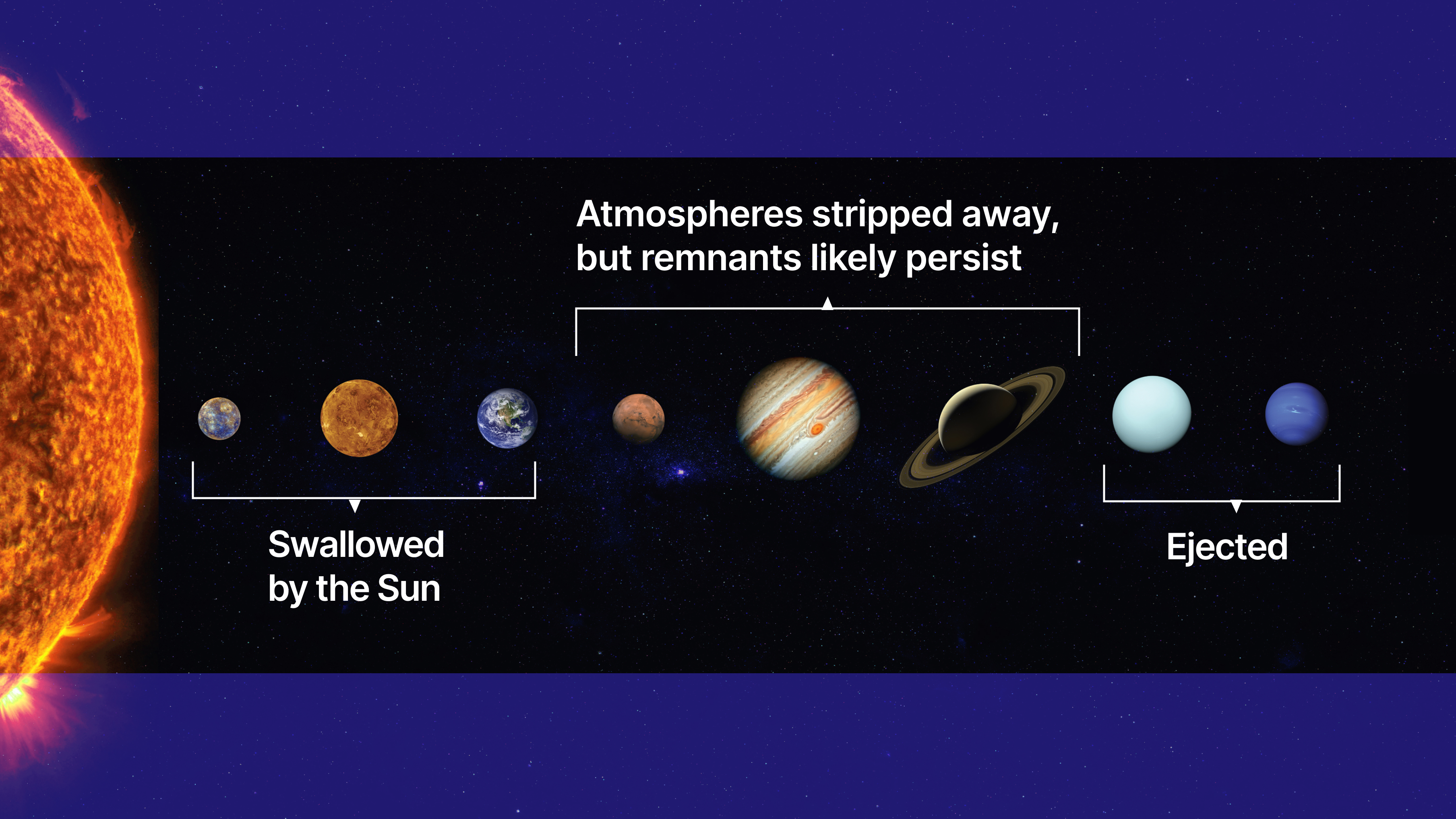
As the Sun reaches its Red Giant phase, its luminosity will spike, initially providing a surplus of energy that could be harvested. A Dyson Swarm—a massive network of mirrors and energy-collection satellites—is the logical tech evolution. Unlike a solid Dyson Sphere, which is structurally impossible under known physics, a swarm would consist of millions of autonomous units orbiting the Sun. These units would beam energy via microwaves or lasers to habitats located at the fringes of the solar system. This project would require advanced robotics and autonomous manufacturing on a scale never before seen, utilizing the resources of the inner planets as they are consumed by the expanding star.
Perfecting Nuclear Fusion: Creating Artificial Suns
If the Sun is no longer a reliable reactor, humanity must build its own. Controlled nuclear fusion—the same process that powers the stars—is the holy grail of technology. By the time the Sun dies, we must have transitioned from experimental reactors like ITER to mass-produced, high-efficiency fusion cells. Using Helium-3 mined from gas giants or deuterium harvested from the ice moons of Jupiter, these “artificial suns” would provide the thermal and electrical energy necessary to keep underground cities or space-faring vessels operational in a sunless void.
Zero-Point Energy and Quantum Vacuum Harvesting
At the bleeding edge of theoretical technology lies the possibility of harvesting energy from the vacuum itself. If humanity reaches the point of solar death, our understanding of quantum field theory must be complete. Tech that can tap into zero-point energy would render the Sun’s death irrelevant, providing a decentralized power source that works anywhere in the universe, regardless of proximity to a star.
Digital Preservation: Can AI and Data Outlive the Star?
The biological human form is incredibly fragile, requiring precise temperatures, atmospheric pressures, and protection from radiation. As the Sun dies, the cost of maintaining biological life becomes prohibitively high. The tech solution to this is the digitization of consciousness and the preservation of our cultural and scientific legacy through high-durability hardware.
Mind Uploading and the Transition to Silicon
One of the most profound technological shifts will be the transition from biological brains to substrate-independent minds. By mapping the human connectome and running it on advanced neural architectures, humanity could escape the physical limitations of a dying planet. A digital civilization requires significantly less energy than a biological one. Thousands of “individuals” could exist within a server the size of a suitcase, powered by a single fusion cell. This allows for long-term survival in the deep cold of space where traditional agriculture and heating are impossible.
Long-term Data Storage in the Deep Cold
The death of the Sun actually provides an advantage for digital tech: a natural heat sink. Electronics operate more efficiently at low temperatures. In the post-solar era, we could see the construction of “Cold-Data Banks” located on Pluto or Kuiper Belt objects. These facilities would use the near-absolute-zero temperatures of space to maintain superconducting processors and petabytes of historical data with zero cooling costs. Using technologies like 5G (and its far future successors) and optical data transmission, these banks would serve as the collective memory of a species that no longer has a home world.

AI Governance and Autonomous Maintenance
In the dark, cold billions of years after the Sun’s death, the maintenance of human legacy cannot be left to human error. Advanced General Intelligence (AGI) and Superintelligence will be required to manage the complex life-support and energy systems. These AI entities would act as the “custodians of the void,” repairing Dyson Swarm components and managing the migration of data across the cosmos without the need for biological intervention.
Interstellar Logistics: Tech for the Great Migration
If we cannot stay in the solar system, we must leave it. The death of the Sun necessitates the development of propulsion and habitat technologies that can bridge the light-years between our dying star and a new home.
Relativistic Travel and Generation Ships
Current chemical rockets are woefully inadequate for interstellar travel. The tech required to survive the Sun’s death includes Ion propulsion, plasma engines, and eventually, Antimatter drives. Antimatter propulsion offers the highest energy density of any known fuel, potentially allowing ships to reach a significant fraction of the speed of light. For larger populations, “Generation Ships”—self-sustaining ecosystems built within hollowed-out asteroids—would serve as mobile planets, using advanced recycling tech to maintain a closed-loop environment for centuries.
Terraforming and Life Support in Deep Space
If we find a suitable exoplanet, the tech stack for terraforming must be ready. This involves the deployment of orbital mirrors to melt ice, synthetic biology to create oxygen-producing microbes, and atmospheric processors to create a breathable mix. However, it is more likely that technology will allow us to bypass planets entirely. O’Neill cylinders—giant rotating space habitats—offer a more controlled environment. These structures use centrifugal force to simulate gravity and advanced LED and plasma technology to simulate a day-night cycle, independent of any star’s light.
The Role of Quantum Entanglement in Communication
As humanity spreads across the stars to avoid the solar collapse, the lag in communication becomes a barrier to a unified civilization. Technology utilizing quantum entanglement for instantaneous communication (often called an “ansible” in theory) would be essential. Maintaining a synchronized tech infrastructure across light-years would require a network that doesn’t rely on the speed of light, ensuring that the disparate remnants of humanity remain connected.
The Role of Quantum Computing in Simulating Survival
The transition from a solar-dependent species to a space-faring one involves trillions of variables. From the structural integrity of deep-space habitats to the genetic stability of small populations, the complexity is beyond human calculation.
Modeling New Habitats in Real-time
Quantum computers will be the central tool for survival. They will be used to simulate the long-term effects of radiation on ship hulls and the complex dynamics of artificial ecosystems. Before we even build a post-solar habitat, quantum simulations will have run millions of “stress tests” to ensure the technology can withstand the 10-billion-year lifespan of a White Dwarf.
Genetic Engineering via AI-Driven CRISPR
To survive the harsh environments of space or the high-gravity worlds of other stars, the human genome itself may need a “tech upgrade.” Using AI-driven CRISPR and synthetic biology, we can engineer resilience to radiation, increased bone density for low-gravity environments, and metabolic changes that allow for long-term hibernation during interstellar transit. Technology, in this sense, becomes an extension of our biology, allowing us to adapt to a universe that no longer includes the Sun.
Conclusion: The Technological Torch
The death of the Sun is a fixed point in the future of our solar system, but it is not a fixed point for the future of intelligence. Through the lens of technology, the “end” is simply a deadline for innovation. By the time the Sun reaches its final stages, the tech we develop—from Dyson Swarms and fusion power to mind uploading and interstellar travel—will have transformed us into a species that is no longer defined by the star it was born under.
We are currently in the “Solar Age,” a period of planetary infancy where we rely on a single, massive, unmanaged nuclear reactor in the sky. The death of the Sun will force us to grow up, demanding that we build our own power, our own habitats, and our own future. In the end, the light of human technology may prove to be far more durable than the light of the Sun itself.
aViewFromTheCave is a participant in the Amazon Services LLC Associates Program, an affiliate advertising program designed to provide a means for sites to earn advertising fees by advertising and linking to Amazon.com. Amazon, the Amazon logo, AmazonSupply, and the AmazonSupply logo are trademarks of Amazon.com, Inc. or its affiliates. As an Amazon Associate we earn affiliate commissions from qualifying purchases.