
Navigating the landscape of government benefits can often feel like deciphering a complex financial puzzle. For millions of Americans, Supplemental Security Income (SSI) serves as a vital financial lifeline, providing essential support to those with limited income and resources due to age, blindness, or disability. However, understanding precisely how these benefits are calculated – what counts, what doesn’t, and how various factors influence the final amount – is crucial for both current recipients and those considering applying. This comprehensive guide aims to demystify the SSI calculation process, offering a clear, insightful, and professional breakdown that empowers individuals to better manage their personal finances and plan for their future.
Understanding Supplemental Security Income (SSI): More Than Just a Safety Net
Before delving into the intricate mathematics of SSI calculation, it’s essential to grasp the fundamental nature of this critical federal program. SSI is not merely another form of Social Security; it operates under distinct rules and serves a specific demographic.
What is SSI and Who is Eligible?
Supplemental Security Income (SSI) is a needs-based federal income supplement program funded by general tax revenues, not by Social Security taxes. It is administered by the Social Security Administration (SSA) but is separate from Social Security retirement, disability, or survivor benefits (SSDI). The primary purpose of SSI is to provide a minimum level of income to aged, blind, or disabled individuals who have very limited financial resources.
To be eligible for SSI, an individual must meet several strict criteria:
- Age: Be 65 or older.
- Blindness: Meet the SSA’s definition of blindness.
- Disability: Meet the SSA’s definition of disability, which generally means being unable to engage in any substantial gainful activity (SGA) due to a medically determinable physical or mental impairment that is expected to last for a continuous period of not less than 12 months or result in death.
- Limited Income: Have countable income below a certain federal limit (the Federal Benefit Rate, or FBR).
- Limited Resources: Have countable resources (assets) below a specific threshold ($2,000 for an individual, $3,000 for a couple).
- Residency: Be a U.S. citizen or national, or in certain categories of eligible aliens, and reside in one of the 50 states, the District of Columbia, or the Northern Mariana Islands.
It’s vital to distinguish SSI from Social Security Disability Insurance (SSDI). SSDI is an entitlement program based on an individual’s work history and contributions to Social Security taxes. SSI, conversely, is a welfare program based purely on financial need, regardless of work history. An individual can receive both SSI and SSDI if their SSDI benefit is low enough to qualify them for supplemental SSI payments.
The Core Principles of SSI Calculation
The calculation of an individual’s SSI benefit amount is a direct reflection of their financial circumstances, designed to ensure a basic standard of living. The process revolves around a few core principles:
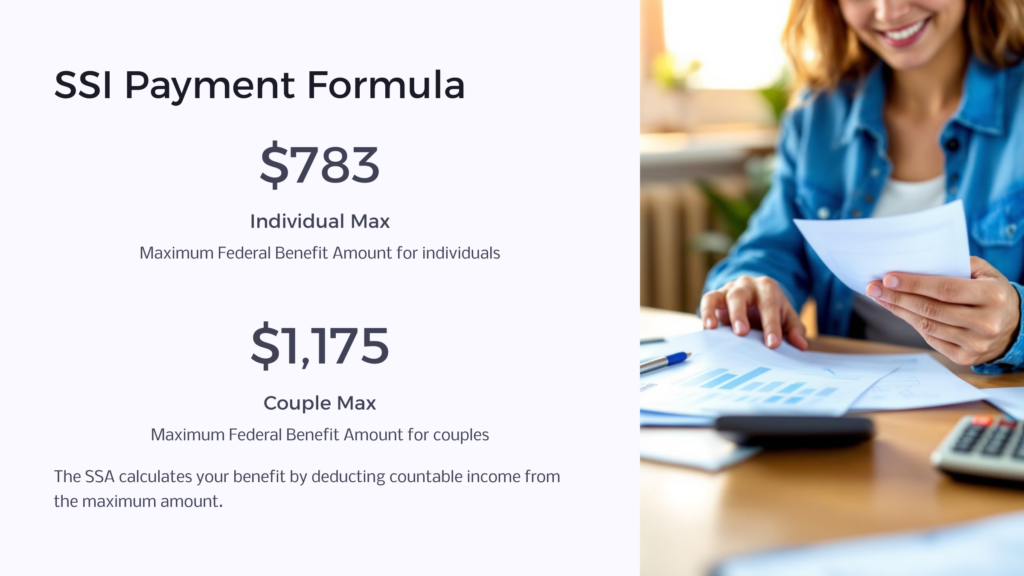
- Maximum Federal Benefit Rate (FBR): This is the maximum monthly SSI payment an individual or eligible couple can receive if they have no other countable income. The FBR is set annually by Congress and typically adjusts with cost-of-living increases. For 2024, the FBR is $943 for an individual and $1,415 for an eligible couple. This rate serves as the starting point for all calculations.
- Counting Income: Almost all income an individual receives is considered when calculating SSI benefits, but not all income is treated equally. The SSA distinguishes between various types of income (earned, unearned, in-kind) and applies specific exclusions and deductions.
- Resource Limits: Beyond income, the SSA also evaluates an individual’s resources – their assets and possessions. There are strict limits on how much an individual or couple can own to qualify for SSI, with specific exemptions for certain types of property.
- State Supplementary Payments: Many states provide an additional payment to the federal SSI benefit, known as a state supplementary payment. This can increase the total monthly benefit, but these payments are determined by individual states and vary widely.
The basic formula for calculating SSI is: Federal Benefit Rate (FBR) – Countable Income = Your Monthly SSI Benefit. This seemingly simple equation hides layers of detail regarding what constitutes “countable income.”
Deconstructing the Income Calculation: Every Dollar Counts (Differently)
The most complex aspect of SSI calculation lies in how the Social Security Administration assesses and counts an individual’s income. It’s not a straightforward dollar-for-dollar reduction; instead, a system of exclusions and deductions aims to provide incentives for work and account for basic needs.
Distinguishing Between Earned and Unearned Income
The SSA categorizes income into two primary types, each with its own set of rules for calculation:
- Earned Income: This is money received from wages, net earnings from self-employment, honoraria, and sheltered workshop payments. The SSA wants to encourage work, so a significant portion of earned income is disregarded.
- Unearned Income: This includes virtually all other types of income. Common examples are Social Security benefits (SSDI, retirement, survivor), pensions, annuities, unemployment benefits, veterans’ benefits, workers’ compensation, interest, dividends, rental income, cash gifts, and support payments (e.g., alimony, child support). Unearned income generally has a greater impact on SSI benefits than earned income.
The Income Exclusions: What Doesn’t Count
Not every dollar an individual receives is counted against their FBR. The SSA provides several key income exclusions:
- General Income Exclusion (GIE): The first $20 of most income received in a month, whether earned or unearned, is generally disregarded. This means the first $20 of unearned income, or the first $20 of earned income (if no unearned income is received), is not counted.
- Earned Income Exclusion (EIE): This is a significant incentive for SSI recipients to work. After the $20 GIE (if applied to earned income), the SSA disregards an additional $65 of earned income, plus half of the remaining earned income.
- Example: If you earn $400 in a month and have no other income:
- $400 (Gross Earnings)
- -$20 (General Income Exclusion) = $380
- -$65 (Earned Income Exclusion) = $315
- Divide by 2 (50% of remaining earned income) = $157.50
- Your countable earned income is $157.50.
- Example: If you earn $400 in a month and have no other income:
- Other Exclusions: Various other types of income are partially or entirely excluded, including:
- Food Stamp (SNAP) benefits.
- Housing assistance from federal programs.
- The value of irregular or infrequent income (up to $30 per quarter for unearned, $60 per quarter for earned).
- Certain educational grants, scholarships, and fellowships.
- Portions of certain government benefits based on need.
- Certain infrequent gifts or inheritances.
How Income Affects Your Benefit
Once all exclusions and deductions are applied, the remaining amount is your “countable income.” This countable income is then subtracted dollar-for-dollar from the Federal Benefit Rate (FBR) to determine your monthly SSI payment.
Formula Review:
- Identify all gross income (earned and unearned).
- Apply the General Income Exclusion ($20).
- If you have unearned income, apply the $20 exclusion to it first.
- If you only have earned income, apply the $20 exclusion to it.
- Apply the Earned Income Exclusion ($65 + half of remaining earned income) to your earned income after the GIE.
- Add any remaining countable unearned income to your countable earned income. This is your total countable income.
- Subtract your total countable income from the Federal Benefit Rate (FBR).
- FBR – Total Countable Income = Monthly SSI Benefit.
Scenario Example (Individual FBR $943):
- Case A: No Income
- Countable Income = $0
- SSI Benefit = $943 – $0 = $943
- Case B: Unearned Income Only (e.g., $200 SSDI benefit)
- $200 (Unearned Income)
- -$20 (General Income Exclusion) = $180
- Countable Unearned Income = $180
- SSI Benefit = $943 – $180 = $763
- Case C: Earned Income Only (e.g., $400 wages)
- $400 (Earned Income)
- -$20 (General Income Exclusion) = $380
- -$65 (Earned Income Exclusion) = $315
- Divide by 2 (50% of remaining earned income) = $157.50
- Countable Earned Income = $157.50
- SSI Benefit = $943 – $157.50 = $785.50
- Case D: Both Earned and Unearned Income (e.g., $200 SSDI + $400 wages)
- Unearned Income Calculation:
- $200 (SSDI)
- -$20 (GIE applied to unearned first) = $180
- Countable Unearned Income = $180
- Earned Income Calculation:
- $400 (Wages)
- (No GIE left, as it was used for unearned income)
- -$65 (Earned Income Exclusion) = $335
- Divide by 2 = $167.50
- Countable Earned Income = $167.50
- Total Countable Income: $180 (unearned) + $167.50 (earned) = $347.50
- SSI Benefit = $943 – $347.50 = $595.50
- Unearned Income Calculation:
As these examples illustrate, the impact of earned income is less severe than unearned income due to the more generous exclusions, underscoring the SSA’s policy to encourage work when possible.
Navigating Resource Limits: What You Own Matters
Beyond income, the SSA also scrutinizes an applicant’s resources – the assets they own and control. Having resources above certain limits will lead to ineligibility for SSI, regardless of income.
Defining Countable Resources
Resources are essentially anything an individual owns that could be converted to cash to pay for food or shelter. This includes, but is not limited to:
- Cash on hand.
- Money in bank accounts (checking, savings, CDs).
- Stocks, bonds, mutual funds.
- Real property (land, buildings) other than the primary residence.
- Certain life insurance policies.
- Vehicles (with specific exceptions).
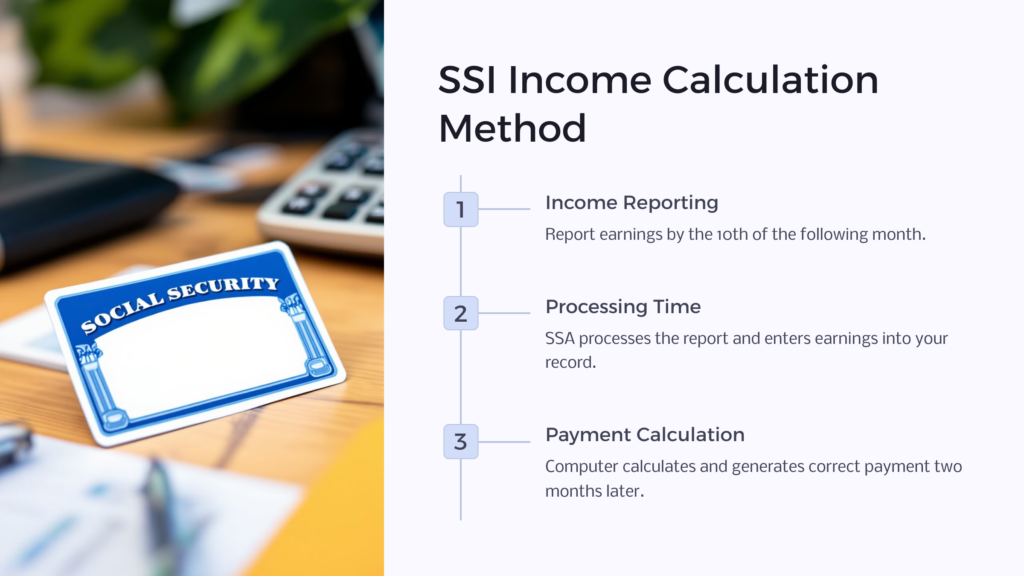
The current resource limits are:
- $2,000 for an individual.
- $3,000 for an eligible couple.
If an individual or couple’s countable resources exceed these limits at any point during a month, they are generally ineligible for SSI benefits for that month.
Key Resource Exclusions: What Doesn’t Count Towards the Limit
Just as with income, the SSA provides crucial exclusions for certain types of resources, recognizing that some assets are essential for daily living or future security:
- Primary Residence: The home you live in and the land it’s on, regardless of value, is typically excluded.
- One Vehicle: One vehicle is excluded regardless of its value, provided it is used by the individual or a member of their household for transportation. This means even a luxury car will not count against the resource limit.
- Household Goods and Personal Effects: Furniture, appliances, clothing, jewelry, and other personal items are generally excluded.
- Life Insurance: Term life insurance policies are excluded. Whole life insurance policies are excluded if their total face value for all policies owned by an individual does not exceed $1,500. If the face value exceeds $1,500, only the cash surrender value above a certain threshold counts.
- Burial Funds/Plots: Up to $1,500 designated for burial expenses per person (if kept separate from other funds) and the value of burial plots are excluded.
- Property Essential for Self-Support: Tools, equipment, or business property used for self-employment can be excluded under certain conditions.
- ABLE Accounts: Funds in an Achieving a Better Life Experience (ABLE) account, up to certain limits, are excluded. These accounts allow eligible individuals with disabilities to save money without losing their eligibility for SSI or other government benefits.
- Retroactive SSI or Social Security Payments: These are excluded for nine months following receipt.
The Impact of Exceeding Resource Limits
Exceeding the resource limit results in immediate ineligibility for SSI benefits. The SSA expects individuals to “spend down” their excess resources on non-countable items (e.g., paying off debt, home repairs, buying an excluded vehicle) to fall back within the limits. If this is done within a specified period, benefits may be reinstated. Failure to do so can lead to benefit suspension or termination, and potentially overpayments if benefits were received while resources were above the limit.
Special Circumstances and Additional Considerations
Beyond the core income and resource calculations, several other factors can significantly influence an individual’s SSI benefit amount, reflecting diverse living situations and needs.
Living Arrangements and Their Impact
An individual’s living arrangement can directly affect their SSI benefit, primarily through a concept called “In-Kind Support and Maintenance” (ISM). If someone else pays for or provides food or shelter, the SSA considers this to be ISM and may reduce the SSI benefit.
- Living Alone/Paying Your Own Way: If an individual lives alone and pays for all their food and shelter, they typically receive the full FBR (minus any countable income).
- Living with Others/ISM: If an individual lives in another person’s household and receives food and shelter from them, the SSA may apply the “One-Third Reduction Rule” (OTR). This rule automatically reduces the FBR by one-third, regardless of the actual value of the support received. Alternatively, if the individual receives ISM but the OTR does not apply, the “Presumed Maximum Value” (PMV) rule might be used, which reduces the FBR by up to one-third plus $20. This complexity makes accurate reporting of living arrangements crucial.
- Institutionalized Individuals: If an individual is residing in a medical facility (hospital, nursing home) where Medicaid is paying more than half the cost of care, their SSI benefit is generally reduced to a maximum of $30 per month (the Personal Needs Allowance).
State Supplementary Payments: An Added Layer of Support
While SSI is a federal program, many states choose to provide an additional “state supplementary payment” on top of the federal benefit. These state supplements vary significantly by state and can depend on factors like living arrangements, specific disability, or age. Some states administer these payments directly, while others have the SSA administer them on their behalf. It is crucial for applicants to check their state’s specific rules, as these supplements can substantially increase the total monthly benefit.
Impairment-Related Work Expenses (IRWE) and Blind Work Expenses (BWE)
To further encourage employment for individuals with disabilities, the SSA allows for certain work-related expenses to be deducted from earned income before calculating countable income.
- Impairment-Related Work Expenses (IRWE): These are costs for items or services that are necessary for an individual to work because of their impairment. Examples include specialized transportation, adaptive equipment, personal attendant services, certain medications, or medical devices. IRWEs are deducted from earned income.
- Blind Work Expenses (BWE): These are similar to IRWEs but apply specifically to individuals who are blind. BWEs include any expenses incurred to earn income due to blindness, such as guide dog expenses, specialized equipment, transportation to and from work, and even federal, state, and local income tax. Unlike IRWEs, BWEs are deducted from earned income before applying the $20 and $65 exclusions, making them even more beneficial.
These deductions highlight the SSA’s effort to support employment for disabled and blind individuals by reducing the financial penalty of working.
Managing Your SSI Benefits and Future Planning
Receiving SSI is not a static event; it requires ongoing engagement and careful financial management. Understanding your responsibilities and options is key to maintaining eligibility and making the most of your benefits.
Reporting Changes to the SSA
One of the most critical responsibilities of an SSI recipient is to promptly report any changes in their circumstances to the Social Security Administration. Failure to do so can lead to serious consequences, including overpayments or even benefit termination. Changes to report include:
- Income: Any change in earned or unearned income.
- Resources: If your bank account balance or other assets increase above the resource limit.
- Living Arrangements: Moving, changes in who you live with, or changes in who pays for your food and shelter.
- Marital Status: Getting married or divorced.
- Disability Status: Improvement in your medical condition or return to work.
- Absence from the U.S.: If you leave the country for 30 consecutive days or more.
Timely reporting helps the SSA ensure you receive the correct benefit amount and avoid costly overpayments.
Overpayments and Underpayments
An overpayment occurs when the SSA pays you more SSI than you were due. This can happen if you don’t report changes promptly, if the SSA makes an administrative error, or if you provide incorrect information. The SSA will typically seek to recover overpayments, often by withholding a portion of future benefits. Recipients have the right to appeal an overpayment decision or request a waiver if they believe they were not at fault or cannot afford to repay.
An underpayment occurs when the SSA pays you less SSI than you were due. If an underpayment is identified, the SSA will issue the additional funds owed to you.

Financial Planning Around SSI
Living on SSI requires careful financial planning. The benefits are designed to cover basic needs, making budgeting essential. Individuals should:
- Create a detailed budget: Track all income and expenses to manage funds effectively.
- Understand work incentives: Explore programs like the Plan to Achieve Self-Support (PASS) or the Ticket to Work program, which allow individuals to set aside income or resources for specific work goals without impacting their SSI benefits. These programs are designed to help SSI recipients achieve financial independence.
- Be aware of the “cliff effect”: Increasing income can sometimes lead to a sharp reduction or loss of benefits, including Medicaid eligibility, which is often tied to SSI. Understanding how different income levels affect benefits is vital for making informed decisions about working.
- Seek professional advice: A financial planner specializing in government benefits or disability planning can provide invaluable guidance on structuring finances, managing resources, and navigating complex rules to maximize well-being while maintaining eligibility.
In conclusion, understanding how SSI is calculated is a powerful tool for financial empowerment. While the system has its complexities, grasping the core principles of income and resource assessment, knowing about key exclusions, and staying diligent in reporting changes can ensure that this critical safety net remains available to those who need it most, facilitating greater financial stability and peace of mind.
aViewFromTheCave is a participant in the Amazon Services LLC Associates Program, an affiliate advertising program designed to provide a means for sites to earn advertising fees by advertising and linking to Amazon.com. Amazon, the Amazon logo, AmazonSupply, and the AmazonSupply logo are trademarks of Amazon.com, Inc. or its affiliates. As an Amazon Associate we earn affiliate commissions from qualifying purchases.