
For millions of Americans, Social Security represents a cornerstone of their financial future, particularly in retirement. Yet, understanding the intricacies of this vital program and accurately estimating the benefits one is entitled to can often feel like navigating a labyrinth. This is where a Social Security calculator becomes an indispensable tool. Far more than a simple number-cruncher, it’s a powerful instrument for strategic financial planning, enabling individuals to peer into their retirement future and make informed decisions today.
In an era where economic uncertainty and evolving financial landscapes are the norm, clarity about one’s future income streams is paramount. A reliable Social Security calculator demystifies the complex formulas used by the Social Security Administration (SSA), providing personalized estimates that can shape everything from retirement age decisions to overall savings strategies. This article will delve into the profound utility of these calculators, explore the factors that influence your benefits, and guide you on how to leverage this tool to build a more secure financial tomorrow.
Understanding Your Social Security Benefits: More Than Just a Number
Social Security isn’t just an abstract government program; it’s a commitment to provide a safety net for retirees, the disabled, and survivors. Grasping its fundamental principles is the first step toward effectively planning your financial future.
The Foundation: How Social Security Works
At its core, Social Security is a pay-as-you-go system. Current workers and their employers contribute a percentage of their earnings (through FICA taxes) into the system, and these contributions fund the benefits paid to current retirees, survivors, and disabled individuals. To qualify for retirement benefits, you generally need to accumulate 40 work credits, which translates to 10 years of work. The amount of your benefit is primarily based on your average indexed monthly earnings (AIME) during your 35 highest-earning years. This indexing adjusts past earnings to account for changes in the national average wage level, ensuring your past contributions retain their relative value over time. While the system appears straightforward, the calculation of individual benefits involves several variables that a calculator helps to simplify.
Why Estimating Your Benefits Matters
Accurate estimation of your Social Security benefits is not merely an academic exercise; it’s a critical component of comprehensive financial planning. Firstly, it allows you to project a significant portion of your retirement income, helping you determine if you’re on track to meet your post-work financial goals. Without this estimate, you might overestimate or underestimate your future income, leading to either insufficient savings or missed opportunities to save more aggressively.
Secondly, it informs crucial decisions, such as when to claim your benefits. Claiming early, at age 62, results in a permanently reduced monthly benefit, while waiting until your Full Retirement Age (FRA)—typically between 66 and 67, depending on your birth year—secures your standard benefit. Delaying beyond your FRA, up to age 70, can further increase your monthly payment by a significant percentage each year. A calculator allows you to model these different scenarios, comparing the total cumulative benefits over your projected lifespan, thus empowering you to choose the claiming strategy that best aligns with your financial needs and longevity expectations. Ultimately, an accurate estimate provides the clarity needed to construct a robust retirement plan, ensuring your golden years are financially comfortable.
The Mechanics of a Social Security Calculator
While the underlying actuarial science of Social Security is complex, a well-designed calculator streamlines the process, making it accessible and actionable for the average user. Understanding what goes into these calculators and how to interpret their outputs is key to maximizing their utility.
Key Inputs: What Information Do You Need?
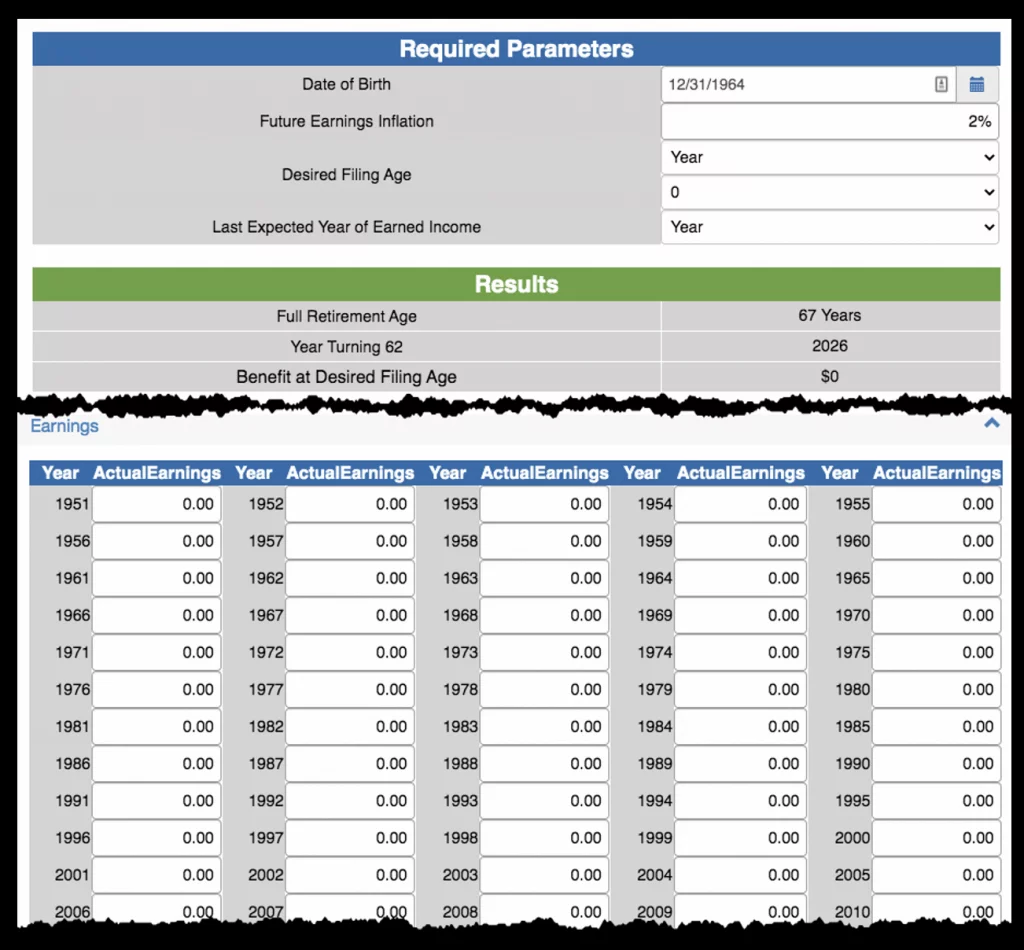
To generate a personalized and accurate estimate, a Social Security calculator requires specific pieces of information. The most crucial input is your date of birth, which determines your Full Retirement Age (FRA) and the range of ages you can claim benefits. Next, your earnings history is paramount. The most reliable calculators will either integrate directly with your Social Security online account or ask you to manually input your annual earnings from your Social Security statement. This data is fundamental because your benefit amount is directly tied to your 35 highest-earning years.
Other important inputs include your desired retirement age (e.g., 62, 66, 70), your marital status, and information about your spouse (if applicable, for potential spousal or survivor benefits). Some advanced calculators might also ask about your anticipated future earnings, which can significantly impact estimates if you’re still several years away from retirement. Providing precise information for these inputs ensures the calculator can produce the most reliable projections possible.
Output Interpretation: What Do the Numbers Mean?
Once you’ve fed the calculator your data, it will typically present a range of estimates. The most common output will be your estimated monthly benefit at different claiming ages: specifically, at age 62 (the earliest eligibility), at your Full Retirement Age (FRA), and at age 70 (the latest you can delay for maximum individual benefit). These estimates are usually presented in today’s dollars, meaning they haven’t been adjusted for future inflation, which is an important consideration for long-term planning.
Additionally, many calculators will show estimates for spousal benefits (if applicable), which can be up to 50% of the primary earner’s full retirement age benefit. Some may also project survivor benefits for your dependents. It’s crucial to understand that these numbers are estimates and not guarantees. They are based on current law and your projected earnings. Interpreting these outputs involves not just looking at the largest number but understanding the trade-offs between claiming earlier for a reduced benefit versus waiting for a larger payment, and how these figures integrate with your other retirement income streams.
Where to Find Reliable Calculators
For the most accurate and authoritative estimates, the Social Security Administration (SSA) website is the gold standard. Their “my Social Security” account portal offers personalized estimates based on your actual earnings record, not just projections. Beyond the SSA, numerous reputable financial planning websites and investment firms offer their own Social Security calculators. When choosing a third-party calculator, ensure it’s from a trusted source, transparent about its methodologies, and requires comprehensive data inputs to produce reliable results. Avoid calculators that promise overly optimistic figures or require minimal information, as these are less likely to provide accurate, actionable insights.
Navigating the Variables: Factors Influencing Your Benefits
The final amount you receive from Social Security is not a fixed sum; it’s the culmination of several dynamic factors, each playing a significant role in shaping your monthly benefit. A comprehensive understanding of these variables is essential for anyone utilizing a calculator.
Earnings History: The Core Driver
Your lifetime earnings record is arguably the most critical determinant of your Social Security benefits. The SSA calculates your Average Indexed Monthly Earnings (AIME) based on your 35 highest-earning years, adjusted for inflation. If you have fewer than 35 years of earnings, zero-earning years will be included in the calculation, effectively reducing your average. This highlights the importance of consistent employment and earning as much as possible, particularly during your peak earning years. Higher lifetime earnings translate directly into a higher AIME and, consequently, a larger monthly benefit. Regularly reviewing your Social Security statement (available via your “my Social Security” account) to check for any discrepancies in your earnings record is a proactive step that can prevent errors from diminishing your future benefits.

Retirement Age: The Crucial Decision
When you decide to claim your Social Security benefits is one of the most impactful decisions you’ll make regarding your retirement income. Your Full Retirement Age (FRA) is the age at which you are entitled to 100% of your primary insurance amount (PIA). This age varies depending on your birth year, typically ranging from 66 to 67.
- Early Claiming (Age 62-FRA): You can claim benefits as early as age 62, but your monthly benefit will be permanently reduced. The reduction can be as much as 30% if you claim at 62 and your FRA is 67.
- Delayed Claiming (FRA-Age 70): For each year you delay claiming past your FRA, up to age 70, your monthly benefit increases by a certain percentage, known as “delayed retirement credits.” These credits can boost your benefit by 8% per year (for those born in 1943 or later), potentially resulting in a benefit up to 32% higher than your FRA benefit.
A Social Security calculator is invaluable here, allowing you to compare the cumulative lifetime benefits of various claiming ages, factoring in different life expectancy assumptions.
Spousal and Survivor Benefits
Social Security also provides crucial benefits for spouses and survivors. If you are married, your spouse may be eligible for benefits based on your work record, even if they have little to no earnings history themselves. A spouse can receive up to 50% of your full retirement age benefit. If your spouse passes away, you may be eligible for survivor benefits, which can be up to 100% of your deceased spouse’s benefit. Special rules apply to divorced spouses, children, and disabled adult children. Understanding these provisions is vital for comprehensive family financial planning, as they can significantly enhance household income during retirement or in the event of a spouse’s death. Many advanced Social Security calculators include options to project these benefits, providing a fuller picture of your family’s potential entitlements.
Other Considerations: Taxation and Work Limits
It’s also important to factor in how Social Security benefits interact with other aspects of your financial life. Your benefits may be taxable if your “provisional income” (which includes adjusted gross income, tax-exempt interest, and 50% of your Social Security benefits) exceeds certain thresholds. Up to 85% of your Social Security benefits could be subject to federal income tax, depending on your income level.
Furthermore, if you claim benefits before your Full Retirement Age and continue to work, your benefits may be temporarily reduced or withheld due to the earnings test. For example, in 2024, if you are under FRA, the SSA deducts $1 from your benefits for every $2 you earn above a certain limit ($22,320). In the year you reach FRA, the deduction is $1 for every $3 earned above a higher limit ($59,520 in 2024), only for earnings before the month you reach FRA. Once you reach FRA, the earnings limit no longer applies, and you can earn as much as you want without affecting your benefits. A good Social Security calculator will often factor in these potential reductions or provide guidance on how they might impact your net benefit.
Leveraging Your Calculator for Strategic Retirement Planning
A Social Security calculator is not just a tool for prediction; it’s a strategic asset that empowers you to mold your retirement future proactively. By running various scenarios, you can refine your claiming strategy and integrate Social Security seamlessly into your broader financial plan.
Scenario Planning: Early vs. Late Retirement
One of the calculator’s most powerful features is its ability to model different retirement scenarios. For example, you can compare the long-term financial implications of claiming benefits at 62 versus waiting until your Full Retirement Age, or even delaying until 70. This exercise often reveals significant differences in cumulative lifetime benefits. While claiming early provides immediate income, the reduced monthly payment can lead to substantially less money over a long retirement. Conversely, delaying can offer a higher monthly income, which can be particularly advantageous if you anticipate a long lifespan or have other income sources to bridge the gap until your delayed claim. By visualizing these trade-offs, you can make a decision that aligns with your health expectations, financial needs, and risk tolerance.
Integrating Social Security with Other Retirement Savings
Social Security is rarely the sole source of retirement income; it’s typically one leg of a three-legged stool, alongside personal savings (401(k)s, IRAs) and potentially pensions. A calculator helps you understand how your estimated Social Security benefits fit into this holistic picture. If your projected benefits cover only a fraction of your anticipated retirement expenses, it underscores the need to increase contributions to your other savings vehicles. Conversely, a robust Social Security benefit might allow for a slightly more conservative withdrawal strategy from your personal savings, helping those funds last longer. By combining your Social Security estimates with projections from your other retirement accounts, you can build a comprehensive budget for your golden years.
Identifying Gaps and Adjusting Your Strategy
The act of calculating your benefits can often highlight potential shortfalls in your retirement plan. If the estimated Social Security income, combined with your other savings, falls short of your desired lifestyle expenses, it’s an immediate signal to adjust your strategy. This might involve increasing your current savings rate, exploring opportunities for online income or side hustles in retirement, considering a partial retirement, or re-evaluating your anticipated retirement expenses. The calculator transforms from a mere estimation tool into a diagnostic instrument, helping you identify financial gaps early enough to take corrective action and ensure a more secure and comfortable retirement.
Beyond the Calculator: Proactive Steps for Maximizing Your Benefits
While a Social Security calculator provides invaluable insights, the journey to maximizing your retirement benefits extends beyond simply inputting numbers. Proactive engagement with your Social Security record and a keen awareness of program updates can further strengthen your financial outlook.
Reviewing Your Earnings Record Annually
Perhaps one of the most overlooked yet critical steps in managing your Social Security benefits is to regularly review your earnings record. You can do this by creating and accessing your “my Social Security” account on the official SSA website. Your earnings record is the foundation upon which your future benefits are calculated. Errors, such as missing earnings from a past employer or incorrect wage reporting, can directly reduce your eventual benefit. By checking your statement annually, you can identify and correct any discrepancies promptly, ensuring that every dollar you’ve contributed to the system is accurately accounted for. This simple, proactive measure can prevent significant financial losses in retirement.
Understanding Cost-of-Living Adjustments (COLAs)
Social Security benefits are designed to maintain their purchasing power over time through annual Cost-of-Living Adjustments (COLAs). These adjustments are based on the Consumer Price Index for Urban Wage Earners and Clerical Workers (CPI-W) and are typically announced in October for the following year. While your calculator provides estimates in today’s dollars, it’s important to understand that your actual benefits will likely increase over your retirement due to COLAs. Keeping an eye on these adjustments and understanding how they are calculated provides further insight into the long-term value of your benefits and how they adapt to inflation. While a calculator might not predict future COLAs, knowing they exist offers an additional layer of reassurance about your long-term income stability.

Seeking Professional Financial Advice
For many, Social Security claiming strategies can be complex, especially when factors like spousal benefits, taxation, earnings limits, or specific health considerations come into play. This is particularly true for couples who need to coordinate their claiming decisions for optimal household benefits. In such intricate situations, seeking guidance from a qualified financial advisor specializing in retirement planning can be highly beneficial. An advisor can provide personalized recommendations based on your unique financial situation, risk tolerance, and life expectancy, potentially uncovering strategies that a standard calculator might not explicitly highlight. They can help integrate your Social Security plan with your broader investment, tax, and estate planning, ensuring a truly comprehensive approach to your retirement future.
In conclusion, a Social Security calculator is an indispensable financial tool that empowers individuals to take control of their retirement planning. By accurately estimating future benefits, understanding the impact of various claiming ages, and integrating these projections into a holistic financial strategy, you can build a more secure and predictable financial future. Beyond the calculations, proactive engagement with your earnings record and a willingness to seek expert advice further solidify your path to a comfortable and worry-free retirement.
aViewFromTheCave is a participant in the Amazon Services LLC Associates Program, an affiliate advertising program designed to provide a means for sites to earn advertising fees by advertising and linking to Amazon.com. Amazon, the Amazon logo, AmazonSupply, and the AmazonSupply logo are trademarks of Amazon.com, Inc. or its affiliates. As an Amazon Associate we earn affiliate commissions from qualifying purchases.