
For millions of Americans, Social Security isn’t just a government program; it’s a cornerstone of their financial security in retirement. It represents decades of hard work, contributions through payroll taxes, and a promise of support when you need it most. Yet, despite its profound importance, many individuals find themselves asking a fundamental question: “How much will I receive from Social Security?” The answer, as with many aspects of personal finance, isn’t a simple fixed figure. It’s a dynamic calculation influenced by a variety of personal factors, policy rules, and strategic decisions you make throughout your working life and as you approach retirement.
Understanding your potential Social Security benefits is more than just curiosity; it’s an essential component of comprehensive retirement planning. It allows you to project your income streams, assess potential gaps in funding, and make informed choices about your savings, investments, and even when you choose to stop working. This article will demystify the complexities of Social Security, guiding you through the critical factors that determine your benefit amount, how to estimate your future payments, and strategies to potentially maximize what you receive. By the end, you’ll have a clearer picture of this vital financial resource and its place in your overall financial well-being.
Understanding the Fundamentals of Social Security
Before delving into the specifics of how your benefit is calculated, it’s crucial to grasp the foundational principles that underpin the Social Security system. This framework ensures that benefits are distributed fairly and sustainably across generations.
The Pillars of Social Security: A Brief Overview
Social Security operates on a pay-as-you-go system, meaning that current workers’ contributions fund the benefits of current retirees, survivors, and individuals with disabilities. It’s not a personal savings account where your exact contributions are held for you; rather, it’s a social insurance program designed to provide a safety net. The program is primarily funded through dedicated payroll taxes, known as Federal Insurance Contributions Act (FICA) taxes, which are split between employees and employers (or paid entirely by self-employed individuals). These taxes are earmarked specifically for Social Security and Medicare.
Who is Eligible for Benefits?
Eligibility for Social Security benefits is tied directly to your work history and contributions. To qualify for retirement benefits, you generally need to have accumulated 40 “credits” of work. In 2024, you earn one credit for every $1,730 in earnings, up to a maximum of four credits per year. This means that, over your working lifetime, you need to have worked and paid Social Security taxes for approximately 10 years to be eligible for retirement benefits. Beyond retirement, Social Security also provides disability benefits for those unable to work due to a severe medical condition and survivor benefits for the families of deceased workers.
The Contribution System: How Your Earnings Translate to Benefits
The amount of FICA taxes you pay directly correlates with your earnings, up to an annual earnings limit (which is $168,600 in 2024). This limit means that earnings above this threshold are not subject to Social Security taxes, and consequently, do not count towards your benefit calculation. The system is progressive, meaning it replaces a higher percentage of pre-retirement earnings for lower-income workers than for higher-income workers, aiming to provide a basic level of income for all eligible individuals. Your contributions over your working life create an earnings record, which is the bedrock upon which your future benefits will be determined.
Factors Influencing Your Social Security Benefit Amount
Calculating your Social Security benefit is not an exact science you can do on the back of a napkin. The Social Security Administration (SSA) uses a complex formula that considers several key factors unique to your personal work history and decisions.
Your Earning Record: The Foundation of Your Benefit
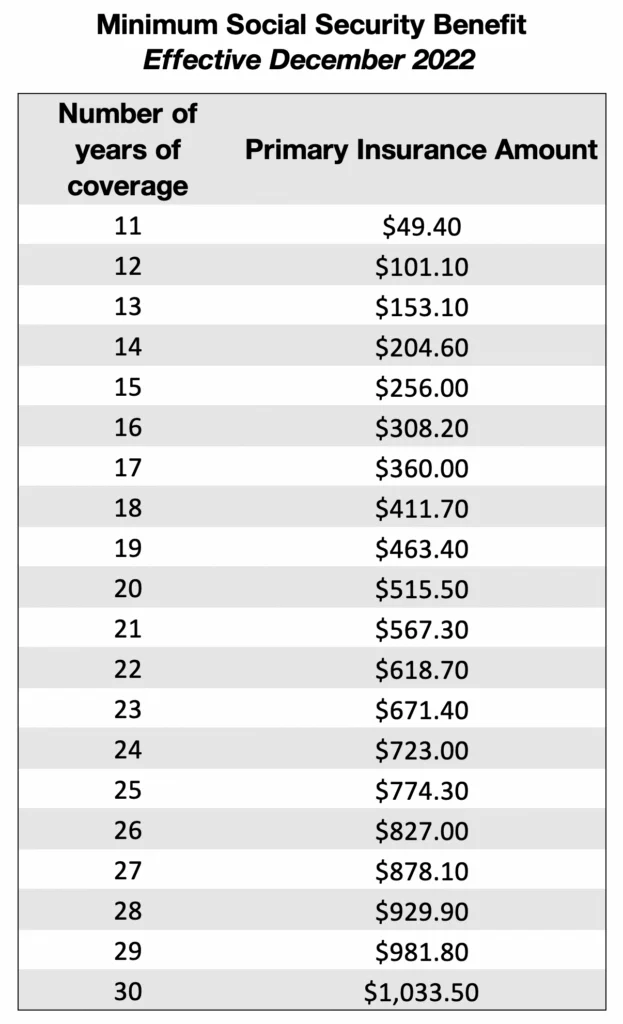
The most significant factor determining your Social Security benefit is your lifetime earnings history. The SSA calculates your Average Indexed Monthly Earnings (AIME) by taking your 35 highest-earning years, adjusting these past wages for inflation to reflect their value in today’s economy, summing them, and then dividing by 420 (the number of months in 35 years). If you have fewer than 35 years of earnings, the missing years are counted as zero, which can significantly lower your average. This AIME is then used in a progressive formula to determine your Primary Insurance Amount (PIA). The PIA is the benefit you would receive if you claim exactly at your Full Retirement Age.
The “Full Retirement Age” (FRA) Defined
Your Full Retirement Age (FRA) is the age at which you are entitled to receive 100% of your PIA. This age is not universal; it depends on your birth year. For those born in 1943 through 1954, FRA is 66. It gradually increases for those born between 1955 and 1960, reaching age 67 for anyone born in 1960 or later. Understanding your FRA is crucial because it acts as the baseline for calculating adjustments if you choose to claim benefits earlier or later.
The Impact of Claiming Age: Early vs. Delayed Retirement
When you decide to start receiving benefits has a profound and permanent impact on your monthly payment.
- Claiming Early: You can begin receiving Social Security retirement benefits as early as age 62. However, claiming before your FRA results in a permanent reduction in your monthly benefit. The reduction is approximately 5/9 of 1% for each month before FRA, up to 36 months, and then 5/12 of 1% for each month beyond 36 months. This can lead to a reduction of up to 30% if you claim at 62 when your FRA is 67.
- Delaying Retirement: Conversely, if you delay claiming benefits past your FRA, you can earn Delayed Retirement Credits (DRCs). These credits increase your monthly benefit by 2/3 of 1% for each month you delay, up to age 70. This translates to an 8% annual increase. By delaying to age 70, you could increase your monthly benefit by 24% to 32% compared to your FRA benefit, depending on your FRA. These increases are permanent and can significantly boost your lifetime benefits.
Spousal and Survivor Benefits: Expanding the Safety Net
Social Security isn’t just for individual workers; it also provides benefits for spouses, divorced spouses, and survivors of eligible workers.
- Spousal Benefits: If your spouse is eligible for Social Security, you may be able to claim a benefit based on their work record. This spousal benefit can be up to 50% of your spouse’s full retirement age benefit. You can only claim spousal benefits if your own benefit, based on your work record, is less than the spousal benefit.
- Survivor Benefits: If your spouse dies, you may be eligible for survivor benefits. A surviving spouse can receive up to 100% of the deceased worker’s basic Social Security benefit, assuming they claim at their own full retirement age (or later). Dependent children and even dependent parents may also qualify for survivor benefits.
- Divorced Spousal Benefits: Even if you’re divorced, you may be eligible for benefits based on your ex-spouse’s work record, provided the marriage lasted at least 10 years, you are currently unmarried, and you are at least 62 years old.
Calculating Your Estimated Social Security Benefit
While the SSA performs the precise calculations, you don’t have to wait until retirement to get an estimate. The SSA provides excellent tools and resources to help you understand your potential future benefits.
Accessing Your Social Security Statement Online
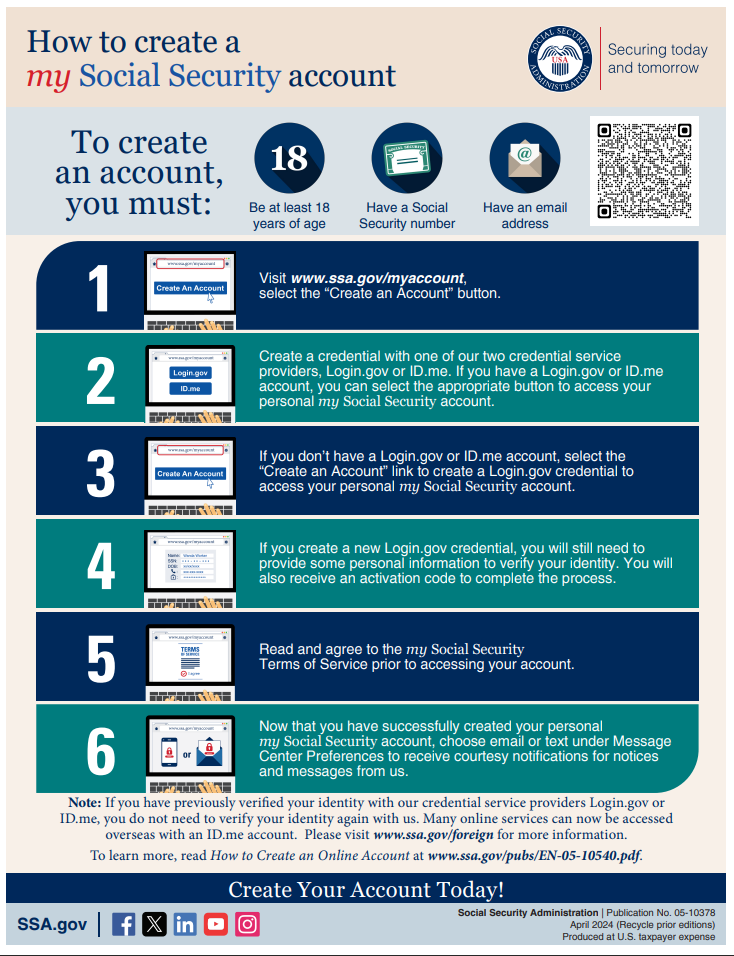
The most accurate and personalized estimate of your Social Security benefits comes directly from your Social Security Statement. You can create an account and access your statement online at the SSA website (www.ssa.gov). Your online statement provides:
- Your complete earnings history, which you should review for accuracy.
- Estimates of your retirement benefits at age 62, at your full retirement age, and at age 70.
- Estimates for disability benefits.
- Estimates for survivor benefits for your family.
This statement is an invaluable tool for retirement planning, offering a clear snapshot of your earned benefits based on your actual work record.
Using the Social Security Administration’s Online Calculators

The SSA also offers several online calculators that allow you to explore different claiming scenarios. These calculators are particularly useful for:
- Retirement Estimator: Provides personalized estimates based on your actual Social Security earnings record. You can input different retirement ages to see how your benefit changes.
- Benefit Calculators: More detailed calculators allow you to model various scenarios, such as the impact of working part-time in retirement or coordinating benefits with a spouse.
These tools are designed to be user-friendly and provide a good approximation of your future benefits, empowering you to experiment with different retirement timelines.
Understanding Your Primary Insurance Amount (PIA)
As mentioned, your Primary Insurance Amount (PIA) is the monthly benefit you would receive if you claim at your full retirement age. The SSA uses a three-part formula that applies different percentages to different segments of your AIME. These segments, called bend points, are adjusted annually. For instance, for someone who becomes eligible in 2024, the formula might be: 90% of the first $1,174 of AIME, plus 32% of AIME between $1,174 and $7,078, plus 15% of AIME over $7,078. This progressive structure is what ensures lower-income workers receive a higher percentage of their pre-retirement earnings. Your online statement will show your estimated PIA, which is the starting point for all other benefit calculations.
What to Do if Your Earnings Record is Incorrect
It is critically important to review your Social Security Statement annually, especially your earnings record. Errors can occur, such as incorrect reporting by an employer or a mistake in data entry. If you find any discrepancies, it’s essential to contact the SSA immediately to rectify them. You will likely need to provide documentation, such as W-2 forms or tax returns, to prove your correct earnings. Correcting errors in your earnings record ensures that your future benefits are calculated accurately, reflecting all your contributions to the system.
Strategizing for Maximizing Your Social Security Benefits
While your earnings history is largely fixed, you do have significant control over how and when you claim your Social Security benefits, which can dramatically impact the total amount you receive over your lifetime. Strategic planning can lead to thousands of dollars in additional benefits.
The Benefits of Delaying Claims Beyond FRA
Delaying the start of your Social Security benefits is often one of the most powerful strategies to maximize your monthly payment. As discussed, for every year you delay past your Full Retirement Age up to age 70, your benefit increases by 8%. This guaranteed 8% annual return is a compelling reason for many to consider delaying, especially if they are in good health and have other retirement income sources.
- Increased Monthly Income: A higher monthly payment provides more financial security, particularly valuable in later retirement stages when other savings might dwindle.
- Inflation Protection: Social Security benefits are typically adjusted annually for inflation through Cost-Of-Living Adjustments (COLAs). A higher starting benefit means a higher base for these COLAs, providing better protection against rising costs over time.
- Spousal and Survivor Impact: Your claiming decision also impacts your spouse. If you have a higher earning record, delaying your benefits can increase the survivor benefit your spouse would receive if you pass away first.
Coordinating Benefits with a Spouse
For married couples, Social Security claiming strategies become more complex but also offer greater opportunities for optimization. Coordinated planning can significantly increase the couple’s combined lifetime benefits.
- Higher Earner Delays, Lower Earner Claims Early: A common strategy involves the higher-earning spouse delaying benefits until age 70 to maximize their payment (which also maximizes the potential survivor benefit). The lower-earning spouse might claim their benefits earlier, perhaps at their FRA or even age 62, to provide some income stream during the interim.
- “File and Suspend” (Now Limited): While the original “file and suspend” strategy was largely eliminated for new filers after April 2016, existing rules allow spouses to claim spousal benefits while their own benefit continues to grow if they were born before specific dates. Understanding these nuanced rules requires careful consideration or professional advice.
- Restricted Application: This strategy, available to those born before January 2, 1954, allows an individual to file a “restricted application” at their FRA to receive spousal benefits only, while their own worker benefit continues to accrue Delayed Retirement Credits until age 70.
The Role of Work While Receiving Benefits
If you claim Social Security benefits before your Full Retirement Age and continue to work, your benefits may be reduced if your earnings exceed certain limits.
- Earnings Limit Before FRA: In 2024, if you are under your FRA, the SSA will deduct $1 from your benefits for every $2 you earn above $22,320.
- Earnings Limit in the Year You Reach FRA: In the year you reach your FRA, the deduction rate is $1 for every $3 earned above a higher limit ($59,520 in 2024), but only for earnings before the month you reach FRA.
- No Earnings Limit at or After FRA: Once you reach your Full Retirement Age, there are no limits on how much you can earn, and your benefits will not be reduced due to work.
It’s important to note that any benefits withheld due to these earnings limits are not lost permanently. When you reach your FRA, your monthly benefit will be recalculated to account for the additional earnings and any withheld payments, effectively increasing your future checks.
Considering Taxation of Social Security Benefits
Another crucial aspect of maximizing your net Social Security benefits is understanding their taxation. Depending on your “combined income” (your adjusted gross income plus non-taxable interest plus one-half of your Social Security benefits), a portion of your Social Security benefits may be subject to federal income tax.
- Up to 50% Taxable: If your combined income is between $25,000 and $34,000 for an individual, or between $32,000 and $44,000 for a married couple filing jointly, up to 50% of your benefits may be taxable.
- Up to 85% Taxable: If your combined income exceeds $34,000 for an individual, or $44,000 for a married couple filing jointly, up to 85% of your benefits may be taxable.
Additionally, some states also tax Social Security benefits. Understanding these thresholds is important for tax planning, as it can influence your overall retirement income strategy and decisions about drawing from other retirement accounts.
Integrating Social Security into Your Broader Retirement Plan
While Social Security is a vital component of retirement income, it’s rarely sufficient on its own. A holistic approach to retirement planning ensures financial stability and comfort.
Social Security as a Foundation, Not the Entire House
For most individuals, Social Security benefits are designed to replace only about 40% of their pre-retirement income (less for higher earners). This means that relying solely on Social Security for retirement is often an insufficient strategy. It should be viewed as a foundational layer, providing a reliable baseline income, upon which you build with other savings and investments. The gap between your Social Security income and your desired retirement lifestyle needs to be filled through other means.
The Importance of Diversified Retirement Savings
To bridge this gap, a diversified approach to retirement savings is critical. This typically includes:
- Employer-Sponsored Plans: 401(k)s, 403(b)s, and 457 plans offer tax-advantaged ways to save, often with employer matching contributions that boost your savings significantly.
- Individual Retirement Accounts (IRAs): Traditional and Roth IRAs provide flexibility and additional tax benefits for retirement savings.
- Taxable Investment Accounts: For those who have maxed out their tax-advantaged accounts, regular brokerage accounts can provide additional growth potential.
- Other Assets: Real estate, annuities, or even a side business can contribute to your retirement income stream.
The goal is to create multiple income sources that, when combined with Social Security, provide the financial security you desire in retirement.
Consulting with a Financial Advisor
Given the complexities of Social Security rules, taxation, and overall retirement planning, consulting with a qualified financial advisor is highly recommended. A financial professional can:
- Help you analyze your specific situation and projections.
- Develop a personalized Social Security claiming strategy that aligns with your financial goals, health status, and other income sources.
- Integrate your Social Security strategy into your broader retirement and estate plans.
- Provide insights into tax-efficient withdrawal strategies from your various retirement accounts.
Their expertise can be invaluable in navigating these intricate decisions and maximizing your financial well-being throughout retirement.
Staying Informed About Future Changes
Social Security is a dynamic program, subject to ongoing legislative review and potential adjustments. While major changes are often debated extensively, it’s important to stay informed about any proposed modifications to benefit calculations, eligibility requirements, or funding mechanisms. Subscribing to updates from reliable financial news sources and the Social Security Administration itself can help you anticipate and adapt to any future changes that might impact your benefits. Proactive engagement with this information ensures that your retirement plans remain robust and adaptable to evolving circumstances.
Understanding “how much in my Social Security” is more than just knowing a number; it’s about comprehending a vital system and making informed decisions that will shape your financial future. By taking the time to learn about eligibility, calculation factors, and claiming strategies, and by integrating this knowledge into a comprehensive retirement plan, you can optimize your benefits and build a more secure financial foundation for your golden years.
aViewFromTheCave is a participant in the Amazon Services LLC Associates Program, an affiliate advertising program designed to provide a means for sites to earn advertising fees by advertising and linking to Amazon.com. Amazon, the Amazon logo, AmazonSupply, and the AmazonSupply logo are trademarks of Amazon.com, Inc. or its affiliates. As an Amazon Associate we earn affiliate commissions from qualifying purchases.