
Earning $100,000 a year is a significant financial milestone for many, often seen as a benchmark for comfortable living and financial stability. However, the direct translation of an annual salary into a monthly income isn’t as straightforward as simply dividing by twelve. While the gross calculation is simple arithmetic, the actual amount you’ll see hit your bank account each month, your net pay, is influenced by a myriad of factors including taxes, deductions, and personal choices. Understanding this distinction is crucial for effective personal finance management, budgeting, and long-term financial planning.
This article delves into the intricacies of a $100,000 annual salary, breaking down the numbers to reveal what it truly means for your monthly finances. We’ll explore the gross versus net income, the various deductions that impact your take-home pay, how to budget effectively with this income, and strategies for leveraging a six-figure salary to build lasting wealth.
The Simple Math: Gross Income Calculation
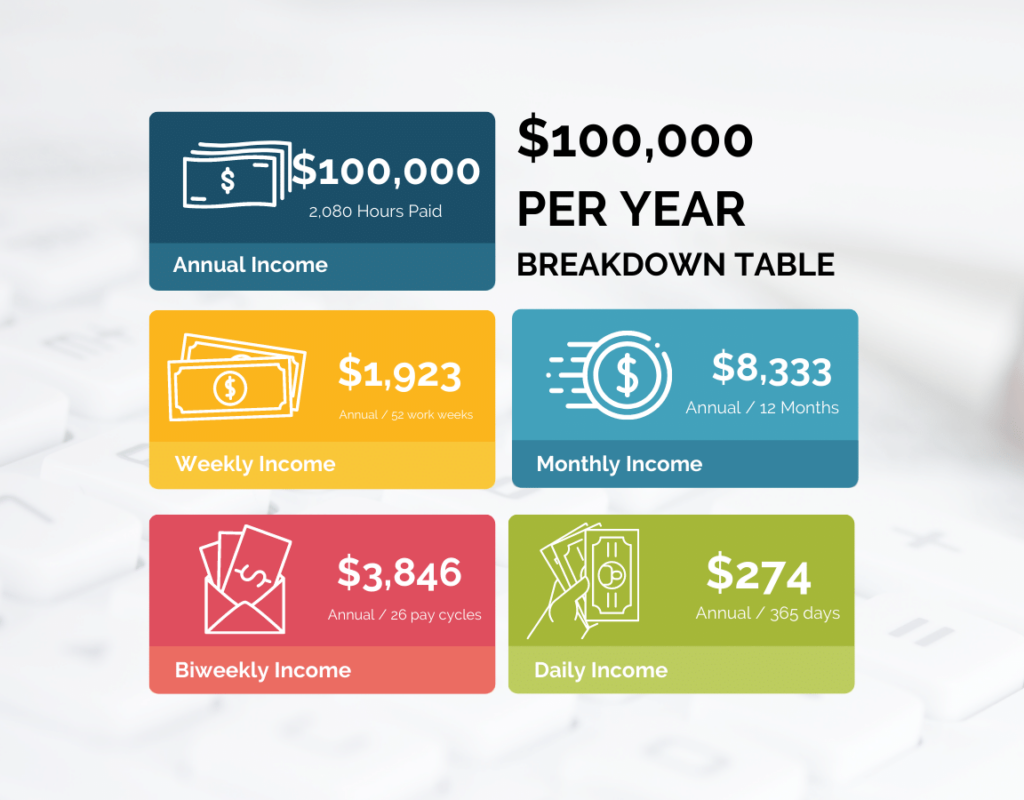
At its most basic, calculating how much $100,000 a year translates to per month involves a simple division. This is your gross monthly income – the amount you earn before any deductions are taken out.
Basic Monthly Breakdown
To find your gross monthly income from a $100,000 annual salary, you simply divide the annual figure by 12 months:
$100,000 / 12 months = $8,333.33 per month
This $8,333.33 represents the total income you earn from your primary employment each month before any withholdings. It’s the figure often cited when discussing salaries, but it’s important to remember that this is not the amount you will typically have available for spending.
Beyond the Obvious: Why Gross isn’t Net
The concept of gross income is fundamental, but its limitations in reflecting your true financial standing are equally important. Your gross income is merely the starting point. From this figure, various mandatory and voluntary deductions are subtracted, leading to your net income – the actual money deposited into your bank account. Ignoring this distinction can lead to significant budgeting errors and financial surprises. Understanding the gap between gross and net is the first step towards realistic financial planning and avoiding the common pitfall of overestimating your disposable income.
Decoding Your Net Paycheck: Taxes and Deductions
The primary reason why your gross monthly income differs significantly from your net pay is the array of taxes and deductions that are automatically withheld from each paycheck. These include federal, state, and local income taxes, as well as contributions to social security, Medicare, and often, employer-sponsored benefits.
Federal Income Tax Implications
The federal government levies income tax on your earnings, and this is typically the largest deduction from your gross pay. The U.S. operates on a progressive tax system, meaning different portions of your income are taxed at different rates. For a $100,000 annual salary, you won’t be taxed at a flat rate; instead, your income will fall into several tax brackets. The exact amount withheld depends on your filing status (single, married filing jointly, head of household) and the number of allowances claimed on your W-4 form. For instance, in 2023, a single individual earning $100,000 would see parts of their income taxed at 10%, 12%, and 22%, and 24%, after considering the standard deduction. This can easily amount to several thousand dollars per month in federal income tax alone.
State and Local Taxes: A Geographical Impact
Beyond federal taxes, many states and some localities also impose their own income taxes. These rates vary dramatically from state to state, with some states having no income tax at all (e.g., Texas, Florida, Washington, Nevada, South Dakota, Wyoming, Alaska) and others having progressive tax structures similar to the federal system (e.g., California, New York, Oregon). For example, someone earning $100,000 in California will face a significantly higher tax burden than someone in Texas. Furthermore, certain cities or counties may impose local income taxes, adding another layer of deduction. This geographical variable is crucial when comparing the real value of a $100,000 salary across different regions.
Payroll Deductions: Social Security, Medicare, and More
Known as FICA (Federal Insurance Contributions Act) taxes, Social Security and Medicare contributions are mandatory deductions from nearly every paycheck.
- Social Security: In 2023, employees contribute 6.2% of their earnings up to an annual limit ($160,200). For a $100,000 salary, this means $6,200 annually, or approximately $516.67 per month.
- Medicare: Employees contribute 1.45% of all earnings, with no income limit. For a $100,000 salary, this is $1,450 annually, or approximately $120.83 per month.
These deductions contribute to future retirement and healthcare benefits and are non-negotiable for most employees.
Pre-Tax Contributions: Retirement and Health Benefits
Many employers offer benefit programs that allow for pre-tax deductions, further reducing your taxable income and thus your overall tax burden.
- Retirement Contributions: Contributions to a 401(k), 403(b), or other employer-sponsored retirement plans are often made on a pre-tax basis. For example, if you contribute 10% of your $100,000 salary ($10,000 annually) to a 401(k), your taxable income for federal (and often state) purposes is reduced by that amount. This is a powerful tool for both saving and tax optimization.
- Health Insurance Premiums: If your employer deducts health, dental, or vision insurance premiums from your paycheck, these are typically pre-tax as well.
- Flexible Spending Accounts (FSAs) and Health Savings Accounts (HSAs): Contributions to these accounts for healthcare or dependent care expenses are also usually pre-tax, offering additional tax savings.
These pre-tax deductions lower your adjusted gross income (AGI), which in turn reduces the amount of federal and state income tax you owe. While they decrease your current net pay, they provide significant long-term financial benefits.
Considering all these deductions, it’s not uncommon for someone earning $100,000 annually to see their net monthly income fall somewhere between $5,500 and $7,000, depending heavily on their location, filing status, and benefit elections.
Understanding Your Spending Power: Cost of Living and Budgeting
Once you have a realistic understanding of your net monthly income, the next critical step is to evaluate your spending power relative to your cost of living. A $100,000 salary, while substantial, will feel very different in San Francisco compared to Omaha, Nebraska. Effective budgeting is paramount to maximize the value of your income.
Geographic Variations in Living Expenses
The purchasing power of a $100,000 salary varies dramatically depending on where you live.
- High Cost-of-Living Areas (HCOL): Cities like New York, San Francisco, Los Angeles, and Washington D.C. have significantly higher costs for housing, transportation, and even groceries. In these areas, a $100,000 salary might afford a modest apartment and require careful budgeting to cover all expenses, making it feel less like a “high income.”
- Medium Cost-of-Living Areas (MCOL): Cities like Atlanta, Dallas, Phoenix, or Denver offer a more balanced cost of living. A $100,000 salary here would likely provide a comfortable lifestyle, allowing for homeownership, savings, and discretionary spending.
- Low Cost-of-Living Areas (LCOL): Regions in the Midwest or South often boast lower housing costs and overall expenses. In these areas, a $100,000 salary could provide a luxurious lifestyle, significant savings potential, and the ability to achieve financial goals more rapidly.

Before making any major financial decisions, research the average cost of living in your specific area, including housing (rent or mortgage), utilities, groceries, transportation, and healthcare.
Crafting a Realistic Monthly Budget
With your estimated net monthly income and an understanding of your local cost of living, you can create a realistic and effective budget. A budget isn’t about restricting yourself; it’s about allocating your money intentionally to align with your financial goals and values.
- Track Your Spending: For a month or two, meticulously track every dollar you spend. This will reveal where your money is actually going versus where you think it’s going.
- Categorize Expenses: Group your spending into categories such as housing, utilities, groceries, transportation, debt payments, personal care, entertainment, and savings.
- Allocate Funds: Assign a specific amount of money to each category for the month. Be realistic – cutting back too severely often leads to failure.
- Review and Adjust: Budgets are not static. Life changes, and so should your budget. Regularly review your spending against your plan and make adjustments as needed.
Tools like budgeting apps (e.g., Mint, YNAB), spreadsheets, or even pen and paper can help you manage this process effectively.
The 50/30/20 Rule: A Guiding Principle
A popular and practical budgeting framework is the 50/30/20 rule, which suggests dividing your after-tax income as follows:
- 50% for Needs: This includes essential expenses like housing, utilities, groceries, transportation, insurance premiums, and minimum debt payments. For a net income of $6,000, this would be $3,000.
- 30% for Wants: This covers discretionary spending that enhances your quality of life but isn’t strictly necessary, such as dining out, entertainment, hobbies, vacations, and shopping. For a net income of $6,000, this would be $1,800.
- 20% for Savings & Debt Repayment: This crucial category includes contributions to your emergency fund, retirement accounts, investment portfolios, and paying down debt beyond the minimums. For a net income of $6,000, this would be $1,200.
While a $100,000 salary provides a solid foundation for this rule, you may need to adjust the percentages based on your specific location and financial goals. For instance, in a HCOL area, your “needs” might consume more than 50%, requiring you to reduce “wants” or find ways to increase your savings rate.
Leveraging a $100k Salary for Financial Growth
Earning $100,000 a year provides a robust platform for accelerating your financial growth and achieving long-term wealth. With careful planning and disciplined execution, you can transform this income into substantial assets.
Strategic Savings and Emergency Funds
A cornerstone of financial security is a fully funded emergency fund, typically three to six months’ worth of essential living expenses. With a $100,000 salary, you should aim to build this fund relatively quickly. Once your emergency fund is established, shift your focus to other strategic savings:
- Short-term Goals: Saving for a down payment on a house, a new car, or a significant vacation.
- Mid-term Goals: Education funding, home renovations, or starting a business.
- Automate Savings: Set up automatic transfers from your checking account to your savings accounts immediately after each payday. This “pay yourself first” approach ensures consistency.
Smart Investing for Long-Term Wealth
A $100,000 salary allows for significant contributions to investment vehicles, which are critical for long-term wealth accumulation.
- Maximize Retirement Accounts: Prioritize contributing to tax-advantaged accounts like your 401(k) (especially if there’s an employer match), IRA (Roth or traditional), and potentially an HSA if eligible. The compound interest generated over decades in these accounts can lead to millions in retirement savings.
- Diversified Portfolio: Invest in a diversified portfolio of low-cost index funds or ETFs that align with your risk tolerance and time horizon. Don’t try to time the market; instead, focus on consistent contributions and long-term growth.
- Brokerage Accounts: Once your tax-advantaged accounts are maxed out, consider opening a taxable brokerage account for additional investments.
Seek advice from a qualified financial advisor if you need help structuring your investment strategy.
Debt Management and Accelerated Paydown
While not all debt is bad (e.g., a low-interest mortgage), high-interest consumer debt (credit cards, personal loans) can severely hamper your financial progress. A $100,000 salary provides an excellent opportunity to eliminate such debt quickly.
- High-Interest Debt First: Prioritize paying off debts with the highest interest rates using strategies like the “debt snowball” or “debt avalanche” method.
- Student Loans: Develop a strategy for student loan repayment. Consider refinancing if it makes financial sense, or focus on paying extra towards the principal to reduce interest paid over the loan’s lifetime.
- Mortgage Paydown: Once other high-interest debts are cleared and your investments are on track, consider making extra payments on your mortgage to reduce interest costs and build equity faster.
Diversifying Income Streams
While your primary job provides the $100,000 salary, consider how you might diversify your income streams. This isn’t about needing more money to live, but about building additional security and accelerating wealth.
- Side Hustles: Explore opportunities to turn a hobby into a side business, freelance your skills, or engage in gig economy work.
- Passive Income: Invest in dividend stocks, real estate (rental properties or REITs), or create digital products that generate income with minimal ongoing effort.
- Skill Development: Continuously invest in your own skills and education to ensure your primary income stream remains strong and offers potential for future raises or career advancement.
The Broader Financial Picture: Is $100k a “Good” Salary?
The question of whether $100,000 a year is a “good” salary is subjective and depends entirely on individual circumstances, financial goals, and geographic location. However, by several objective measures, it certainly represents a strong financial position for many.
Benchmarking Against National Averages
Nationally, a $100,000 salary significantly exceeds the median household income in the United States, which was approximately $74,580 in 2022. This places you in a higher income bracket, suggesting greater financial flexibility and opportunity compared to the average American household. It often provides the means to comfortably cover essential expenses, save for retirement, and pursue discretionary spending without excessive financial stress.
Personal Financial Goals vs. Income Level
Ultimately, the “goodness” of a $100,000 salary is defined by how well it enables you to achieve your personal financial goals.
- Debt Freedom: Can you eliminate consumer debt, pay down student loans, and accelerate mortgage payments?
- Retirement Security: Are you able to contribute substantially to retirement accounts and be on track for your desired retirement lifestyle?
- Major Purchases: Can you save for a down payment on a home, a child’s education, or other significant life investments?
- Financial Independence: Is this income allowing you to build assets and passive income streams that could eventually support you without working?
If a $100,000 salary, combined with prudent financial management, allows you to confidently pursue these aspirations, then it is indeed a very good salary for your situation.
The Evolving Value of $100k Over Time
It’s also important to consider the evolving value of $100,000 over time due to inflation. What $100,000 could buy a decade ago is more than what it can buy today, and what it buys today will be more than what it buys a decade from now. This underscores the importance of not just earning a good salary, but also wisely investing and growing your money to maintain and increase your purchasing power over the long run. Regular salary reviews, skill development, and strategic career moves are vital to ensure your income keeps pace with or outpaces inflation and your rising cost of living.
In conclusion, while $100,000 a year translates to a gross monthly income of $8,333.33, your actual take-home pay will be notably less after taxes and deductions. However, this level of income, when managed strategically and coupled with diligent budgeting and smart investing, provides a powerful foundation for achieving substantial financial security and long-term wealth. Understanding these nuances is the key to truly unlocking the potential of a six-figure salary.
aViewFromTheCave is a participant in the Amazon Services LLC Associates Program, an affiliate advertising program designed to provide a means for sites to earn advertising fees by advertising and linking to Amazon.com. Amazon, the Amazon logo, AmazonSupply, and the AmazonSupply logo are trademarks of Amazon.com, Inc. or its affiliates. As an Amazon Associate we earn affiliate commissions from qualifying purchases.