
Navigating the landscape of disability benefits can be a daunting challenge, fraught with complex terminology, varying eligibility criteria, and intricate calculation methodologies. For individuals facing an inability to work due to illness or injury, understanding how these crucial financial lifelines are determined is not just an academic exercise – it’s a vital step in securing financial stability and peace of mind. Whether you’re considering applying, are already in the process, or simply planning for future contingencies, deciphering the calculations behind disability benefits is essential. This article will demystify the core components of how disability benefits are calculated across various programs, empowering you with the knowledge to better understand your potential entitlements.

Understanding Social Security Disability Benefits (SSDI & SSI)
The U.S. Social Security Administration (SSA) offers two primary federal disability programs: Social Security Disability Insurance (SSDI) and Supplemental Security Income (SSI). While both provide financial assistance to individuals with disabilities, their eligibility requirements and benefit calculation methods are distinct, catering to different financial and work history profiles.
Social Security Disability Insurance (SSDI)
SSDI is a benefit program designed for individuals who have worked for a significant period, paid Social Security taxes (FICA), and accumulated enough “work credits” to be insured. It operates much like an insurance policy, where your past contributions determine your future benefits. The calculation of SSDI benefits is primarily based on your average lifetime earnings, not on the nature or severity of your disability itself.
The SSA uses a formula to calculate your Primary Insurance Amount (PIA), which is the base amount of your monthly benefit. This formula involves determining your Average Indexed Monthly Earnings (AIME). The AIME is derived by taking your earnings from the years you worked, indexing them to account for changes in general wage levels over time, and then averaging the highest 35 years of these indexed earnings. Importantly, the indexing factor adjusts past earnings to reflect current wage levels, ensuring that your earliest contributions aren’t undervalued.
Once your AIME is established, the SSA applies a progressive formula using “bend points” to calculate your PIA. For example, a certain percentage (e.g., 90%) of the first segment of your AIME is added to a smaller percentage (e.g., 32%) of the next segment, and an even smaller percentage (e.g., 15%) of the remaining AIME. This progressive structure means that lower earners receive a higher percentage of their average earnings back as benefits compared to higher earners, though higher earners will still receive a larger absolute dollar amount.
Factors that can influence your SSDI benefit amount include your age at disability onset, your past earnings record, and whether you have eligible family members (spouse or minor children) who might also receive auxiliary benefits, subject to a family maximum limit. Unlike some other disability programs, SSDI benefits are not reduced by unearned income or assets, though earnings from work after disability onset are subject to specific rules (e.g., Substantial Gainful Activity or SGA limits).
Supplemental Security Income (SSI)
SSI is a needs-based program that provides financial assistance to low-income individuals who are aged, blind, or disabled, regardless of their work history. Unlike SSDI, you do not need to have paid Social Security taxes to qualify for SSI. The calculation of SSI benefits is simpler and is primarily determined by a Federal Benefit Rate (FBR) minus any “countable income” you receive.
The FBR is a standard monthly amount set by the federal government and can vary based on your living arrangement (e.g., living alone, living with others who contribute to your support, living in a Medicaid-funded institution). Many states also provide a state supplementary payment, which is added to the federal benefit, further increasing the total monthly payment.
To determine your countable income, the SSA subtracts certain exclusions from your total gross income. For instance, the first $20 of most unearned income (e.g., pensions, dividends) is generally excluded, as is the first $65 of earned income plus half of the remainder. This means that if you have some income, your SSI benefit will be reduced, but not dollar-for-dollar. For example, if you earn $100 in a month, $85 would be disregarded ($65 + $35/2 = $65 + $17.50 = $82.50) from calculations, reducing your SSI benefit by only $8.75.
Crucially, SSI has strict limits on assets and resources. To be eligible, an individual generally cannot have more than $2,000 in countable resources, and a couple cannot have more than $3,000. These resources include cash, bank accounts, stocks, and bonds, though certain assets like your primary residence and one vehicle are typically excluded. Understanding these income and resource rules is vital, as exceeding them can lead to ineligibility or a reduction in benefits.
Private Disability Insurance Calculations
Beyond government programs, many individuals secure disability coverage through private insurance policies, either independently or via their employer. These policies provide income replacement during periods of disability and come in two main forms: short-term and long-term disability insurance.
Short-Term Disability (STD)
Short-term disability insurance is designed to replace a portion of your income for a limited period, typically ranging from a few weeks to several months (e.g., 3 to 6 months). It kicks in after a short “elimination period” (the waiting period before benefits begin, often 7 to 14 days) and covers temporary incapacitation due to illness, injury, or even maternity leave.
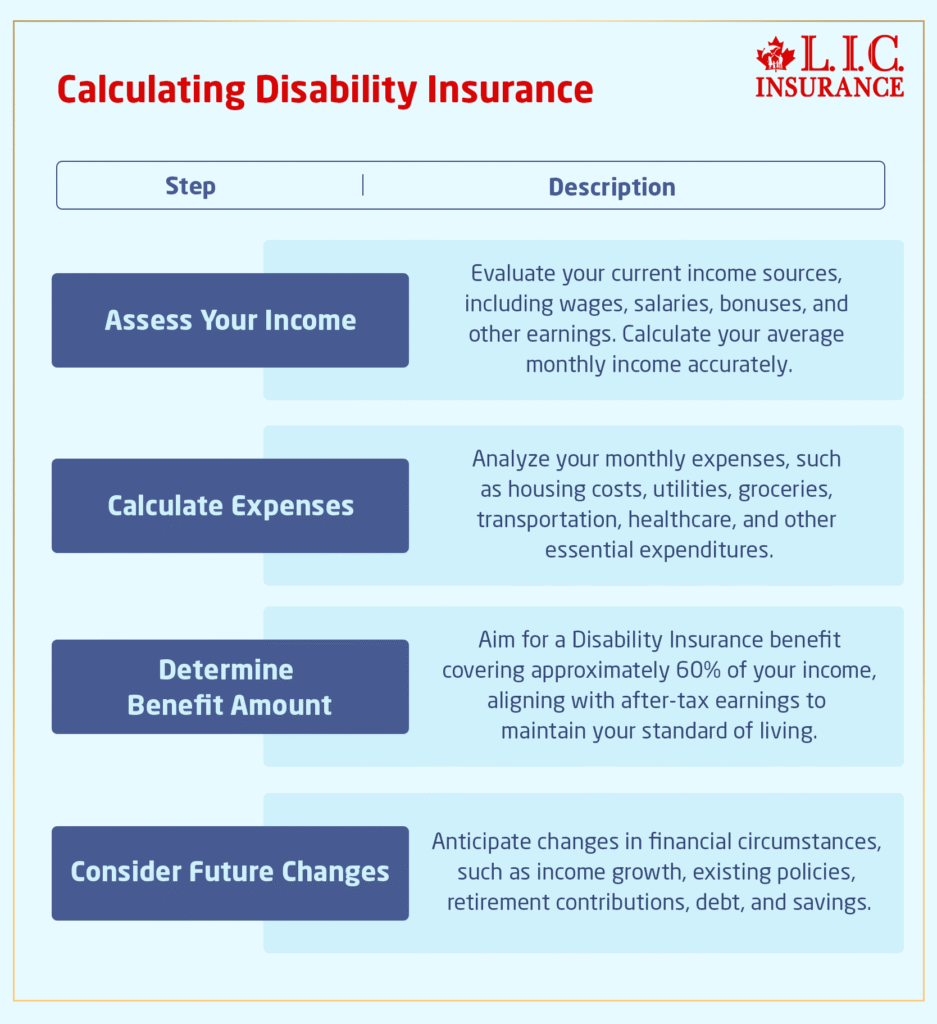
The calculation for STD benefits is usually straightforward: it’s a fixed percentage of your pre-disability gross income. Common percentages range from 50% to 70% of your weekly or bi-weekly earnings, subject to a maximum benefit amount. For example, if your policy covers 60% of your income and you earned $1,000 per week, your STD benefit would be $600 per week. These benefits are typically taxable if your employer paid the premiums with pre-tax dollars, or tax-free if you paid the premiums with after-tax dollars. The specific terms, percentages, and maximums are detailed in your individual policy or employer’s benefit plan documentation.
Long-Term Disability (LTD)
Long-term disability insurance takes over when short-term benefits expire, providing income replacement for extended periods – potentially years, up to retirement age, or until recovery. LTD policies are more complex than STD, with critical definitions impacting eligibility and benefit amounts.
Similar to STD, LTD benefits are calculated as a percentage of your pre-disability gross income, often ranging from 60% to 70%. However, LTD policies usually have higher monthly maximums than STD policies, reflecting the potential for longer benefit durations. For instance, a policy might offer 66.67% of your salary up to a maximum of $10,000 per month.
A key aspect of LTD calculations is the “definition of disability.” Many policies begin with an “own occupation” definition, meaning you’re considered disabled if you can’t perform the duties of your specific job. After a certain period (e.g., 24 months), this often transitions to an “any occupation” definition, requiring you to be unable to perform any job for which you are reasonably suited by education, training, or experience. This shift can significantly impact continued eligibility.
Other factors influencing LTD benefits include waiting periods (which can be 90 to 180 days), the benefit period (how long benefits will be paid), and coordination with other income sources. Many LTD policies are “offset” by other benefits, such as SSDI or worker’s compensation. This means your LTD benefit might be reduced dollar-for-dollar by the amount you receive from these other programs, ensuring your total income replacement doesn’t exceed a certain threshold (often 70-80% of your pre-disability income). Some policies may also include Cost of Living Adjustments (COLAs) to help your benefits keep pace with inflation over time.
Worker’s Compensation Disability Benefits
Worker’s compensation is a state-mandated insurance program designed to provide medical care and wage replacement to employees who suffer job-related injuries or illnesses. Each state has its own worker’s comp laws, so specific calculations can vary significantly. However, the general principles for temporary and permanent disability benefits are consistent.
Temporary Disability Benefits
When a work-related injury or illness prevents an employee from working for a temporary period, they may be eligible for temporary disability benefits. These benefits are intended to replace a portion of the lost wages while the employee is recovering and unable to perform their job duties.
The calculation for temporary disability is typically based on a percentage of the employee’s average weekly wage (AWW) earned before the injury. Most states pay 2/3 (or 66.67%) of the AWW, subject to state-specific minimum and maximum weekly benefit amounts. For example, if your AWW was $900, your temporary disability benefit might be $600 per week, provided it falls within the state’s caps.
The AWW calculation itself can be complex, often averaging wages over a specific period (e.g., 52 weeks) before the injury, and may include overtime, bonuses, and even the value of certain perks. Temporary benefits continue until the worker is medically cleared to return to work, or until they reach Maximum Medical Improvement (MMI), which means their medical condition has stabilized and is not expected to improve further.
Permanent Disability Benefits
If a work-related injury or illness results in a lasting impairment even after reaching MMI, the worker may be eligible for permanent disability benefits. These can be categorized as Permanent Partial Disability (PPD) or Permanent Total Disability (PTD).
Permanent Partial Disability (PPD): This is the most common type of permanent disability and covers situations where an employee has a permanent impairment but can still work, perhaps in a reduced capacity or a different job. The calculation for PPD is often based on an impairment rating assigned by a doctor, which quantifies the degree of functional loss. This rating is then cross-referenced with state-specific schedules (e.g., a certain number of weeks of benefits for the loss of a finger, or a percentage of the body as a whole). The weekly benefit amount is again usually a percentage of the AWW (e.g., 2/3), multiplied by the number of weeks assigned to the specific impairment.
Permanent Total Disability (PTD): This applies to severe cases where an employee is deemed permanently unable to return to any gainful employment due to the work injury. PTD benefits usually pay the same weekly rate as temporary total disability (e.g., 2/3 of AWW, subject to state minimums and maximums) but continue for a much longer duration – often for life, or until the worker reaches a specific age.
Some states also consider loss of earning capacity in PPD calculations, assessing how the impairment impacts the worker’s ability to earn wages in the future. Benefits can be paid as a structured settlement over time or, in some cases, as a lump sum, which is often calculated by taking the total projected benefits and discounting them to a present value.
Navigating the Application and Appeals Process
Understanding benefit calculations is only one part of the journey; successfully applying for and receiving benefits is another. The application process, especially for complex programs like SSDI, can be arduous and often involves multiple stages of review and potential appeals.
Gathering Documentation
Regardless of the type of disability benefit you are seeking, meticulous documentation is paramount. This includes comprehensive medical records detailing your diagnosis, treatment history, medications, and prognoses. Physician statements that clearly outline your functional limitations and how they impact your ability to work are crucial. For SSDI and private insurance, you’ll also need work history, tax records, and other financial statements. For SSI, detailed income and asset information is essential. A well-organized application with robust medical evidence significantly improves your chances of approval.
Understanding the Application Journey
For Social Security Disability, the journey often begins with an initial application, followed by a reconsideration if denied. Many applicants are initially denied and must then request a hearing before an Administrative Law Judge (ALJ). This process can take several months to several years. For private disability insurance, the application typically involves submitting forms from you, your employer, and your doctor, followed by a review by the insurer. Worker’s compensation claims follow state-specific procedures, often involving reporting the injury to your employer, medical evaluations, and filing claims with the state board.
The role of legal counsel, particularly an attorney specializing in disability law, cannot be overstated, especially for SSDI and worker’s compensation. These professionals can help you gather necessary documentation, frame your case effectively, represent you in hearings, and navigate the complex legal and administrative procedures. Their expertise can significantly increase the likelihood of a successful outcome and ensure that your benefit calculations are fair and accurate.
Potential Impact of Other Income and Resources
It’s also crucial to understand how other sources of income or benefits might impact your disability payments. As mentioned, private LTD policies often offset SSDI benefits. Worker’s compensation benefits might also reduce SSDI payments if the combined total exceeds 80% of your average earnings before you became disabled. Unemployment benefits generally conflict with disability benefits, as unemployment requires you to be “able and available for work.” Pensions, severance pay, and even spousal or dependent benefits under SSDI can all interact with your primary disability payment calculations. Understanding these potential offsets and interactions is key to accurate financial planning.
Financial Planning with Disability Benefits in Mind
Even with disability benefits, your financial landscape will likely change. Proactive financial planning can help you adapt and maintain long-term security.
Budgeting and Financial Adjustments
It’s important to prepare for a potential reduction in income when transitioning to disability benefits. Create a detailed budget that accounts for your new income level and prioritize essential expenses. Look for areas where you can reduce spending. Consider how medical expenses, which may increase, will be covered (e.g., Medicare after 24 months of SSDI, Medicaid with SSI, or employer-sponsored health plans with LTD).
Long-Term Financial Security
Disability can be a long-term reality. Exploring additional insurance options, such as critical illness insurance or supplemental policies, might provide an extra layer of protection. For those who receive lump-sum settlements from worker’s compensation or other sources, careful investment and management are critical to ensure the funds last as intended. Maintaining a robust emergency fund is always a wise strategy.
Seeking Professional Guidance
Given the complexities, seeking advice from financial advisors who specialize in disability planning or those with expertise in navigating reduced income scenarios can be invaluable. They can help you create a sustainable budget, manage investments, and plan for your financial future. Similarly, legal experts specializing in disability law are indispensable for navigating applications, appeals, and ensuring you receive the maximum benefits you are entitled to. Their combined expertise can help alleviate the stress of financial uncertainty during an already challenging time.
In conclusion, the calculation of disability benefits is not a one-size-fits-all formula. It varies significantly based on the program (SSDI, SSI, private, worker’s comp), your work history, income, assets, and the specific terms of your policy or state laws. While the intricacies can be overwhelming, a foundational understanding of these calculations is crucial for anyone facing disability. Proactive planning, meticulous documentation, and judicious engagement with legal and financial professionals can empower you to navigate this complex system effectively and secure the financial support necessary to live with dignity and stability.
aViewFromTheCave is a participant in the Amazon Services LLC Associates Program, an affiliate advertising program designed to provide a means for sites to earn advertising fees by advertising and linking to Amazon.com. Amazon, the Amazon logo, AmazonSupply, and the AmazonSupply logo are trademarks of Amazon.com, Inc. or its affiliates. As an Amazon Associate we earn affiliate commissions from qualifying purchases.