
Navigating the complexities of Social Security benefits can seem daunting, yet understanding how your future income is calculated is a cornerstone of sound personal financial planning. For millions of Americans, Social Security represents a crucial component of their retirement income, providing a safety net that has been a bedrock of economic security for generations. Determining your specific benefit amount involves a combination of your earnings history, age at which you claim benefits, and the specific formulas used by the Social Security Administration (SSA). This comprehensive guide aims to demystify the process, empowering you with the knowledge to make informed decisions about your financial future.

Understanding the Foundations of Social Security Benefits
Before diving into the specifics of calculation, it’s essential to grasp the fundamental principles that govern Social Security. It’s not merely a savings account, but rather a pay-as-you-go system where current workers’ contributions fund the benefits of current retirees and other beneficiaries.
What is Social Security and Who is Eligible?
Social Security is a federal insurance program in the United States, providing benefits for retirees, disabled workers, and survivors of deceased workers. It is funded through payroll taxes, typically split between employers and employees, known as FICA (Federal Insurance Contributions Act) taxes. To be eligible for retirement benefits, you generally need to have accumulated 40 “credits” of work, which translates to about 10 years of working and paying Social Security taxes. You can earn up to 4 credits each year. The amount of earnings required for a credit changes annually. For instance, in 2023, you earned one credit for each $1,640 of earnings, up to the maximum of 4 credits for earnings of $6,560.
Beyond retirement, Social Security also offers:
- Disability Benefits: For individuals who are unable to work due to a severe medical condition.
- Survivor Benefits: For eligible family members (e.g., spouses, children, dependent parents) of a deceased worker.
- Spousal and Dependent Benefits: For spouses and minor children of retired or disabled workers.
Understanding which benefits you or your family might be entitled to is the first step in assessing your overall Social Security picture.
Key Factors Influencing Your Benefit Amount
Several critical factors directly impact the size of your monthly Social Security check. Being aware of these elements allows for strategic planning and estimation.
- Earnings Record: Your benefit amount is primarily based on your average indexed monthly earnings (AIME) over your 35 highest-earning years. The SSA indexes your past earnings to account for changes in the average wage level in the economy, making them comparable to current wages.
- Age at Which You Claim Benefits: This is perhaps the most significant variable under your control. While you can start receiving retirement benefits as early as age 62, your benefit amount will be permanently reduced. Conversely, delaying benefits past your Full Retirement Age (FRA) can result in a higher monthly payment.
- Full Retirement Age (FRA): Your FRA is the age at which you are entitled to 100% of your primary insurance amount (PIA). This age varies depending on your birth year. For those born in 1943-1954, it’s 66. It gradually increases to 67 for those born in 1960 or later.
- Cost-of-Living Adjustments (COLAs): Social Security benefits are subject to annual COLAs, which are designed to help benefits keep pace with inflation. These adjustments are typically announced in the fall and applied starting in January of the following year.
Accessing Your Earnings Record and Benefit Estimates
The most accurate way to determine your potential Social Security benefits is to consult the official sources provided by the Social Security Administration. The SSA offers powerful tools to help you understand your individual situation.
The Importance of Your Social Security Statement
The Social Security Statement is a vital document that provides a personalized estimate of your future Social Security benefits. It summarizes your earnings history, estimates your benefits at different claiming ages (age 62, full retirement age, and age 70), and outlines potential disability and survivor benefits. Reviewing this statement regularly is crucial to ensure your earnings record is accurate. Errors in your earnings history can lead to lower benefits, so prompt correction is essential.
Creating and Utilizing Your ‘my Social Security’ Account
The ‘my Social Security’ online account is the most convenient and powerful tool for managing your Social Security information. By creating a secure account at www.ssa.gov/myaccount, you can:
- View your complete earnings record.
- Get personalized benefit estimates based on your actual earnings.
- Review the estimated Social Security and Medicare taxes you’ve paid.
- Print your Social Security Statement.
- Manage your benefits once you start receiving them (e.g., change your address, set up direct deposit).
This account serves as a digital portal to all your Social Security-related data, allowing you to project and plan with confidence.
Verifying Your Earnings History
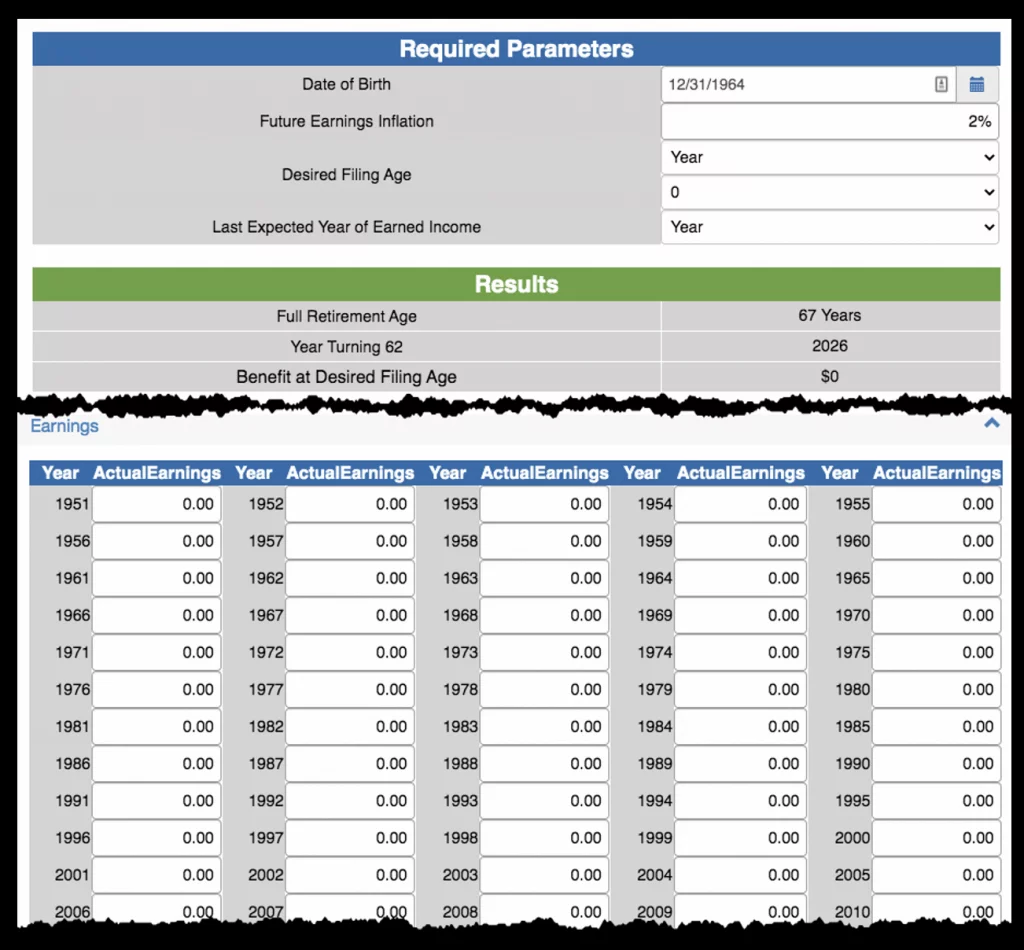
It’s your responsibility to check your earnings history periodically. Your ‘my Social Security’ account displays your reported earnings year by year. If you find any discrepancies, such as missing earnings for a particular year, or amounts that don’t match your W-2s or tax returns, you should contact the SSA immediately. Providing documentation like W-2 forms or tax returns can help correct your record and ensure your benefits are accurately calculated based on your lifetime contributions.
The Role of Age in Benefit Determination
The age at which you decide to claim your Social Security retirement benefits has a profound and permanent impact on the monthly amount you receive. This decision is one of the most critical financial choices many individuals will make in their retirement planning.
Full Retirement Age (FRA) Explained
Your Full Retirement Age (FRA) is the age at which you are entitled to receive 100% of your Primary Insurance Amount (PIA). As mentioned earlier, this age varies based on your birth year. For example:

- Born 1943-1954: FRA is 66
- Born 1955: FRA is 66 and 2 months
- Born 1956: FRA is 66 and 4 months
- …
- Born 1960 or later: FRA is 67
Understanding your specific FRA is fundamental because it serves as the benchmark for how your benefits are adjusted if you claim early or late.
Claiming Benefits Early: The Impact on Your Payments
You can elect to start receiving Social Security retirement benefits as early as age 62. However, claiming benefits before your FRA results in a permanent reduction of your monthly payment. This reduction can be significant. For someone with an FRA of 67, claiming at age 62 means a reduction of about 30%. This reduction is applied to your Primary Insurance Amount and remains in effect for the rest of your life, even after you reach your FRA. While receiving benefits earlier might provide immediate financial relief, it comes at the cost of a smaller monthly income stream for the duration of your retirement.
Delaying Benefits: Maximizing Your Monthly Check
Conversely, if you delay claiming benefits past your Full Retirement Age, up to age 70, you can earn Delayed Retirement Credits (DRCs). These credits permanently increase your monthly benefit amount. For each year you delay claiming past your FRA, your benefit increases by a certain percentage, typically 8% per year. For someone with an FRA of 67, delaying until age 70 can result in an additional 24% on top of their full retirement benefit. This strategy is often appealing to individuals who are healthy, continue to work, or have other sufficient retirement income sources, as it maximizes the guaranteed income stream for the rest of their lives.
Calculating Your Primary Insurance Amount (PIA)
The heart of your Social Security benefit calculation lies in determining your Primary Insurance Amount (PIA). This is the monthly benefit you would receive if you start collecting benefits exactly at your Full Retirement Age. The SSA uses a specific formula to arrive at this figure.
Average Indexed Monthly Earnings (AIME)
The first step in calculating your PIA is to determine your Average Indexed Monthly Earnings (AIME). The SSA takes your earnings from your entire working history and selects the 35 years in which you earned the most. These earnings are then “indexed” to account for the changes in general wage levels over time, ensuring that earlier earnings are brought up to current value. For example, $10,000 earned in 1980 will be indexed to reflect what that amount would be worth in a more recent year. The sum of these indexed earnings for the 35 highest-earning years is then divided by 420 (the number of months in 35 years) to arrive at your AIME.
The Bend Points Formula
Once your AIME is established, the SSA applies a “bend points” formula to calculate your PIA. This formula is progressive, meaning it replaces a higher percentage of earnings for lower-income workers than for higher-income workers. The formula uses three different percentages (90%, 32%, and 15%) applied to specific segments of your AIME, known as “bend points.” These bend points are adjusted annually based on the national average wage index.
For example, for someone reaching age 62 in 2023, the formula might look something like this:
- 90% of the first $1,115 of AIME
- Plus 32% of AIME between $1,115 and $6,721
- Plus 15% of AIME over $6,721
The sum of these calculations yields your PIA. This progressive formula ensures that Social Security provides a foundational level of support for all beneficiaries, regardless of their lifetime earnings.
Understanding Cost-of-Living Adjustments (COLAs)
After your PIA is calculated and you begin receiving benefits, your monthly payments are subject to annual Cost-of-Living Adjustments (COLAs). COLAs are designed to ensure that the purchasing power of Social Security benefits is not eroded by inflation. Each year, typically in October, the SSA announces the COLA for the following year, based on the Consumer Price Index for Urban Wage Earners and Clerical Workers (CPI-W). For example, if the COLA is 3%, your monthly benefit check will increase by 3% starting in January. This mechanism is crucial for long-term financial security in retirement.
Strategic Considerations for Claiming Benefits
Determining your Social Security benefits isn’t just about calculations; it’s also about strategic planning that integrates with your broader financial picture. The decisions you make can significantly impact your overall retirement income and legacy.
Spousal and Survivor Benefits
Social Security benefits extend beyond individual earnings. If you are married or divorced, you might be eligible for spousal benefits based on your current or ex-spouse’s work record. A spouse can receive up to 50% of the primary earner’s PIA if they claim at their own FRA. Additionally, survivor benefits are available to eligible family members (e.g., widow(er)s, minor children) of a deceased worker. A surviving spouse, for instance, can receive up to 100% of the deceased worker’s benefit. Understanding these auxiliary benefits is crucial, especially for couples, as it allows for coordinated claiming strategies that can maximize total household benefits.
Working While Receiving Benefits
If you claim Social Security benefits before your Full Retirement Age and continue to work, your benefits may be temporarily reduced if your earnings exceed certain annual limits. For instance, in 2023, if you were under FRA for the entire year, the SSA withheld $1 in benefits for every $2 you earned above $21,240. In the year you reach your FRA, the limits are higher, and the reduction is $1 for every $3 earned above a higher threshold. Once you reach your FRA, these earning limits no longer apply, and you can earn as much as you like without your Social Security benefits being reduced. The benefits withheld due to earnings are not lost; they are added back into your benefit calculation when you reach your FRA, slightly increasing your monthly payment.
Tax Implications of Social Security Benefits
It’s important to be aware that your Social Security benefits may be taxable. If your “combined income” (adjusted gross income + nontaxable interest + half of your Social Security benefits) exceeds certain thresholds, up to 85% of your Social Security benefits may be subject to federal income tax. The thresholds are $25,000 for single filers and $32,000 for married couples filing jointly. Some states also tax Social Security benefits, so it’s essential to research your state’s specific tax laws. Incorporating these potential taxes into your retirement income planning is vital for an accurate assessment of your net benefits.
Seeking Professional Financial Advice
While the SSA provides excellent resources, the decision of when and how to claim Social Security benefits is often complex and highly individualized. A qualified financial advisor specializing in retirement planning can help you analyze your unique financial situation, consider various claiming scenarios, and integrate Social Security into your overall retirement income strategy. They can help you weigh factors such as your health, other income sources, life expectancy, and spousal benefits to create a strategy that maximizes your lifetime benefits and aligns with your financial goals.
Determining your Social Security benefits involves more than just a quick calculation; it’s a dynamic process influenced by your work history, personal choices, and ongoing economic factors. By leveraging the tools provided by the SSA, understanding the impact of key variables like age and earnings, and considering broader financial implications, you can confidently plan for a secure and stable retirement.
aViewFromTheCave is a participant in the Amazon Services LLC Associates Program, an affiliate advertising program designed to provide a means for sites to earn advertising fees by advertising and linking to Amazon.com. Amazon, the Amazon logo, AmazonSupply, and the AmazonSupply logo are trademarks of Amazon.com, Inc. or its affiliates. As an Amazon Associate we earn affiliate commissions from qualifying purchases.