
In the intricate world of personal finance, investing, business operations, and even daily budgeting, one fundamental mathematical concept stands paramount: percentages. Far from being a mere academic exercise, understanding how to calculate and interpret percentages is an indispensable skill that empowers individuals to make informed decisions, track progress, identify opportunities, and mitigate risks. Whether you’re dissecting an investment return, comparing loan interest rates, calculating a discount, or analyzing profit margins, percentages provide a universal language to quantify relationships and compare magnitudes in a standardized way.
This comprehensive guide aims to demystify the process of finding the percentage of a number, equipping you with the knowledge and practical methods to confidently apply this skill across various financial scenarios. We’ll break down the core concepts, walk through step-by-step calculations, explore real-world financial applications, and highlight tools that streamline the process, ensuring you’re well-prepared to navigate your financial journey with precision and insight.

The Core Concept: Understanding Percentages
Before delving into the mechanics of calculation, it’s crucial to grasp what a percentage truly represents. This foundational understanding will illuminate why percentages are so powerful in financial analysis.
What is a Percentage?
At its heart, “percentage” means “per hundred” or “out of one hundred.” It’s a way of expressing a number as a fraction of 100. The symbol “%” is used to denote a percentage. For instance, 25% means 25 out of 100, or 25/100. This standardization to a base of 100 allows for easy comparison of different quantities, even if their original total values are vastly different.
Imagine comparing the performance of two different investments. If one investment yielded $50 on a $1,000 principal and another yielded $100 on a $5,000 principal, simply comparing the dollar amounts ($50 vs. $100) doesn’t tell the whole story. However, converting these to percentages – 5% for the first ($50/$1,000 * 100) and 2% for the second ($100/$5,000 * 100) – immediately reveals which investment performed relatively better.
The Basic Formula
The fundamental formula for calculating a percentage is elegantly simple:
Percentage = (Part / Whole) × 100
- Part: This is the specific quantity or amount you are interested in.
- Whole: This is the total quantity, the base amount against which the “part” is being compared.
- 100: Multiplied by 100 to convert the resulting decimal or fraction into a percentage.
This formula serves as the bedrock for all percentage calculations, whether you’re working backward, finding a part from a whole and a percentage, or determining the percentage change between two values.
Practical Examples for Clarity
Let’s consider a couple of straightforward financial examples to solidify this basic understanding:
-
Scenario 1: Budgeting
You have a monthly income of $4,000. You allocate $1,200 for rent. What percentage of your income goes towards rent?- Part = $1,200 (rent)
- Whole = $4,000 (total income)
- Percentage = ($1,200 / $4,000) × 100 = 0.30 × 100 = 30%
-
Scenario 2: Sales Tax
A product costs $50, and the sales tax is $3. What is the sales tax percentage?- Part = $3 (sales tax)
- Whole = $50 (product cost)
- Percentage = ($3 / $50) × 100 = 0.06 × 100 = 6%
These examples highlight how the “Part / Whole × 100” formula applies directly to common financial situations, providing immediate, actionable insights.
Step-by-Step Guide to Calculating Percentages
While the basic formula is straightforward, calculating percentages often involves different variations depending on what information you have and what you want to find. Let’s break down the most common types of percentage calculations in a financial context.
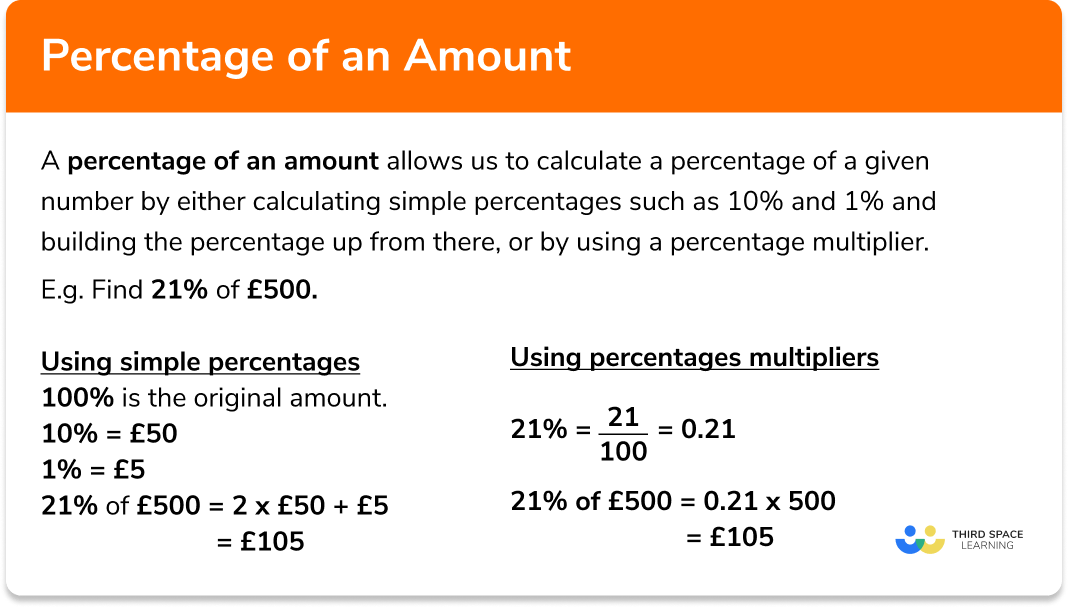
Finding a Percentage of a Number
This is perhaps the most frequent calculation. You know the whole amount and a percentage, and you want to find the corresponding part. For instance, calculating a discount, an interest amount, or a commission.
Method 1: Convert Percentage to Decimal
This is generally the easiest and most common approach.
- Convert the percentage to a decimal: Divide the percentage by 100 (or simply move the decimal point two places to the left).
- Example: 20% becomes 0.20; 7.5% becomes 0.075.
- Multiply the decimal by the whole number: The result is the “part” you’re looking for.
-
Financial Example: Calculating a Discount
You see a laptop for $1,200, and it’s advertised with a 15% discount. How much is the discount in dollars?- Convert 15% to a decimal: 15 / 100 = 0.15
- Multiply by the whole number: 0.15 × $1,200 = $180
- The discount is $180, meaning you’d pay $1,200 – $180 = $1,020.
-
Financial Example: Calculating Simple Interest
You have a savings account with $5,000 that earns 2% annual interest. How much interest will you earn in one year?- Convert 2% to a decimal: 2 / 100 = 0.02
- Multiply by the principal: 0.02 × $5,000 = $100
- You will earn $100 in interest.
Method 2: Convert Percentage to Fraction
This method is less common for practical calculations but reinforces the concept.
- Convert the percentage to a fraction: Place the percentage over 100 (e.g., 20% becomes 20/100).
- Multiply the fraction by the whole number: Simplify the fraction if possible before multiplying.
- Financial Example: Calculating a Commission
A salesperson earns a 10% commission on a $3,500 sale. How much is their commission?- Convert 10% to a fraction: 10/100
- Multiply by the whole number: (10/100) × $3,500 = (1/10) × $3,500 = $350
- The salesperson earns a $350 commission.
Expressing One Number as a Percentage of Another
This is where you have two numbers, and you want to know what percentage the first number is of the second (the whole). This uses the “Part / Whole × 100” formula directly.
-
Financial Example: Debt-to-Income Ratio
Your total monthly debt payments are $800, and your gross monthly income is $4,000. What is your debt-to-income ratio as a percentage?- Part = $800 (debt payments)
- Whole = $4,000 (gross income)
- Percentage = ($800 / $4,000) × 100 = 0.20 × 100 = 20%
- Your debt-to-income ratio is 20%.
-
Financial Example: Portfolio Allocation
You have $15,000 invested in stocks and a total investment portfolio of $50,000. What percentage of your portfolio is in stocks?- Part = $15,000 (stocks)
- Whole = $50,000 (total portfolio)
- Percentage = ($15,000 / $50,000) × 100 = 0.30 × 100 = 30%
- 30% of your portfolio is allocated to stocks.
Calculating Percentage Increase or Decrease
This type of calculation is crucial for analyzing changes over time, such as investment growth, inflation rates, or price fluctuations.
Formula: ((New Value – Old Value) / Old Value) × 100
-
Financial Example: Investment Growth
Your investment portfolio was worth $50,000 at the start of the year and is now worth $57,500. What is the percentage increase?- New Value = $57,500
- Old Value = $50,000
- Percentage Increase = (($57,500 – $50,000) / $50,000) × 100
- = ($7,500 / $50,000) × 100 = 0.15 × 100 = 15%
- Your portfolio increased by 15%.
-
Financial Example: Price Decrease
A stock you own dropped from $120 per share to $96 per share. What is the percentage decrease?- New Value = $96
- Old Value = $120
- Percentage Decrease = (($96 – $120) / $120) × 100
- = (-$24 / $120) × 100 = -0.20 × 100 = -20%
- The stock decreased by 20%. (Note: The negative sign indicates a decrease).
Real-World Financial Applications of Percentages
The ability to calculate percentages is not just a mathematical skill; it’s a vital tool for navigating virtually every aspect of your financial life.
Personal Finance: Budgeting, Savings, and Debt
- Budgeting: Allocate a percentage of your income to different categories (e.g., 50% for needs, 30% for wants, 20% for savings and debt repayment, known as the 50/30/20 rule). Track actual spending as a percentage of your budget to ensure you’re on track.
- Savings Goals: Determine what percentage of each paycheck you need to save to reach a specific financial goal by a certain date.
- Debt Management: Understand interest rates (APR – Annual Percentage Rate) on credit cards, loans, and mortgages. Calculate how much of your payment goes towards principal vs. interest. Your debt-to-income ratio (DTI) is a crucial percentage lenders use to assess your creditworthiness.
Investing: Returns, Growth, and Risk
- Return on Investment (ROI): Calculate the percentage gain or loss on an investment relative to its initial cost. This is fundamental for evaluating investment performance.
- Portfolio Allocation: Determine what percentage of your total portfolio is allocated to different asset classes (e.g., stocks, bonds, real estate) to manage risk and diversification.
- Stock Price Changes: Analyze daily, weekly, or annual percentage changes in stock prices to understand market movements.
- Dividend Yield: Understand the percentage return an investor receives in dividends relative to the stock’s price.
Business Finance: Profit Margins, Discounts, and Taxes
- Profit Margins: Calculate gross profit margin, operating profit margin, and net profit margin to assess a business’s profitability. (e.g., Net Profit Margin = (Net Profit / Revenue) × 100).
- Markups and Discounts: Businesses use percentages to set prices (markup from cost) and offer promotional discounts to customers.
- Sales Tax and VAT: Calculate the correct amount of sales tax or Value Added Tax (VAT) to charge customers and remit to authorities.
- Commission Structures: Understand and calculate commissions for sales teams, often based on a percentage of sales revenue.
- Growth Rates: Analyze sales growth, customer growth, or market share growth as percentages over time.
Online Income & Side Hustles: Commissions and Royalty Rates
- Affiliate Marketing: Many affiliate programs pay a percentage commission on sales generated through your unique link.
- Freelance Platforms: Some platforms charge a percentage fee on your earnings.
- Content Creation Royalties: Authors, musicians, and artists often earn a percentage of sales or streams of their work.
- E-commerce Profitability: If you sell products online, calculating your profit margin per item as a percentage helps in pricing and scaling decisions.
Tools and Resources for Percentage Calculation
While manual calculation is essential for understanding, various tools can streamline the process for speed and accuracy, especially with complex numbers or large datasets.
Calculators
- Standard Calculators: Your basic scientific or even phone calculator can easily handle percentage calculations. Most have a “%” button that automatically divides by 100. To find 20% of 150, you might type “150 * 20 % =” or “150 * 0.20 =”.
- Online Percentage Calculators: Numerous websites offer dedicated percentage calculators that simplify various scenarios (e.g., “what is X% of Y?”, “X is what % of Y?”, “percentage increase/decrease”).
Spreadsheets (Excel, Google Sheets)
Spreadsheets are incredibly powerful for financial calculations, especially when dealing with multiple data points or needing to perform calculations repeatedly.
- Finding a percentage of a number: If you have a number in cell A1 and want to find 20% of it, you would use
=A1*0.20or=A1*20%. - Expressing one number as a percentage of another: If you have a part in A1 and a whole in B1, use
=(A1/B1)*100to display the result as a percentage. Alternatively, use=(A1/B1)and then format the cell as a percentage (Excel/Sheets will automatically multiply by 100 and add the “%” symbol). - Calculating percentage change: If the old value is in A1 and the new value is in B1, use
=((B1-A1)/A1)*100.
Online Converters and Apps
For quick conversions or specific financial calculations (like loan amortization with interest), many dedicated financial apps and online tools integrate percentage functions. These can be particularly useful for complex scenarios where multiple percentages and factors are at play.
Empowering Your Financial Journey with Percentage Prowess
Mastering how to find the percentage of a number is more than just learning a mathematical formula; it’s about acquiring a fundamental literacy that underpins almost every aspect of financial management. From the simplest task of calculating a discount on a purchase to the complexities of analyzing investment returns or understanding your business’s profitability, percentages provide clarity, context, and comparison.
By embracing the methods outlined in this guide and applying them to your personal and professional financial endeavors, you gain a significant advantage. You become a more informed consumer, a savvier investor, and a more strategic business operator. Practice these calculations, utilize the available tools, and let your newfound percentage prowess empower you to make smarter, more confident financial decisions on your journey to financial well-being.
aViewFromTheCave is a participant in the Amazon Services LLC Associates Program, an affiliate advertising program designed to provide a means for sites to earn advertising fees by advertising and linking to Amazon.com. Amazon, the Amazon logo, AmazonSupply, and the AmazonSupply logo are trademarks of Amazon.com, Inc. or its affiliates. As an Amazon Associate we earn affiliate commissions from qualifying purchases.