
In the dynamic world of personal finance, investing, and business, numbers tell a story. They reveal growth, contraction, opportunities, and challenges. Among the most crucial metrics for interpreting these stories is “percent increase.” Far from being a mere academic exercise, understanding how to calculate percent increase is an indispensable skill that empowers individuals and businesses to make informed decisions, track progress, and gauge performance. Whether you’re assessing the growth of your investment portfolio, analyzing a raise in your salary, or scrutinizing the rising cost of living, mastering this fundamental calculation is key to navigating your financial journey with clarity and confidence.
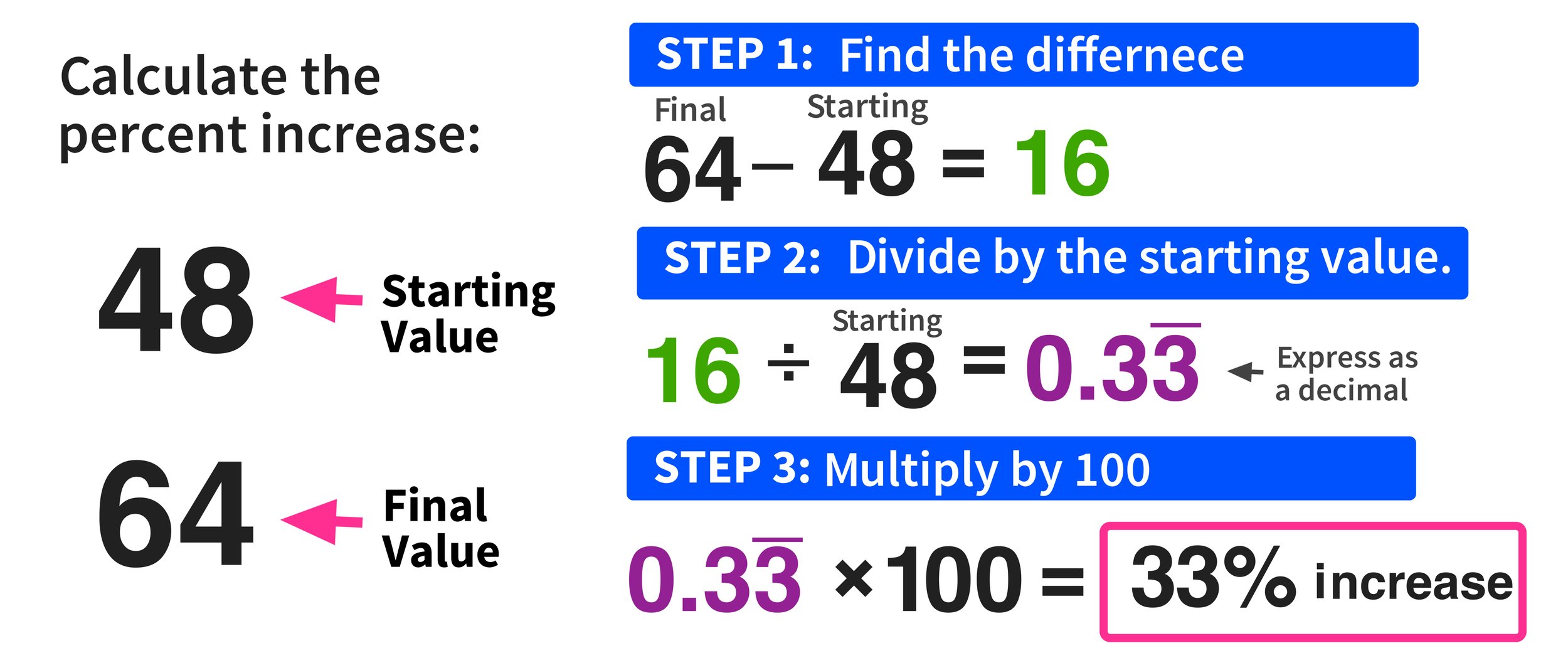
This article delves into the mechanics of calculating percent increase, explores its profound relevance across various financial applications, highlights common pitfalls to avoid, and demonstrates how to leverage financial tools for efficient analysis. By the end, you’ll not only understand the formula but also appreciate its strategic implications for achieving your financial aspirations.
The Fundamental Formula: Unpacking Percent Increase
At its core, calculating percent increase is about understanding the relative change between an initial value and a subsequent value. It tells us by how much, proportionally, a quantity has grown. This measurement is far more insightful than an absolute increase alone, as it provides context. An increase of $100 means very different things if the original amount was $10,000 versus $1,000.
The Core Calculation Explained
The formula for percent increase is straightforward and widely applicable:
$$text{Percent Increase} = left( frac{text{New Value} – text{Original Value}}{text{Original Value}} right) times 100$$
Let’s break down each component:
- Original Value: This is your starting point, the initial number or baseline figure from which you are measuring change. It’s crucial to identify this correctly, as it forms the denominator of your fraction.
- New Value: This is the subsequent number, the figure after the change has occurred.
- New Value – Original Value: This calculation gives you the absolute increase or the raw difference between the two numbers. This is your numerator.
- Dividing by the Original Value: This step is what converts the absolute increase into a relative change. By dividing the difference by the starting point, you express the increase as a proportion of the original amount. This yields a decimal.
- Multiplying by 100: Finally, multiplying the decimal result by 100 converts it into a percentage, making it easily interpretable.
Step-by-Step Guide with a Simple Example
Let’s walk through an example to solidify this concept. Suppose you invested $5,000 in a stock, and after a year, its value grew to $5,750. What was your percent increase?
- Identify the Original Value: Your initial investment was $5,000. So, Original Value = $5,000.
- Identify the New Value: The value after a year is $5,750. So, New Value = $5,750.
- Calculate the Difference (Absolute Increase):
New Value – Original Value = $5,750 – $5,000 = $750.
This means your investment increased by $750. - Divide the Difference by the Original Value:
$750 / $5,000 = 0.15.
This decimal represents the proportion of the original value that the investment increased by. - Multiply by 100 to Get the Percentage:
0.15 * 100 = 15%.
Therefore, your investment experienced a 15% percent increase. This simple calculation provides a clear and contextualized measure of your investment’s performance.
Why Percent Increase Matters in Your Financial Journey
Understanding percent increase transcends academic curiosity; it’s a practical skill with profound implications across virtually every facet of your financial life. From managing your household budget to strategizing your investment portfolio, this metric offers critical insights that absolute numbers alone often fail to convey.
Personal Finance: Tracking Your Wealth and Expenses
In personal finance, percent increase is a powerful tool for monitoring your financial health and making informed budgeting decisions.
- Salary Increases: When negotiating a raise or evaluating a new job offer, knowing the percent increase in your salary (e.g., a 5% raise) helps you understand its real impact on your purchasing power and overall income growth, especially when compared to inflation.
- Budgeting and Expense Management: Tracking how your expenses change over time is vital. If your utility bill increased from $100 to $120, that’s a 20% increase. Identifying these percentage shifts for categories like groceries, housing, or transportation can highlight trends, enable you to adjust your budget proactively, and identify areas for cost-cutting.
- Savings Growth: Observing the percent increase in your savings account balance or emergency fund offers a motivating indicator of your progress towards financial goals. This is particularly relevant when considering the impact of interest earnings.
Investing: Gauging Performance and Returns
For investors, percent increase is arguably the most common and vital metric for assessing the success of their holdings and making strategic allocation decisions.
- Stock Market Gains/Losses: When an investment advisor reports that your portfolio achieved a 12% return last year, they are referring to the percent increase in its value. This allows for easy comparison between different investments, benchmarks (like the S&P 500), and historical performance.
- Mutual Fund or ETF Performance: Fund managers frequently communicate returns as percentage increases over various periods (e.g., 1-year, 5-year, 10-year returns). This standardized metric is essential for comparing funds and selecting those aligned with your risk tolerance and objectives.
- Real Estate Appreciation: The value of real estate is often discussed in terms of its appreciation rate, which is a percent increase. Understanding this helps homeowners assess their equity growth and potential investment returns from property.
- Compound Interest: The magic of compound interest relies on consistent percentage growth. Even small percent increases, when compounded over long periods, can lead to substantial wealth accumulation. Calculating the percent increase each year helps visualize this powerful financial principle.
Business Finance: Measuring Growth and Profitability
In the realm of business, percent increase is a fundamental indicator of operational success, market penetration, and financial health.
- Revenue Growth: Businesses constantly monitor their revenue growth percentage year-over-year or quarter-over-quarter. A healthy percent increase in revenue signals expanding sales and market demand.
- Profit Margin Changes: Understanding the percent increase or decrease in gross or net profit margins helps businesses evaluate their operational efficiency and pricing strategies.
- Cost Increases/Decreases: Tracking the percent increase in raw material costs, labor expenses, or overheads is crucial for managing profitability and making strategic adjustments to operations or pricing.
- Sales Growth Over Periods: Analyzing percent increases in sales for specific products, regions, or customer segments can inform marketing strategies, product development, and resource allocation.
Common Pitfalls and Advanced Considerations
While the formula for percent increase is straightforward, its application and interpretation can sometimes lead to misunderstandings. Being aware of common pitfalls and considering more nuanced scenarios is crucial for accurate financial analysis.
Misinterpreting the Base Value
The most frequent error in calculating percent increase is incorrectly identifying the “Original Value” (the denominator). The base value must always be the starting point or the figure before the increase occurred.
- Example: If your sales grew from $100 in Q1 to $120 in Q2, the Q1 sales ($100) are the original value. However, if you’re comparing Q2 sales ($120) to Q1 sales of the previous year ($90), then the previous year’s Q1 sales ($90) become the original value. Using the wrong base value will lead to an incorrect and misleading percentage. Always ensure your comparison makes logical sense for the context.
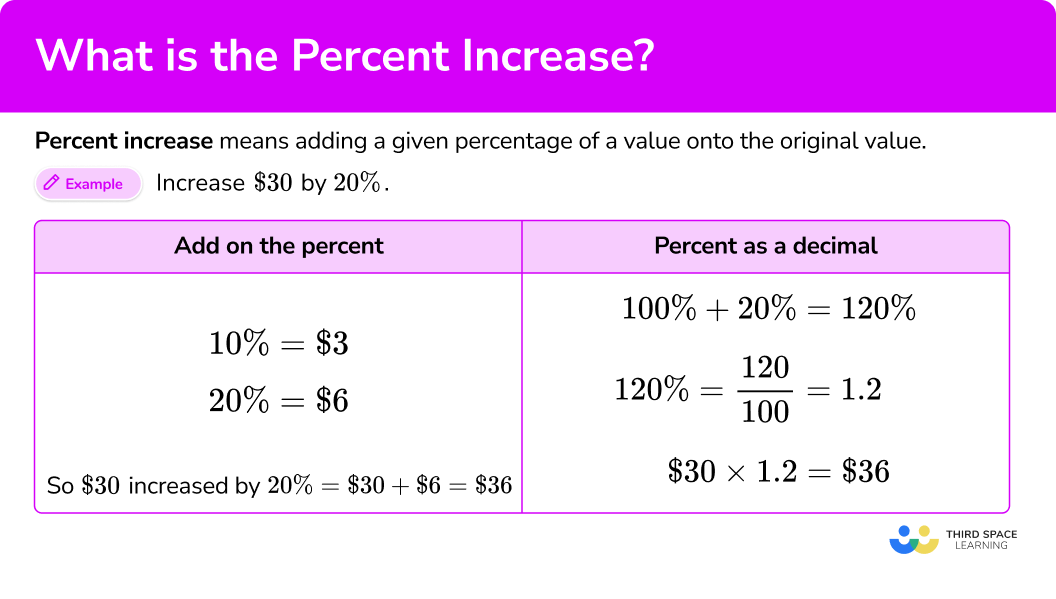
Percent Change vs. Percentage Points
This distinction is critical, especially when discussing rates, yields, or other figures already expressed as percentages.
-
Percent Increase (or Percent Change): This refers to the relative change between two numbers, as calculated by our formula.
-
Percentage Points: This refers to the absolute difference between two percentages.
-
Example: If an interest rate increases from 5% to 6%:
- The absolute increase is 1 percentage point (6% – 5%).
- The percent increase is ((6 – 5) / 5) * 100 = (1 / 5) * 100 = 20%.
Misunderstanding this difference can lead to dramatically different interpretations of financial data. A 1 percentage point increase in a low rate (e.g., 1% to 2%) represents a 100% percent increase, while a 1 percentage point increase in a high rate (e.g., 20% to 21%) is only a 5% percent increase.
Dealing with Negative Numbers and Zero
Special care is needed when the numbers involved are negative or when the original value is zero.
- Zero Original Value: If the original value is zero, the percent increase formula involves division by zero, which is mathematically undefined. In practical terms, an increase from zero to any positive number is often described as an “infinite” or “undefined” percent increase, as any positive value is an immeasurable proportional increase from nothing. For financial reporting, you would typically state the absolute gain and clarify the starting point was zero.
- Negative Original Value: Calculating percent increase from a negative number can be confusing to interpret. If a company’s losses shrunk (e.g., from -$100 to -$50), while mathematically an “increase” in value, it’s often more intuitive to describe this as a “reduction in losses” or to focus on the absolute change. If an original value is negative and the new value is positive (e.g., from -$50 to $20), the formula still works, but the interpretation requires careful context, as it represents a swing from loss to gain. It’s often clearer to analyze the absolute change and explain the directional shift.
Leveraging Financial Tools for Seamless Calculations
While understanding the manual calculation is paramount, in today’s fast-paced financial world, leveraging technology can streamline the process for larger datasets or frequent computations.
Spreadsheet Software (Excel/Google Sheets)
Spreadsheet programs are invaluable for calculating percent increase, especially when dealing with multiple data points or historical trends.
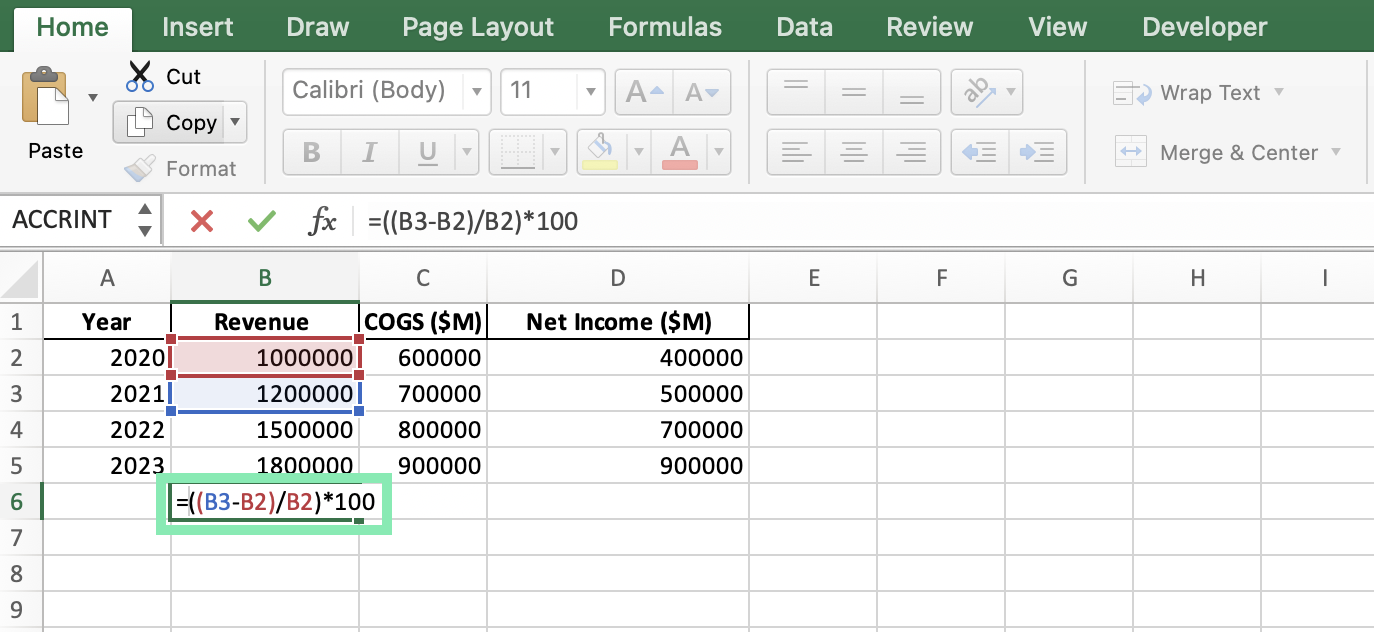
- Formulas: You can easily set up formulas. If your Original Value is in cell A2 and your New Value is in cell B2, the formula
=(B2-A2)/A2will give you the decimal change. Simply format the cell as a percentage to display it correctly. For an absolute formula that handles potential division by zero errors or provides a specific output in such cases, more advancedIFstatements can be incorporated. - Efficiency: Spreadsheets allow you to quickly apply the formula across entire columns of data, making it efficient to track investment performance, budget variances, or sales growth over many periods.
Online Calculators and Financial Apps
For quick, one-off calculations, a multitude of online percent change calculators are readily available.
- Convenience: These tools often require just two inputs (original and new value) and instantly provide the result, ideal for on-the-spot analysis.
- Integrated Functionality: Many personal finance apps, investment platforms, and business intelligence tools integrate percent change calculations directly into their dashboards, automatically showing you the percent increase in your portfolio value, budget categories, or revenue figures. This eliminates manual calculation and provides real-time insights.
The Power of Manual Understanding
Despite the convenience of digital tools, a firm grasp of the underlying mathematical principles remains essential. Relying solely on a calculator without understanding the logic can lead to misinterpretations or an inability to spot errors. A manual understanding empowers you to:
- Verify Results: Double-check calculator outputs or software-generated reports.
- Interpret Nuances: Understand why a number is a certain percentage and what that truly signifies.
- Solve Problems Without Tools: If you’re discussing finances or making a quick mental calculation, knowing the formula is invaluable.
Beyond the Numbers: Strategic Implications
Mastering the calculation of percent increase is not merely an exercise in arithmetic; it’s a fundamental step towards enhanced financial literacy and more effective decision-making. The ability to interpret and apply this metric has significant strategic implications for both personal and business financial success.
Setting Financial Goals
Understanding percent increase enables you to set realistic, measurable, and impactful financial goals. Instead of vague aspirations, you can quantify your objectives:
- “I aim to increase my net worth by 15% this year.”
- “Our business needs to achieve a 10% revenue growth quarter-over-quarter.”
- “I want to reduce my outstanding debt by 25% within six months.”
These percentage-based goals provide clear targets and a framework for tracking progress.
Informed Decision-Making
Percent increase is a cornerstone of informed financial decision-making in various scenarios:
- Evaluating Investment Opportunities: When comparing potential investments, the projected percent increase in value (return on investment) is a primary factor. Understanding this helps you assess risk vs. reward.
- Salary Negotiations: Knowing the average percent increase for your industry or role strengthens your position in salary discussions. You can also analyze the true value of a job offer by comparing the percent increase from your current salary.
- Comparing Product Prices: Identifying percent increases in product prices over time helps you understand inflationary pressures and make smarter purchasing decisions.
- Understanding Inflation: The consumer price index (CPI), often reported as a percent increase, directly impacts your purchasing power. Understanding this helps you adjust your financial plans to maintain or grow your real wealth.
Communicating Financial Performance
Whether you’re presenting to stakeholders, discussing finances with a partner, or reporting to your board, articulating changes in terms of percent increase is a highly effective way to communicate financial performance clearly and concisely. It provides context and allows for easy comparisons, making complex data more digestible and impactful.
In conclusion, the ability to figure percent increase between two numbers is far more than a mathematical trick; it’s a vital life skill in the realm of money. From the smallest personal budget adjustments to the largest corporate financial strategies, this calculation provides the lens through which growth, change, and performance are accurately measured and understood. By mastering this fundamental concept, you unlock a deeper understanding of your financial landscape, empowering you to set smarter goals, make more informed decisions, and ultimately, steer your financial future with greater confidence and success. Embrace this powerful tool, and let the numbers tell you their full, insightful story.
aViewFromTheCave is a participant in the Amazon Services LLC Associates Program, an affiliate advertising program designed to provide a means for sites to earn advertising fees by advertising and linking to Amazon.com. Amazon, the Amazon logo, AmazonSupply, and the AmazonSupply logo are trademarks of Amazon.com, Inc. or its affiliates. As an Amazon Associate we earn affiliate commissions from qualifying purchases.