
Return on Investment (ROI) stands as a cornerstone metric in the world of finance, serving as a critical indicator for evaluating the efficiency and profitability of an investment. Whether you’re a seasoned investor, a small business owner, or simply managing your personal finances, understanding how to accurately estimate ROI is fundamental to making informed decisions that drive financial growth and achieve strategic objectives. This comprehensive guide delves into the core principles, practical applications, and advanced considerations for calculating and interpreting ROI across various financial landscapes.
Understanding the Fundamentals of ROI
At its heart, ROI is a straightforward yet powerful ratio that helps you compare the gain from an investment relative to its cost. It’s a versatile metric applicable to virtually any investment, from purchasing a stock to funding a new business project or even investing in higher education.

What is Return on Investment?
Return on Investment is a performance measure used to evaluate the efficiency or profitability of an investment or compare the efficiency of a number of different investments. It directly measures the amount of return on a particular investment, relative to the investment’s cost. A high ROI means the investment’s gains compare favorably to its cost. As a performance ratio, ROI is not expressed in currency but as a percentage or a ratio, making it easy to compare across diverse investment opportunities.
The Basic ROI Formula
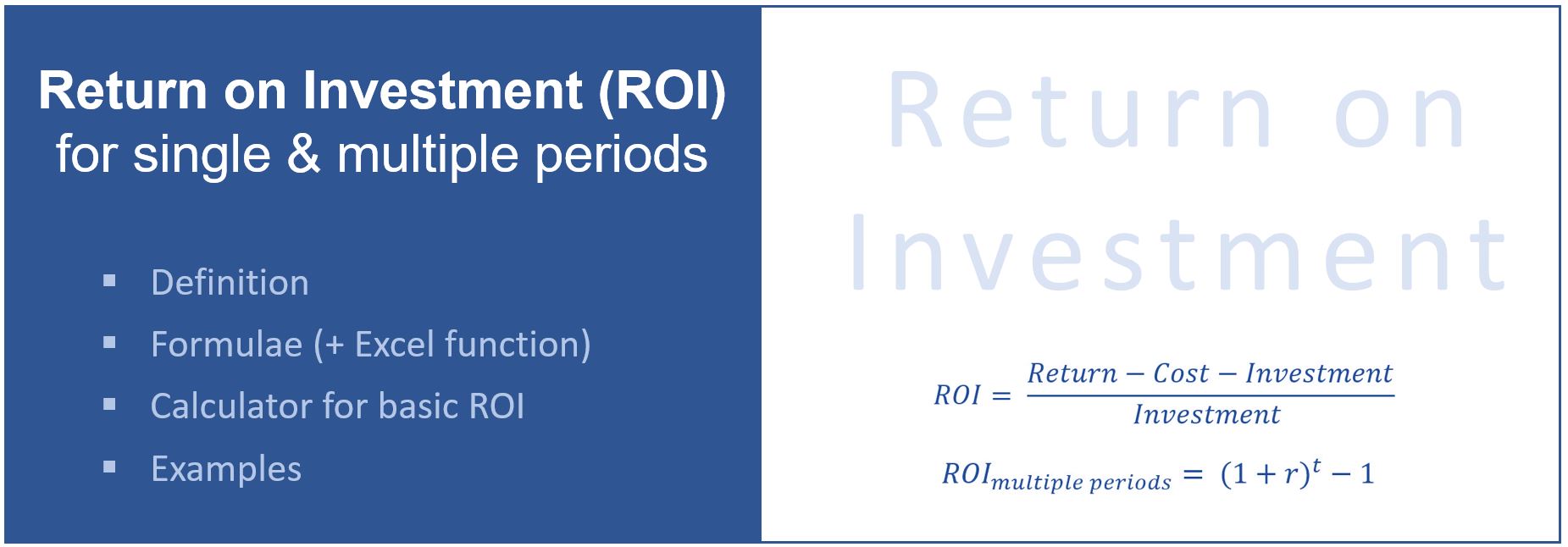
The most common and fundamental formula for calculating ROI is:
ROI = (Net Profit / Cost of Investment) x 100%
Where:
- Net Profit refers to the total monetary gain from an investment after deducting all expenses. This could be sale proceeds minus initial cost, or simply the gain over and above the initial outlay.
- Cost of Investment is the total amount of money initially invested or spent.
For example, if you invest $10,000 in a stock and sell it for $12,000, your net profit is $2,000.
ROI = ($2,000 / $10,000) x 100% = 20%.
This simple calculation provides a clear, digestible figure that indicates the direct financial impact of an investment.
Why ROI Matters
ROI is more than just a number; it’s a decision-making tool. Its importance stems from several key benefits:
- Investment Comparison: ROI allows investors to easily compare the profitability of different investment opportunities, helping them allocate capital to the most lucrative ventures.
- Performance Evaluation: For ongoing projects or businesses, ROI serves as a benchmark to assess past performance and identify areas for improvement.
- Justification for New Projects: Businesses frequently use projected ROI to justify capital expenditures, new product development, or expansion plans to stakeholders and potential investors.
- Risk Assessment: While not a direct measure of risk, a low or negative projected ROI can signal a high-risk investment that may not yield desirable returns.
- Resource Allocation: By identifying where capital generates the highest returns, individuals and organizations can optimize resource allocation strategies.
Applying ROI Estimation Across Financial Scenarios
The power of ROI lies in its versatility. It can be adapted to evaluate a wide spectrum of financial decisions, from personal savings to multi-million dollar corporate projects.
Investment Portfolios and Securities
For individual investors, ROI is crucial for assessing the performance of stocks, bonds, mutual funds, real estate, and other assets within a portfolio. When evaluating an asset you’ve sold, the calculation is straightforward. For assets still held, you might use the current market value as your “sale price” to estimate a potential ROI.
- Example: You bought 100 shares of a company at $50 each ($5,000 total). After a year, the shares are worth $60 each ($6,000 total), and you received $100 in dividends. Your net profit is ($6,000 + $100) – $5,000 = $1,100.
ROI = ($1,100 / $5,000) x 100% = 22%.
Business Projects and Capital Expenditures
Businesses use ROI extensively to evaluate the viability of new initiatives, equipment purchases, or facility upgrades. These calculations often involve estimating future revenues, cost savings, and the lifespan of an asset.
- Example: A manufacturing company invests $500,000 in new machinery. Over five years, this machinery is projected to increase production efficiency, leading to $150,000 in annual cost savings and increased revenue. Total projected benefit = $150,000 x 5 = $750,000.
ROI = ($750,000 – $500,000) / $500,000 x 100% = 50%.
Marketing Campaigns and Sales Initiatives
Marketing departments frequently employ ROI to measure the effectiveness of advertising campaigns, digital marketing efforts, or sales promotions. Here, the challenge lies in accurately attributing sales increases directly to the marketing spend.
- Example: A company spends $20,000 on a digital marketing campaign. This campaign generates an additional $60,000 in sales, with a gross profit margin of 50% on those sales. The net profit directly attributable to the campaign is $60,000 * 50% = $30,000.
ROI = ($30,000 – $20,000) / $20,000 x 100% = 50%.
Education and Personal Development
While less tangible, investing in education, certifications, or personal skill development can also be viewed through an ROI lens. The “return” often comes in the form of higher salaries, promotions, or new career opportunities, while the “cost” includes tuition, fees, books, and foregone income.
- Example: An individual invests $30,000 in a master’s degree program. Post-graduation, their annual salary increases by an average of $10,000. After accounting for taxes and other factors, they calculate an additional $7,000 in disposable income per year directly attributable to the degree. If they project this benefit for 10 years, the total benefit is $70,000.
ROI = ($70,000 – $30,000) / $30,000 x 100% = 133.33%.
Key Considerations for Accurate ROI Estimation
While the basic formula is simple, an accurate ROI estimation requires careful consideration of several factors that can significantly influence the outcome.

Defining All Costs and Benefits
A common pitfall is underestimating costs or overestimating benefits.
- Costs: Include direct costs (purchase price, labor, materials) and indirect costs (overhead allocation, training, maintenance, opportunity cost, financing charges, taxes).
- Benefits: Include direct revenue increases, cost savings, increased efficiency, and potential future growth opportunities. Be conservative with projections.
The Time Value of Money (TVM)
The concept of the time value of money states that a dollar today is worth more than a dollar tomorrow due to its potential earning capacity. Simple ROI calculations often ignore the time horizon, which can distort comparisons between investments with different durations. For long-term investments, using techniques like Net Present Value (NPV) or Internal Rate of Return (IRR) accounts for TVM.
Accounting for Risk and Uncertainty
All investments carry some level of risk. Future returns are never guaranteed. When estimating ROI, it’s prudent to:
- Conduct Sensitivity Analysis: Evaluate ROI under different scenarios (best-case, worst-case, most likely-case) to understand the range of potential outcomes.
- Apply Discount Rates: In more advanced calculations (like NPV), a higher discount rate can be used for riskier projects to reflect the higher required return.
- Factor in Volatility: For market investments, consider historical volatility and potential future price fluctuations.
Incorporating Intangible Benefits
Some investments yield benefits that are difficult to quantify monetarily but still add significant value. These “soft benefits” might include:
- Improved brand reputation
- Increased customer satisfaction
- Enhanced employee morale
- Better data insights
- Strategic alignment with long-term goals
While not directly part of the ROI calculation, these intangibles should be considered in conjunction with the quantitative ROI to provide a holistic view of an investment’s value.
Setting a Realistic Time Horizon
The duration over which you measure ROI significantly impacts the result. A short-term ROI might look great, but a long-term perspective might reveal a different story once recurring costs or deferred benefits are included. Always define the period for which the ROI is being calculated to ensure meaningful comparisons.
Advanced ROI Metrics and Tools
For more complex financial decisions, especially in business finance, specialized metrics go beyond the simple ROI to provide a deeper analysis.
Net Present Value (NPV)
NPV is a capital budgeting tool that calculates the present value of all cash inflows and outflows associated with an investment, discounted at a specific rate (often the cost of capital). A positive NPV indicates that the project is expected to generate more cash flow than its initial cost, after accounting for the time value of money. It is considered superior to simple ROI for long-term project evaluations.
NPV Formula: Σ [Cash Flow / (1 + r)^t] – Initial Investment
Where:
- r = discount rate
- t = number of time periods
Internal Rate of Return (IRR)
IRR is the discount rate that makes the Net Present Value (NPV) of all cash flows from a particular project equal to zero. Essentially, it’s the expected annual rate of growth that an investment is projected to generate. Projects with an IRR higher than the company’s cost of capital are generally considered desirable. IRR provides a single percentage that is easier to compare across different projects than NPV.
Payback Period
The payback period is the time it takes for an investment to generate enough cash flow to recover its initial cost. While it doesn’t consider the time value of money or profitability beyond the payback point, it’s a useful metric for assessing liquidity and risk, especially for projects where rapid capital recovery is critical.
Sensitivity Analysis
This technique involves changing one or more variables in the ROI calculation (e.g., sales volume, cost of materials, discount rate) to see how the ROI changes. It helps identify the variables that have the most significant impact on profitability and quantifies the risk associated with uncertainty in key assumptions.
Limitations and Complementary Metrics
While ROI is a powerful tool, it has limitations and should not be the sole determinant of an investment decision.
Short-Term vs. Long-Term Focus
Simple ROI may not adequately capture long-term strategic value or sustainable growth. An investment with a low short-term ROI might be crucial for future market positioning, research and development, or building brand equity.
Ignoring Scale or Initial Investment Size
A 100% ROI on a $1,000 investment yields $1,000 in profit, whereas a 20% ROI on a $1,000,000 investment yields $200,000. ROI alone doesn’t tell you the absolute dollar return, which is often a more critical factor for large-scale decisions. Therefore, always consider the absolute profit alongside the percentage.
Qualitative Factors and Strategic Alignment
Some investments, particularly in areas like employee training, community relations, or environmental initiatives, may have a low or difficult-to-quantify financial ROI but offer substantial qualitative benefits and contribute significantly to an organization’s mission and long-term sustainability. These strategic considerations often necessitate decisions that go beyond pure financial metrics.
In conclusion, estimating Return on Investment is an indispensable skill for anyone navigating the financial world. By mastering the basic formula, diligently accounting for all relevant costs and benefits, considering the time value of money and risk, and leveraging advanced metrics where appropriate, individuals and businesses can make more informed, profitable, and strategically sound investment decisions. Always remember that ROI is a guide, not a dictator; it should be used in conjunction with a holistic understanding of an investment’s impact and alignment with broader financial and strategic goals.
aViewFromTheCave is a participant in the Amazon Services LLC Associates Program, an affiliate advertising program designed to provide a means for sites to earn advertising fees by advertising and linking to Amazon.com. Amazon, the Amazon logo, AmazonSupply, and the AmazonSupply logo are trademarks of Amazon.com, Inc. or its affiliates. As an Amazon Associate we earn affiliate commissions from qualifying purchases.