
Percentages are a fundamental language in personal and business finance. From calculating interest rates and investment returns to understanding budget allocations and profit margins, a solid grasp of percentages is indispensable. While addition, subtraction, and multiplication of percentages are often intuitive, the concept of “dividing a percent” can sometimes introduce confusion. This guide demystifies the process, exploring its practical applications across various financial scenarios to help you make more informed decisions.
Understanding the Basics: What is a Percent and Why Divide It?
Before delving into the mechanics of division, it’s crucial to solidify our understanding of what a percent truly represents and why one might need to divide it in a financial context.

The Essence of a Percent
A “percent” literally means “per one hundred.” It’s a way to express a number as a fraction of 100. For instance, 25% is equivalent to 25/100 or 0.25 in decimal form. Percentages are powerful because they allow us to standardize comparisons and understand proportions regardless of the absolute numbers involved. A 10% return on a $1,000 investment is proportional to a 10% return on a $100,000 investment, even though the dollar amounts differ significantly.
Practical Scenarios for Dividing Percentages in Finance
While it might seem counterintuitive at first glance, dividing percentages is a common operation in finance, often used to:
- Allocate portions of a percentage: Distributing a budget allocation among multiple categories or individuals.
- Determine proportional shares: Figuring out what percentage each component contributes to an overall percentage.
- Calculate ratios of percentages: Comparing the relative size or efficiency of one percentage against another.
- Break down composite rates: Understanding how an overall rate is split or derived from various sources.
Understanding these scenarios helps contextualize the mathematical operation, moving beyond abstract numbers to real-world financial insights.
Method 1: Dividing a Percentage by a Whole Number
This is perhaps the most straightforward application of dividing a percent. It occurs when you have an existing percentage allocation or rate and need to split it evenly among several parts or periods.
The fundamental principle here is to treat the percentage as its decimal equivalent for calculation.
Steps:
- Convert the percentage to a decimal: Divide the percentage by 100. (e.g., 30% becomes 0.30).
- Divide the decimal by the whole number.
- Convert the result back to a percentage (optional but recommended for clarity): Multiply the decimal result by 100.
Let’s illustrate with financial examples.
Scenario: Budget Allocation
Imagine your personal finance budget allocates 30% of your net income towards “Discretionary Spending.” You want to further subdivide this 30% equally into three sub-categories: “Dining Out,” “Entertainment,” and “Shopping.” What percentage of your total income should each sub-category receive?
- Convert to decimal: 30% = 0.30
- Divide by the whole number: 0.30 / 3 = 0.10
- Convert back to percentage: 0.10 * 100 = 10%
So, 10% of your net income would be allocated to “Dining Out,” 10% to “Entertainment,” and 10% to “Shopping.” This ensures that the sum (10% + 10% + 10%) equals the original 30% discretionary spending.
Scenario: Investment Returns Distribution
A mutual fund reports an average annual return of 12% over the last four years. If you want to understand the average annual contribution to this overall percentage, assuming consistent performance each year, how would you calculate it?
- Convert to decimal: 12% = 0.12
- Divide by the whole number (number of years): 0.12 / 4 = 0.03
- Convert back to percentage: 0.03 * 100 = 3%
This indicates an average contribution of 3% per year to achieve the 12% return over four years, assuming a simple average and not compounding. This type of calculation is useful for simplifying complex returns or for setting annual targets based on long-term goals.
Method 2: Dividing a Percentage by Another Percentage
This method is more complex and often yields a ratio or a multiplier rather than a simple percentage. It’s used when you want to compare two proportional values, asking questions like “how many times greater is X percent than Y percent?” or “what percentage of Y percent is X percent?”.
Steps:
- Convert both percentages to decimals.
- Divide the first decimal by the second decimal.
- Interpret the result: The result is a ratio. If you want to express it as a percentage of the denominator percentage, multiply by 100.
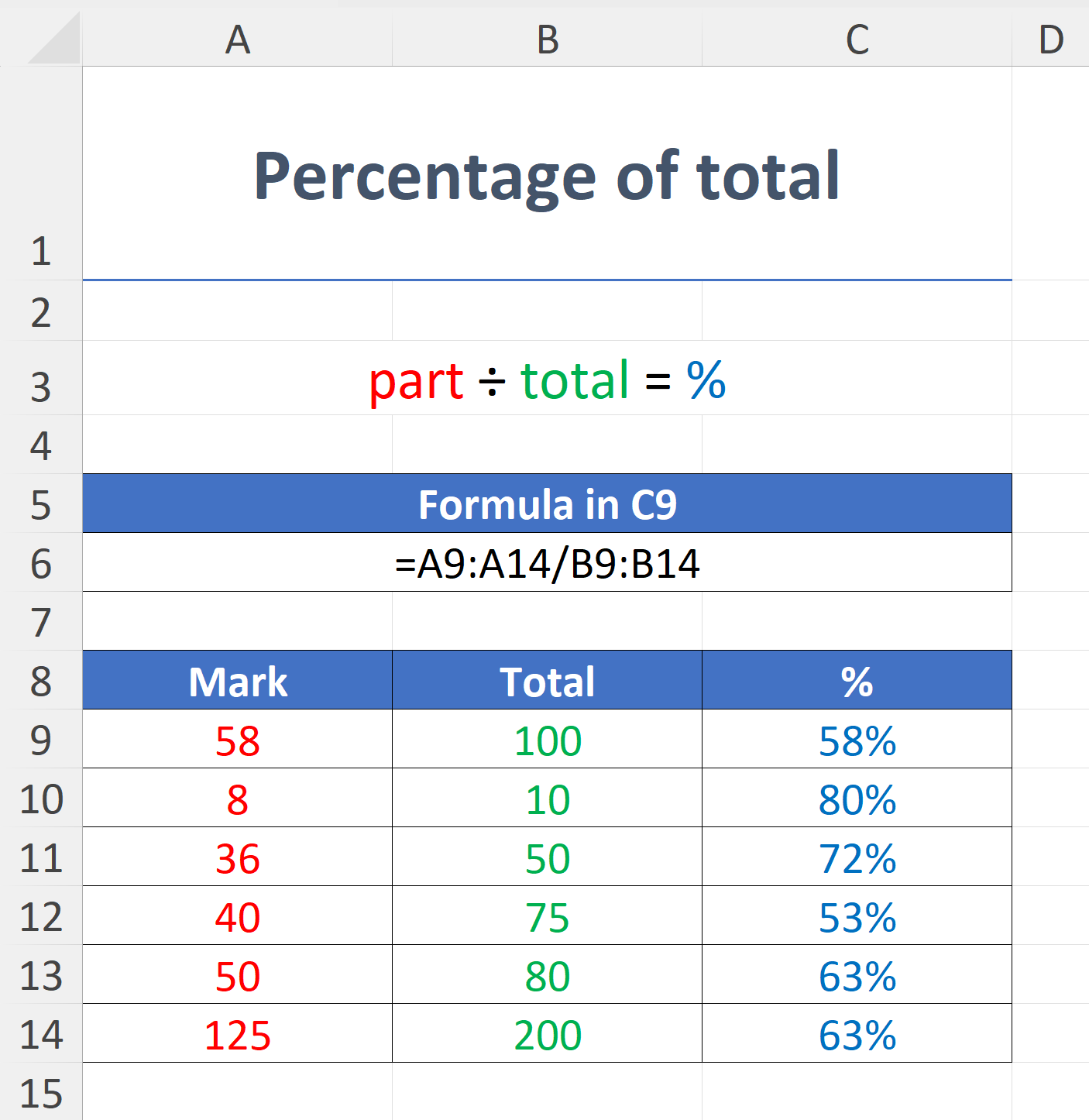
Let’s look at financial applications.
Scenario: Performance Ratios and Efficiency
Consider a company where its Research & Development (R&D) expenditure is 8% of its total revenue, and its Marketing expenditure is 4% of its total revenue. You want to determine how many times larger R&D spending is compared to Marketing spending in relation to revenue.
- Convert to decimals: R&D = 8% = 0.08; Marketing = 4% = 0.04
- Divide R&D by Marketing: 0.08 / 0.04 = 2
The result is 2. This means R&D expenditure is 2 times greater than Marketing expenditure, both as a percentage of total revenue. This isn’t expressing R&D as 2% of something, but rather that its proportion is twice as large.
Alternatively, if you asked “What percentage of marketing spending is R&D spending?”, the answer would be 2 * 100 = 200%.
Scenario: Comparing Proportional Shares
Suppose an investor holds two different stocks in a portfolio. Stock A constitutes 45% of the portfolio’s total value, and Stock B constitutes 15%. How much larger is Stock A’s share compared to Stock B’s share, proportionally?
- Convert to decimals: Stock A = 45% = 0.45; Stock B = 15% = 0.15
- Divide Stock A’s share by Stock B’s share: 0.45 / 0.15 = 3
This indicates that Stock A’s share is 3 times larger than Stock B’s share within the portfolio. This kind of analysis is crucial for understanding concentration risk or comparing relative allocations.
Advanced Applications: When Division Isn’t Just Subtraction
Understanding percentage division extends beyond simple distribution. It underpins more complex financial calculations and analyses, helping investors and financial managers gain deeper insights.
Weighted Averages and Portfolio Rebalancing
While direct percentage division might not be the sole operation, the principles are inherent in calculations involving weighted averages. For example, if you have a portfolio with different asset classes, each with a percentage allocation and its own percentage return, you might divide to understand the proportional impact of one asset’s return relative to another’s, or to a benchmark. When rebalancing a portfolio, if an asset’s allocation has grown from an initial 20% to 30%, you might need to understand its current weight relative to the target to determine how much to sell or buy, involving implicit division of current vs. target percentages.
Calculating Effective Rates and Yields
In finance, you often encounter nominal rates and need to calculate effective rates over different periods. For instance, if a bond offers a 6% annual yield, but you want to understand its quarterly equivalent yield (for simplified comparison), you might initially divide the percentage by 4. However, it’s more accurate to use specific financial formulas involving roots, reflecting compounding. Still, a quick, albeit simplified, approach for apportioning the nominal rate involves division. For example, if an annual fee is 1.2% and it’s billed monthly, dividing 1.2% by 12 gives you 0.1% per month. This is a common simplification for internal budgeting and communication.
Common Pitfalls and Best Practices
While dividing percentages seems straightforward once the methods are clear, several common errors can lead to incorrect financial conclusions.
Confusing Percentages with Decimal Equivalents
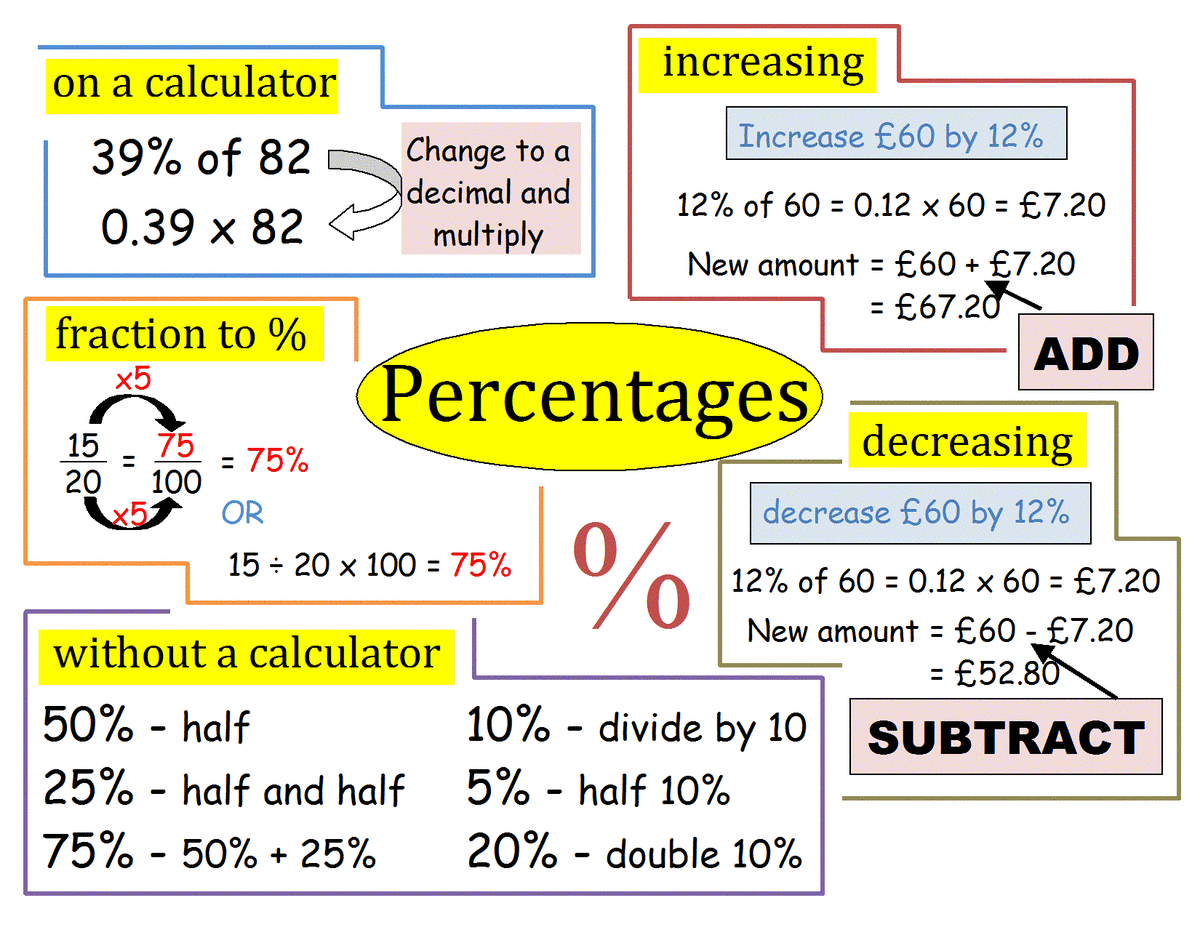
The most frequent mistake is performing operations directly with the percent symbol (e.g., trying to divide 30% by 20% directly in your head without converting). Always remember to convert percentages to their decimal form (divide by 100) before performing any arithmetic operations, and then convert back to a percentage (multiply by 100) if the final result needs to be expressed as a percentage.
Misinterpreting the Base Value
A percentage always relates to a specific “whole” or base value. When dividing percentages, especially when one percentage is divided by another, ensure you understand what each percentage represents and what the result signifies. Is it a portion of the original whole, a ratio, or a multiplier? For example, dividing “20% of revenue” by “10% of profit” would be nonsensical if the bases (revenue and profit) are vastly different and not directly comparable in that context. Always define your terms and the underlying base for each percentage.
Leveraging Financial Tools for Accuracy
For complex financial calculations involving percentages, relying on spreadsheets (like Microsoft Excel or Google Sheets) or specialized financial calculators is a best practice. These tools automatically handle decimal conversions and complex formulas, significantly reducing the chance of manual error.
For example, in Excel:
- To divide a percentage by a whole number: If cell A1 contains 30% and you want to divide by 3, simply use the formula
=A1/3. Excel understands that A1 is a percentage and will perform the calculation correctly, often displaying the result as a percentage automatically if the cell is formatted as such. - To divide a percentage by another percentage: If A1 contains 30% and B1 contains 10%, use
=A1/B1. The result will be 3, indicating that 30% is 3 times larger than 10%.
Mastering the division of percentages enhances your financial literacy, enabling you to dissect complex financial data, allocate resources more effectively, and interpret financial reports with greater precision. By understanding the underlying principles and applying them correctly, you empower yourself to make smarter financial decisions in all aspects of personal and business finance.
aViewFromTheCave is a participant in the Amazon Services LLC Associates Program, an affiliate advertising program designed to provide a means for sites to earn advertising fees by advertising and linking to Amazon.com. Amazon, the Amazon logo, AmazonSupply, and the AmazonSupply logo are trademarks of Amazon.com, Inc. or its affiliates. As an Amazon Associate we earn affiliate commissions from qualifying purchases.