
In the dynamic world of personal finance, investing, business, and daily transactions, understanding percentages is not merely an academic exercise—it’s a critical life skill. From calculating discounts on your shopping to deciphering interest rates on loans, analyzing investment returns, or even determining your profit margins in a side hustle, percentages are the universal language of financial comparison and growth. Mastering this fundamental concept empowers you to make informed decisions, optimize your financial strategies, and navigate the complex monetary landscape with confidence.
This article will demystify the process of calculating percentages, providing clear methodologies and illustrating their indispensable applications across various financial scenarios.

The Fundamental Concept: What is a Percentage?
At its heart, a percentage is a way to express a number as a fraction of 100 (per cent means “per hundred”). It’s a standardized way to represent a proportion or a part of a whole, allowing for easy comparison even when the original “wholes” are vastly different in size. Instead of saying “I got 10 out of 20 questions right” and “my friend got 20 out of 40 questions right,” percentages allow us to instantly see that both achieved 50%, conveying a clear, comparable measure of performance.
Defining the “Part” and the “Whole”
To calculate a percentage, you always need two core components:
- The Part: This is the specific amount or quantity you are interested in expressing as a portion of the whole.
- The Whole (or Base): This is the total amount, the original value, or the complete quantity against which the part is being measured.
When you ask “what is X percent of Y?” X is the percentage you’re looking to apply, and Y is the whole. When you ask “what percentage is X of Y?”, X is the part, and Y is the whole. Understanding which number represents the part and which represents the whole is the first crucial step in any percentage calculation.
Why Percentages Reign Supreme in Finance
The prevalence of percentages in finance stems from their ability to normalize comparisons and clearly communicate proportional change.
- Standardization: Whether you’re comparing a small local business’s growth to a multinational corporation’s, or a modest savings account interest rate to a high-yield investment, percentages provide a common denominator.
- Clarity in Change: An increase of $100 means very different things if your starting point was $1,000 versus $1,000,000. Expressing this as a 10% increase versus a 0.01% increase immediately clarifies the relative magnitude of the change.
- Decision Making: From evaluating loan offers to assessing investment performance, understanding percentage impacts allows for more astute financial planning and risk assessment.
The Core Methods for Calculating Percentages
While calculators and spreadsheets simplify the process, understanding the underlying mathematical principles is key to truly grasping how percentages work and applying them correctly in diverse financial situations.
Method 1: The Decimal Conversion (Simplest Approach)
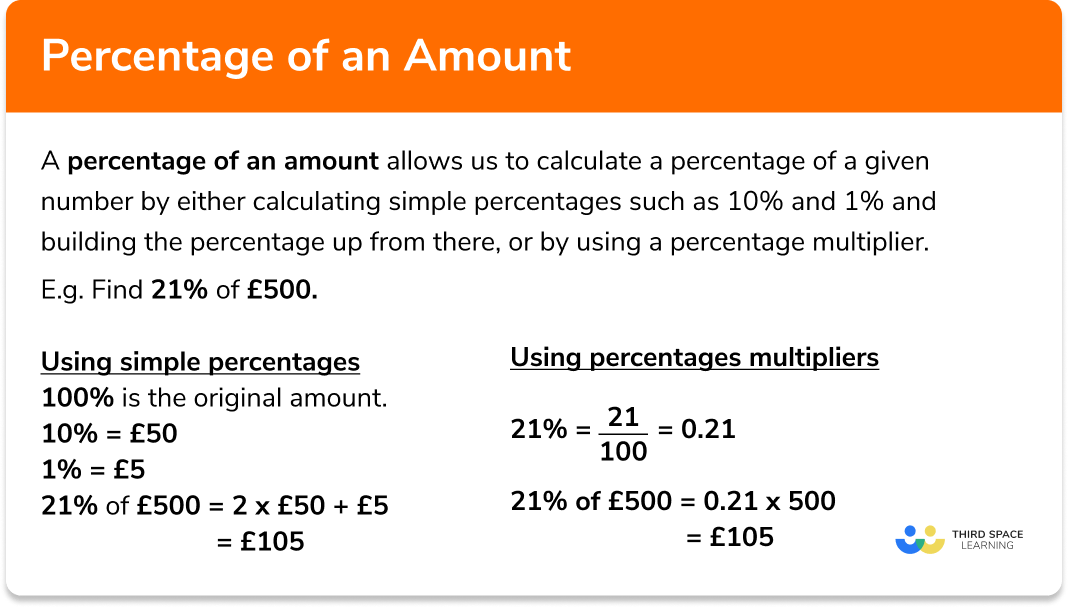
This is perhaps the most straightforward and commonly used method, especially when you need to find a percentage of a number. It involves converting the percentage into its decimal equivalent and then multiplying it by the whole number.
Formula: Percentage of Number = (Percentage / 100) * Whole Number
Or, more simply: Percentage of Number = Decimal Equivalent * Whole Number
To convert a percentage to a decimal, divide it by 100 (or simply move the decimal point two places to the left).
Example: Calculating a Discount
Imagine you’re at a store, and there’s a jacket priced at $150, marked down by 20%. How much will you save, and what’s the final price?
- Convert the percentage to a decimal: 20% / 100 = 0.20
- Multiply by the whole: 0.20 * $150 = $30
- This $30 is your saving.
- Calculate the final price: $150 – $30 = $120
So, a 20% discount on a $150 jacket saves you $30, making the final price $120.
Method 2: The Fractional Approach (Understanding the Ratio)
This method emphasizes the “part over whole” ratio that defines a percentage. It’s particularly useful when you want to figure out what percentage one number is of another.
Formula: Percentage = (Part / Whole) * 100
Example: Calculating Sales Tax
Suppose you bought an item for $85, and the sales tax added was $6.80. What was the sales tax percentage?
- Identify the Part and the Whole:
- Part (sales tax amount) = $6.80
- Whole (original item price) = $85
- Divide the part by the whole: $6.80 / $85 = 0.08
- Multiply by 100 to convert to a percentage: 0.08 * 100 = 8%
The sales tax percentage was 8%.
Method 3: The Proportion Method (When the Percentage is Unknown)
This method uses the concept of equivalent ratios and is excellent for situations where you know three out of four values in a percentage relationship and need to find the fourth. It’s often expressed as:
Formula: Part / Whole = Percentage / 100
You can then cross-multiply and solve for the unknown.
Example: Calculating Investment Return Percentage
You invested $5,000, and after a year, your investment grew to $5,600. What was your percentage return on investment (ROI)?
- Determine the gain (the “part”): $5,600 (new value) – $5,000 (original value) = $600 gain.
- Set up the proportion: We want to find what percentage $600 is of the original investment ($5,000).
600 / 5000 = X / 100
- Cross-multiply:
600 * 100 = 5000 * X60,000 = 5000X
- Solve for X:
X = 60,000 / 5000X = 12
Your investment had a 12% return.
Practical Applications in Personal Finance and Investing
The ability to calculate percentages is not just a mathematical curiosity; it’s a superpower for managing your money effectively.
Navigating Discounts, Sales, and Markups
Every savvy consumer uses percentages to maximize savings. Understanding how to calculate discounts instantly tells you the true value of a sale.
Scenario: Black Friday Savings
A new TV costs $800. During a Black Friday sale, it’s advertised at “25% off plus an additional 10% off for store cardholders.”
- First discount: 25% of $800 = 0.25 * $800 = $200.
- Price after first discount = $800 – $200 = $600.
- Second discount (applied to the new price): 10% of $600 = 0.10 * $600 = $60.
- Final price = $600 – $60 = $540.

Knowing this prevents the common mistake of simply adding percentages (e.g., assuming 25% + 10% = 35% off the original price, which would be $520—a significant difference).
Understanding Interest Rates (Loans, Savings, Credit Cards)
Interest rates, whether you’re paying them or earning them, are almost always expressed as percentages.
Scenario: Compound Interest Growth
You deposit $1,000 into a savings account that offers an annual interest rate of 5%. How much will you have after one year?
- Calculate interest earned: 5% of $1,000 = 0.05 * $1,000 = $50.
- Total after one year: $1,000 + $50 = $1,050.
If this compounds, the next year’s interest would be calculated on $1,050, demonstrating the power of compound interest over time. Conversely, understanding the percentage interest on a credit card balance helps you visualize the true cost of debt.
Deciphering Investment Returns and Fees
When it comes to investments, percentage returns are the metric for success, while percentage fees can quietly erode your gains.
Scenario: Portfolio Performance Analysis
Your investment portfolio was worth $100,000 at the start of the year and grew to $108,000 by year-end. Your broker charged fees totaling $500.
- Gross gain: $108,000 – $100,000 = $8,000.
- Gross percentage return: ($8,000 / $100,000) * 100 = 8%.
- Net gain (after fees): $8,000 – $500 = $7,500.
- Net percentage return: ($7,500 / $100,000) * 100 = 7.5%.
This clearly shows that while an 8% gross return is good, fees reduced your actual profit to a 7.5% net return.
Leveraging Percentages in Business and Side Hustles
For entrepreneurs, small business owners, or anyone with a side hustle, percentages are the backbone of financial analysis and strategic planning.
Calculating Profit Margins and Break-Even Points
Understanding profit margins as a percentage is vital for pricing products and assessing business health.
Scenario: Pricing a Product
You make handmade crafts. Materials cost $15 per item, and you want a 40% profit margin on the selling price. What should you sell it for?
This is a common point of confusion. A 40% profit margin on the selling price is different from a 40% markup on cost.
Let ‘S’ be the selling price.
Profit = S - Cost
Profit Margin % = (Profit / S) * 100
So, 40 = ((S - 15) / S) * 100
0.40 = (S - 15) / S
0.40S = S - 15
15 = S - 0.40S
15 = 0.60S
S = 15 / 0.60
S = $25
You need to sell the item for $25 to achieve a 40% profit margin on the selling price. (Profit: $10, which is 40% of $25).
Analyzing Growth Rates and Market Share
Businesses routinely track growth and market penetration using percentages to benchmark performance and inform strategic decisions.
Scenario: Business Performance Tracking
Your business generated $500,000 in revenue last year and $625,000 this year. What is your year-over-year growth rate?
- Calculate the increase in revenue (the “part”): $625,000 – $500,000 = $125,000.
- Divide by the previous year’s revenue (the “whole”): $125,000 / $500,000 = 0.25.
- Convert to percentage: 0.25 * 100 = 25%.
Your business achieved a 25% year-over-year growth rate.
Managing Commissions, Royalties, and Payroll
Percentages are fundamental to compensation structures and expense management.
Scenario: Sales Team Incentives
A salesperson earns a 15% commission on all sales. If they sold $10,000 worth of products, how much commission do they earn?
- Calculate the commission: 15% of $10,000 = 0.15 * $10,000 = $1,500.
This direct calculation helps in payroll management and setting clear incentive structures.
Tools and Tips for Mastering Percentage Calculations
While the underlying math is simple, there are ways to ensure accuracy and efficiency in your percentage calculations.
The Power of Calculators and Spreadsheets
For complex numbers or numerous calculations, don’t hesitate to use digital tools:
- Basic Calculators: Most have a ‘%’ button, but it’s crucial to understand how your specific calculator handles it (e.g., 150 – 20% might give you the final price directly, or it might just calculate 20% of 150).
- Spreadsheets (Excel, Google Sheets): These are invaluable. You can set up formulas that automatically calculate percentages, track financial data, and perform “what-if” analyses. For example, if A1 is your whole number and B1 is your percentage, you can use
=A1*(B1/100)to find the percentage of the number. To find what percentage A1 is of A2, use=(A1/A2)*100.
Common Mistakes to Avoid
- Order of Operations: When dealing with multiple discounts or taxes, ensure you apply them sequentially to the remaining balance, not the original total.
- Misidentifying the “Whole”: Always be clear about which number represents the base or the total from which the percentage is being calculated.
- Percentage vs. Percentage Point: A shift from 5% to 7% is a 2 percentage point increase, but a (7-5)/5 = 40% percentage increase in the rate itself. This distinction is critical in financial reporting.
- Adding Percentages Incorrectly: As seen in the discount example, you cannot simply add percentage changes unless they are being applied to the same base at the same time.
Developing Your “Percentage Intuition”
With practice, you can develop a quick intuition for common percentages:
- 10% is easy: just move the decimal one place left. (10% of $250 is $25)
- 5% is half of 10%. (5% of $250 is $12.50)
- 20% is double 10%. (20% of $250 is $50)
- 25% is a quarter. (25% of $250 is $62.50)
- 50% is half. (50% of $250 is $125)
These mental shortcuts are incredibly useful for quick estimations and verifying calculator results.
In conclusion, the question “how do you figure out a percentage of a number?” unlocks a vast array of financial understanding and capability. Whether you’re managing your personal budget, evaluating investment opportunities, or running a business, a firm grasp of percentage calculations is an indispensable tool. By understanding the core methods and their practical applications, you gain greater control over your financial destiny, making smarter decisions that contribute to your long-term monetary success.
aViewFromTheCave is a participant in the Amazon Services LLC Associates Program, an affiliate advertising program designed to provide a means for sites to earn advertising fees by advertising and linking to Amazon.com. Amazon, the Amazon logo, AmazonSupply, and the AmazonSupply logo are trademarks of Amazon.com, Inc. or its affiliates. As an Amazon Associate we earn affiliate commissions from qualifying purchases.