
In the intricate world of finance, where numbers dictate everything from daily spending to long-term wealth accumulation, one concept stands out as a universal language: percentages. From calculating a discount on your groceries to understanding the nuances of interest rates on a mortgage, percentages are the bedrock upon which nearly all financial transactions and analyses are built. They are not merely mathematical curiosities but essential tools that empower individuals and businesses to make informed decisions, compare options, and track progress. For anyone seeking true financial fluency, understanding “how to do a percentage” isn’t just about basic arithmetic; it’s about unlocking a deeper insight into monetary flows, investment growth, and budgetary control.

This article delves into the indispensable role of percentages in personal and business finance. We’ll demystify their calculation, explore their myriad applications across various financial contexts, and equip you with the knowledge to wield this fundamental concept with confidence and precision. Whether you’re a budding investor, a shrewd shopper, or a business owner analyzing profit margins, mastering percentages is your gateway to financial empowerment.
The Fundamentals: What is a Percentage and Why Does it Matter in Money?
At its core, a percentage is a way of expressing a number as a fraction of 100. The word “percentage” derives from “per cent,” meaning “per hundred.” It’s represented by the symbol “%” and offers a standardized, easily digestible format to communicate proportions, changes, or ratios. While seemingly simple, its implications in finance are profound and far-reaching.
Defining the Concept: Proportion and Relation
A percentage fundamentally describes a part of a whole or a relationship between two numbers in terms of 100. For instance, if you say “50% of the budget,” it instantly conveys that half of the budget is being discussed. This standardized representation makes comparing different quantities, even those from vastly different total amounts, incredibly straightforward. Instead of comparing a $5 discount on a $100 item to a $50 discount on a $1000 item by their absolute values, percentages (5% for both) immediately reveal their proportional equivalence. This common ground is crucial for consistent financial analysis.
Everyday Financial Applications: Beyond the Obvious
Percentages are woven into the very fabric of our financial lives, often without us consciously realizing it.
- Shopping and Sales: Black Friday deals, seasonal clearances, and loyalty program rewards are all expressed as percentages off the original price.
- Taxes: Sales tax, income tax brackets, property tax rates – these are all percentage-based calculations that directly impact your disposable income and purchasing power.
- Tips: When dining out, calculating a 15-20% tip is a common practice.
- Interest Rates: Whether it’s the interest you earn on a savings account, the rate on a credit card, or the APR (Annual Percentage Rate) on a loan or mortgage, percentages dictate the cost of borrowing and the growth of savings.
- Commissions: Salespeople often earn a percentage of their total sales.
Beyond the Basics: Strategic Financial Insight
Beyond these everyday examples, percentages enable sophisticated financial thinking. They allow for:
- Performance Comparison: How do you compare the success of a small business that grew revenue by $10,000 to a large corporation that grew revenue by $1,000,000? By expressing growth as a percentage, you can compare their relative growth rates.
- Budgeting and Allocation: Allocating specific percentages of your income to housing, savings, debt repayment, and discretionary spending helps create a balanced and sustainable financial plan.
- Investment Analysis: Gauging the return on investment (ROI) or understanding portfolio diversification is invariably done through percentages. A 7% annual return is a clearer metric than a raw dollar figure that varies with the principal amount.
Core Percentage Calculations for Financial Success
Understanding the core methods of calculating percentages is the first step toward financial mastery. These basic formulas are the building blocks for nearly every financial analysis you’ll undertake.
Calculating a Percentage of a Number
This is perhaps the most common application, used to find a specific portion of a whole amount.
Formula: (Percentage / 100) × Whole Amount
Example: You want to find 15% of $200.
- Convert the percentage to a decimal: 15 / 100 = 0.15
- Multiply by the whole amount: 0.15 × $200 = $30
Financial Applications: Calculating sales tax on a purchase, determining the discount amount during a sale, figuring out a commission earned on a sale, or calculating the interest due on a loan for a specific period. If your sales tax is 7% on a $50 item, you’d calculate 0.07 * $50 = $3.50 in tax.
Finding the Percentage One Number Is of Another
This calculation helps you understand the proportion one value represents relative to another.
Formula: (Part / Whole) × 100
Example: You spent $75 on groceries out of a total monthly budget of $500. What percentage of your budget went to groceries?
- Divide the part by the whole: $75 / $500 = 0.15
- Multiply by 100 to get the percentage: 0.15 × 100 = 15%
Financial Applications: Determining what percentage of your income goes to rent, calculating profit margins (profit as a percentage of revenue), assessing the allocation of funds within an investment portfolio, or figuring out your savings rate (savings as a percentage of income).
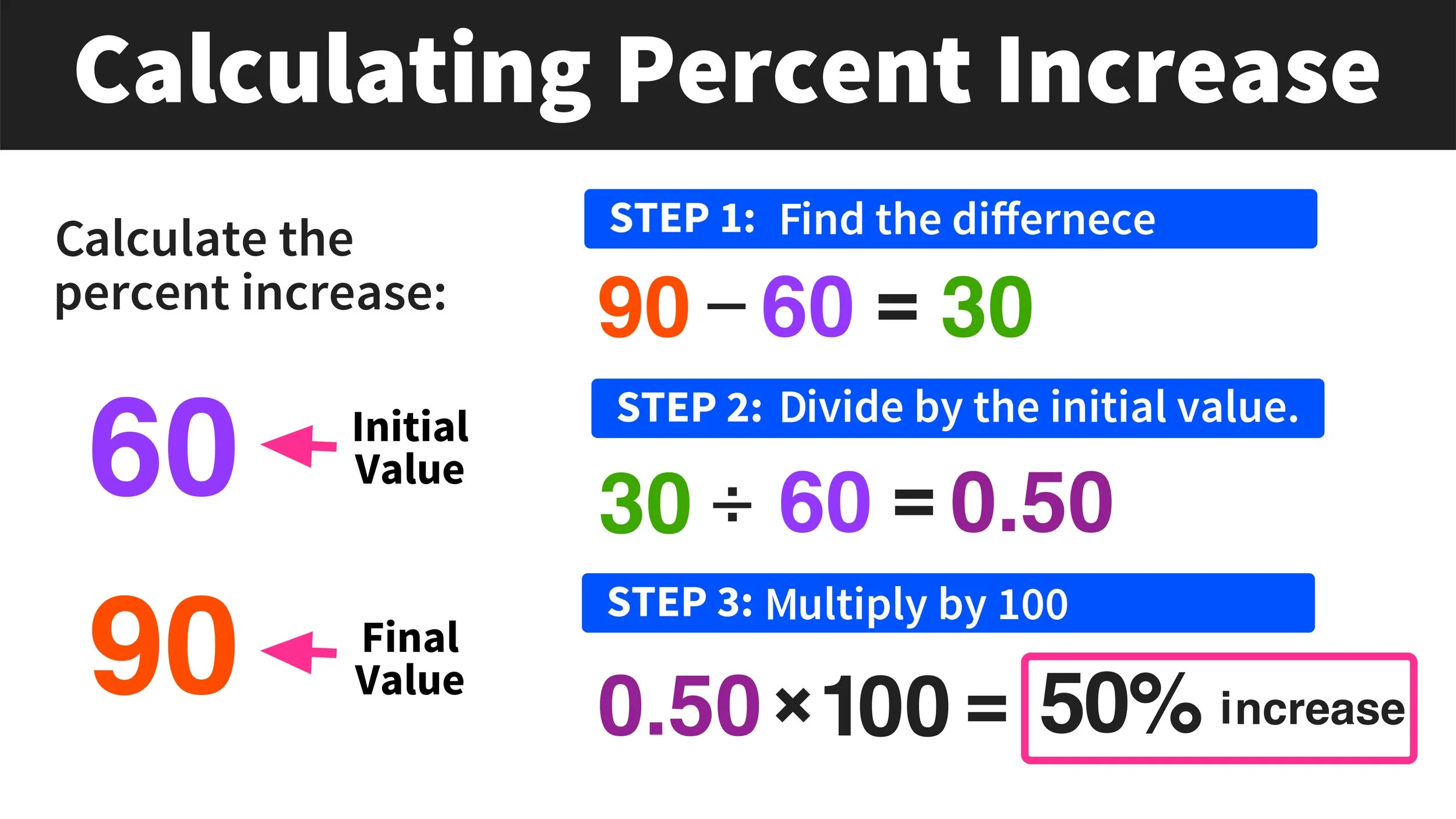
Calculating Percentage Change (Increase or Decrease)
This is vital for tracking growth, decline, and performance over time, whether for investments, revenue, or expenses.
Formula: ((New Value – Old Value) / Old Value) × 100
Example: Your investment portfolio grew from $10,000 to $11,500. What was the percentage increase?
- Find the difference: $11,500 – $10,000 = $1,500
- Divide the difference by the original value: $1,500 / $10,000 = 0.15
- Multiply by 100: 0.15 × 100 = 15% increase
Financial Applications: Analyzing year-over-year revenue growth for a business, tracking the appreciation or depreciation of an asset, understanding inflation rates, or measuring the change in a stock price. If your utility bill went from $80 to $90, that’s a ((90-80)/80)*100 = 12.5% increase.
Working Backwards: Finding the Original Number
Sometimes you know the final amount after a percentage change, and you need to find the starting figure.
Formula for Increase: New Value / (1 + Percentage Increase as Decimal)
Formula for Decrease: New Value / (1 – Percentage Decrease as Decimal)
Example (Increase): You bought an item for $120, which included a 20% markup. What was the original cost?
- Convert percentage to decimal: 20% = 0.20
- Original cost: $120 / (1 + 0.20) = $120 / 1.20 = $100
Example (Decrease): You paid $85 for an item after a 15% discount. What was the original price? - Convert percentage to decimal: 15% = 0.15
- Original price: $85 / (1 – 0.15) = $85 / 0.85 = $100
Financial Applications: Calculating the original price of an item before tax or discount, determining the initial investment required to reach a target future value given an expected return, or understanding the pre-tax income needed to achieve a certain net income.
Advanced Applications: Percentages in Financial Strategy
Beyond basic calculations, percentages are integral to strategic financial planning and complex analyses, offering profound insights into wealth management and business performance.
Compound Interest and Investment Growth
The concept of compound interest—interest earned on both the initial principal and the accumulated interest from previous periods—is perhaps the most powerful demonstration of percentages in action for long-term wealth building.
- Annual Percentage Yield (APY): This reflects the total amount of interest paid on an account over a year, taking into account compounding. It’s crucial for comparing savings accounts or CDs.
- Annual Percentage Rate (APR): This represents the annual cost of borrowing, expressed as a percentage. For loans, particularly credit cards, understanding APR helps in assessing the true cost of debt. A small percentage difference in APY or APR can translate to thousands of dollars over time.

Budgeting and Financial Ratios
Percentages are the backbone of effective budgeting, allowing for flexible allocation and easy comparison regardless of income level.
- The 50/30/20 Rule: A popular budgeting guideline suggesting 50% of income for needs, 30% for wants, and 20% for savings and debt repayment.
- Debt-to-Income Ratio (DTI): Lenders use this percentage to assess your ability to manage monthly payments and repay debts. It’s calculated as total monthly debt payments divided by gross monthly income. A high DTI can hinder loan approvals.
- Savings Rate: This essential metric (monthly savings divided by monthly income) indicates your progress toward financial goals and retirement.
Understanding Financial Statements
In business finance, percentages transform raw numbers into actionable insights.
- Profit Margins: Gross profit margin (gross profit / revenue), operating profit margin (operating profit / revenue), and net profit margin (net profit / revenue) reveal a company’s efficiency at different stages of its operations.
- Return on Investment (ROI): A fundamental metric (net profit / cost of investment) to evaluate the efficiency of an investment or compare the efficiency of different investments.
- Year-over-Year (YoY) Growth: Expressing growth in revenue, profit, or customer base as a percentage compared to the previous year provides a clear trend analysis.
Common Pitfalls and How to Avoid Them
While powerful, percentages can be misleading if not understood and applied correctly. Awareness of common pitfalls is key to accurate financial analysis.
Misinterpreting Percentage Points vs. Percentage Change
This is a critical distinction, especially in economic and financial news. If an interest rate increases from 2% to 3%, that’s a 1 percentage point increase. However, it’s a 50 percent increase (calculated as ((3-2)/2)*100). Confusing the two can lead to vastly different interpretations of financial impacts.
Base Value Confusion
Always ensure you are calculating a percentage based on the correct original or ‘base’ value. For instance, if an item’s price is reduced by 20% and then increased by 20%, it does not return to its original price because the second percentage is calculated on a smaller base. ($100 – 20% = $80; $80 + 20% = $96, not $100).
The Impact of Compounding vs. Simple Interest
Failing to appreciate the dramatic difference between simple interest (calculated only on the principal) and compound interest (calculated on principal plus accumulated interest) can lead to significant misestimations of investment growth or debt accumulation over time. Compound interest, while a friend to investors, can be a formidable foe for those in debt.
Ignoring Inflation
When evaluating investment returns or salary increases, percentages alone might not tell the whole story. A 3% salary increase might feel good, but if inflation is 4%, your real purchasing power has actually decreased by 1%. Always consider the ‘real’ return after accounting for inflation.
Tools and Resources for Mastering Percentage Calculations
Fortunately, you don’t need to be a mathematical prodigy to master percentages. Numerous tools and resources can simplify these calculations and enhance your financial decision-making.
Digital Calculators and Spreadsheets
- Basic Calculators: Most smartphones and dedicated calculators have a ‘%’ button, making quick percentage calculations effortless.
- Spreadsheet Software (Excel, Google Sheets): These are invaluable for more complex financial modeling. Functions like
=(A1/B1)to get a decimal, then formatted as a percentage, or=(A1*B1%)for calculating a percentage of a number, make calculations robust and repeatable. They are essential for budgeting, tracking investments, and business financial analysis.
Online Financial Calculators
Numerous websites offer specialized calculators for various financial scenarios:
- Loan Calculators: Determine monthly payments, total interest paid, and amortization schedules based on interest rates (percentages).
- Investment Growth Calculators: Project the future value of investments, taking into account compound interest and regular contributions.
- Mortgage Calculators: Help understand the impact of different interest rates and down payments on your monthly obligations.
Financial Literacy Resources
Continual learning is key. Books, online courses, and reputable financial websites offer deeper dives into financial concepts, including practical applications of percentages in real-world scenarios. Many financial advisors also provide resources and guidance on understanding these core metrics.
Conclusion
The question “how do you do a percentage?” goes far beyond a simple math problem; it’s a fundamental query about financial literacy and empowerment. From the simplest discount to the most complex investment analysis, percentages are the indispensable tools that allow us to quantify, compare, and strategize within the financial landscape.
By understanding what a percentage represents, mastering the core calculation methods, recognizing their advanced applications in budgeting and investing, and being mindful of common pitfalls, you equip yourself with the ability to navigate financial decisions with greater clarity and confidence. Embrace percentages as your allies in the pursuit of financial well-being. Practice applying them to your daily financial interactions, leverage available digital tools, and continuously seek to deepen your financial acumen. In doing so, you transform abstract numbers into concrete insights, paving the way for smarter financial choices and a more secure future.
aViewFromTheCave is a participant in the Amazon Services LLC Associates Program, an affiliate advertising program designed to provide a means for sites to earn advertising fees by advertising and linking to Amazon.com. Amazon, the Amazon logo, AmazonSupply, and the AmazonSupply logo are trademarks of Amazon.com, Inc. or its affiliates. As an Amazon Associate we earn affiliate commissions from qualifying purchases.