
The festive season, particularly Christmas Eve, brings with it a unique blend of anticipation and quiet reflection. While many businesses wind down, financial markets operate on their own distinct rhythm, often diverging from standard business hours. For investors, traders, and anyone with a vested interest in the financial world, understanding these specific operating hours—especially around major holidays—is not just a matter of curiosity, but a critical component of effective financial planning and strategy. Christmas Eve, while not a full market holiday, typically sees shortened trading sessions, a nuance that can significantly impact market dynamics and individual investment decisions.

This article delves into the specifics of stock market closures on Christmas Eve, primarily focusing on the major U.S. exchanges like the New York Stock Exchange (NYSE) and Nasdaq. We’ll explore the rationale behind these altered schedules, the practical implications for investors, and offer strategies for navigating the unique trading environment that accompanies holiday periods. Understanding these intricacies is paramount for mitigating risk, capitalizing on potential opportunities, and ensuring your financial decisions align with the market’s true operating calendar.
Navigating Holiday Trading: The Nuances of Market Schedules
Financial markets, by their very nature, are designed for continuous operation, reflecting the constant flow of global economic activity. However, national holidays and specific observances necessitate adjustments to these schedules. These changes are not arbitrary; they are embedded in the market’s operational framework to accommodate societal norms, administrative processes, and the well-being of market participants. For investors, recognizing the difference between a full market closure and a shortened trading day is crucial, as each scenario presents distinct challenges and opportunities.
The Rationale Behind Holiday Market Hours
The decision to alter trading hours on holidays like Christmas Eve stems from several practical and cultural considerations. Historically, financial markets have aligned their operating calendars with national holidays to allow employees of exchanges, brokerages, and related financial institutions to observe these significant cultural or religious events. While many people might assume Christmas Eve is a full holiday, its status in the U.S. is often more nuanced, sometimes observed as a half-day or not at all by some sectors, leading to a compromise in market hours.
For stock exchanges, shortened trading days serve a dual purpose. Firstly, they provide a break for market professionals, reducing the administrative burden on clearing houses and settlement systems that operate behind the scenes. Secondly, they acknowledge the typically lower trading volumes and reduced market participation that characterize the periods immediately preceding major holidays. With many institutional traders, fund managers, and retail investors taking time off, market activity naturally decelerates. Maintaining full trading hours under such conditions could lead to disproportionate price swings due to thin liquidity, making a shortened session a pragmatic solution to ensure orderly markets while still allowing for necessary transactions. This balance helps to mitigate excessive volatility that could arise from fewer active participants and the resulting wider bid-ask spreads.
Key Stock Exchanges and Their Policies
In the United States, the two primary stock exchanges are the New York Stock Exchange (NYSE) and the Nasdaq Stock Market. Both exchanges generally follow similar holiday schedules, though there can be subtle differences. On full holidays, such as Christmas Day (December 25th), both the NYSE and Nasdaq are entirely closed, along with the bond markets. This means no trading activity occurs, and all market services are suspended.
However, Christmas Eve (December 24th) is often treated differently. Historically, if Christmas Eve falls on a weekday, the NYSE and Nasdaq typically observe an early close. This means trading will conclude earlier than the standard 4:00 PM ET closing time. This early closure applies not only to equity markets but often extends to options and futures trading as well, though specific derivatives markets may have their own unique hours. It is imperative for market participants to always consult the official holiday schedule published annually by the respective exchanges, as these policies can occasionally be subject to minor adjustments or variations based on the day of the week the holiday falls on or other unforeseen circumstances. For instance, if Christmas Eve falls on a weekend, the market’s normal weekend closure would supersede any early closure policy.
Christmas Eve: A Closer Look at Trading Times
Understanding the precise timing of market closures on Christmas Eve is essential for anyone engaged in trading or investing. It dictates when orders can be placed and executed, when portfolios can be adjusted, and when critical market data ceases to flow. The specifics often vary slightly year to year, but a general pattern emerges for the major U.S. equity markets and other financial instruments.
NYSE and Nasdaq: Specific Closing Times
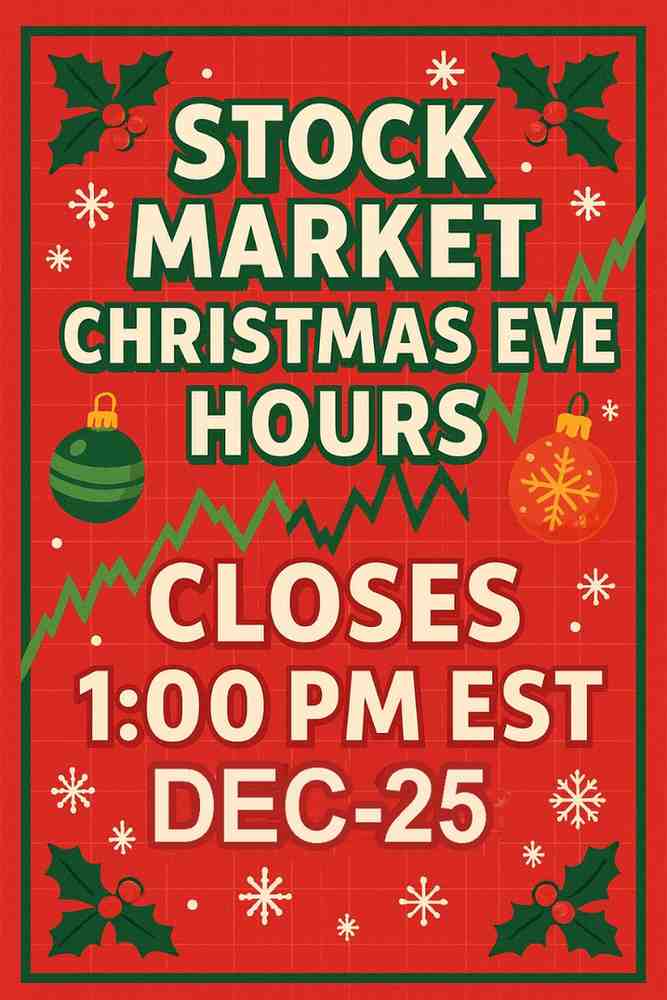
For both the New York Stock Exchange (NYSE) and the Nasdaq Stock Market, if Christmas Eve (December 24th) falls on a weekday, the equities markets typically close early. The standard closing time for these exchanges is 4:00 PM Eastern Time (ET). On Christmas Eve, however, they will generally close at 1:00 PM ET. This three-hour truncation significantly shortens the trading day, meaning investors have less time to react to news or execute trades.
This early closure applies to regular trading hours. Pre-market and after-hours trading sessions may also be affected, often being either shortened or entirely cancelled on such days. While specific brokerages might still allow clients to place orders during these extended hours, the liquidity and execution certainty during these periods on an early-closure day can be significantly lower than usual. It’s crucial for traders to verify their brokerage’s specific policies regarding pre-market and after-hours trading around holiday schedules. This uniform early closure ensures consistency across the major U.S. equity markets, simplifying planning for institutional and retail investors alike.
Bond Market and Other Financial Instruments
While equity markets close early, the bond market often follows a similar, if not earlier, schedule. The Securities Industry and Financial Markets Association (SIFMA) typically recommends an early close for the bond market on Christmas Eve. Historically, the bond market, including trading in U.S. Treasuries, corporate bonds, and municipal bonds, may close as early as 2:00 PM ET on Christmas Eve, sometimes even earlier than the equity markets. It’s important to note that SIFMA’s recommendations are generally followed by most major financial institutions and bond trading desks, but it’s always wise to confirm with specific brokers or platforms.
Other financial instruments, such as options and futures contracts, also adhere to modified schedules. Futures contracts traded on exchanges like the CME Group (Chicago Mercantile Exchange) might have their own distinct early closing times or even full closures depending on the specific contract (e.g., equity index futures, commodity futures, currency futures). These schedules can be complex and vary by asset class and exchange. Investors trading these instruments must consult the official websites of the relevant exchanges (e.g., CBOE for options, CME for futures) for precise holiday trading hours. Furthermore, currency markets (Forex), which typically trade 24 hours a day, five days a week, might also experience reduced liquidity and wider spreads on Christmas Eve, even if they technically remain open.
International Markets: A Brief Overview
The impact of Christmas Eve on trading hours is not confined to the U.S. financial markets. Many international exchanges, particularly those in predominantly Christian countries or those with strong historical ties to Western cultures, also observe altered schedules. For instance, stock exchanges in the UK, Europe (e.g., Germany, France), Canada, Australia, and parts of Asia might also implement early closures or even full closures on Christmas Eve, known as “bank holidays” in some regions.
The specific timing will vary by country and exchange. For example, the London Stock Exchange typically closes early on Christmas Eve. Conversely, markets in countries where Christmas is not a primary public holiday might maintain regular trading hours, though they could still experience reduced activity due to the global interconnectedness of financial markets and the reduced participation of international investors. Investors with portfolios exposed to global markets must diligently track the holiday calendars of each relevant exchange to avoid unexpected non-trading days or early closures that could impact their international holdings or trading strategies. This global patchwork of holiday schedules underscores the necessity of thorough pre-planning for any internationally diversified investor.
Why Shortened Sessions Matter: Impact on Investors and Trading Strategies
The mere act of shortening a trading day might seem minor, but its ripple effects across market dynamics and investor behavior can be significant. Early closures are not just about convenience; they fundamentally alter the trading environment, demanding a more strategic approach from market participants.
Reduced Liquidity and Increased Volatility
One of the most immediate and profound impacts of a shortened trading day, especially around a major holiday like Christmas Eve, is the significant reduction in market liquidity. Liquidity refers to the ease with which an asset can be converted into cash without affecting its market price. When fewer participants are trading—due to holidays, vacations, or a general slowdown—there are fewer buyers and sellers in the market. This reduction in volume means that even relatively small buy or sell orders can have a disproportionately large impact on prices, leading to wider bid-ask spreads and increased price volatility.
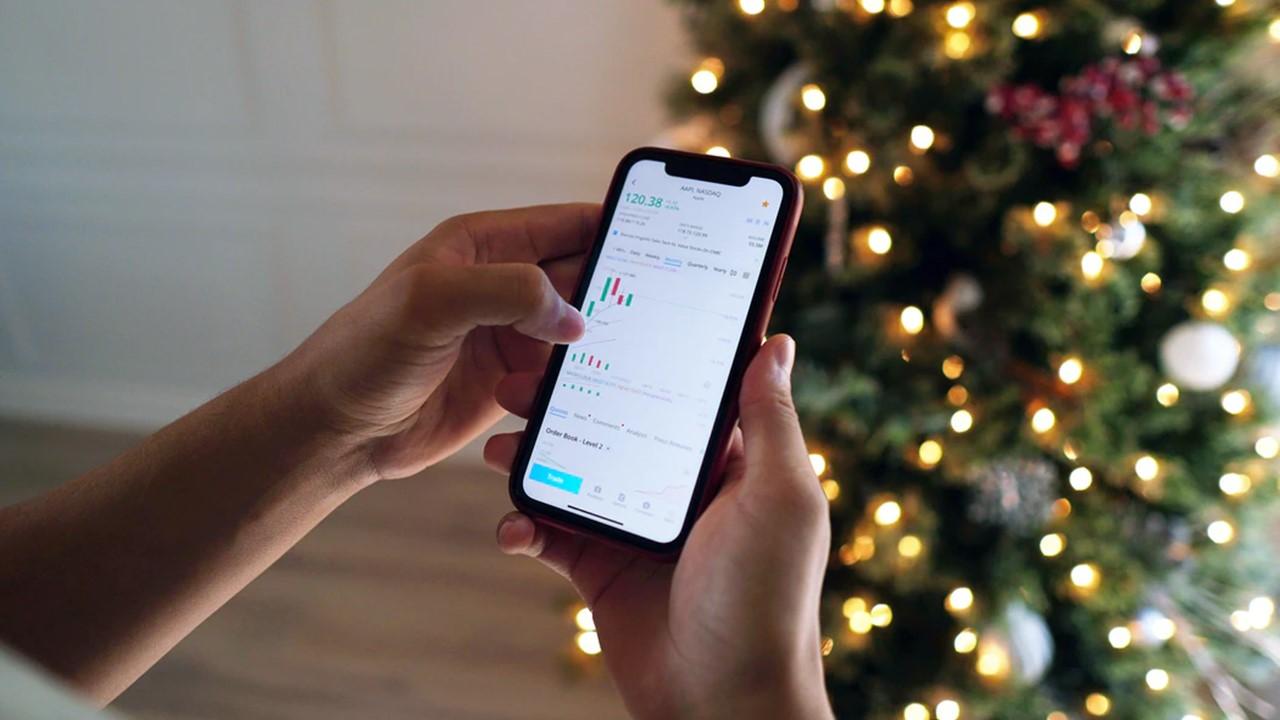
For investors, this can translate into several challenges. Executing large orders might become difficult without causing significant price slippage. Stop-loss orders, designed to limit losses, might be triggered at prices far worse than anticipated if a sudden price swing occurs on low volume. Similarly, trying to enter or exit positions quickly could lead to less favorable execution prices. The reduced liquidity also makes the market more susceptible to “thin market rallies” or “flash crashes,” where a lack of opposing orders allows prices to move rapidly and dramatically in one direction.
The “Santa Claus Rally” and Other Holiday Effects
Shortened trading sessions around holidays can also coincide with, or even influence, well-known market phenomena. One such effect is the “Santa Claus Rally,” a recurring tendency for stock prices to rise during the last five trading days of December and the first two trading days of January. While the exact causes are debated—ranging from year-end tax planning, institutional window dressing, general holiday optimism, or even simply self-fulfilling prophecy—shortened holiday trading days can amplify its characteristics. Lower liquidity on days like Christmas Eve might, paradoxically, make it easier for smaller buying pressures to move markets upward, contributing to this festive surge.
Conversely, some market participants might use early closures for “tax-loss harvesting” at year-end, selling losing positions to offset capital gains, which could exert downward pressure on specific stocks. These holiday-specific behaviors, combined with the structural changes of a shortened trading day, create a unique and often unpredictable market environment that seasoned investors must account for. Understanding these subtle behavioral patterns is as important as knowing the market’s operational hours.
Operational Considerations for Traders
For active traders, the implications of an early market close are highly practical. Day traders, who rely on intraday price movements, have a significantly smaller window of opportunity. Their strategies, which might be optimized for full-day volatility patterns, need to be adjusted for a truncated session. The typical “lunchtime lull” or end-of-day surge patterns might be compressed or entirely absent.
Furthermore, managing open positions overnight or over the extended holiday weekend becomes a critical risk management concern. With the market closed for an extended period, any significant news, geopolitical events, or economic data releases that occur during the closure can lead to large “gaps” in pricing when the market reopens. This “gap risk” can be substantial, as positions cannot be adjusted until trading resumes. Therefore, traders must carefully assess their exposure and consider closing out positions or using options to hedge against potential price shocks before the early close on Christmas Eve. The operational challenges extend beyond mere timing; they encompass risk assessment, strategy modification, and psychological preparation for a less predictable market.
Practical Tips for Holiday Trading
Navigating holiday trading periods, especially early closures like Christmas Eve, requires a disciplined and informed approach. Without proper preparation, investors and traders can find themselves exposed to unnecessary risks or miss out on opportunities. Here are some practical tips to consider.
Pre-Planning and Due Diligence
The most crucial step is proactive planning. Always check the official holiday schedules published by the relevant exchanges (NYSE, Nasdaq, SIFMA, CME, etc.) well in advance. Do not rely on assumptions. Note down not just full closures but also early closing times for all markets relevant to your portfolio, including equities, bonds, options, and futures. This due diligence extends to understanding your brokerage’s specific policies for order execution, settlement, and customer support during holiday periods.
Beyond just knowing the hours, consider the broader market context. Research any major economic reports, earnings announcements, or geopolitical events scheduled around the holiday period. These could influence market sentiment and price action, even in a shortened session. Review your current portfolio: identify any positions that might be particularly vulnerable to reduced liquidity or potential news over the extended break. This proactive review allows for strategic adjustments rather than reactive panic.
Managing Risk in Thin Markets
Given the heightened volatility and reduced liquidity characteristic of thin holiday markets, robust risk management is paramount. Traders should consider reducing their position sizes or avoiding highly speculative trades altogether. Wider stop-loss orders might be necessary to accommodate potential price swings without premature triggering, but be mindful of the increased slippage risk.
For longer-term investors, the advice is often simpler: consider avoiding active trading during these periods unless absolutely necessary. The marginal gains from trying to capitalize on short-term holiday fluctuations might not outweigh the increased risks. If you must trade, prioritize highly liquid assets and avoid illiquid small-cap stocks that can be disproportionately affected by low trading volumes. Remember that even seemingly minor trades can have outsized impacts in a thinly traded environment.
Utilizing Post-Market and Pre-Market Trading
While the regular trading session on Christmas Eve is shortened, some investors might consider utilizing pre-market and after-hours trading sessions offered by their brokers. However, this comes with a significant caveat: liquidity during these extended hours is typically even thinner than during a shortened regular session. This can lead to even wider bid-ask spreads and greater price volatility.
While pre-market and after-hours trading can offer flexibility, they are generally recommended only for experienced traders who understand the inherent risks. If you do engage, use limit orders rather than market orders to ensure your trades are executed at or near your desired price. Market orders in a low-liquidity environment can lead to unexpected and unfavorable execution prices. For most retail investors, it’s often safer to complete all necessary transactions during the shortened regular trading hours or to wait until the markets return to their full schedule after the holiday.
Beyond Christmas Eve: Other Important Market Holidays
The principles learned from navigating Christmas Eve closures extend to a host of other market holidays throughout the year. Understanding the various types of closures and knowing where to find official information is a cornerstone of responsible investing.
Full Market Closures vs. Early Closures
It’s critical to distinguish between full market holidays, when exchanges are entirely shut down, and early closure days, when trading concludes ahead of schedule. Full market holidays in the U.S. typically include:
- New Year’s Day
- Martin Luther King, Jr. Day
- Presidents’ Day (Washington’s Birthday)
- Good Friday
- Memorial Day
- Juneteenth National Independence Day
- Independence Day (July 4th)
- Labor Day
- Thanksgiving Day
- Christmas Day
On these days, no trading occurs. Early closures, like Christmas Eve, are less frequent but require just as much attention. Other potential early closure days might include the day after Thanksgiving (Black Friday) for the equity markets, and often early closures for the bond market on the day before other major holidays. Each market segment (equities, bonds, options, futures) may have its own specific variations, making constant vigilance necessary.
Preparing for Future Holiday Schedules
To ensure you are always prepared, bookmark the official holiday calendars of the major exchanges you interact with. The NYSE and Nasdaq publish their holiday schedules well in advance, usually for the upcoming year, on their respective websites. SIFMA also provides a bond market holiday calendar. Make it a habit to check these resources at the beginning of each year or whenever you plan significant trading activity around a holiday period.
Incorporating these schedules into your financial planning calendar will help you avoid surprises, manage your risk effectively, and make informed decisions about your portfolio. Whether it’s the quiet early close of Christmas Eve or a full market shutdown, understanding when the market is open—and when it’s not—is a fundamental aspect of successful money management and investing. By treating holiday schedules as an integral part of your financial strategy, you empower yourself to navigate the market with confidence and precision, regardless of the festive distractions.
aViewFromTheCave is a participant in the Amazon Services LLC Associates Program, an affiliate advertising program designed to provide a means for sites to earn advertising fees by advertising and linking to Amazon.com. Amazon, the Amazon logo, AmazonSupply, and the AmazonSupply logo are trademarks of Amazon.com, Inc. or its affiliates. As an Amazon Associate we earn affiliate commissions from qualifying purchases.