
The New York Stock Exchange (NYSE), often dubbed “The Big Board,” stands as a monumental pillar of global finance, a symbol of capitalist enterprise and a daily barometer for economic health. For both seasoned investors and curious onlookers, understanding its operational hours is fundamental to comprehending market dynamics, investment strategies, and the rhythm of the financial world. The question of “what time does the NYSE open and close?” goes beyond a simple clock reading; it delves into the structured environment that facilitates trillions of dollars in transactions annually and dictates the pulse of global investing.
The NYSE maintains a remarkably consistent and well-defined schedule, a tradition steeped in history yet continually adapting to the demands of modern finance. Its hours are meticulously planned to foster liquidity, ensure fair trading, and provide a predictable framework for market participants worldwide. This article will thoroughly explore the standard trading hours, delve into the critical importance of these timings, examine the nuances of extended-hours trading, touch upon the historical evolution of market operations, and offer practical considerations for investors navigating this bustling financial arena.
The Standard Trading Hours of the New York Stock Exchange
At its core, the NYSE operates on a clear and consistent schedule, forming the backbone of the North American equity market. This predictability is crucial for maintaining order and efficiency in an otherwise dynamic and often volatile environment.
Understanding the Regular Trading Session
The New York Stock Exchange’s regular trading session begins at 9:30 AM Eastern Time (ET) and concludes at 4:00 PM ET, Monday through Friday. This 6.5-hour window is the period when the vast majority of trading volume occurs, characterized by high liquidity and tighter bid-ask spreads, making it the primary focus for most investors and traders. The opening bell, a long-standing tradition, signals the commencement of trading, often accompanied by a celebratory ringing by a dignitary or corporate executive. Similarly, the closing bell marks the end of the regular session, concluding the day’s official price discovery.
These hours are carefully chosen, considering the interplay with other major global financial centers. The 9:30 AM ET opening allows for overlap with the closing hours of European markets and the morning hours for North and South American markets, facilitating a continuous flow of capital and information across continents. The standardization of these hours ensures that all participants, from large institutional investors to individual retail traders, have equal access to the market during its most active phase.
Weekends and Federal Holidays: When the Market Rests
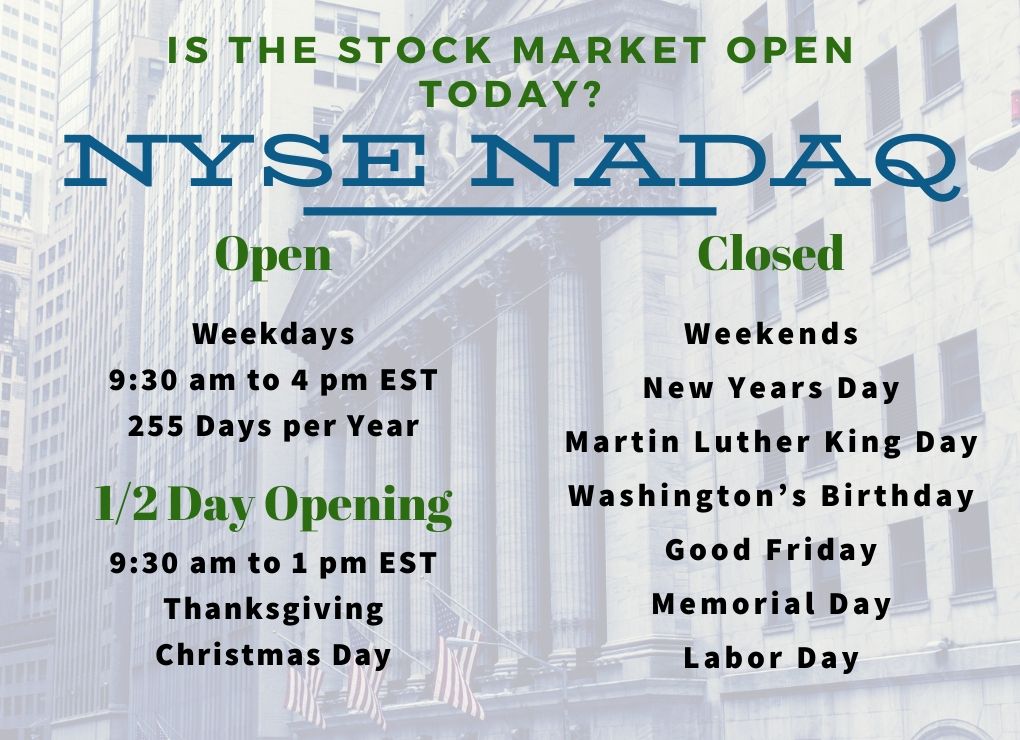
While the market’s activity during the week is relentless, the NYSE, like most major exchanges globally, observes a number of holidays throughout the year, during which it remains closed. These closures align mostly with U.S. federal holidays and certain other traditional observances, ensuring that the financial sector can pause and reflect, and staff can observe these national holidays.
Common NYSE holidays include:
- New Year’s Day
- Dr. Martin Luther King, Jr. Day
- Presidents’ Day
- Good Friday
- Memorial Day
- Juneteenth National Independence Day
- Independence Day (July 4th)
- Labor Day
- Thanksgiving Day
- Christmas Day
It’s also important to note that if a holiday falls on a weekend, the market will typically close on the preceding Friday or the following Monday. Additionally, the NYSE may occasionally have early closures, such as on the day after Thanksgiving (Black Friday), where it might close at 1:00 PM ET. These exceptions are usually announced well in advance, allowing investors to adjust their strategies accordingly. These periods of closure are vital not just for observance but also for preventing erratic trading volumes and ensuring that banks and other financial infrastructure are fully operational when the market is open.
Why These Hours Matter: Impact on Investors and Traders
The specific opening and closing times of the NYSE are far more than mere scheduling details; they are critical factors that profoundly influence market behavior, trading strategies, and the overall investor experience.
Market Liquidity and Volatility Dynamics
The concentrated 6.5-hour trading window is instrumental in creating the deep liquidity that defines the NYSE. When millions of buyers and sellers converge during these specific hours, it leads to a high volume of transactions, ensuring that orders can be executed quickly and efficiently without significantly impacting the price. This high liquidity results in tighter bid-ask spreads, meaning the difference between the highest price a buyer is willing to pay and the lowest price a seller is willing to accept is minimal, benefiting all participants.
Conversely, the market often exhibits heightened volatility during the first and last hours of the trading day. The opening hour frequently sees a flurry of activity as traders react to overnight news, economic data releases, and pre-market trading activity. Similarly, the closing hour can be volatile due to institutional investors making large block trades, portfolio rebalancing, or individual traders trying to get in or out of positions before the market closes. Understanding these patterns is key for day traders seeking to capitalize on short-term price movements and for long-term investors aiming for optimal entry or exit points.
The Significance of the Opening and Closing Bells
The ceremonial ringing of the opening and closing bells at the NYSE is a deeply symbolic act that underscores the significance of these market transitions. The opening bell marks the start of a new day for price discovery. All the news, earnings reports, economic data, and global market movements that occurred since the previous close are absorbed and priced into the market during this initial period. This often leads to significant price gaps and rapid movements in the first few minutes, making it a critical time for active traders.
The closing bell signals the end of official market operations for the day. It’s a moment when final trades are settled, and the closing prices for all listed securities are established. These closing prices are vital for calculating portfolio values, setting benchmarks, and influencing subsequent pre-market trading. The period leading up to the closing bell can also see a surge in activity, often driven by institutional investors executing “market-on-close” orders designed to match the closing price, which can create its own set of unique trading dynamics.
Global Market Interplay
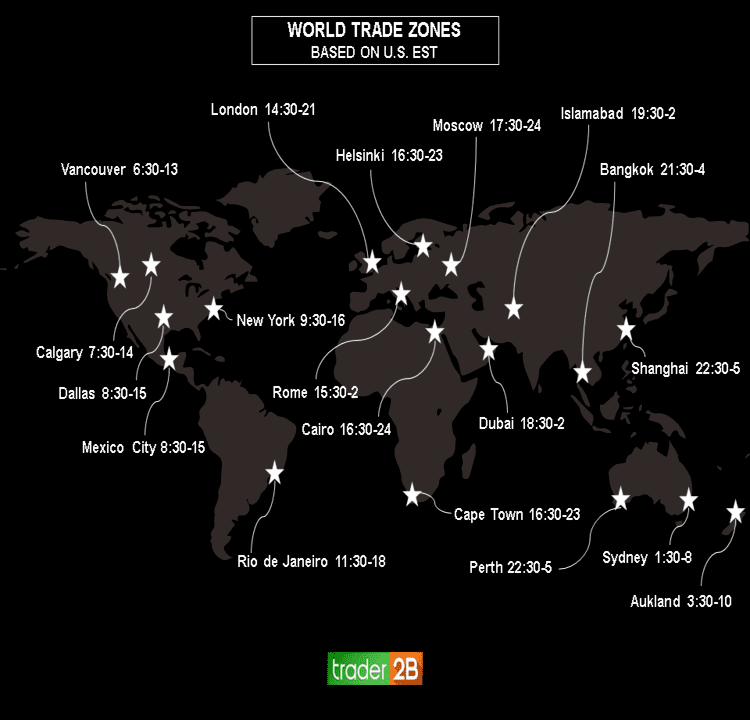
The NYSE’s trading hours are not isolated; they exist within a complex ecosystem of global financial markets. Its 9:30 AM to 4:00 PM ET schedule creates strategic overlaps with other major exchanges, fostering a continuous, nearly 24-hour cycle of global trading. For instance, the NYSE opens as European markets like the London Stock Exchange are nearing their closing hours, allowing for a smooth handover of global trading sentiment and liquidity. Similarly, the NYSE’s afternoon coincides with the early morning trading in parts of Asia when their markets reopen, further connecting the financial world.
This interplay means that events or news breaking in one region can ripple across others, influencing prices and trading volumes. An economic announcement from Europe, for example, might influence the NYSE open, while a major earnings report released after the NYSE close could dictate the sentiment for Asian markets overnight. Investors with diversified global portfolios must be acutely aware of these interconnections and the impact of time zones on their investment decisions.
Beyond Standard Hours: Pre-Market and After-Hours Trading
While 9:30 AM to 4:00 PM ET represents the official trading session, the world of stock trading extends beyond these boundaries, offering opportunities and challenges in what is known as extended-hours trading.
Pre-Market Trading: Setting the Stage
Pre-market trading typically begins as early as 4:00 AM ET and runs until the regular market opens at 9:30 AM ET. This period allows certain market participants, primarily institutional investors and, increasingly, retail investors through electronic communication networks (ECNs), to place orders and execute trades before the opening bell.
Pre-market activity is often driven by significant news releases, such as quarterly earnings reports, mergers and acquisitions announcements, or major economic data, which are frequently disseminated before the market officially opens. Traders use this window to react to these developments, potentially positioning themselves ahead of the regular session. However, pre-market trading is characterized by significantly lower liquidity and wider bid-ask spreads compared to regular hours, making prices more volatile and potentially less reflective of true market sentiment.
After-Hours Trading: Reacting to News
Following the regular 4:00 PM ET close, after-hours trading typically continues until 8:00 PM ET. Similar to pre-market, this segment allows for trading outside the standard session, largely through ECNs. Companies often choose to release crucial information, such as quarterly earnings or guidance revisions, after the market closes, giving investors and analysts time to digest the information without the immediate pressure of an open market.
After-hours trading serves as a crucial period for investors to react to these post-market announcements. A company reporting better-than-expected earnings, for instance, might see its stock price surge in after-hours trading, while a negative announcement could lead to a sharp decline. Like pre-market, after-hours trading also suffers from reduced liquidity and increased volatility, which can lead to larger price swings on relatively low trading volumes.
Risks and Rewards of Extended-Hours Trading
Engaging in pre-market or after-hours trading comes with both potential benefits and significant drawbacks. The primary reward is the ability to react immediately to breaking news, potentially capitalizing on early price movements or mitigating losses before the regular session. It offers flexibility for those who cannot trade during standard hours and allows for quicker position adjustments.
However, the risks are substantial. The most prominent risk is lower liquidity, meaning fewer buyers and sellers are active. This can lead to wider bid-ask spreads, making it more expensive to execute trades and potentially causing significant price dislocations. Higher volatility is another concern; with less trading volume, a single large order can disproportionately move the stock price. Furthermore, price transparency can be reduced, as not all trading platforms display the full scope of extended-hours quotes. Finally, there’s less regulatory oversight in some aspects compared to regular trading, and most orders may not be executed at the desired price due to market conditions. For these reasons, extended-hours trading is generally recommended for experienced investors who understand and can manage its inherent risks.
Historical Context and Evolution of Trading Hours
The NYSE’s operational hours are not arbitrary; they are a product of centuries of evolution, shaped by technological advancements, regulatory changes, and the ever-increasing interconnectedness of global finance.
From Manual Parity to Digital Precision
The NYSE’s roots trace back to the Buttonwood Agreement of 1792, establishing a trading environment that was entirely manual. In those early days, trading hours were less rigid, dictated more by daylight and the practicalities of human interaction on a physical trading floor. As the exchange grew and evolved through the 19th and 20th centuries, hours became more formalized, often influenced by banking hours and the physical constraints of clearing and settling trades. The move from shouting orders in a pit to sophisticated electronic trading platforms has been a transformative journey.
For much of its history, the NYSE had even longer trading hours than today, sometimes extending to six or even seven hours, but often closing for a mid-day break. The current 9:30 AM to 4:00 PM ET schedule largely solidified in the 20th century as financial markets became more integrated and the need for standardized, predictable operating hours became paramount. The transition from purely manual trading to hybrid and eventually predominantly electronic trading allowed for greater efficiency and the very possibility of extended-hours trading that we see today.
Adapting to Modern Market Demands
In recent decades, discussions about further extending the NYSE’s regular trading hours, or even moving to a 24/7 model, have periodically surfaced. These discussions are often driven by advancements in technology, the rise of global markets, and the increasing influence of cryptocurrencies, which operate around the clock. Proponents argue that longer hours could offer greater flexibility for international investors and allow for faster reactions to global news.
However, the NYSE has largely maintained its traditional 6.5-hour regular session. The reasons for this are multifaceted:
- Liquidity Concentration: Concentrating trading within specific hours ensures maximum liquidity, which is vital for fair pricing and efficient execution. Spreading trading over longer periods could dilute liquidity and increase volatility.
- Operational Demands: The periods outside regular trading hours are crucial for market maintenance, system updates, regulatory checks, and the processing of the previous day’s trades.
- Human Element: Despite technological advancements, the market still relies heavily on human participants, analysts, and support staff, who need predictable working hours.
- Regulatory Framework: The current regulatory structure is largely built around the established trading day, and extending hours would necessitate significant changes to oversight, compliance, and settlement processes.
While the “bell-to-bell” regular session remains a constant, the availability of pre-market and after-hours trading demonstrates a pragmatic adaptation to modern demands, offering flexibility without completely dismantling the proven structure of the main trading day.
Practical Considerations for Investors
Understanding NYSE trading hours is not merely an academic exercise; it has tangible implications for how investors approach the market and manage their portfolios.
Time Zones and International Investing
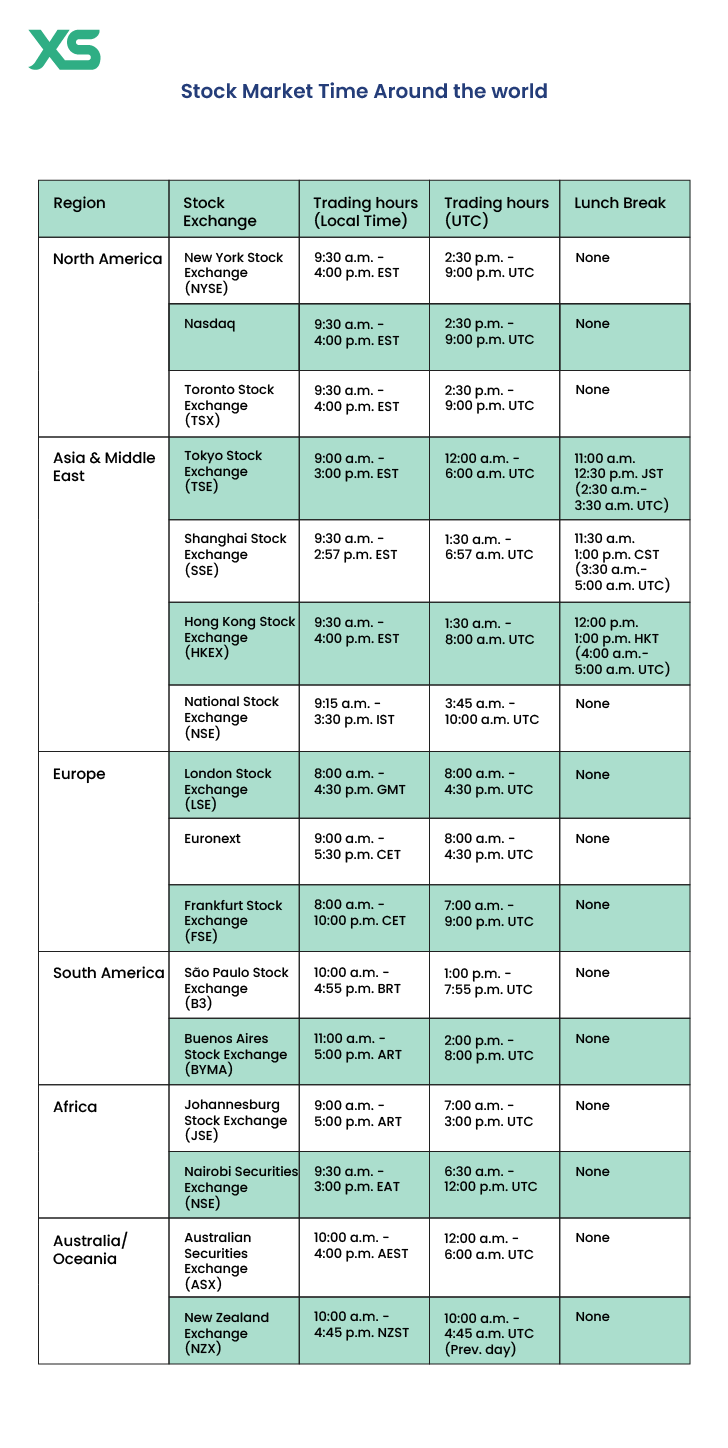
For investors located outside the Eastern Time zone, accurately converting NYSE hours to their local time is critical. A trader in London (GMT) must remember that 9:30 AM ET is 2:30 PM GMT, and a trader in Hong Kong (HKT) would see the market open at 9:30 PM HKT. This conversion is vital for planning when to monitor news, place trades, or respond to market movements. International investors also need to juggle the operating hours of their local exchanges with those of the NYSE, especially if they are involved in multi-market strategies or investing in American Depository Receipts (ADRs). Many financial news sites and brokerage platforms provide tools to help with these time zone conversions, making it easier for global participants to stay informed and active.
Developing a Trading Strategy Around Market Hours
Different types of investors will factor NYSE hours into their strategies in various ways:
- Day Traders: These short-term traders often focus on the opening and closing hours, leveraging the increased volatility and liquidity to execute rapid trades. They are keenly aware of the immediate reactions to news and economic data.
- Swing Traders: Those holding positions for a few days to a few weeks will pay attention to market close for establishing positions and the opening for executing trades, but are less concerned with minute-by-minute fluctuations.
- Long-Term Investors: For investors with a horizon of months or years, the daily opening and closing times are less critical. Their focus is on fundamental analysis and long-term trends, though they will still monitor major news released outside trading hours that could impact their holdings.
- Algorithmic Traders: Automated systems are often programmed to react to market conditions during regular hours, and some are specifically designed for the unique dynamics of pre-market and after-hours trading.
Regardless of the strategy, understanding when the market is most active, when news is typically released, and when liquidity is highest or lowest, is fundamental to effective decision-making.
Utilizing Financial Tools and Resources
In today’s digital age, investors have a wealth of tools at their disposal to stay informed about NYSE trading hours and related market activity. Online brokerage platforms provide real-time market data, often including extended-hours quotes and indicators of market liquidity. Financial news websites and apps offer constant updates on market openings, closures, and holiday schedules, often with customizable alerts.
Many platforms also allow investors to set specific order types, such as “good till canceled” or “fill or kill,” which can manage how trades are executed relative to market hours. Utilizing these resources effectively allows investors to navigate the complexities of NYSE trading hours with greater confidence and make more informed decisions, ensuring their investment activities align with their personal schedules and strategic goals. The digital age has certainly empowered individual investors, making the once-exclusive world of market timing more accessible than ever before.
aViewFromTheCave is a participant in the Amazon Services LLC Associates Program, an affiliate advertising program designed to provide a means for sites to earn advertising fees by advertising and linking to Amazon.com. Amazon, the Amazon logo, AmazonSupply, and the AmazonSupply logo are trademarks of Amazon.com, Inc. or its affiliates. As an Amazon Associate we earn affiliate commissions from qualifying purchases.