
The Dow Jones Industrial Average (DJIA) stands as one of the most recognizable and historically significant stock market indices in the world. Often cited as a barometer for the health of the American economy, its performance, particularly reaching new record highs, captures the attention of investors, economists, and the general public alike. A “record high” for the Dow isn’t merely a numerical achievement; it signifies periods of robust economic growth, strong corporate earnings, investor optimism, and a confluence of market-driving forces that propel stock valuations to unprecedented levels. Understanding what these peaks represent, the factors that fuel them, and their implications is crucial for anyone navigating the complexities of modern financial markets.

As of early 2024, the Dow Jones Industrial Average has consistently pushed into new territory, frequently surpassing its previous closing highs. While market conditions are dynamic, the DJIA has seen significant milestones, often breaching psychological thresholds like 35,000, 36,000, and even 38,000 points, with the all-time closing record high currently hovering around 38,800-39,000 points in recent months (e.g., February/March 2024), continuously being updated by daily market activity. These figures are not just abstract numbers; they reflect the collective optimism and perceived value of America’s largest and most influential companies. To truly grasp the significance of these milestones, we must delve deeper into the nature of the Dow, its historical trajectory, and the economic engines behind its remarkable ascent.
Understanding the Dow Jones Industrial Average (DJIA)
To appreciate the gravity of a Dow Jones record high, one must first understand the index itself. Far from a comprehensive measure of the entire stock market, the DJIA is a price-weighted average of 30 significant companies listed on U.S. stock exchanges.
A Century of Industrial Barometer
Conceived by Charles Dow in 1896, the Dow Jones Industrial Average initially comprised 12 industrial stocks. Its purpose was to track the performance of the most influential American industries, providing a snapshot of the nation’s economic vitality. Over its more than 125-year history, the composition of the Dow has evolved dramatically, reflecting shifts in the American economy from heavy manufacturing to technology, finance, and consumer services. Despite its age and anachronistic “industrial” name, it remains a widely watched indicator, largely due to its historical legacy and the sheer size and influence of its constituent companies.
The “Blue-Chip” Index: Composition and Methodology
The 30 companies that comprise the Dow are often referred to as “blue chips” – well-established, financially sound, and leading corporations with a long history of stable earnings. Examples include giants like Apple, Microsoft, Johnson & Johnson, Walmart, and Coca-Cola. Unlike market-capitalization-weighted indices (like the S&P 500), the Dow is price-weighted. This means that stocks with higher share prices have a greater impact on the index’s movement than stocks with lower share prices, regardless of their total market value. This methodology has its critics, as a $1 change in a high-priced stock moves the index more than a $1 change in a low-priced stock, even if the latter represents a larger percentage change or a larger company. However, for many, its simplicity and focus on dominant companies provide a clear, albeit narrow, lens into market sentiment.
Why the Dow Still Matters in a Modern Market
In an era of sophisticated financial tools and broader indices, some question the relevance of the Dow. Yet, its enduring appeal stems from several factors. Its history provides a valuable long-term perspective on market cycles and economic trends. Furthermore, the companies within the Dow are household names, making the index easily relatable for average investors. Media outlets frequently lead their financial news with the Dow’s performance, solidifying its place in public consciousness. While professional investors often prefer the broader S&P 500 or even total market indices for a more accurate representation of market health, the Dow’s psychological impact and symbolic value remain undeniable, especially when it reaches record highs, signaling a period of perceived prosperity.
The Journey to New Peaks: A Historical Perspective
The Dow’s journey to successive record highs is a testament to the long-term growth trajectory of the U.S. economy and corporate America. Each new peak is not just a statistical anomaly but often marks the culmination of specific economic cycles and market dynamics.
Defining “Record High”: More Than Just a Number
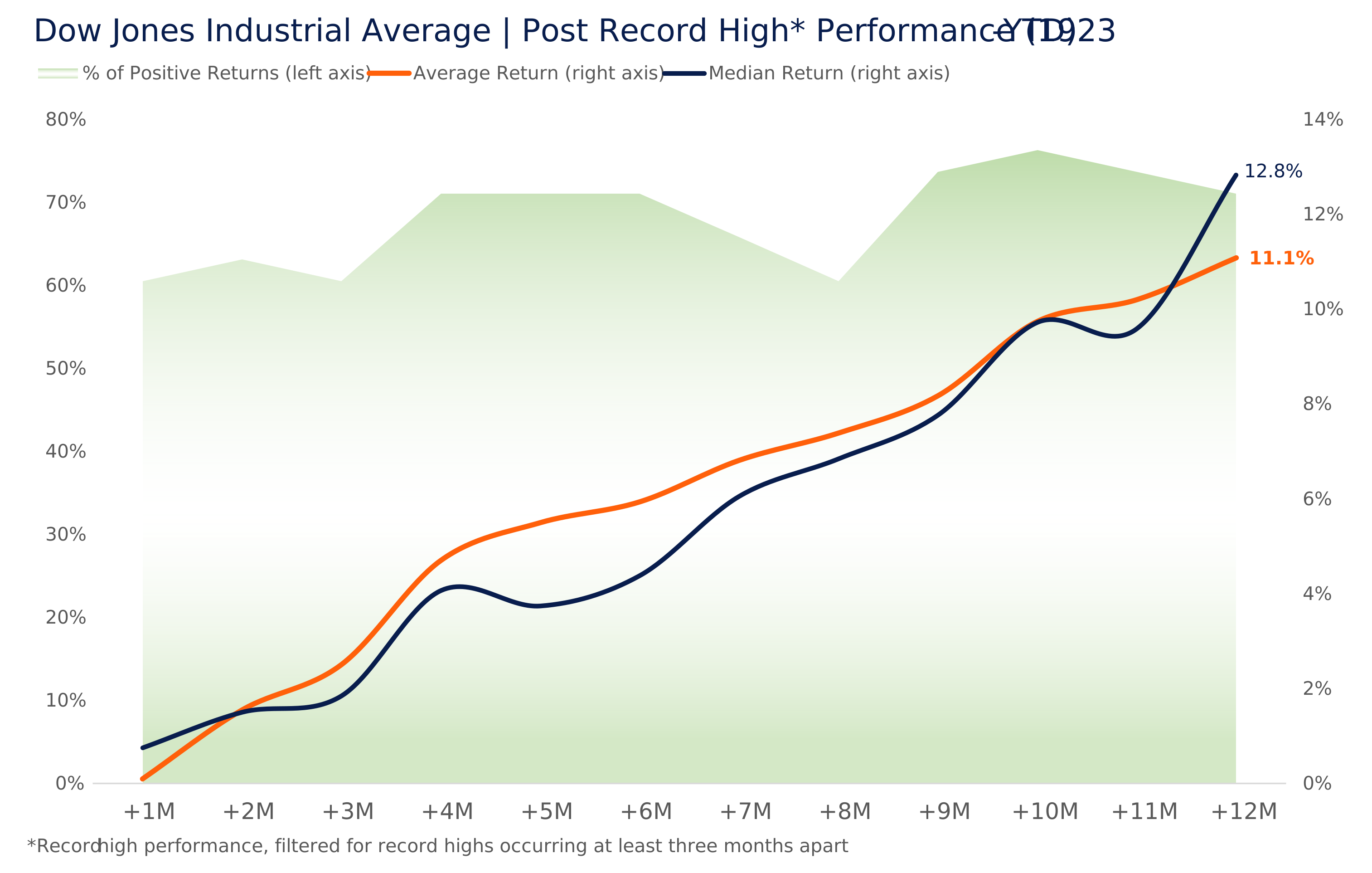
A “record high” for the Dow typically refers to its highest closing price ever recorded. While intra-day highs might momentarily exceed this, the closing price is the official benchmark. Reaching a new record high is often celebrated as a sign of economic strength and investor confidence. However, it’s crucial to understand that these highs are nominal values, not adjusted for inflation. A record high today, while numerically impressive, doesn’t always reflect the same purchasing power as a record high from decades past. Nevertheless, the symbolic power of surpassing previous peaks fuels optimism and often encourages further investment, creating a self-reinforcing cycle in bull markets.
Key Milestones and Market Eras
The Dow’s history is punctuated by remarkable growth phases. Post-World War II saw significant expansion as the U.S. became an economic superpower. The 1990s witnessed the Dot-Com boom, pushing the Dow past 10,000 for the first time, driven by technology and globalization. The recovery following the 2008 financial crisis demonstrated the market’s resilience, with a prolonged bull run that saw the Dow consistently breaking new ground throughout the 2010s. More recently, the post-pandemic recovery, fueled by unprecedented fiscal and monetary stimulus, rapid vaccine development, and adapting corporate strategies, propelled the Dow to unprecedented heights, quickly recovering from the initial economic shock and setting new records above 30,000, 35,000, and approaching 40,000 points. Each era had its unique drivers, but a common thread has been innovation, adaptability, and investor belief in the future growth of leading American enterprises.
The Psychology of Market Peaks and Investor Behavior
Market peaks are deeply intertwined with investor psychology. When the Dow hits new records, it often generates a sense of euphoria and a fear of missing out (FOMO) among potential investors, drawing more money into the market. This positive feedback loop can accelerate price appreciation. Conversely, experienced investors might view new highs with a degree of caution, wondering if valuations are becoming stretched and anticipating a potential correction. Understanding this duality – the excitement of growth versus the prudence of risk management – is essential for making informed investment decisions during such periods. The emotional component often plays a significant role in market momentum, both upwards and downwards.
Drivers Behind the Dow’s Ascent: Economic and Corporate Catalysts
The Dow’s climb to record highs is not accidental; it is the culmination of various economic and corporate forces working in tandem. Identifying these catalysts provides deeper insight into the market’s performance.
Corporate Earnings and Profitability
At the core of any stock market rally is corporate profitability. Companies in the Dow are typically industry leaders, and their ability to consistently grow revenues, manage costs, and deliver strong earnings is a primary driver of their stock prices. When corporate profits are robust and exceed expectations, it signals a healthy business environment, justifying higher valuations. Technological advancements, efficient global supply chains, and effective management strategies all contribute to enhancing these companies’ bottom lines, directly fueling the Dow’s upward trajectory.
Monetary Policy and Interest Rates

Central bank policies, particularly those of the U.S. Federal Reserve, exert immense influence on market performance. During periods of economic uncertainty or slow growth, central banks often implement expansionary monetary policies, such as lowering interest rates and quantitative easing. Lower interest rates make borrowing cheaper for companies, encouraging investment and expansion. They also make bonds less attractive relative to stocks, pushing investors towards equities in search of higher returns. Conversely, when inflation risks emerge, the Fed may raise rates, making money more expensive and potentially slowing market gains. The recent era of historically low interest rates following the 2008 crisis and the COVID-19 pandemic significantly contributed to the multi-year bull market and record highs.
Technological Innovation and Sectoral Shifts
The Dow’s composition has continuously adapted to reflect the evolving economy. The inclusion and strong performance of technology giants like Apple and Microsoft have been pivotal in recent record highs. Technological innovation drives productivity gains, creates new markets, and enables companies to operate more efficiently. From cloud computing and artificial intelligence to biotechnology and renewable energy, these advancements translate into significant revenue growth and investor enthusiasm for the companies at the forefront. The ability of Dow components to innovate and adapt to these shifts is critical to their long-term success and the index’s overall performance.
Geopolitical Stability and Consumer Confidence
A stable geopolitical environment generally fosters greater investor confidence. Reduced international tensions, predictable trade policies, and effective governance create a more favorable climate for business investment and consumer spending. Consumer confidence, in particular, plays a vital role. When consumers feel secure about their jobs and financial futures, they are more likely to spend, which in turn boosts corporate revenues and profits. Conversely, geopolitical instability or significant declines in consumer sentiment can quickly reverse market gains and trigger corrections.
Implications for Investors and the Broader Economy
Record highs for the Dow Jones are not just news headlines; they carry significant implications for individual investors and the wider economy.
The Wealth Effect and Consumer Spending
When stock markets reach new highs, investors often experience a “wealth effect.” As the value of their investment portfolios increases, they tend to feel wealthier and more secure, which can lead to increased consumer spending. This boost in consumption can further stimulate economic growth, creating a positive feedback loop that supports businesses and employment. However, it’s also important to remember that the wealth effect primarily benefits those who own stocks, potentially exacerbating wealth inequality if a significant portion of the population is not participating in the stock market.
Portfolio Management in a High-Value Market
For investors, record highs present both opportunities and challenges. While rising markets are favorable, they can also lead to concerns about overvaluation. Investors might wonder whether to “take profits” or if the market still has room to grow. In such an environment, disciplined portfolio management becomes even more crucial. This includes regularly rebalancing portfolios to maintain desired asset allocations, reviewing investment goals, and assessing the risk tolerance. Chasing high-flying stocks without due diligence can be perilous, as corrections can occur swiftly.
Is a Record High a Sign of Overvaluation or Robust Health?
This is a perennial debate among financial analysts. A record high could signify genuine, robust economic health and strong corporate fundamentals, suggesting that valuations are justified by future growth prospects. However, it could also indicate that asset prices have outpaced underlying economic realities, leading to an overvalued market susceptible to a significant correction. Analysts use various metrics, such as price-to-earnings (P/E) ratios, to assess market valuation. A high P/E ratio, especially when compared to historical averages, might suggest that the market is “expensive.” Discerning between healthy growth and speculative froth requires careful analysis of multiple economic indicators and corporate performance metrics.
Diversification and Risk Management in Bull Markets
Even in a strong bull market reaching record highs, diversification remains a cornerstone of prudent investment strategy. Relying too heavily on a few top-performing stocks or a single asset class can expose an investor to undue risk. While the Dow itself represents 30 diverse blue-chip companies, individual investors should ensure their broader portfolio includes a mix of asset classes, sectors, and geographies to mitigate potential downturns. Furthermore, maintaining an emergency fund and investing only capital that one can afford to lose are fundamental risk management principles that become even more salient when markets appear to be at their peak.
Navigating the Future: Sustaining Momentum Amidst Volatility
The financial markets are characterized by constant flux. While record highs reflect current optimism, the future is always uncertain, with a myriad of factors influencing the Dow’s trajectory.
Current Economic Headwinds and Tailwinds
Looking ahead, the Dow’s ability to maintain or surpass its current record highs will depend on a delicate balance of economic forces. Tailwinds might include continued technological innovation, potential productivity gains, strong consumer spending, and manageable inflation. Conversely, headwinds could involve persistent inflationary pressures forcing central banks to maintain higher interest rates, geopolitical conflicts, supply chain disruptions, or a slowdown in global economic growth. The interplay of these forces will dictate whether the market sustains its upward momentum or faces a period of consolidation or correction.
The Role of Innovation and Disruption
Innovation remains a powerful engine for market growth. Companies that can disrupt existing industries, create new products and services, and adapt to changing consumer demands are likely to continue driving corporate earnings and stock values. The Dow’s continued relevance will depend on its ability to evolve its composition to include these innovative leaders. As sectors shift and technology advances, the index must reflect the cutting edge of American enterprise to accurately serve as an economic barometer.
Long-Term Investing Principles in Dynamic Markets
For the long-term investor, periods of record highs and subsequent volatility reinforce the importance of foundational investment principles. These include a long-term perspective, regular investing (dollar-cost averaging), diversification, and avoiding emotional decisions based on short-term market fluctuations. While the allure of quick gains during a market boom can be strong, successful investing often involves patience and adherence to a well-thought-out financial plan. The Dow’s journey through numerous cycles, including booms and busts, underscores the resilience of the market over the long run and the potential rewards for those who stay invested with a strategic approach.
In conclusion, the record high for the Dow Jones Industrial Average is a multi-faceted phenomenon. It’s a reflection of corporate strength, economic dynamism, and investor sentiment. While it signals prosperity and builds confidence, it also necessitates a prudent and analytical approach from investors. Understanding the “what” and “why” behind these market milestones empowers individuals to make more informed decisions, navigate the ever-evolving financial landscape, and ultimately contribute to their long-term financial well-being.
aViewFromTheCave is a participant in the Amazon Services LLC Associates Program, an affiliate advertising program designed to provide a means for sites to earn advertising fees by advertising and linking to Amazon.com. Amazon, the Amazon logo, AmazonSupply, and the AmazonSupply logo are trademarks of Amazon.com, Inc. or its affiliates. As an Amazon Associate we earn affiliate commissions from qualifying purchases.