
For many investors, opening a brokerage app to see a sea of red can trigger an immediate sense of anxiety. The question “Why is the market down today?” is one of the most searched queries in the financial world, yet the answer is rarely monolithic. The stock market is a complex, living ecosystem influenced by a tapestry of macroeconomic data, corporate performance, geopolitical shifts, and the collective psychology of millions of participants.
Understanding the mechanics behind a market downturn is essential for any investor looking to move beyond emotional reactions and toward strategic decision-making. Whether it is a minor correction or the start of a more significant bearish trend, today’s market movement is the result of specific financial catalysts.
1. Macroeconomic Headwinds and Central Bank Policy
The most common culprit behind a broad market sell-off is the shifting landscape of macroeconomic policy, specifically the actions taken by central banks like the Federal Reserve. Markets thrive on liquidity and predictability; when either is threatened, prices tend to retract.
The Impact of Inflation and Interest Rates
Inflation is perhaps the most significant “invisible hand” in the modern economy. When the Consumer Price Index (CPI) or Personal Consumption Expenditures (PIE) price index comes in higher than anticipated, the market reacts negatively. High inflation erodes the purchasing power of consumers and increases the input costs for businesses, ultimately squeezing profit margins.
To combat inflation, central banks raise interest rates. This makes borrowing more expensive for corporations looking to expand and for consumers looking to buy homes or cars. From an investment perspective, higher rates increase the “discount rate” used to value future cash flows. This hits growth stocks—particularly in the tech sector—the hardest, as their valuations are built on the promise of future earnings that are now worth less in today’s dollars.
Monetary Tightening and Liquidity Drains
Beyond just interest rates, the concept of “Quantitative Tightening” (QT) plays a massive role. During periods of economic growth, central banks often inject liquidity into the system. When they begin to pull that money back to cool the economy, there is simply less “fuel” to push stock prices higher. When liquidity dries up, volatility spikes, and even high-quality assets can see their prices dip as investors move toward the safety of cash or short-term government bonds.
2. Corporate Earnings and the Reality of Valuation
While the “macro” view provides the backdrop, the “micro” view—individual corporate health—is what often triggers localized or sector-specific downturns. If the market is down today, it may be because several heavy-hitting companies failed to meet the high expectations set by Wall Street.
The Weight of Earnings Guidance
Four times a year, public companies release their quarterly earnings. However, the market is forward-looking. A company can report record-breaking profits for the previous three months, but if the CEO issues “weak guidance” (a pessimistic outlook for the future), the stock will likely plummet. Because major indices like the S&P 500 or the Nasdaq 100 are market-cap weighted, a significant drop in a few “mega-cap” stocks can drag the entire market down with them.
Overvaluation and the Mean Reversion
Sometimes, the market is down simply because it became too expensive. Financial analysts look at the Price-to-Earnings (P/E) ratio to determine if a stock is trading at a fair price. When P/E ratios across an entire sector reach historical highs, the market becomes “frothy.” In these scenarios, it doesn’t take a catastrophic event to cause a sell-off; it only takes a lack of new buyers. This is known as a mean reversion, where prices pull back to align more closely with the actual underlying value of the businesses.
3. Geopolitical Instability and Global Supply Chains
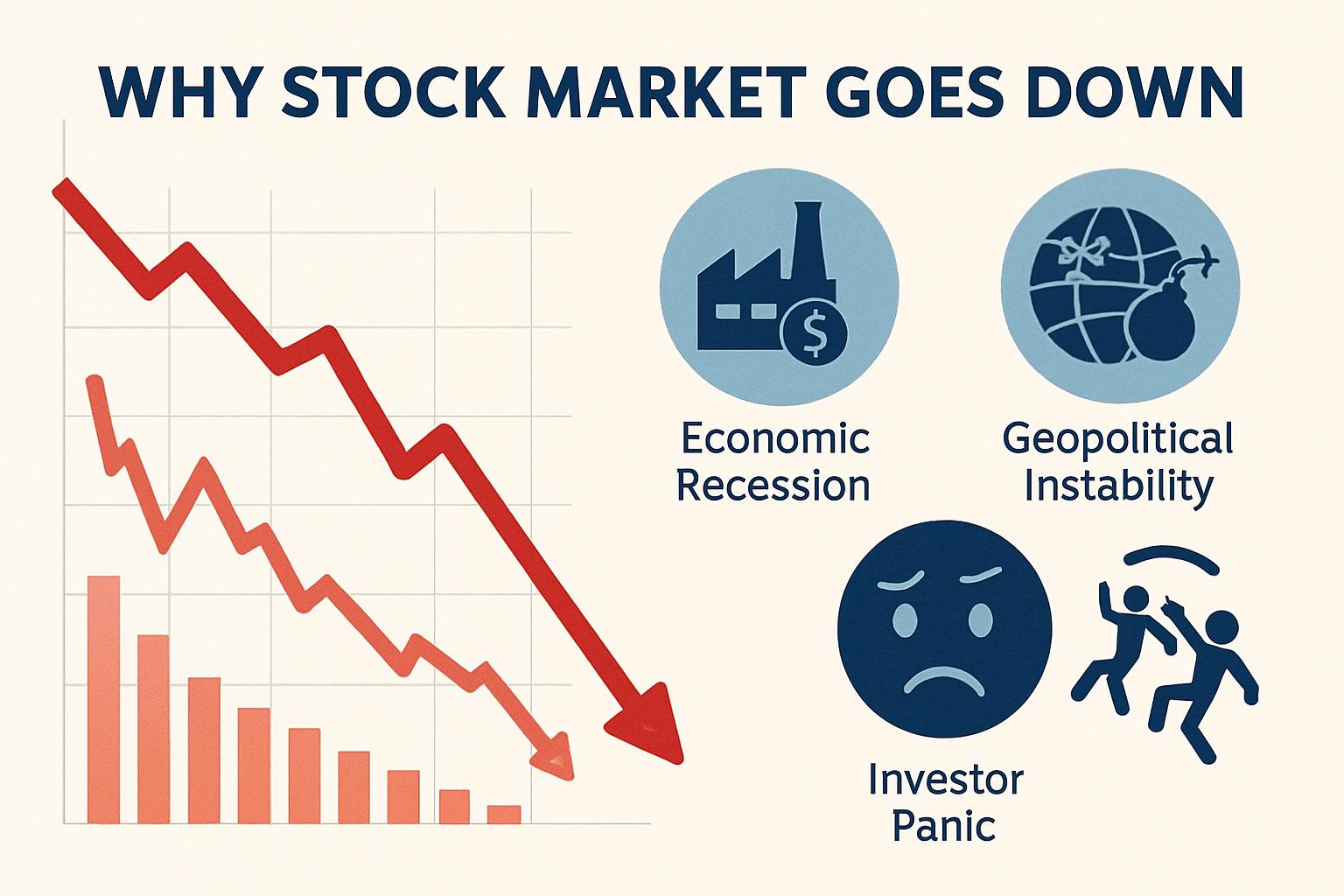
In our interconnected global economy, an event on the other side of the world can have an immediate impact on a domestic portfolio. Markets loathe uncertainty, and nothing creates uncertainty quite like geopolitical friction.
Energy Costs and Resource Scarcity
Geopolitical tensions in oil-producing regions frequently lead to a spike in crude oil prices. Since almost every industry relies on energy—whether for manufacturing, shipping, or heating—rising oil prices act as a tax on the entire economy. When energy costs jump, investors anticipate lower corporate profits and reduced consumer spending, leading to a preemptive sell-off in the equities market.
Trade Relations and Regulatory Shifts
The “Money” niche is heavily influenced by international trade policy. Sudden tariffs, trade wars, or aggressive regulatory changes in major economies like China or the European Union can disrupt supply chains overnight. If a major semiconductor manufacturer or an automotive giant faces new export restrictions, the ripples are felt across the entire market. Investors respond to these “shocks” by de-risking—selling off volatile assets in favor of “safe havens” like gold or Treasury bills.
4. Technical Factors and the Role of Algorithmic Trading
In the modern era, the question of why the market is down is often answered by silicon rather than sentiment. Over 60-70% of daily trading volume is now attributed to algorithmic and high-frequency trading (HFT). These systems are programmed to react to specific price triggers and news headlines in milliseconds.
Breaking Through Support Levels
Technical analysts look at “support” and “resistance” levels—psychological price points where a stock has historically stopped falling or rising. If a major index like the Dow Jones Industrial Average breaks below a key support level, it can trigger a cascade of automated “sell” orders. This creates a feedback loop: the price drops, triggering more algorithms to sell, which drops the price even further. This is why market downturns often feel much faster and more aggressive than market rallies.
Margin Calls and Forced Liquidation
When the market begins to dip, investors who have borrowed money to buy stocks (trading on margin) may receive “margin calls.” If they cannot deposit more cash, their broker will automatically sell their positions to cover the loan. This forced liquidation adds massive selling pressure to the market, often regardless of the actual fundamental value of the stocks being sold. This “cascading” effect is a primary driver of the sharp, vertical drops seen during particularly bad trading days.
5. Investor Psychology: Fear, Greed, and the VIX
Finally, we must consider the human element. Behavioral finance teaches us that investors are not always rational actors. We are prone to “herd mentality,” where the sight of a falling market causes others to sell out of fear, even if their long-term thesis for owning a stock hasn’t changed.
The Fear Gauge (VIX)
The CBOE Volatility Index, or VIX, is often called the “fear gauge.” It measures the market’s expectation of 30-day volatility. When the VIX spikes, it indicates that investors are buying “put options” (insurance against a market drop). High VIX levels are almost always correlated with a down market. Today’s dip might simply be a reflection of a sudden shift in sentiment—a move from “Greed” to “Fear” based on a news headline or a collective realization that a recent rally was unsustainable.
Strategic Response: Navigating the Red
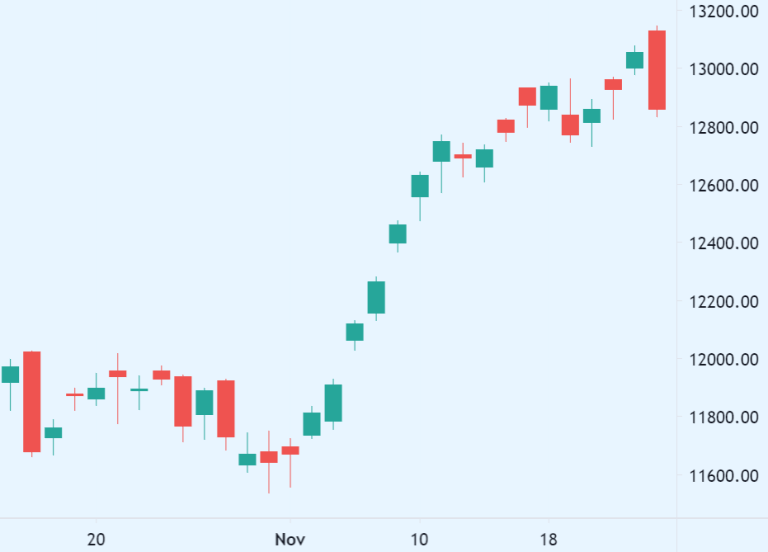
For the disciplined investor, a down market is not a signal to panic, but a signal to reassess. History shows that the market moves in cycles. Downturns provide an opportunity to “tax-loss harvest” or to engage in Dollar-Cost Averaging (DCA), where you buy more shares at a lower price, effectively lowering your average cost basis over time.
Understanding that the market is down today due to a combination of interest rate fears, corporate earnings, or technical triggers allows you to maintain a professional distance from the numbers on the screen. In the world of finance, time in the market is almost always more valuable than timing the market. By identifying the specific niche reasons for today’s decline—be it a Fed announcement or a sector rotation—you can stay informed without falling prey to the emotional volatility that characterizes the average retail trader.
aViewFromTheCave is a participant in the Amazon Services LLC Associates Program, an affiliate advertising program designed to provide a means for sites to earn advertising fees by advertising and linking to Amazon.com. Amazon, the Amazon logo, AmazonSupply, and the AmazonSupply logo are trademarks of Amazon.com, Inc. or its affiliates. As an Amazon Associate we earn affiliate commissions from qualifying purchases.