
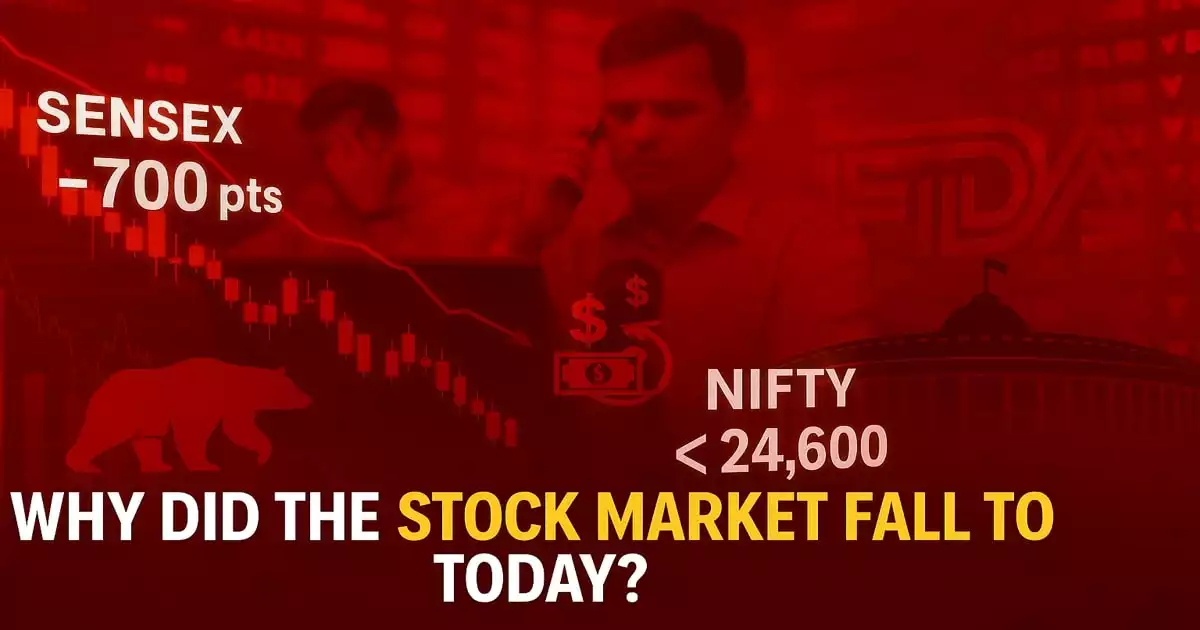
Today’s sudden market downturn has sent ripples across global financial markets, leaving investors grappling with uncertainty and searching for answers. Stock market crashes are complex events, rarely attributable to a single cause, but rather a confluence of macroeconomic forces, shifting market sentiment, and technical trading dynamics. Understanding these underlying factors is crucial for both seasoned investors and those new to the financial landscape, offering perspective amidst volatility.
Macroeconomic Headwinds and Interest Rate Pressures
A primary driver behind significant market corrections often stems from the broader macroeconomic environment. Today’s sell-off appears deeply rooted in several interconnected global economic challenges, most notably inflation and the aggressive monetary policy responses designed to combat it.

Inflationary Pressures and Cost of Capital
Persistently high inflation, driven by factors such as supply chain disruptions, robust consumer demand, and geopolitical events impacting energy and commodity prices, erodes purchasing power and corporate profit margins. Businesses face higher input costs, which, if not fully passed on to consumers, compress profitability. For investors, high inflation also diminishes the real returns on investments.
To counter inflation, central banks worldwide have been embarking on a path of interest rate hikes. While necessary to cool an overheating economy, rising interest rates increase the cost of borrowing for companies, making expansion more expensive and debt servicing more onerous. For growth companies, whose valuations are often heavily reliant on future earnings discounted back to the present, higher interest rates make those future earnings less valuable today, leading to significant downward pressure on their stock prices. Furthermore, higher interest rates make fixed-income assets, like government bonds, more attractive relative to riskier equities, prompting a rotation of capital out of stocks.
Geopolitical Instability and Economic Uncertainty
Global geopolitical events introduce a layer of unpredictability that can significantly impact investor confidence. Conflicts, trade disputes, or political instability in key regions can disrupt global supply chains, influence commodity prices, and alter international economic relations. Such uncertainties increase the perceived risk of investments, leading investors to demand a higher risk premium for holding equities or to move into safer assets altogether. Today’s market reaction likely reflects a heightened sensitivity to ongoing global tensions and their potential long-term economic repercussions, adding to the general sense of apprehension.
Shifting Market Sentiment and Investor Psychology
Beyond the quantifiable economic data, market crashes are heavily influenced by human psychology. Fear and uncertainty can spread rapidly through financial markets, triggering a cascade of selling that amplifies initial price declines.
The Contagion of Fear and Panic Selling
When markets begin to fall, psychological biases often take over. The “fear of missing out” (FOMO) that drives bull markets can quickly turn into the “fear of losing everything” during a downturn. This shift in sentiment can lead to panic selling, where investors liquidate positions irrespective of fundamental value, simply to avoid further losses. This emotional response often exacerbates market declines, creating a self-fulfilling prophecy where selling begets more selling. News headlines, social media chatter, and financial media coverage can act as amplifiers, accelerating the spread of negative sentiment and contributing to a herd mentality.
Liquidity Crunch and Margin Calls

A rapid market decline can also trigger a liquidity crunch. As asset prices fall, investors may find it harder to sell their holdings without significantly impacting the price, especially for less liquid assets. This can lead to a downward spiral as sellers are forced to accept lower prices. Furthermore, investors who trade on margin – borrowing money to purchase securities – face margin calls when the value of their collateralized investments drops below a certain threshold. To meet these calls, they are forced to sell other assets, irrespective of their long-term potential, adding further downward pressure on prices across the board. This forced selling can create a domino effect, extending the market’s decline beyond what economic fundamentals alone might suggest.
Technical Factors and Market Structure
Modern financial markets are also shaped by sophisticated technical factors and trading mechanisms that can contribute to rapid price movements, both up and down.
Algorithmic Trading and High-Frequency Trading
A significant portion of today’s trading volume is executed by algorithms and high-frequency trading (HFT) firms. These automated systems are designed to react to market data and execute trades at lightning speed, often based on pre-programmed strategies. While they contribute to market liquidity in normal conditions, during periods of high volatility, algorithms can exacerbate price swings. For instance, if many algorithms are programmed to sell when certain price thresholds are breached or specific indicators flash red, they can collectively trigger a rapid succession of sell orders, accelerating a market decline faster than human traders could react. This can create “flash crashes” where prices plummet in minutes, only to recover partially or fully later.
Index Funds, ETFs, and Passive Investing
The rise of passive investing through index funds and Exchange Traded Funds (ETFs) has fundamentally altered market dynamics. While offering diversification and lower costs, their structure can have unintended consequences during severe downturns. When investors redeem shares from an index fund or ETF, the fund manager must sell the underlying securities in the fund’s portfolio, often across a broad range of stocks, regardless of their individual merits. This broad-based selling can impact a wide array of stocks simultaneously, even those with strong fundamentals, amplifying market-wide declines. The interconnectedness through these vehicles means that selling pressure in one area can quickly transmit across the entire market.
Navigating the Aftermath: An Investor’s Perspective
In the wake of a market crash, it’s natural for investors to feel anxious. However, understanding the underlying causes and maintaining a long-term perspective are critical for prudent financial decision-making.
Reassessing Investment Strategies
Periods of market volatility offer an opportunity to re-evaluate one’s investment strategy and risk tolerance. For long-term investors, market corrections can present opportunities to acquire quality assets at lower prices. It’s crucial to differentiate between temporary market noise and fundamental shifts in a company’s prospects. Rebalancing portfolios to align with original asset allocation targets, diversifying across different asset classes, and ensuring a robust emergency fund are foundational steps during such times.
The Importance of Long-Term Vision
Historically, stock markets have demonstrated resilience and a tendency to recover from downturns over time. While the immediate pain of a crash can be severe, those who maintain a long-term investment horizon and avoid making emotional decisions are often better positioned to weather the storm. Focus on the fundamentals of the companies you own, the broader economic trends, and your personal financial goals rather than daily price fluctuations.
Today’s stock market crash is a stark reminder of the dynamic and sometimes unforgiving nature of financial markets. It underscores the interplay of economic policy, human psychology, and technical trading mechanisms. For investors, knowledge and a disciplined approach remain the most valuable tools in navigating such turbulent waters.
aViewFromTheCave is a participant in the Amazon Services LLC Associates Program, an affiliate advertising program designed to provide a means for sites to earn advertising fees by advertising and linking to Amazon.com. Amazon, the Amazon logo, AmazonSupply, and the AmazonSupply logo are trademarks of Amazon.com, Inc. or its affiliates. As an Amazon Associate we earn affiliate commissions from qualifying purchases.