
Share trading, often perceived as a complex realm exclusively for financial gurus, is in reality a fundamental mechanism of modern capitalism, offering individuals the opportunity to participate in the growth of companies and build personal wealth. At its core, it’s about buying and selling small pieces of ownership in publicly traded companies, with the hope that their value will increase over time, or to earn income through dividends.
This guide aims to demystify share trading, breaking down its intricate processes into digestible concepts. From understanding what a share truly represents to the mechanics of executing a trade and navigating market dynamics, we’ll explore the essential knowledge required for anyone looking to step into the world of stock market investing. Whether you’re a novice considering your first investment or seeking to deepen your understanding, comprehending the fundamental principles of share trading is the first crucial step towards informed and potentially profitable financial decisions.

Understanding the Fundamentals of Share Trading
Before diving into the mechanics, it’s vital to grasp the foundational concepts that underpin share trading. A clear understanding of these basics will provide a solid framework for your investment journey.
What is a Share?
A share, also known as a stock or equity, represents a unit of ownership in a company. When you buy a share, you become a part-owner of that company, albeit a tiny one for most individual investors. Companies issue shares primarily to raise capital for their operations, expansion, or debt repayment. In return for your investment, shareholders typically gain certain rights, which can include a claim on the company’s earnings (through dividends) and assets, as well as voting rights on corporate matters, usually proportional to the number of shares held.
The Stock Market Explained
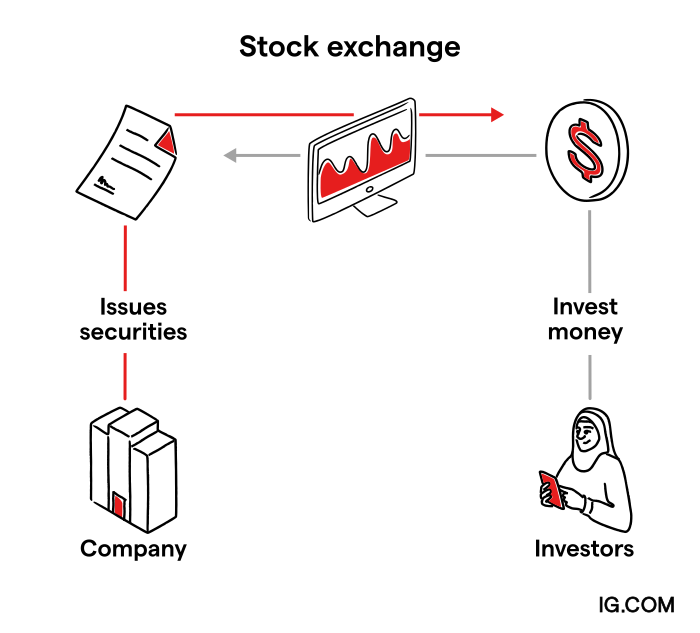
The stock market is essentially a network of exchanges and marketplaces where securities (like shares) are bought and sold. It serves two primary functions:
- Primary Market: This is where companies initially issue new shares to the public through processes like Initial Public Offerings (IPOs). The company directly receives the funds from these sales.
- Secondary Market: Once shares have been issued, they are traded among investors on exchanges like the New York Stock Exchange (NYSE) or NASDAQ. Companies do not directly receive money from secondary market trades; rather, it’s investors buying and selling existing shares from each other.
The stock market’s role is crucial as it facilitates liquidity, allowing investors to buy and sell shares relatively easily, and provides a transparent pricing mechanism based on supply and demand. Participants range from individual retail investors like you, to large institutional investors such as pension funds and hedge funds, all typically interacting through brokers.
Key Terminology
Navigating the stock market requires familiarity with specific terms:
- Bid Price: The highest price a buyer is willing to pay for a share.
- Ask Price (Offer Price): The lowest price a seller is willing to accept for a share.
- Spread: The difference between the bid and ask price.
- Volume: The number of shares traded over a specific period, indicating liquidity and investor interest.
- Market Capitalization (Market Cap): The total value of a company’s outstanding shares, calculated by multiplying the current share price by the number of shares outstanding.
- Bull Market: A period characterized by rising stock prices and investor optimism.
- Bear Market: A period marked by falling stock prices and widespread pessimism.
Types of Share Trading and Investment Strategies
Share trading isn’t a one-size-fits-all endeavor. Investors employ various strategies depending on their financial goals, risk tolerance, and time horizon.
Short-Term vs. Long-Term Investing
The most fundamental distinction lies in the investment horizon:
- Short-Term Trading: This includes strategies like day trading (buying and selling shares within the same trading day) and swing trading (holding shares for a few days or weeks). Short-term traders aim to profit from small, rapid price movements and typically rely heavily on technical analysis (studying price charts and patterns). It’s characterized by higher risk and requires significant time commitment and market knowledge.
- Long-Term Investing (Buy and Hold): This strategy involves buying shares of fundamentally strong companies and holding them for years, or even decades. Long-term investors believe in the company’s sustained growth over time and are less concerned with short-term market fluctuations. They primarily use fundamental analysis, evaluating a company’s financial health, management, and industry prospects.
Growth vs. Value Investing
These are two popular long-term investment philosophies:
- Growth Investing: Focuses on companies expected to grow their earnings and revenue at a faster rate than the overall market. These companies often reinvest profits back into the business rather than paying dividends. Growth stocks can be more volatile but offer significant upside potential.
- Value Investing: Involves identifying companies whose shares appear to be trading below their intrinsic value. Value investors look for “bargains” – companies with strong fundamentals that the market has temporarily underestimated or overlooked. They believe the market will eventually recognize the true value, leading to price appreciation.
Income Investing (Dividends)
Some investors prioritize income generation over capital appreciation. Income investing focuses on companies that consistently pay dividends to their shareholders. These are often mature, stable companies with predictable earnings. Dividend reinvestment plans (DRIPs) allow investors to automatically use their dividends to buy more shares, compounding their returns over time.
The Mechanics of Placing a Trade
Once you understand the basics and have a strategy in mind, the next step is to know how to actually buy or sell shares. This process invariably involves a brokerage firm.
Choosing a Brokerage Account
To trade shares, you need a brokerage account, which acts as an intermediary between you and the stock exchange.
- Full-Service Brokers: Offer a wide range of services, including personalized advice, research, and portfolio management. They typically charge higher fees or commissions.
- Discount Brokers (Online Brokers): Provide a platform for you to execute trades independently. They offer lower fees, often commission-free trading for stocks and ETFs, and a variety of research tools. For most individual investors, online discount brokers are the preferred choice.
When selecting a broker, consider factors such as trading fees, available research tools, customer support, platform usability (desktop and mobile), and the range of investment products offered.
Understanding Order Types
When you place a trade, you instruct your broker on how to execute it using different order types:
- Market Order: An instruction to buy or sell a share immediately at the best available current price. Market orders prioritize execution speed but don’t guarantee a specific price, which can be a risk in fast-moving markets.
- Limit Order: An instruction to buy or sell a share only at a specified price or better. For buying, you set the maximum price you’re willing to pay; for selling, the minimum price you’re willing to accept. Limit orders guarantee price but not execution.
- Stop-Loss Order: An instruction to sell a share once its price falls to a specified level. This is a crucial risk management tool designed to limit potential losses. For example, if you own a share trading at $100, you might set a stop-loss at $95 to protect against a significant downturn.
- Stop-Limit Order: A combination of a stop-loss and a limit order. It triggers a limit order when the stop price is reached. This provides more control over the execution price than a simple stop-loss but carries the risk that the limit order might not be filled if the price moves too quickly.
Executing a Trade
Using your chosen brokerage platform, you will navigate to the trading section, select the stock you wish to trade, specify whether you want to buy or sell, enter the number of shares, choose your order type (e.g., market, limit), and confirm the details. After execution, the trade will be confirmed, and the shares will be settled (transferred to your account) typically within two business days (T+2).
Key Factors Influencing Share Prices
Share prices are in constant flux, driven by a complex interplay of company-specific, economic, and market-wide factors. Understanding these influences is crucial for making informed decisions.
Company-Specific Factors
- Earnings Reports: A company’s quarterly and annual financial results (revenue, profit, earnings per share) are major drivers. Strong earnings growth often boosts investor confidence and share price.
- Management Quality and Strategy: Competent leadership and a clear, effective business strategy can significantly impact a company’s long-term prospects.
- Product Launches and Innovation: Successful new products or groundbreaking technological advancements can open new markets and fuel growth.
- Industry Trends and Competition: A company’s performance is often influenced by the overall health and trends of its industry, as well as the intensity of its competition.
- Mergers and Acquisitions (M&A): Announcements of M&A activity can cause significant price movements for the companies involved, as investors react to potential synergies or acquisition premiums.
Economic Factors
Broader economic conditions play a significant role in market sentiment and company performance:
- Interest Rates: Higher interest rates can make borrowing more expensive for companies, potentially slowing growth, and also make fixed-income investments more attractive, diverting capital away from stocks.
- Inflation: High inflation can erode purchasing power and increase operating costs for businesses.
- Gross Domestic Product (GDP) Growth: A strong economy generally translates to higher corporate profits and investor confidence.
- Employment Data and Consumer Confidence: These indicators reflect the health of the economy and consumer spending, which directly impacts many businesses.
- Geopolitical Events: International conflicts, political instability, or major policy changes can create uncertainty and impact global markets.
Market Sentiment and Technical Analysis
- Investor Psychology: Fear and greed are powerful emotions that can drive market sentiment. Periods of irrational exuberance (greed) can lead to bubbles, while panic selling (fear) can trigger market corrections.
- Supply and Demand: The basic economic principle dictates that if more people want to buy a share than sell it, the price will rise, and vice versa.
- Technical Analysis: Short-term traders often use technical analysis, which involves studying historical price charts and trading volumes to identify patterns and predict future price movements. While not universally accepted as a predictor, it can influence trading decisions.
Risks and Rewards of Share Trading
While share trading offers compelling opportunities for wealth creation, it’s essential to approach it with a clear understanding of both its potential rewards and inherent risks.
Potential Rewards
- Capital Appreciation: The most common reward is an increase in the value of your shares over time, allowing you to sell them for more than you paid.
- Dividend Income: Many companies distribute a portion of their profits to shareholders as dividends, providing a regular income stream.
- Diversification: Shares can be a valuable component of a diversified investment portfolio, helping to spread risk across different asset classes.
- Inflation Hedge: Historically, stocks have outperformed inflation over the long term, helping to preserve and grow purchasing power.
Inherent Risks
- Market Volatility: Share prices can fluctuate significantly in response to news, economic data, or investor sentiment, leading to rapid gains or losses.
- Company-Specific Risk: A single company’s poor performance, management issues, or even bankruptcy can lead to a substantial loss of investment value, regardless of broader market trends.
- Liquidity Risk: For less frequently traded shares, it might be difficult to sell them quickly without significantly impacting their price.
- Emotional Decision-Making: succumbing to fear during downturns or greed during rallies can lead to impulsive, financially detrimental decisions.
- Loss of Capital: The most significant risk is the possibility of losing a portion or even all of your invested capital. There’s no guarantee of returns, and past performance is not indicative of future results.
Risk Mitigation Strategies
To navigate these risks effectively, consider:
- Diversification: Spreading your investments across various companies, industries, and even asset classes to reduce the impact of a single poor-performing investment.
- Thorough Research: Invest time in understanding the companies you invest in, their financial health, and their industry landscape.
- Long-Term Perspective: For many investors, adopting a long-term view can help ride out short-term market fluctuations and benefit from compounding returns.
- Risk Management Tools: Utilize stop-loss orders to limit potential losses on individual trades.
- Only Invest What You Can Afford to Lose: Never invest money that you might need in the short term or whose loss would significantly impact your financial well-being.
Getting Started: Steps for Aspiring Traders
Embarking on your share trading journey requires preparation, discipline, and a commitment to continuous learning.
Education and Research
Before investing a single dollar, immerse yourself in financial education. Read reputable books on investing, follow established financial news outlets, and consider taking online courses. Understand how to interpret financial statements (balance sheets, income statements, cash flow statements) as they provide crucial insights into a company’s health.
Develop a Trading Plan
A well-defined plan is your roadmap. It should outline:
- Your Financial Goals: What do you want to achieve (e.g., retirement, down payment for a house)?
- Risk Tolerance: How much risk are you comfortable taking?
- Time Horizon: Are you investing for the short or long term?
- Investment Strategy: Which types of shares and strategies align with your goals and risk profile?
- Entry and Exit Criteria: Under what conditions will you buy a share, and when will you sell it?
Start Small and Paper Trade
Don’t rush into live trading with significant capital. Many brokerage platforms offer “paper trading” or simulated accounts, allowing you to practice trading with virtual money in real-market conditions. This is an invaluable way to test your strategies, learn the platform, and gain confidence without risking actual capital. When you do start with real money, begin with a small amount that you are comfortable losing entirely.

Continuous Learning and Adaptation
The financial markets are dynamic and constantly evolving. Stay informed about economic news, industry trends, and company developments. Regularly review your portfolio’s performance, assess what worked and what didn’t, and be prepared to adapt your strategy as market conditions or your personal circumstances change. Discipline and emotional control are just as vital as market knowledge.
Share trading is a powerful tool for wealth creation, offering an accessible avenue for individuals to participate in economic growth. While it presents opportunities for significant returns, it also carries inherent risks that demand respect and careful management. By understanding the fundamentals, developing a clear strategy, utilizing appropriate tools, and committing to continuous learning, aspiring investors can navigate the complexities of the stock market with greater confidence and make more informed decisions towards achieving their financial aspirations. Remember, successful investing is not about getting rich quick; it’s about disciplined, informed, and patient participation in the market over time.
aViewFromTheCave is a participant in the Amazon Services LLC Associates Program, an affiliate advertising program designed to provide a means for sites to earn advertising fees by advertising and linking to Amazon.com. Amazon, the Amazon logo, AmazonSupply, and the AmazonSupply logo are trademarks of Amazon.com, Inc. or its affiliates. As an Amazon Associate we earn affiliate commissions from qualifying purchases.