
In the dynamic world of financial markets, the question, “What did the Dow close today?” is a common refrain, echoing through boardrooms, investment forums, and even casual conversations. It’s more than just a query about a number; it’s a window into the day’s economic sentiment, a quick pulse check on corporate health, and a barometer for investor confidence. While a single day’s closing figure for the Dow Jones Industrial Average (DJIA) rarely dictates long-term financial strategy, understanding its daily movements, the factors influencing them, and its broader significance is crucial for anyone engaging with the financial world, from seasoned investors to curious beginners.

The Dow, as it’s affectionately known, represents a sliver of the vast U.S. stock market, yet its historical gravitas and the prominence of its constituent companies give it outsized importance as an economic indicator. Its daily fluctuations reflect a complex interplay of corporate earnings, economic data, geopolitical events, and even investor psychology. This article delves into the nuances of the Dow’s daily performance, unraveling what its closing price truly signifies and how it fits into a broader understanding of personal finance and investment strategy.
The Dow Jones Industrial Average: An Enduring Economic Barometer
The Dow Jones Industrial Average stands as one of the oldest and most frequently cited stock market indices in the world. Established in 1896 by Charles Dow, editor of The Wall Street Journal and co-founder of Dow Jones & Company, its initial purpose was to provide a clear, concise measure of the health of the U.S. industrial sector. Over a century later, while its methodology has evolved and its components have shifted, its core function as a snapshot of the American economy remains intact.
A Brief History and Its Components
Initially comprising just 12 companies, predominantly railroads and industrial manufacturers, the DJIA has expanded to include 30 of the largest and most influential publicly traded companies in the United States. These aren’t necessarily the largest by market capitalization, nor are they strictly “industrial” anymore; the index now features a diverse array of sectors, including technology, finance, healthcare, and retail. Iconic names like Apple, Microsoft, Goldman Sachs, Johnson & Johnson, and Walmart are typically found among its ranks, making it a proxy for broad corporate America.
Unlike other indices such as the S&P 500, which is market-capitalization weighted, the Dow is a price-weighted index. This means that stocks with higher share prices have a greater impact on the index’s value than those with lower share prices, regardless of their total market value. This unique weighting scheme can sometimes lead to different performance narratives compared to other indices, but it doesn’t diminish its role as a widely recognized benchmark. Its daily calculation involves summing the prices of the 30 stocks and dividing by a “Dow Divisor,” a number adjusted for stock splits and other corporate actions to maintain historical continuity.
Why the Dow Matters to Everyday Investors
For everyday investors, the Dow’s daily close serves several practical purposes. Firstly, it offers a quick, digestible summary of the market’s direction. If the Dow closes up, it generally signals a positive day for large-cap U.S. stocks, fostering a sense of optimism. Conversely, a close down might suggest a more cautious or negative outlook. This immediate feedback helps investors gauge the general climate without delving into complex individual stock analyses, though such analysis is always recommended for specific investment decisions.
Secondly, many retirement accounts and investment portfolios are tied, directly or indirectly, to the performance of broad market indices, including the Dow. Mutual funds and Exchange Traded Funds (ETFs) that track the Dow or a basket of large-cap stocks will see their values fluctuate in line with the index. Therefore, monitoring the Dow’s performance provides a benchmark against which personal investment performance can be loosely measured, albeit with the understanding that diversified portfolios often include many assets not reflected in the DJIA.
Understanding Market Closures and Their Implications
The market close, typically at 4:00 PM Eastern Time for U.S. stock exchanges, marks the official end of regular trading for the day. The Dow’s closing value is the final calculated price of the index at that precise moment. This daily ritual is a pivotal point, capturing the cumulative effect of all trading activity, news events, and investor sentiment throughout the day.
The Significance of Daily Price Movements
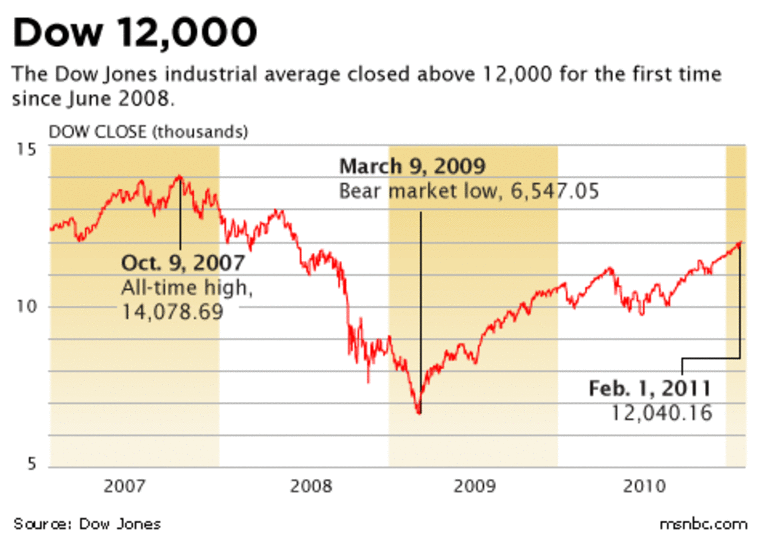
Every tick, every fluctuation throughout the trading day, contributes to the final closing price. A “closing up” or “closing down” headline summarizes whether the collective value of the 30 companies increased or decreased from the previous day’s close. These daily movements, whether modest or dramatic, are not isolated events. They are often reactions to breaking news, economic reports, corporate earnings announcements, or shifts in investor expectations.
For instance, a significant upward close might follow a surprisingly positive jobs report, indicating a strengthening economy. Conversely, a sharp downward close could be a response to unexpected inflation data or geopolitical instability. While long-term investors are often advised not to overreact to daily swings, tracking these movements helps in understanding the market’s immediate interpretation of events and economic trends. Day traders, by contrast, rely almost entirely on these short-term movements to execute their strategies.
Factors Influencing the Dow’s Daily Close
The factors that can sway the Dow’s closing value are multifaceted and often interconnected:
- Economic Data: Key indicators like Gross Domestic Product (GDP), inflation rates (Consumer Price Index, Producer Price Index), employment figures (non-farm payrolls, unemployment rate), manufacturing data, and consumer confidence surveys provide a continuous stream of information about the health of the economy. Positive data often boosts confidence and drives the market up, while negative data can trigger sell-offs.
- Corporate Earnings Reports: Each quarter, the 30 companies within the Dow (and thousands of others) release their earnings reports. Performance above or below analyst expectations for profit and revenue can significantly impact not only the individual stock but also the broader index, especially if several major components disappoint or impress simultaneously.
- Interest Rate Decisions: Central banks, particularly the Federal Reserve in the U.S., play a crucial role through their monetary policy. Decisions on interest rates directly affect borrowing costs for businesses and consumers, influencing corporate profitability, investment, and spending, thereby impacting stock valuations.
- Geopolitical Events: International conflicts, political instability, trade disputes, and even major global health crises can create uncertainty, leading to investor anxiety and market volatility.
- Commodity Prices: Fluctuations in oil prices, gold, and other commodities can impact the profitability of specific sectors (e.g., energy companies) and overall inflation expectations, subsequently affecting the broader market.
- Investor Sentiment and Technical Analysis: Beyond fundamentals, market psychology plays a role. Fear, greed, and herd mentality can amplify movements. Technical analysts study price charts and trading volumes to predict future movements, and their collective actions can influence daily closes.
How to Interpret “Closing Up” or “Closing Down”
A simple “Dow closed up by X points” or “Dow closed down by Y points” needs context. A movement of 100 points might seem significant, but on a 30,000-point index, it represents less than a 0.5% change, which is relatively minor. Larger percentage moves, especially over 1% or 2%, typically signal a more pronounced shift in market sentiment or a reaction to a major event.
It’s also essential to consider what specific stocks within the Dow contributed most to the movement. If one or two heavily weighted stocks had an exceptional day, they might mask underperformance in other components, or vice versa. Smart investors look beyond the headline number to understand the underlying drivers and whether the movement is broad-based or concentrated.
Beyond the Numbers: Broader Economic Context
While the Dow’s daily close provides an immediate snapshot, its true value lies in its contribution to a broader economic narrative. Understanding this narrative requires looking beyond daily numbers and considering the larger economic forces at play.

The Role of Macroeconomic Indicators
Macroeconomic indicators, such as GDP growth, inflation, and employment figures, are the bedrock upon which market valuations are built. A strong, growing economy with low inflation and full employment generally creates a fertile ground for corporate profits and, consequently, higher stock prices. The Dow’s movements often anticipate or react to changes in these fundamental indicators. For example, consistently positive jobs reports can signal robust consumer spending, which benefits many Dow components, leading to an upward trend in the index. Conversely, signs of an impending recession, such as inverted yield curves or declining manufacturing output, can trigger prolonged periods of market weakness.
Geopolitical Events and Their Market Ripple Effects
The interconnectedness of the global economy means that events far from Wall Street can have profound impacts on the Dow. A conflict in a major oil-producing region, a significant trade policy shift by a global superpower, or even a localized natural disaster with supply chain implications can send ripples through international markets and influence U.S. stock performance. These events introduce uncertainty, a factor that markets inherently dislike, often leading to increased volatility and defensive investor behavior. For instance, a trade war could negatively impact multinational Dow components reliant on global supply chains and export markets, causing their stock prices to decline and pulling the index down.
Corporate Earnings and Sectoral Performance
At the heart of stock market performance are the earnings of individual companies. Consistent, robust earnings growth is a primary driver of stock appreciation. When the 30 companies within the Dow report strong earnings, it signals health across diverse sectors, often leading to a rally in the index. However, if several key components miss their earnings targets, or issue cautious outlooks, it can drag the Dow down, even if the broader economic picture seems stable. Furthermore, understanding sectoral performance within the Dow can be insightful. For example, if technology stocks are driving the Dow’s gains, it might indicate a broader trend of innovation and digital transformation, while strength in industrial companies could signal renewed manufacturing activity.
Strategies for Navigating Market Volatility
Given the constant ebb and flow reflected in the Dow’s daily closes, investors need well-thought-out strategies to navigate market volatility and achieve their financial goals. Reacting emotionally to daily news and market swings is often detrimental to long-term success.
Long-Term Investing vs. Short-Term Trading
For most individual investors, a long-term investment horizon is the most prudent approach. This strategy involves identifying quality assets (like diversified index funds or robust individual companies) and holding them for many years, often decades, to benefit from compounding returns and to ride out short-term market fluctuations. The daily close of the Dow becomes less about immediate action and more about confirming long-term trends. A bad day on the Dow is just one data point in a journey spanning thousands of trading days.
Short-term trading, conversely, involves frequent buying and selling to profit from small price movements. This is a highly specialized and risky endeavor, often requiring sophisticated tools, deep market knowledge, and significant time commitment. While day traders certainly pay close attention to the Dow’s daily closes and intraday movements, it’s a game for professionals and not typically recommended for the average investor building wealth for retirement.
Diversification as a Risk Management Tool
One of the most fundamental principles in investing is diversification. By spreading investments across various asset classes (stocks, bonds, real estate), different industries, and geographical regions, investors can mitigate the impact of poor performance in any single area. While the Dow represents large-cap U.S. stocks, a truly diversified portfolio would include exposure to small-cap stocks, international markets, bonds, and potentially alternative investments. This way, if the Dow has a particularly bad day or year, other parts of the portfolio might still perform well, cushioning the overall impact.
The Importance of Financial Literacy and Continuous Learning
Understanding the Dow’s daily close and its context is just one facet of financial literacy. A comprehensive understanding involves grasping concepts like risk tolerance, asset allocation, inflation, interest rates, tax efficiency, and the power of compounding. The financial landscape is ever-changing, with new investment vehicles, regulations, and economic theories emerging regularly. Therefore, continuous learning is not just an advantage but a necessity for successful investing. Subscribing to reputable financial news sources, reading investment books, and consulting with qualified financial advisors are all valuable steps in building and maintaining financial acumen.
Looking Ahead: What Drives Future Dow Performance?
Predicting the Dow’s future performance with certainty is impossible, yet identifying the key drivers provides valuable insight for long-term strategic planning. Several overarching themes are likely to shape the trajectory of the Dow and the broader market in the coming years.
Technological Innovation and Market Disruption
Technology has been a dominant force in market performance for decades, and its influence is only set to grow. Artificial intelligence, quantum computing, biotechnology, renewable energy, and other emerging technologies are poised to disrupt industries, create new markets, and drive significant economic growth. Companies at the forefront of these innovations, many of which are already Dow components or potential future additions, will likely see substantial gains. Investors need to monitor these trends and understand which companies are best positioned to capitalize on them. However, disruption also implies that established players who fail to adapt could face challenges.
Regulatory Changes and Fiscal Policies
Government policies, both fiscal (taxation, spending) and regulatory (environmental, antitrust, data privacy), profoundly impact corporate profitability and market dynamics. Changes in corporate tax rates, for example, can directly affect earnings per share, while new regulations can create hurdles or opportunities for specific industries. The political landscape, electoral cycles, and the resulting policy shifts will continue to be critical factors shaping investor confidence and the economic environment in which Dow companies operate.
Global Economic Interconnectedness
The Dow is inherently influenced by the global economy. Trade relationships, international supply chains, currency fluctuations, and the economic health of major global partners (like China and Europe) directly affect the multinational corporations within the index. As the world becomes more interconnected, understanding global economic trends and geopolitical stability will be increasingly vital for anticipating market movements and making informed investment decisions.
In conclusion, “What did the Dow close today?” is a question that opens a gateway to a deeper understanding of financial markets. While a single day’s number is merely a snapshot, its consistent monitoring, combined with an appreciation for economic context, corporate performance, and strategic financial planning, empowers investors to make more informed decisions on their journey toward financial well-being. The Dow remains an invaluable, if sometimes oversimplified, indicator in the complex tapestry of global finance.
aViewFromTheCave is a participant in the Amazon Services LLC Associates Program, an affiliate advertising program designed to provide a means for sites to earn advertising fees by advertising and linking to Amazon.com. Amazon, the Amazon logo, AmazonSupply, and the AmazonSupply logo are trademarks of Amazon.com, Inc. or its affiliates. As an Amazon Associate we earn affiliate commissions from qualifying purchases.