
The question “how many companies are in the Dow?” might seem straightforward, but its answer unravels a rich tapestry of financial history, economic representation, and investment strategy. At its core, the Dow Jones Industrial Average (DJIA), often simply referred to as “the Dow,” is one of the most widely recognized stock market indices globally. It serves as a daily barometer for the health of the U.S. stock market and, by extension, the broader American economy. For investors, financial professionals, and even the general public, understanding the composition and mechanics of the Dow is crucial to interpreting market movements and making informed financial decisions.

Beyond a simple count, the companies comprising the Dow represent a select group of leading American corporations whose performance is considered indicative of the nation’s economic pulse. These aren’t just any companies; they are giants in their respective industries, chosen for their stability, size, and influence. This article will delve into the precise number of companies in the Dow, explore the rigorous selection process, and illuminate why this seemingly simple index holds such profound significance in the world of finance. We’ll unpack its historical context, its unique calculation methodology, and its practical implications for investors navigating the complexities of the market.
Unpacking the Dow: More Than Just a Number
To truly appreciate the Dow, one must look beyond the immediate numerical answer to its composition and delve into its foundational principles. The index is not merely a collection of stocks; it is a meticulously curated snapshot designed to offer insights into the U.S. industrial and economic landscape.
Defining the Dow Jones Industrial Average (DJIA)
At its heart, the Dow Jones Industrial Average is a stock market index that measures the stock performance of 30 large companies listed on stock exchanges in the United States. It is one of several indices created by Charles Dow, editor of The Wall Street Journal and co-founder of Dow Jones & Company. Unlike broad-based indices that track thousands of companies, the DJIA is highly selective, focusing on a smaller, more exclusive group of publicly traded companies. This selectivity is precisely what gives it its unique character and influence as a bellwether for the market.
The DJIA’s purpose has always been to provide a clear, easily digestible indicator of the market’s overall direction. Its calculation is unique, being a price-weighted average rather than a market-capitalization-weighted average, a distinction we will explore further. This means that stocks with higher prices have a greater impact on the index’s movement, irrespective of the company’s total market value. While this methodology has drawn criticism, it has also contributed to the Dow’s enduring legacy and its distinct representation of economic strength.
A Legacy of Industrial Strength
The genesis of the Dow dates back to 1896, with its initial iteration comprising just 12 companies. Its name, “Industrial Average,” was quite literal at the time, reflecting America’s economic backbone of heavy industry: railroads, sugar, tobacco, and oil. Companies like General Electric (a founding member that remained in the index for over a century until 2018) epitomized the industrial might of the era. Over the decades, as the U.S. economy diversified and evolved, so too did the composition of the Dow.
Today, while the “Industrial” moniker remains, the index encompasses a far broader range of sectors. It includes technology giants, financial institutions, healthcare providers, and consumer goods companies. This evolution underscores the Dow’s adaptability and its commitment to reflecting the contemporary structure of the American economy. Despite this sectoral expansion, the core principle remains: to select companies that are leaders in their respective fields, contributing significantly to national output and employment.
The Exclusive Thirty: Selection and Significance
The most direct answer to the titular question is 30 companies. This number has been fixed since 1928, despite the massive expansion of the U.S. economy and the proliferation of publicly traded companies. The exclusivity of this group is a cornerstone of the Dow’s identity and a key factor in its market influence.
The Rigorous Selection Process: Who Makes the Cut?
The process for selecting and changing the components of the Dow is not governed by a rigid set of quantitative rules, unlike many other indices. Instead, a committee composed of editors from The Wall Street Journal and representatives from S&P Dow Jones Indices makes discretionary decisions. Their primary objective is to ensure the index accurately reflects the broad spectrum of the U.S. market and economy. Key criteria often considered include:
- Reputation and Sustained Growth: Companies must have an excellent reputation and demonstrate sustained growth.
- Broad Investor Interest: They should be of interest to a large number of investors.
- Industry Leadership: Components are typically leaders in their respective industries.
- Representation of the U.S. Economy: The committee aims for a balance of sectors that accurately represent the modern American economic landscape.
- Financial Health and Stability: While not explicitly stated as a rule, inclusion implies a company is financially sound and stable, though this can change over time.
Changes to the Dow’s composition are relatively infrequent but highly impactful. When a company is added or removed, it often triggers significant market attention, reflecting both the prestige of inclusion and the implications for passive funds that track the index.
Representing the American Economy
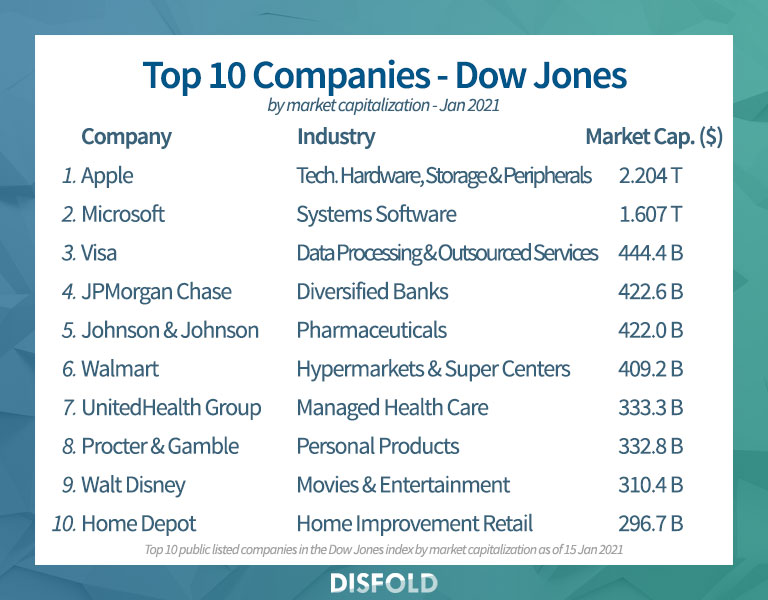
The limited number of 30 companies forces the selection committee to choose only the most influential and representative corporations. This means that each company within the Dow carries significant weight as a proxy for its sector and the broader economy. For instance, the inclusion of companies like Apple (technology), Johnson & Johnson (healthcare), JPMorgan Chase (financials), and Walmart (consumer retail) provides a diverse cross-section of economic activity.
When these 30 companies collectively perform well, it suggests a robust economy with strong corporate earnings and investor confidence. Conversely, a downturn in the Dow can signal broader economic headwinds. This makes the DJIA a critical indicator for economists, policymakers, and investors seeking a quick gauge of market sentiment and economic health. Its components are often household names, making the index highly relatable to the everyday person, unlike more obscure, though perhaps more comprehensive, indices.
The Impact of Inclusion and Exclusion
For a company, inclusion in the Dow is a significant badge of honor. It brings increased visibility, enhanced prestige, and often a boost in stock price due to increased institutional investment, particularly from passively managed index funds and ETFs that mirror the Dow’s composition. Being part of the Dow often means joining an exclusive club of economic heavyweights, signaling financial strength and leadership.
Conversely, exclusion from the Dow, while not necessarily a dire indictment of a company’s health, can lead to a temporary dip in stock price and a perceived loss of prestige. It often signifies that the company no longer represents the leading edge of its sector or the broader economy in the way it once did, or that another company is deemed more representative. Such changes underscore the dynamic nature of economic leadership and the continuous evolution of what defines American industrial strength.
Beyond the Count: How the Dow Reflects the Market
Knowing there are 30 companies is just the starting point. Understanding how their movements translate into the Dow’s overall performance reveals crucial insights into its utility and its limitations as a market indicator for the Money sphere.
Price-Weighted vs. Market-Cap Weighted Indices

The Dow Jones Industrial Average is a price-weighted index. This is a critical distinction that sets it apart from many other major indices, such as the S&P 500 or the Nasdaq Composite, which are market-capitalization-weighted. In a price-weighted index, stocks with higher share prices have a greater influence on the index’s value than stocks with lower share prices, regardless of the companies’ overall market capitalization (total value of all outstanding shares).
For example, if Company A has a stock price of $300 and Company B has a stock price of $100, a $1 increase in Company A’s stock price will have three times the impact on the Dow’s movement than a $1 increase in Company B’s stock price. This can sometimes lead to situations where a smaller company by market value, but with a high stock price, disproportionately influences the index compared to a much larger company with a lower share price. Critics argue this doesn’t always accurately reflect the true economic footprint of the companies. However, proponents appreciate its simplicity and historical consistency.
The Dow Divisor: A Unique Calculation
To account for stock splits, dividends, and changes in the index’s components (additions or removals), the Dow uses a unique mechanism called the Dow Divisor. The Dow’s value is calculated by summing the prices of the 30 component stocks and then dividing that sum by the Dow Divisor.
The Dow Divisor is not a fixed number; it is adjusted over time to ensure that the index’s value remains comparable before and after corporate actions or changes in composition. This means that the impact of a 1-point change in any Dow component’s stock price on the overall index can be determined by the reciprocal of the divisor. For instance, if the divisor is 0.15, a $1 increase in a single stock’s price would translate to a roughly 6.67-point rise in the Dow (1 / 0.15). This complex adjustment ensures that changes in the index truly reflect market movements rather than artificial fluctuations caused by stock splits or component changes.
Limitations and Criticisms of the DJIA
Despite its prestige and widespread recognition, the DJIA faces several criticisms, primarily stemming from its price-weighted methodology and limited scope:
- Limited Representation: With only 30 companies, the Dow is not as broad or diversified as indices like the S&P 500 (which tracks 500 large U.S. companies). It may not fully capture the performance of the entire U.S. stock market or specific sectors.
- Price-Weighting Distortion: As discussed, high-priced stocks, even from smaller market-cap companies, can disproportionately influence the index, potentially misrepresenting overall market sentiment.
- Discretionary Selection: The non-quantitative, committee-driven selection process can be perceived as subjective, lacking the transparency of rules-based indexing.
- “Industrial” Misnomer: While updated, the name still harkens back to an older economic structure, potentially misleading new investors about its current composition.
However, its simplicity, long history, and focus on highly visible, leading companies continue to make it a valuable and frequently cited benchmark, particularly for capturing the sentiment of large-cap corporate America.
Investing with the Dow: Practical Implications
For investors, understanding the Dow’s components and mechanics is not just academic; it has practical applications for portfolio construction, risk assessment, and market analysis.
Tracking the Dow: ETFs and Index Funds
Individual investors rarely buy all 30 stocks of the Dow directly. Instead, they gain exposure to the index through Exchange Traded Funds (ETFs) and index mutual funds. The most prominent example is the SPDR Dow Jones Industrial Average ETF (DIA), often referred to as “Diamonds.” This ETF holds shares of all 30 Dow components in a manner designed to track the performance of the index.
Investing in a Dow-tracking ETF offers several advantages:
- Diversification: While limited to 30 companies, it still provides diversification across various leading sectors.
- Simplicity: It’s an easy way to gain exposure to blue-chip U.S. stocks without having to research and buy individual companies.
- Liquidity: ETFs like DIA are highly liquid and can be traded throughout the day.
For investors seeking exposure to established, large-cap companies, a Dow-centric investment vehicle can be a core component of a diversified portfolio, representing a bet on the continued strength and leadership of American corporations.
Understanding Dow Components for Portfolio Analysis
Even if an investor doesn’t directly track the Dow, knowing its components can be invaluable for portfolio analysis. Many of these companies are significant holdings in broader market funds, and their individual performance can sway overall market sentiment. By monitoring the Dow components, investors can:
- Gauge Sector Health: Identify which sectors are driving the market’s performance based on the movements of key Dow stocks (e.g., tech stocks like Apple or Microsoft, financial stocks like Visa).
- Assess Blue-Chip Stability: The stability and financial health of Dow companies are often indicators of broader market confidence.
- Identify Investment Opportunities: While passive investing in the Dow is common, some investors use the Dow as a watchlist for individual stock opportunities, particularly during market dips when strong companies might become undervalued.
- Contextualize News: Financial news often reports on Dow movements. Understanding the constituents helps investors contextualize these reports and relate them to their own investments.
Diversification and the Role of Broader Indices
While the Dow offers a concentrated view of leading companies, it’s crucial for investors to remember the importance of broader diversification. Relying solely on the Dow for market exposure can be risky due to its limited number of companies and price-weighted methodology. Most financial advisors recommend a portfolio that includes exposure to a wider range of companies, market capitalizations (small-cap, mid-cap), and even international markets, typically achieved through diversified index funds like the S&P 500, Russell 2000, or total market funds.
The Dow should be seen as one valuable tool among many for understanding market dynamics and potentially forming a portion of an investment strategy, rather than the sole arbiter of market health. It provides a focused lens on a powerful segment of the U.S. economy, but a comprehensive financial strategy necessitates a broader perspective.
The Evolving Dow: Adapting to Economic Shifts
The enduring relevance of the Dow hinges on its ability to evolve alongside the American economy. While its core structure remains, the names within its list of 30 companies have changed significantly over its long history.
Historical Changes and Company Evolution
From its initial 12 industrial stalwarts, the Dow has seen numerous changes, reflecting profound shifts in economic power and technological advancement. The removal of industrial mainstays like General Electric or Eastman Kodak and the inclusion of technology and healthcare giants illustrate this adaptability. Each change is a deliberate effort by the selection committee to ensure the index accurately portrays the most significant drivers of the U.S. economy.
These changes are more than just cosmetic; they tell a story of economic transformation. The shift from an economy dominated by manufacturing to one driven by services, technology, and information is clearly visible in the Dow’s historical component changes. This continuous re-evaluation ensures that the “Industrial Average,” despite its anachronistic name, remains a timely and relevant indicator for investors focusing on the contemporary American economic landscape.
The Future of the DJIA in a Digital Economy
In an increasingly digital and globalized economy, the Dow continues to hold its own. While its limitations are often debated, its simplicity and focus on established market leaders provide a valuable contrast to more complex, technology-heavy indices. As the economy continues to evolve, the Dow will undoubtedly see further shifts in its composition, with new industries and companies rising to prominence. Its future relevance will depend on its committee’s continued ability to judiciously select the 30 companies that best encapsulate the present and future direction of U.S. economic might.
For investors, the Dow will likely remain a significant touchstone. Its movements will continue to be reported daily, influencing sentiment and providing a quick, albeit focused, snapshot of the financial health of America’s corporate titans. Understanding the 30 companies that comprise this iconic index is not just an exercise in trivia; it’s an essential element of financial literacy and a practical guide for navigating the complex world of investing.
aViewFromTheCave is a participant in the Amazon Services LLC Associates Program, an affiliate advertising program designed to provide a means for sites to earn advertising fees by advertising and linking to Amazon.com. Amazon, the Amazon logo, AmazonSupply, and the AmazonSupply logo are trademarks of Amazon.com, Inc. or its affiliates. As an Amazon Associate we earn affiliate commissions from qualifying purchases.