
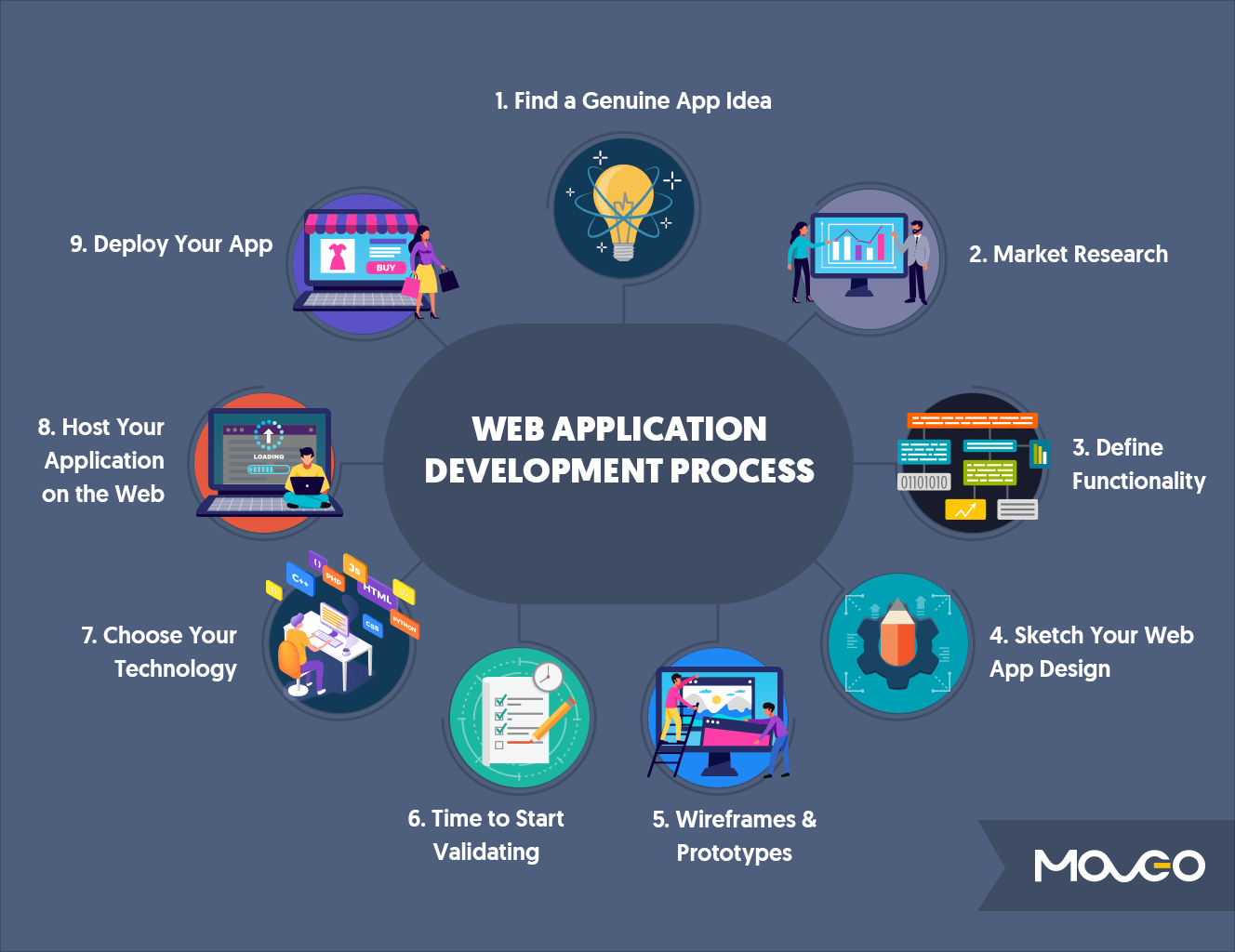
Developing a web application involves a multifaceted process that transcends mere coding. It encompasses strategic planning, architectural decisions, user-centric design, robust development, and ongoing maintenance. Understanding each phase is crucial for transforming an idea into a functional, scalable, and successful digital product. This comprehensive guide delves into the essential steps and considerations for building a modern web app, ensuring a strong foundation for both immediate success and future growth in the dynamic technology landscape.
1. Defining the Vision and Scope: The Blueprint for Success
Before writing a single line of code, establishing a clear vision and meticulously defining the project’s scope are paramount. This initial phase dictates the entire development trajectory, influencing everything from technology choices to budget allocation and timeline. A well-defined blueprint minimizes rework, manages expectations, and aligns all stakeholders towards a common goal.

1.1 Ideation and Problem Identification
Every successful web app begins with a compelling idea that addresses a specific user need or solves a market problem. This stage involves extensive brainstorming, market research, and competitive analysis to validate the concept’s viability. Questions to consider include: What problem does this app solve? Who are the target users? What unique value proposition does it offer? How does it differ from existing solutions? Clearly articulating these aspects forms the core mission statement for the web app.
1.2 Requirements Gathering and Feature Prioritization
Once the core idea is solidified, the next step is to gather detailed functional and non-functional requirements. Functional requirements specify what the system does (e.g., user login, data display, payment processing), while non-functional requirements dictate how the system performs (e.g., speed, security, scalability, usability).
Prioritization is critical, especially for a Minimum Viable Product (MVP). An MVP includes only the essential features needed to launch and test the core concept with early adopters. Techniques like MoSCoW (Must-have, Should-have, Could-have, Won’t-have) or impact-effort matrixes help in categorizing features, ensuring resources are allocated to the most critical elements first. This iterative approach allows for real-world feedback to inform subsequent feature development, reducing risk and ensuring market fit.
1.3 User Experience (UX) and User Interface (UI) Design
The success of a web app hinges significantly on its usability and aesthetic appeal. UX design focuses on the user’s overall experience, ensuring the app is intuitive, efficient, and enjoyable to use. This involves creating user personas, mapping user journeys, wireframing (low-fidelity layouts), and prototyping (interactive models). The goal is to understand how users will interact with the app and to optimize those interactions for maximum satisfaction.
UI design, on the other hand, deals with the visual elements and interactivity of the app. This includes layout, color schemes, typography, buttons, and other graphical components. A well-executed UI not only makes the app visually appealing but also reinforces brand identity and enhances the user’s ability to navigate and interact with the system effortlessly. Close collaboration between UX/UI designers and developers ensures that the designs are not only user-friendly but also technically feasible.
2. Architecting the Solution: Choosing the Right Tech Stack
The technology stack is the collection of programming languages, frameworks, libraries, servers, and databases used to build and run a web application. Selecting the appropriate stack is a critical decision that impacts performance, scalability, development speed, and maintainability. This choice should align with the project’s requirements, the development team’s expertise, and future growth considerations.
2.1 Frontend Development: The Client Side
The frontend, or client-side, is what users directly interact with in their web browser. It’s built using a combination of technologies:
- HTML (HyperText Markup Language): Provides the structure and content of web pages.
- CSS (Cascading Style Sheets): Controls the visual presentation, layout, and styling.
- JavaScript: Adds interactivity, dynamic content, and complex functionalities.
Modern web app development heavily relies on JavaScript frameworks and libraries that streamline frontend development and create rich, single-page applications (SPAs) or progressive web apps (PWAs). Popular choices include:
- React: A JavaScript library for building user interfaces, maintained by Facebook. Known for its component-based architecture and virtual DOM, making it highly efficient.
- Angular: A comprehensive, opinionated framework maintained by Google. It offers a structured approach with built-in features for large-scale enterprise applications.
- Vue.js: A progressive framework known for its simplicity, flexibility, and ease of integration. It’s a popular choice for both small and large projects due to its gentle learning curve.
The selection often depends on project complexity, performance needs, and developer familiarity.
2.2 Backend Development: The Server Side
The backend, or server-side, handles the application’s core logic, database interactions, user authentication, and API management. It’s the invisible engine that powers the frontend. Various programming languages and frameworks are used for backend development:
- Node.js (JavaScript): Allows JavaScript to be used on the server side, leveraging an asynchronous, event-driven architecture, making it highly efficient for real-time applications and microservices.
- Python (Django/Flask): Python is favored for its readability, extensive libraries, and frameworks like Django (full-featured, “batteries-included”) and Flask (lightweight, micro-framework). Excellent for data science, AI integration, and rapid development.
- Ruby on Rails (Ruby): Known for its “convention over configuration” philosophy, enabling fast development and productivity, particularly for CRUD (Create, Read, Update, Delete) heavy applications.
- PHP (Laravel/Symfony): PHP remains a dominant language for web development, with robust frameworks like Laravel and Symfony offering modern features, extensive communities, and scalability for a wide range of applications.
- Java (Spring Boot): Enterprise-grade choice, known for its robustness, scalability, and performance, often used for large-scale systems and microservices with the Spring Boot framework.
The choice of backend technology often depends on factors like scalability requirements, processing power needs, third-party integrations, and the existing expertise of the development team.
2.3 Database Selection
Databases are essential for storing, managing, and retrieving application data. The choice between SQL (relational) and NoSQL (non-relational) databases depends on the data structure, scalability needs, and query patterns.

- SQL Databases: Examples include PostgreSQL, MySQL, SQL Server, and Oracle. They use a structured tabular format, ensuring data integrity through strict schemas and ACID (Atomicity, Consistency, Isolation, Durability) properties. Ideal for applications requiring complex queries, transactions, and structured data.
- NoSQL Databases: Examples include MongoDB (document-oriented), Cassandra (column-family), Redis (key-value), and Neo4j (graph). They offer flexibility with schema-less data models, high scalability, and better performance for large volumes of unstructured or semi-structured data. Ideal for applications with rapidly changing data requirements, real-time analytics, or massive scaling needs.
Cloud database services like Amazon RDS, Azure SQL Database, Google Cloud SQL, or cloud-native NoSQL options like DynamoDB or Firestore offer managed solutions, simplifying database administration and scaling.
3. The Development Lifecycle: Building and Testing
With the foundation laid and the tech stack chosen, the development phase involves writing code, integrating components, and rigorously testing the application. This is typically an iterative process, often following agile methodologies to allow for flexibility and continuous improvement.
3.1 Agile Development and Version Control
Most modern web app development teams adopt agile methodologies such as Scrum or Kanban. These approaches emphasize iterative development cycles (sprints), continuous feedback, and adaptive planning. This allows teams to deliver working software incrementally, respond to changes quickly, and ensure the product evolves in line with user needs.
Version control systems (VCS) like Git are indispensable for collaborative development. Git tracks changes to code, allows multiple developers to work on the same project concurrently without conflicts, and provides a history of all modifications. Platforms like GitHub, GitLab, and Bitbucket provide cloud-based hosting for Git repositories, facilitating code review, issue tracking, and continuous integration.
3.2 Coding and Integration
Developers translate the design specifications and functional requirements into executable code. This involves building out both the frontend and backend components, implementing business logic, and creating APIs for communication between different parts of the application. The frontend team focuses on user interface components, client-side logic, and API consumption, while the backend team builds the server, database interactions, and API endpoints.
Integration is a crucial aspect, ensuring that all modules, third-party services (e.g., payment gateways, authentication services), and external APIs work together seamlessly. This often involves careful API design, data mapping, and error handling to ensure robust communication across the system.
3.3 Testing and Quality Assurance
Thorough testing is non-negotiable for delivering a high-quality web app. Various types of testing are conducted throughout the development lifecycle:
- Unit Tests: Verify individual components or functions of the code in isolation.
- Integration Tests: Ensure different modules or services interact correctly.
- End-to-End (E2E) Tests: Simulate real user scenarios to validate the entire application flow from start to finish.
- Performance Tests: Evaluate the app’s speed, responsiveness, and stability under various load conditions.
- Security Tests: Identify vulnerabilities and weaknesses that could be exploited.
- User Acceptance Testing (UAT): Involves end-users or stakeholders testing the application to ensure it meets business requirements and user expectations.
Automated testing frameworks are widely used to streamline the testing process, allowing tests to be run frequently and consistently, which is crucial for continuous integration and continuous delivery (CI/CD) pipelines.
4. Deployment, Monitoring, and Maintenance
Launching a web app is not the final step; it’s the beginning of its operational lifecycle. Effective deployment, continuous monitoring, and proactive maintenance are essential for ensuring the app remains secure, performant, and relevant over time.
4.1 Deployment and Hosting
Deployment involves making the web app accessible to users. This typically requires a hosting environment, which can range from shared hosting to virtual private servers (VPS), dedicated servers, or increasingly, cloud platforms. Cloud providers like Amazon Web Services (AWS), Microsoft Azure, and Google Cloud Platform (GCP) offer scalable, flexible, and cost-effective solutions for hosting web applications. They provide services for computing (e.g., EC2, Azure VMs, Compute Engine), databases, storage, and networking.
Modern deployment strategies often utilize containerization technologies like Docker and orchestration platforms like Kubernetes to package applications and their dependencies, ensuring consistent environments across development, testing, and production. Continuous Integration/Continuous Deployment (CI/CD) pipelines automate the build, test, and deployment processes, enabling rapid and reliable releases.
4.2 Monitoring and Analytics
Once deployed, continuous monitoring is vital to track the app’s performance, identify issues, and understand user behavior. Monitoring tools collect data on server health, application errors, response times, and resource utilization. Analytics platforms (e.g., Google Analytics, Mixpanel) provide insights into user engagement, traffic patterns, feature usage, and conversion rates. This data is invaluable for making informed decisions about future improvements and optimizing the user experience. Alerting systems are configured to notify teams immediately of critical issues, minimizing downtime and impact on users.
4.3 Security and Maintenance
Security is an ongoing concern. Regular security audits, penetration testing, and adherence to best practices (e.g., secure coding guidelines, input validation, encryption) are critical. Keeping all dependencies, libraries, and frameworks updated helps patch known vulnerabilities. Firewalls, DDoS protection, and robust access controls are fundamental layers of defense.
Maintenance involves fixing bugs, releasing updates, improving performance, and adding new features based on user feedback and market demands. This continuous cycle of improvement, driven by monitoring data and user engagement, ensures the web app remains competitive, relevant, and valuable to its users. Planning for scalability from the outset is also crucial, enabling the app to handle increased user loads and data volumes as it grows.
aViewFromTheCave is a participant in the Amazon Services LLC Associates Program, an affiliate advertising program designed to provide a means for sites to earn advertising fees by advertising and linking to Amazon.com. Amazon, the Amazon logo, AmazonSupply, and the AmazonSupply logo are trademarks of Amazon.com, Inc. or its affiliates. As an Amazon Associate we earn affiliate commissions from qualifying purchases.