
Tesla, a name synonymous with electric vehicles, has consistently pushed the boundaries of automotive technology, and at the heart of its groundbreaking advancements lies its sophisticated battery technology. Far from relying on a single, static solution, Tesla employs a dynamic and evolving strategy, leveraging a range of battery chemistries and innovative cell designs to meet diverse performance requirements, cost targets, and sustainability goals. Understanding “what type of battery Tesla uses” is to delve into a fascinating interplay of material science, engineering prowess, and strategic manufacturing.
The Core Chemistry: Lithium-ion Dominance and Its Evolution
From its inception, Tesla has been a staunch advocate for lithium-ion (Li-ion) batteries, recognizing their unparalleled advantages for electric vehicle applications. The fundamental principles of lithium-ion technology — where lithium ions move between the anode and cathode during charge and discharge cycles — offer a potent combination of energy density, power output, and lifecycle stability crucial for long-range, high-performance EVs.

The Fundamental Advantages of Lithium-ion
Lithium-ion batteries possess several inherent qualities that make them ideal for electric vehicles. High energy density means more power can be packed into a smaller, lighter package, directly translating to increased range and less vehicle weight. Their superior power output allows for rapid acceleration and regenerative braking capabilities, defining the exhilarating driving experience characteristic of Teslas. Furthermore, continuous advancements have significantly improved their longevity and cycle life, enabling batteries to withstand thousands of charge-discharge cycles without significant degradation, an essential factor for vehicle durability and resale value. Compared to older battery technologies like nickel-metal hydride or lead-acid, lithium-ion offers a vastly superior power-to-weight ratio and minimal self-discharge, making it the undisputed champion for modern EV propulsion.
Early Iterations: Panasonic and the 18650 Format
Tesla’s journey with lithium-ion batteries began with a reliance on commercially available cells, primarily from Panasonic. The early Roadster, Model S, and Model X utilized thousands of small, cylindrical 18650 cells. Named for their dimensions (18mm diameter, 65mm length), these cells were originally developed for laptop computers and other consumer electronics. Tesla’s genius lay not in inventing the cell itself, but in orchestrating a massive parallel architecture, effectively stringing together thousands of these cells into large battery packs, meticulously managed by a sophisticated Battery Management System (BMS). This approach allowed Tesla to leverage existing, high-volume production lines, rapidly scale manufacturing, and benefit from economies of scale. However, assembling such a vast number of individual cells posed challenges in terms of cooling, wiring complexity, and manufacturing cost.
Evolution to 2170 and Beyond
As Tesla matured, so did its battery strategy. For the mass-market Model 3 and subsequently the Model Y, Tesla co-developed a new, larger cylindrical cell format with Panasonic: the 2170 cell (21mm diameter, 70mm length). This seemingly small increase in size brought significant advantages. The larger volume allowed for greater energy density per cell, meaning fewer cells were needed to achieve the same or greater total energy capacity for the vehicle. This simplification reduced the complexity of the battery pack, lowered manufacturing costs, improved thermal management, and enhanced overall pack efficiency. The shift to the 2170 format represented a crucial step in Tesla’s quest to make EVs more affordable and accessible, demonstrating a continuous drive towards optimizing existing chemistries and form factors.
Tesla’s Strategic Diversification: Beyond a Single Chemistry
While lithium-ion remains the overarching technology, Tesla has increasingly diversified the specific chemical compositions within its batteries. This strategic choice allows the company to tailor battery characteristics to different vehicle models and customer needs, balancing factors like cost, range, performance, and supply chain robustness.
LFP (Lithium Iron Phosphate) for Standard Range Vehicles
In a significant strategic pivot, Tesla began integrating Lithium Iron Phosphate (LFP) batteries into its standard range vehicles, particularly the Model 3 and Model Y in various markets. LFP batteries, characterized by an iron-based cathode, offer several compelling advantages. They are generally more cost-effective than nickel-based chemistries, benefiting from a simpler and more abundant material supply chain. A key technical benefit is their superior thermal stability, making them less prone to thermal runaway and enhancing safety. Crucially for drivers, LFP batteries can be charged to 100% regularly without significant long-term degradation, unlike nickel-based batteries which typically recommend charging to 80-90% for optimal longevity. While traditionally having a lower energy density than nickel-cobalt chemistries, advancements in cell design and pack integration have made LFP a viable option for standard range vehicles, providing sufficient daily range and significantly reducing vehicle acquisition costs.
NMC (Nickel Manganese Cobalt) and NCA (Nickel Cobalt Aluminum) for Performance Models
Conversely, for its long-range and performance-oriented vehicles, Tesla continues to primarily rely on Nickel Manganese Cobalt (NMC) and Nickel Cobalt Aluminum (NCA) chemistries. These formulations, particularly NCA (used extensively with Panasonic-supplied cells) and NMC (used with other suppliers like LG Chem and CATL in some regions), boast higher energy density. This translates directly to greater range and higher power output, essential for the flagship performance variants of the Model S, Model X, and performance versions of the Model 3/Y. The higher nickel content in these cathodes allows for more energy to be stored per unit of mass, but they are also typically more expensive due to the cost of nickel and cobalt, and they have historically been more sensitive to charging cycles, often prompting Tesla to recommend charging to less than 100% for daily use.
The Rationale Behind Chemistry Choice
Tesla’s use of multiple battery chemistries is a deliberate and intelligent strategy. It allows the company to balance cost, range, and performance across its product lineup. LFP cells offer a more affordable entry point for customers, provide robust safety, and simplify charging habits. NCA/NMC cells cater to those demanding maximum range and exhilarating performance. Furthermore, this diversification strengthens Tesla’s supply chain resilience, reducing dependency on a single material or supplier, and allowing them to navigate global resource fluctuations more effectively. The choice of battery chemistry is a complex optimization problem, and Tesla’s approach demonstrates a sophisticated understanding of market demands and technological trade-offs.
The Game-Changer: The 4680 Battery Cell
Perhaps the most significant battery innovation announced by Tesla in recent years is the development and ongoing production of the 4680 battery cell. Unveiled at Tesla’s “Battery Day” in 2020, this new cylindrical format (46mm diameter, 80mm length) represents a multi-faceted leap in battery technology, encompassing not just a new size but radical design and manufacturing changes.
The “Tabless” Design Revolution
The defining feature of the 4680 cell is its “tabless” design. Traditional cylindrical cells have small tabs that connect the anode and cathode to the cell casing, through which current flows. These tabs create resistance, generate heat, and limit the cell’s power capability. Tesla’s tabless design effectively turns the entire top and bottom surfaces of the cell into connections, dramatically reducing the internal resistance. This innovation translates into several key benefits: significantly higher power output, reduced heat generation (improving efficiency and lifespan), and simpler manufacturing, as the need for precise tab welding is eliminated. This design allows for faster charging and discharging, crucial for both performance and user convenience.
Structural Battery Pack Integration
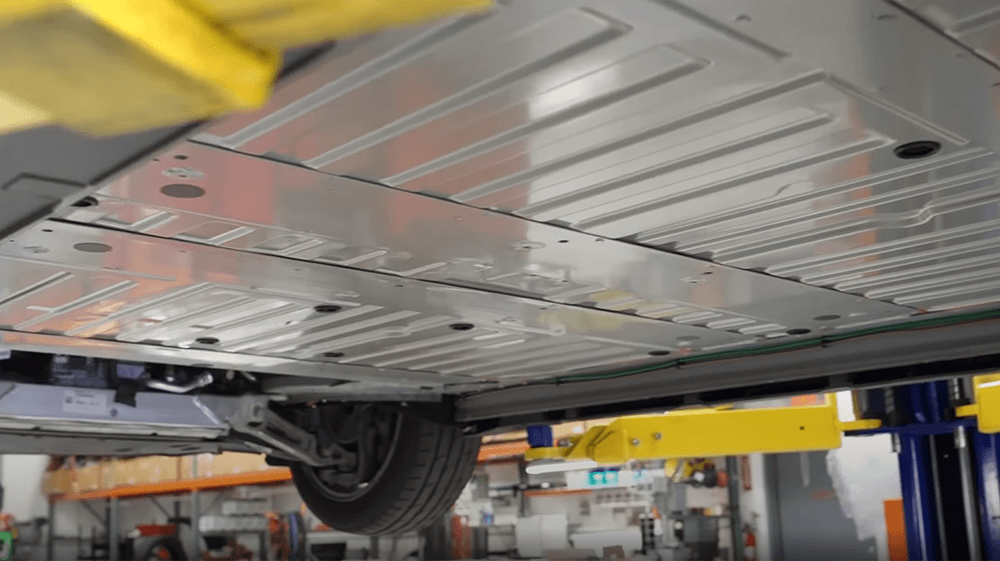
Beyond the cell itself, Tesla is pioneering a structural battery pack concept utilizing the 4680 cells. Instead of encasing battery modules within a separate vehicle chassis, the 4680 cells are directly integrated into the vehicle’s structure. The battery pack effectively becomes a part of the car’s frame, connecting the front and rear underbody castings. This revolutionary approach offers immense advantages: improved vehicle rigidity and crash safety, reduced overall vehicle weight (by eliminating redundant structural components and optimizing material use), and a simpler, more streamlined manufacturing process for the entire vehicle. This integration represents a holistic design philosophy, treating the battery not just as an energy storage unit, but as a fundamental structural element of the car.
In-House Production and Scalability

A critical aspect of the 4680 strategy is Tesla’s move towards in-house production. While collaborations with external battery manufacturers like Panasonic and LG Chem will continue, Tesla is establishing its own large-scale 4680 production facilities, notably at Gigafactory Texas and Gigafactory Berlin. This vertical integration provides Tesla with greater control over the entire battery manufacturing process, from raw materials to final assembly. It also allows for rapid iteration and optimization of the production line, driving down costs and accelerating scalability – essential for meeting the growing demand for EVs, especially for upcoming vehicles like the Cybertruck and Tesla Semi.
Anticipated Benefits: Cost, Range, and Performance Improvements
The combination of the tabless design, structural pack, and in-house production is expected to deliver substantial improvements across the board. Tesla projects significant cost reductions per kWh – a critical factor for achieving true mass-market affordability. The efficiency gains from the tabless design and lighter structural pack should translate into increased range for a given battery capacity, or alternatively, the same range with a smaller, lighter battery. Furthermore, the enhanced power delivery will contribute to even more impressive performance metrics, such as acceleration and sustained high-speed driving. The 4680 cell is not merely an incremental upgrade; it represents a foundational shift that promises to redefine EV capabilities and economics.
Beyond the Cell: Battery Management and Software Intelligence
The physical battery cells are only one part of the equation. Tesla’s technological prowess extends significantly to the sophisticated systems that manage, control, and optimize these cells throughout their lifespan.
Sophisticated Battery Management Systems (BMS)
At the core of Tesla’s battery intelligence is its highly advanced Battery Management System (BMS). This critical piece of hardware and software continuously monitors every individual cell within the pack, tracking voltage, current, temperature, and state of charge. The BMS protects the battery from overcharging, over-discharging, overheating, and other conditions that could damage the cells or compromise safety. It actively balances the charge across all cells, ensuring they discharge and charge uniformly, which significantly extends the battery’s lifespan and maintains performance over many years. Tesla’s BMS is renowned for its precision and robustness, directly contributing to the remarkable longevity and safety record of its vehicles.
Thermal Management: Keeping Batteries Optimal
Lithium-ion batteries perform best within a narrow temperature range. Too cold, and performance suffers; too hot, and degradation accelerates rapidly, posing safety risks. Tesla employs highly effective liquid thermal management systems that circulate coolant through intricate pathways within the battery pack. This system actively heats the battery in cold weather (to enable fast charging and full power output) and cools it during rapid charging or aggressive driving (to prevent overheating). This sophisticated thermal control is crucial for maximizing battery efficiency, longevity, and consistent performance across diverse climates and driving conditions.
Software Updates and Over-the-Air Enhancements
A unique aspect of Tesla’s approach is its ability to continuously improve battery performance and longevity through over-the-air (OTA) software updates. Much like a smartphone, a Tesla vehicle’s battery management algorithms can be refined, updated, and optimized remotely. These updates can introduce new charging profiles, improve range estimation, enhance thermal management strategies, and even unlock additional power or efficiency, all without the need for a physical service visit. This continuous improvement model ensures that Tesla vehicles become smarter and more efficient over time, showcasing the power of software in an otherwise hardware-centric domain.
Data-Driven Optimization
Tesla collects vast amounts of real-world operational data from its fleet, ranging from driving patterns and charging habits to ambient temperatures and battery performance metrics. This anonymized, aggregated data is invaluable for data-driven optimization. Engineers analyze this data to identify trends, predict potential issues, refine battery models, and inform future battery research and development. This continuous feedback loop allows Tesla to constantly push the boundaries of what its batteries can achieve, ensuring that future generations of its vehicles benefit from insights gleaned from millions of miles driven globally.
The Future of Tesla Batteries: Innovation on the Horizon
Tesla’s battery journey is far from over. The company continues to invest heavily in research and development, constantly exploring new materials, chemistries, and manufacturing processes to maintain its leadership position.
Advancements in Anode and Cathode Materials
Future innovations will likely focus on even more advanced materials. For cathodes, this means continuing to reduce reliance on costly and ethically sensitive cobalt, moving towards higher nickel content chemistries (e.g., nickel-rich NMC) or exploring new alternatives. For anodes, silicon-based anodes hold immense promise. Silicon can store significantly more lithium ions than traditional graphite, potentially leading to a substantial increase in energy density. The challenge lies in managing silicon’s volumetric expansion during charging, but breakthroughs in this area could unlock the next major leap in battery performance.
Solid-State Battery Potential
While still largely in the research phase for automotive applications, solid-state batteries are considered the holy grail of EV battery technology. By replacing the liquid electrolyte with a solid one, solid-state batteries promise even higher energy density, faster charging speeds, greater safety (due to the elimination of flammable liquid electrolytes), and an extended lifespan. Tesla, like many other automotive and battery companies, is undoubtedly monitoring and likely researching solid-state technology, positioning itself to adopt this transformative chemistry once it becomes commercially viable and scalable.
Recycling and Sustainability Initiatives
As EV adoption accelerates, the lifecycle management of batteries becomes increasingly important. Tesla is actively pursuing battery recycling and repurposing initiatives, aiming to establish closed-loop systems that recover valuable materials like lithium, nickel, and cobalt. This not only reduces the environmental impact but also strengthens the supply chain and lowers the long-term cost of batteries. Ethical sourcing of raw materials, ensuring responsible mining practices, also remains a critical focus as Tesla strives for a sustainable future.
Vertical Integration and Supply Chain Control
Tesla’s ongoing efforts to produce its own 4680 cells exemplify a broader strategy of vertical integration and supply chain control. By bringing more of the battery production process in-house, from cell design to pack assembly, Tesla aims to reduce costs, enhance quality control, and mitigate supply chain risks. This strategic independence will be crucial for Tesla to scale its vehicle production to ambitious targets, ensuring a reliable and cost-effective supply of its most critical component.
Conclusion: Tesla’s Relentless Pursuit of Battery Excellence
Answering “what type of battery does Tesla use” reveals a complex and dynamic landscape. It’s not a single battery type but a sophisticated ecosystem of evolving chemistries, innovative cell designs, and intelligent management systems. From its foundational reliance on lithium-ion cells, through its strategic diversification into LFP for affordability and NCA/NMC for performance, to the revolutionary 4680 tabless cell and structural pack, Tesla has consistently demonstrated a relentless pursuit of battery excellence.
Its profound understanding of material science, coupled with cutting-edge engineering and data-driven software intelligence, has positioned Tesla as a leading innovator in battery technology. This continuous innovation in energy storage is not just about extending range or increasing power; it’s about driving down costs, enhancing safety, improving sustainability, and ultimately, accelerating the world’s transition to a sustainable energy future. Tesla’s batteries are more than just power sources; they are a testament to the company’s vision and its enduring impact on the global automotive and energy landscape.
aViewFromTheCave is a participant in the Amazon Services LLC Associates Program, an affiliate advertising program designed to provide a means for sites to earn advertising fees by advertising and linking to Amazon.com. Amazon, the Amazon logo, AmazonSupply, and the AmazonSupply logo are trademarks of Amazon.com, Inc. or its affiliates. As an Amazon Associate we earn affiliate commissions from qualifying purchases.