
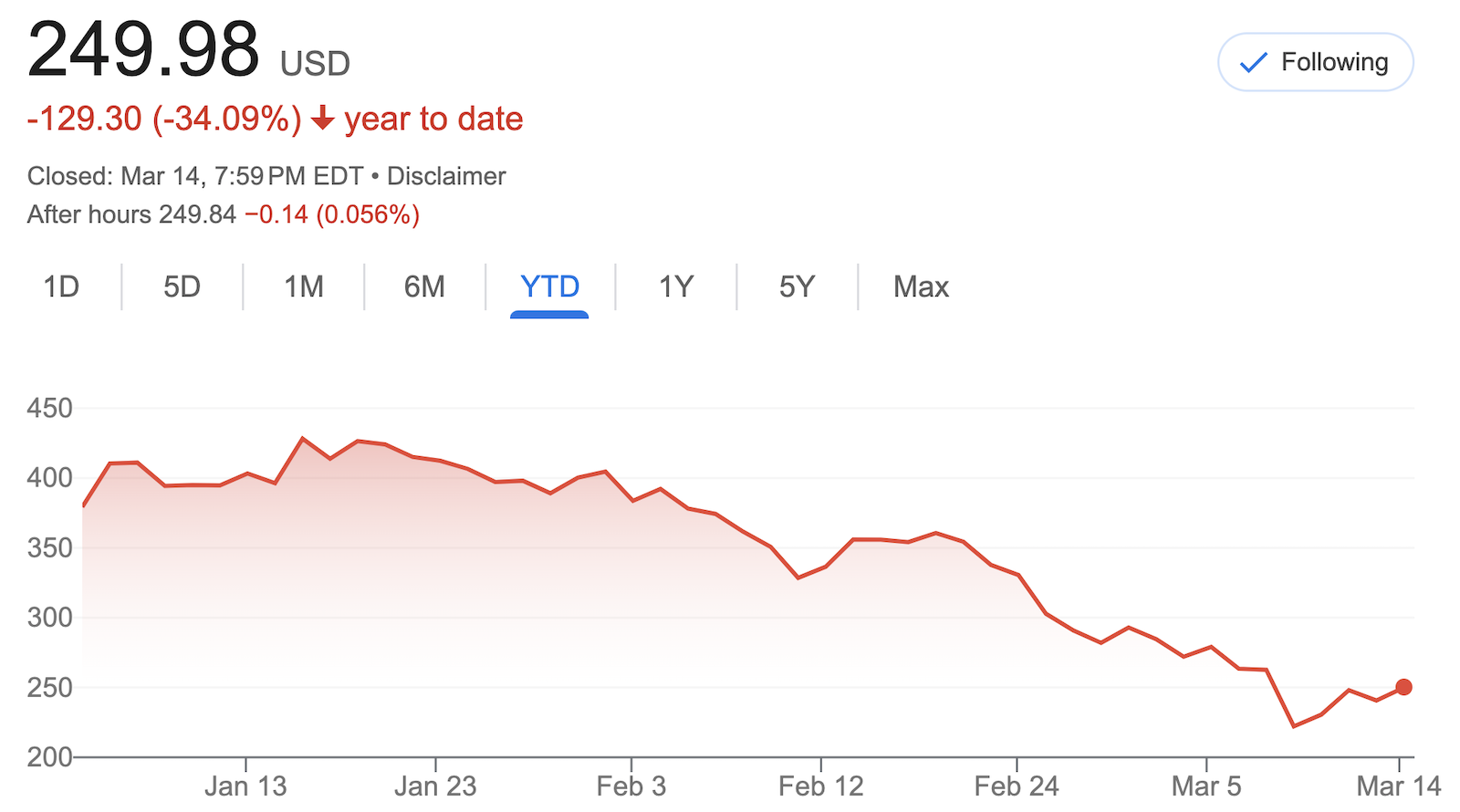
Tesla (TSLA) has been a polarizing stock for over a decade, synonymous with both unprecedented growth and stomach-churning volatility. For investors, the question of “how low will Tesla stock go?” isn’t merely an academic exercise; it’s a critical query impacting portfolio decisions, risk management, and long-term financial planning. Understanding the potential downside requires a multi-faceted analysis rooted in macroeconomic trends, company-specific fundamentals, market sentiment, and technical indicators – all squarely within the realm of astute financial investigation.
Tesla’s journey from a niche electric vehicle (EV) maker to a global automotive and energy giant has been anything but linear. Its stock has defied traditional valuation metrics for years, driven by innovation, a cult-like following, and the transformative vision of its CEO, Elon Musk. However, as the company matures and the EV landscape becomes increasingly crowded, the dynamics influencing its share price are evolving. What once seemed an unstoppable ascent now faces the more conventional pressures of market cycles, competitive intensity, and the cold reality of profit margins. This article will delve into the various financial and market forces that could dictate Tesla’s floor, offering insights for both current holders and prospective investors navigating this high-stakes investment.

Understanding Tesla’s Volatility: A Deep Dive into Market Dynamics
Tesla’s stock price swings are not random; they are a complex interplay of internal company performance, external market forces, and the unique influence of its leadership. Deciphering these elements is crucial for any investor attempting to gauge its potential trajectory.
Macroeconomic Headwinds and Interest Rates
The broader economic environment plays a significant, often underappreciated, role in the valuation of growth stocks like Tesla. In periods of high inflation and rising interest rates, investors typically rotate out of speculative growth assets and into more stable, value-oriented companies. This is because higher interest rates increase the cost of capital for businesses and reduce the present value of future earnings – a concept particularly impactful for companies whose valuations heavily rely on projected long-term growth.
When central banks aggressively raise interest rates to combat inflation, the discount rate applied to future cash flows increases, making those distant profits less attractive today. Tesla, with its premium valuation often justified by its future potential in EVs, AI, and energy, becomes more susceptible to these shifts. Furthermore, economic slowdowns or recessions can dampen consumer demand for big-ticket items like new cars, especially luxury or technologically advanced ones, directly impacting Tesla’s sales volume and revenue growth. A weakened consumer balance sheet, coupled with tighter lending conditions, inevitably translates into lower demand for electric vehicles, regardless of their innovative appeal. Investors, anticipating such downturns, tend to de-risk their portfolios, leading to broader market sell-offs that invariably drag down high-beta stocks like TSLA.
Competitive Landscape and EV Market Saturation
Tesla once enjoyed a near-monopoly in the premium EV segment, affording it significant pricing power and market share. However, the competitive landscape has fundamentally shifted. Traditional automotive giants like General Motors, Ford, Volkswagen, and Hyundai, along with new entrants from China (e.g., BYD, Nio, Xpeng) and other regions, have poured billions into their own EV platforms. This intensified competition has several financial implications for Tesla:
Firstly, it leads to price wars. As competitors introduce compelling EV models at various price points, Tesla is often forced to cut its prices to maintain market share, directly impacting its automotive gross margins – a key financial metric closely watched by investors. Lower margins can significantly erode profitability and challenge the premium valuation previously afforded to the company.
Secondly, market saturation in key regions, particularly in China and parts of Europe, means that achieving exponential growth rates becomes increasingly difficult. While global EV adoption is still expanding, the pace of growth for any single manufacturer will inevitably slow as the market matures and competition for each sale intensifies. This pressure on growth rates can deflate investor expectations and, consequently, the stock’s multiple.
Thirdly, brand differentiation becomes harder. While Tesla still benefits from its early-mover advantage and technological prowess, many competitors are now catching up, offering comparable range, performance, and features. The “Tesla premium” based solely on innovation is diminishing, forcing investors to scrutinize the company’s financial performance against industry averages rather than its own historical, unencumbered growth.
Elon Musk Factor and Geopolitical Risks
Elon Musk is arguably Tesla’s greatest asset and, at times, its biggest liability. His visionary leadership, entrepreneurial drive, and ability to inspire fervor among consumers and investors are unparalleled. However, his highly public persona, controversial statements, and involvement in other ventures (notably X, formerly Twitter) can introduce an idiosyncratic risk factor. Market sentiment around Tesla is frequently influenced by Musk’s actions and pronouncements, which can lead to rapid shifts in investor confidence. Concerns about his focus, the potential for him to sell TSLA shares to fund other projects, or negative publicity generated by his social media activity can all trigger sell-offs.
Beyond Musk, geopolitical risks also play a role. Tesla has significant manufacturing operations in China and relies on global supply chains. Trade tensions between major economic powers, regulatory changes in key markets, or regional conflicts can disrupt production, increase costs, and limit market access. For instance, increased scrutiny on data security in China or changes in subsidies for foreign EV makers could directly impact Tesla’s operational efficiency and profitability in a critical growth market. These external, unquantifiable risks add another layer of uncertainty to Tesla’s stock performance, making it harder to predict its floor based solely on fundamental analysis.
Key Valuation Metrics and Financial Health Indicators
While sentiment and macro factors drive short-term price movements, a company’s financial health and valuation metrics provide the bedrock for long-term investment analysis. For a company like Tesla, understanding these indicators is paramount.
P/E Ratio vs. Growth Prospects
The Price-to-Earnings (P/E) ratio is a fundamental valuation metric, comparing a company’s share price to its per-share earnings. Tesla has historically commanded a P/E ratio significantly higher than the automotive industry average, often justified by its superior growth rates and future potential in diversified segments like energy storage, AI, and autonomous driving. However, as growth rates moderate and competition intensifies, investors become more scrutinizing of this premium.
A high P/E ratio implies that investors expect substantial future growth. If Tesla’s actual growth in vehicle deliveries, revenue, and profitability begins to lag these high expectations, or if analysts revise their growth forecasts downwards, the market could re-rate the stock, leading to a compression of its P/E multiple. This “multiple compression” can cause a significant drop in stock price even if earnings continue to grow, simply because the market is no longer willing to pay as high a premium for each dollar of earnings. Investors must constantly evaluate whether Tesla’s current and projected growth trajectory warrants its P/E, especially in comparison to peers or broader market indices. For example, if Tesla’s growth falls to that of a mature automaker, its P/E would likely fall much closer to the industry average, signaling a potentially much lower stock price.
Revenue Growth, Margins, and Free Cash Flow
These core financial metrics offer a clear picture of Tesla’s operational performance and financial strength.
- Revenue Growth: Sustained, high revenue growth is essential for a growth stock. A slowdown or contraction in revenue growth, particularly if it signals market saturation or loss of competitiveness, can severely impact investor confidence. Tesla’s ability to continue expanding its product lines (e.g., Cybertruck, next-gen vehicles) and geographic presence is critical here.
- Gross Margins: Automotive gross margins, which represent the profit made on each vehicle sold before operating expenses, are crucial. Tesla’s margins have fluctuated, impacted by price cuts, production inefficiencies, and battery costs. Sustained pressure on gross margins suggests a tougher competitive environment and less pricing power, directly reducing profitability. Declining margins can send a strong negative signal to the market, indicating that the company’s competitive advantages are eroding.
- Operating Margins: These reflect the efficiency of Tesla’s overall business operations. Improving operating margins indicate that the company is effectively managing its overhead and scaling its operations efficiently. Conversely, deteriorating operating margins despite revenue growth could point to increasing operational costs or lack of leverage from economies of scale.
- Free Cash Flow (FCF): FCF is the cash a company generates after accounting for cash outflows to support operations and maintain its capital assets. Robust and consistent FCF is a sign of financial health and provides the company with capital for reinvestment, debt reduction, or shareholder returns. A decline in FCF, or persistent negative FCF, can raise concerns about a company’s ability to fund its growth ambitions internally, potentially requiring external financing which could dilute existing shareholders or increase debt burden. For investors, FCF often represents the true earnings power of a company.
Monitoring these metrics quarter-over-quarter and year-over-year, and comparing them against analyst estimates and industry benchmarks, provides a fundamental basis for assessing Tesla’s intrinsic value and potential floor.
Production and Delivery Targets vs. Reality

Tesla’s financial narrative has always been closely tied to its ambitious production and delivery targets. The company’s ability to scale manufacturing, overcome supply chain hurdles, and consistently meet or exceed its self-imposed goals has historically been a significant catalyst for stock appreciation. However, misses on these targets can lead to sharp corrections.
Delays in product launches (e.g., Cybertruck, Semi), slower-than-expected ramps of new factories (e.g., Gigafactory Berlin, Texas), or challenges in sourcing critical components (e.g., chips, batteries) can directly impact the number of vehicles delivered. When Tesla fails to meet its delivery guidance, it not only impacts current revenue but also casts doubt on its future growth trajectory and operational efficiency. Investors interpret such misses as signs of execution risk, leading to downward revisions of future earnings estimates and a corresponding sell-off in the stock. The market penalizes companies that consistently overpromise and underdeliver, especially those with premium valuations. Conversely, strong delivery numbers often provide a boost, demonstrating the company’s capacity to execute its growth strategy.
Technical Analysis and Support Levels
Beyond fundamentals, technical analysis provides insights into potential price floors by studying historical price movements, volume, and chart patterns. While not foolproof, it can offer a roadmap for traders and provide context for long-term investors.
Identifying Critical Price Floors
Technical analysts scrutinize price charts to identify “support levels” – prices at which buying interest has historically been strong enough to prevent further declines. These levels often correspond to previous lows, areas of high trading volume, or psychological thresholds. For Tesla, identifying these critical price floors involves looking at:
- Historical Support Zones: Periods where the stock repeatedly bounced off a certain price range. These zones can act as magnets, attracting buyers when the stock approaches them.
- Moving Averages: Widely used indicators like the 50-day, 100-day, or 200-day simple moving averages can act as dynamic support levels. When the stock trades significantly below these averages, it can signal bearish momentum, but a bounce off a key moving average can indicate a potential reversal.
- Fibonacci Retracements: This tool uses horizontal lines to indicate where support and resistance are likely to occur, based on key percentages (e.g., 38.2%, 50%, 61.8%) of a previous major price move. For a stock like Tesla, which has experienced massive rallies and corrections, Fibonacci levels can highlight potential areas where a downtrend might find a temporary or permanent bottom.
- Chart Patterns: Patterns like “double bottoms” or “head and shoulders” on longer timeframes can signal potential trend reversals or continuations, helping identify where a stock might consolidate before finding a new direction.
While technical analysis does not predict the future, it provides a probabilistic framework for understanding market psychology and potential areas of capitulation or accumulation.
Volume Trends and Investor Sentiment
Trading volume, which measures the number of shares traded over a period, provides crucial insights into the conviction behind price movements.
- High Volume on Declines: If Tesla’s stock is falling on unusually high trading volume, it often signals strong selling pressure and a high level of capitulation among investors. This can be interpreted as a bearish sign, suggesting that more participants are exiting their positions, potentially pushing the stock lower. However, extremely high volume during a sharp decline can also signal a “capitulation event,” where most weak hands have sold, potentially setting the stage for a short-term bounce or bottom.
- Low Volume on Declines: Conversely, if the stock is drifting lower on low volume, it might suggest a lack of strong conviction from sellers, or that institutional investors are merely trimming positions rather than aggressively dumping shares.
- Increasing Volume on Rallies: A stock rally accompanied by rising volume indicates strong buying interest and conviction, suggesting the upward movement is sustainable.
- Divergence: Discrepancies between price action and volume can also be telling. For example, if Tesla’s stock reaches a new low but on significantly lower volume than previous lows, it might suggest that selling pressure is weakening, even if the price is still falling.
Analyzing volume alongside price action helps confirm or question the strength of a trend and provides clues about whether a potential bottom is being formed or if further declines are likely. Sentiment indicators, derived from options activity (put/call ratios), short interest, and news sentiment, also offer a lens into prevailing market attitudes towards Tesla, which can influence its price trajectory.
Investment Strategies for Navigating Tesla’s Swings
Investing in a volatile stock like Tesla requires a well-defined strategy and a robust risk management framework. Understanding its potential downside isn’t just about predicting a bottom; it’s about preparing for various scenarios.
Long-Term vs. Short-Term Perspectives
Investors in Tesla generally fall into two camps:
- Long-Term Investors: These individuals believe in Tesla’s disruptive potential, its long-term vision in EVs, AI, robotics, and energy, and are willing to weather short-term fluctuations. Their focus is on the company’s fundamental growth trajectory over several years. For them, significant pullbacks can be viewed as opportunities to accumulate more shares at a lower cost basis. Their strategy often involves “buy and hold,” focusing on the company’s innovation, market expansion, and sustained profitability. They might look at Tesla through a 5-10 year lens, confident that short-term macroeconomic cycles or competitive pressures will eventually be overcome by the company’s long-term strategic advantages.
- Short-Term Traders: These participants aim to profit from Tesla’s daily or weekly price swings. They rely heavily on technical analysis, market sentiment, and news catalysts to make rapid buying and selling decisions. Their objective is to capitalize on volatility, and they employ tools like options, leverage, and stop-loss orders to manage risk. For short-term traders, identifying potential floors and ceilings is crucial for setting entry and exit points. However, this approach carries significantly higher risk and demands constant attention to market movements.
Understanding one’s own investment horizon and risk tolerance is the first step in formulating an appropriate strategy for Tesla.
Dollar-Cost Averaging and Risk Management
For long-term investors concerned about “how low will Tesla stock go” but still bullish on its future, dollar-cost averaging (DCA) is a powerful risk management technique. Instead of investing a lump sum at a single price point, DCA involves investing a fixed amount of money at regular intervals (e.g., monthly, quarterly), regardless of the stock’s price. This strategy helps mitigate the risk of buying at a market top, as it averages out the purchase price over time. When the stock is low, the fixed investment buys more shares; when it’s high, it buys fewer.
Beyond DCA, general risk management principles are critical:
- Position Sizing: Never allocate an disproportionately large portion of your portfolio to a single, highly volatile stock like Tesla. Over-concentration can expose an investor to catastrophic losses if the stock performs poorly.
- Stop-Loss Orders: For shorter-term investors or those looking to protect against significant downside, setting stop-loss orders can automatically sell shares if the price drops below a predetermined level, limiting potential losses.
- Review Investment Thesis: Regularly revisit the reasons for investing in Tesla. Has the fundamental story changed? Are competitive threats more severe than anticipated? Being honest about changes to the investment thesis helps in making rational decisions, rather than emotional ones.
Diversification and Portfolio Allocation
Perhaps the most fundamental principle of risk management in investing is diversification. Even the most bullish investor on Tesla should not put all their eggs in one basket.
- Diversify Across Asset Classes: Beyond individual stocks, a well-diversified portfolio includes bonds, real estate, commodities, or other alternative investments. This spreads risk across different market conditions.
- Diversify Across Industries: Within equities, owning stocks from various sectors (e.g., tech, healthcare, financials, consumer staples) ensures that a downturn in one industry doesn’t decimate the entire portfolio.
- Diversify Within the EV/Tech Sector: Even if an investor is bullish on the EV trend, owning shares in several promising EV-related companies (e.g., battery manufacturers, charging infrastructure providers, other EV makers) can reduce reliance on any single company’s performance.
Proper portfolio allocation, tailored to an individual’s financial goals, time horizon, and risk tolerance, is paramount. Tesla, given its volatility and growth potential, should typically be part of a broader, well-diversified portfolio, rather than being the sole or dominant holding. This approach helps cushion the impact of a sharp decline in Tesla’s stock price, providing stability while still allowing participation in its potential upside.
Conclusion
The question “how low will Tesla stock go?” remains an enduring challenge for investors. There is no definitive answer, as the stock’s future trajectory will be shaped by a confluence of evolving factors: the broader macroeconomic environment, the intensifying competitive landscape in the EV market, the continued influence of Elon Musk, and Tesla’s own ability to execute on its ambitious growth plans while maintaining profitability.
While technical analysis can point to potential support levels and fundamental metrics offer insights into intrinsic value, the ultimate floor for any stock, especially one as dynamic as Tesla, is influenced by unforeseeable events and shifts in market sentiment. What is clear, however, is that informed decision-making requires a deep understanding of these various forces.
For long-term investors, the focus should remain on Tesla’s innovation, its strategic positioning in multiple high-growth industries, and its long-term financial health, utilizing strategies like dollar-cost averaging to navigate volatility. For shorter-term traders, meticulous risk management and reliance on technical indicators are essential. Ultimately, successful investing in a high-growth, high-volatility stock like Tesla is less about predicting a precise bottom and more about developing a robust, diversified investment strategy that aligns with one’s personal financial goals and risk tolerance, ensuring that you are prepared for both the exhilarating highs and the challenging lows.
aViewFromTheCave is a participant in the Amazon Services LLC Associates Program, an affiliate advertising program designed to provide a means for sites to earn advertising fees by advertising and linking to Amazon.com. Amazon, the Amazon logo, AmazonSupply, and the AmazonSupply logo are trademarks of Amazon.com, Inc. or its affiliates. As an Amazon Associate we earn affiliate commissions from qualifying purchases.