
Navigating federal tax payments can seem like a complex maze, but understanding the available methods and procedures simplifies the process considerably. For millions of taxpayers, timely and accurate submission of federal tax payments is a critical annual responsibility. Whether you’re an individual filing a Form 1040, a business handling quarterly estimated taxes, or someone managing other specific tax obligations, knowing the correct payment channels is essential for financial compliance and peace of mind.
Understanding Your Federal Tax Obligations
Before delving into the “how” and “where” of sending your payment, it’s crucial to grasp the fundamentals of your federal tax obligations. The U.S. tax system operates on a “pay-as-you-go” principle, meaning taxes are typically withheld from paychecks or paid through estimated tax payments throughout the year. However, if your withholdings or estimated payments don’t cover your total tax liability, you’ll owe the remaining balance when you file your annual tax return.
Who Needs to Pay Federal Taxes?
Virtually all U.S. citizens and residents are subject to federal taxes on their worldwide income. This includes wages, salaries, self-employment income, investment income, and various other forms of earnings. The requirement to file a tax return and potentially pay taxes depends on factors such as your gross income, filing status, and age. Businesses, trusts, and other entities also have specific federal tax responsibilities. Understanding your individual or entity’s tax situation is the first step towards fulfilling your obligations correctly.
Types of Federal Taxes
While “federal tax payment” often brings to mind income tax, it’s important to remember that the federal government levies various types of taxes. These can include:
- Income Tax: The most common form, paid on earnings from wages, investments, and other sources.
- Self-Employment Tax: Covers Social Security and Medicare taxes for self-employed individuals.
- Estimated Taxes: Quarterly payments made by individuals and businesses who expect to owe at least $1,000 in tax (or $500 for corporations) and do not have sufficient withholdings. This often applies to self-employed individuals, independent contractors, and those with significant investment income.
- Excise Taxes: Taxes on certain goods and services, often included in the price.
- Estate and Gift Taxes: Taxes on the transfer of wealth.
This article primarily focuses on income tax payments and estimated taxes, as these are the most common payment scenarios for the average taxpayer.
Electronic Tax Payment Options: Fast, Secure, and Convenient
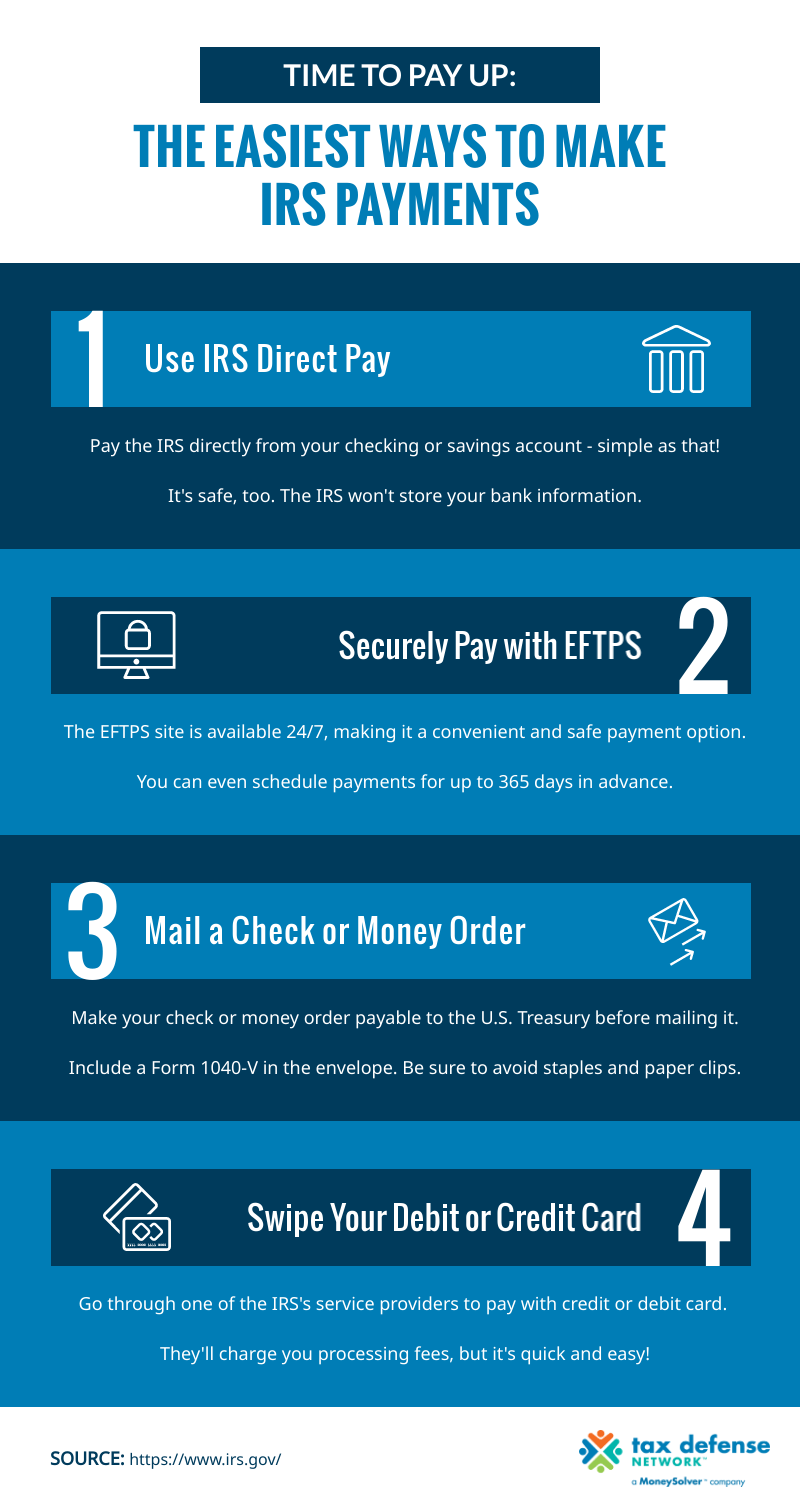
The Internal Revenue Service (IRS) strongly encourages electronic payment methods due to their speed, security, and convenience. These options often eliminate the need for paper checks and trips to the post office, ensuring your payment is processed efficiently.
IRS Direct Pay
IRS Direct Pay is arguably the most straightforward and popular electronic payment method for individuals. It allows you to pay your tax bill directly from your checking or savings account, without any processing fees. You can use it to pay your annual tax return balance (Form 1040 series), estimated taxes (Form 1040-ES), or various other tax forms.
How it works:
- Visit the IRS Direct Pay website (irs.gov/directpay).
- Select the reason for payment (e.g., “Tax Return or Notice,” “Estimated Tax”).
- Choose the tax year and enter your personal details (e.g., Social Security Number, date of birth, filing status from a previous tax return for verification).
- Enter your bank account number and routing number.
- Review and submit your payment. You will receive an email confirmation once the payment is submitted, and a second email when it’s processed. It’s crucial to keep these confirmations for your records.
Electronic Federal Tax Payment System (EFTPS)
EFTPS is a federal government service for paying federal taxes electronically. It’s particularly common for businesses and individuals who make estimated tax payments. While it requires enrollment, it offers greater flexibility, allowing users to schedule payments up to 365 days in advance.
How it works:
- Enroll: Visit eftps.gov or call EFTPS to enroll. This process involves a mailed PIN, so plan ahead.
- Access: Once enrolled and you have your PIN, you can log in online or use the voice response system.
- Schedule Payment: Enter your tax information (e.g., tax type, tax period, amount) and schedule the payment date. You will receive an EFTPS confirmation number, which should be saved as proof of payment.
EFTPS is an excellent tool for managing regular tax payments, ensuring they are always on time.
Payment by Debit Card, Credit Card, or Digital Wallet
For those who prefer the convenience of plastic or digital wallets, the IRS partners with several third-party payment processors. While these methods offer immediate payment and convenience, it’s important to note that the processors charge a fee based on the payment amount (ranging from 1.87% to 2.25% for credit cards, and a flat fee for debit cards, usually between $2.50 and $3.95).
How it works:
- Access the list of authorized payment processors on the IRS website (irs.gov/payments/pay-your-taxes-by-debit-card-credit-card-or-digital-wallet).
- Choose a processor that offers the best terms for your payment method.
- Follow the processor’s instructions to make your payment. You’ll need your tax information (e.g., Social Security Number, tax year, payment amount).
- Keep the confirmation number provided by the processor.
This option can be beneficial for those who need to pay quickly or wish to earn credit card rewards, but the fees should always be weighed against the benefits.
Traditional Payment Methods: Mail, Cash, and More

While electronic payments are encouraged, traditional methods remain viable for many taxpayers, particularly those who prefer not to use online banking or credit cards for tax payments.
Payment by Check or Money Order
Paying by check or money order is a common traditional method. However, it requires careful attention to detail to ensure your payment reaches the IRS and is correctly applied to your account.
How it works:
- Use Payment Voucher (Form 1040-V): If you are mailing a payment for your Form 1040 series return, always include a Form 1040-V, Payment Voucher. This voucher contains essential information like your name, address, Social Security Number, and the amount you are paying, helping the IRS correctly credit your account.
- Make Check Payable To: Make your check or money order payable to the “U.S. Treasury.”
- Write Information on Payment: On the front of your check or money order, clearly write your:
- Full name and address
- Daytime phone number
- Social Security Number (or Employer Identification Number for businesses)
- Tax year for which the payment is being made (e.g., “2023 Form 1040”)
- Form number you are paying (e.g., “Form 1040-ES” for estimated taxes)
- Mailing Address: The mailing address depends on the type of return you’re filing and the state you live in. The IRS provides specific mailing addresses in the instructions for each tax form (e.g., Form 1040 instructions, Form 1040-ES instructions). Always refer to the most current instructions available on irs.gov. Do not send cash through the mail.
- Mail Early: Send your payment several days before the deadline to account for potential mail delays. The postmark date generally determines the payment date.
Cash Payments
Paying federal taxes with cash is an option, but it’s the least convenient and requires a specific process. The IRS does not accept cash payments directly at its offices.
How it works:
- Choose a Retail Partner: The IRS has partnered with various retail stores (e.g., 7-Eleven, Family Dollar, CVS) that accept cash payments for federal taxes.
- Get a Payment Code: You must first obtain a payment code from a third-party processor website (e.g., OfficialPayments.com/fed or PayNearMe.com/irs). This usually requires providing your Social Security Number or EIN and the payment amount.
- Visit Retail Location: Take the payment code (via text, email, or printout) to a participating retail location. The cashier will scan the code, accept your cash payment (up to certain limits, typically $500 per payment), and provide you with a receipt.
- Keep Records: Retain your receipt from the retail store as proof of payment.
Crucial Steps for Accurate and Timely Submission
Regardless of your chosen payment method, several critical steps ensure your payment is accurate and submitted on time, preventing potential penalties.
Payment Due Dates and Extensions
Most individual tax returns and payments are due by April 15th (or the next business day if April 15th falls on a weekend or holiday). Estimated tax payments have quarterly due dates: April 15, June 15, September 15, and January 15 of the following year.
If you cannot file your return by the deadline, you can request an extension (Form 4868 for individuals). However, an extension to file is not an extension to pay. You must still pay any taxes you owe by the original deadline to avoid penalties and interest, even if you are filing an extension for the return itself. Estimate your tax liability carefully and pay what you can by the due date.
What if You Can’t Pay On Time?
If you find yourself unable to pay your federal tax bill by the deadline, don’t ignore it. The IRS offers several options to help taxpayers in financial distress:
- Short-Term Payment Plan: You may be granted up to 180 days to pay your tax liability in full, although interest and penalties still apply.
- Offer in Compromise (OIC): An OIC allows certain taxpayers to resolve their tax liability with the IRS for a lower amount than what they originally owe. This is typically an option when taxpayers are in significant financial difficulty.
- Installment Agreement: If you owe $50,000 or less (for individuals) or $25,000 or less (for businesses) and meet certain criteria, you may be able to set up a monthly payment plan for up to 72 months. While interest and penalties still accrue, an installment agreement prevents further enforcement actions.
It’s always best to communicate with the IRS as soon as possible if you anticipate payment difficulties.
Common Pitfalls to Avoid
- Wrong Tax Year: Ensure your payment is clearly designated for the correct tax year.
- Incorrect SSN/EIN: Verify your Social Security Number or Employer Identification Number is accurate on all payment forms and correspondence.
- Mailing to the Wrong Address: Double-check the IRS mailing address for your specific form and state.
- Not Including Payment Voucher: For mailed checks, always include the appropriate payment voucher (e.g., Form 1040-V).
- Assuming an Extension to File is an Extension to Pay: These are separate actions; payment is generally due by the original deadline.
- Ignoring IRS Notices: Respond promptly to any correspondence from the IRS regarding your tax payments.
Confirming Your Payment and Record Keeping
After making your payment, the final step is to confirm its receipt and maintain meticulous records. This safeguards you against potential disputes and serves as essential documentation for future reference.
How to Verify Your Payment
- Electronic Payments: For IRS Direct Pay, save the confirmation emails. For EFTPS, record your confirmation number. For credit/debit card payments, keep the confirmation from the third-party processor. You can also check your bank or credit card statements.
- Mailed Payments: While you won’t get an immediate confirmation, you can periodically check your IRS online account (if available) or wait for your account transcript to reflect the payment. Some taxpayers send checks via certified mail for a return receipt, providing proof of delivery.
- Cash Payments: Keep the receipt provided by the retail partner.

Importance of Documentation
Maintain a dedicated folder for all tax-related documents, including:
- Copies of your tax returns.
- Payment confirmations (electronic or paper receipts).
- Bank statements showing withdrawals for tax payments.
- Any correspondence from the IRS.
These records are invaluable for reconciling your tax accounts, responding to IRS inquiries, or preparing for future tax seasons. Staying organized with your financial documents is a cornerstone of sound personal finance and ensures you are always prepared regarding your tax obligations.
aViewFromTheCave is a participant in the Amazon Services LLC Associates Program, an affiliate advertising program designed to provide a means for sites to earn advertising fees by advertising and linking to Amazon.com. Amazon, the Amazon logo, AmazonSupply, and the AmazonSupply logo are trademarks of Amazon.com, Inc. or its affiliates. As an Amazon Associate we earn affiliate commissions from qualifying purchases.