
NVIDIA (NVDA) has emerged as a titan in the technology sector, particularly with its dominant position in artificial intelligence (AI) chips, graphics processing units (GPUs), and data center solutions. For investors, the company’s remarkable growth trajectory and market capitalization have been a primary focus. However, a significant question for a subset of investors revolves around its dividend policy: When will NVIDIA pay its next dividend, and what can investors expect from its approach to shareholder returns?
Understanding NVIDIA’s stance on dividends requires a dive into its financial strategy, the mechanics of dividend payments, and the broader context of its industry and growth prospects. Unlike many mature companies that offer substantial dividend yields, NVIDIA’s history reflects a different priority – reinvestment for aggressive growth.

Understanding NVIDIA’s Dividend Strategy
NVIDIA has historically paid a relatively modest quarterly dividend. For a company valued in the trillions of dollars and at the forefront of several technological revolutions, its dividend yield is notably low, often hovering well under 0.1%. This isn’t an oversight or a sign of financial distress; rather, it’s a strategic choice common among high-growth technology firms.
The Growth vs. Income Dilemma for Tech Giants
For a company like NVIDIA, the primary focus has always been on innovation and market expansion. The capital generated is overwhelmingly channeled back into research and development, acquisitions, and scaling production capabilities to meet skyrocketing demand for its groundbreaking products. This reinvestment strategy is designed to fuel future growth, enhance competitive advantage, and ultimately drive capital appreciation for shareholders, rather than providing immediate income through dividends.
Many tech companies, especially those in hyper-growth phases, adopt a similar approach. Firms like Amazon or Tesla have historically paid no dividends at all, preferring to plow every dollar of profit back into their operations. Apple, Microsoft, and Meta (Facebook) are examples of tech giants that started paying dividends only after reaching a certain level of maturity and market saturation, or when their free cash flow became so immense that reinvestment opportunities couldn’t fully absorb it. Even then, their dividend yields are typically lower than those of companies in more traditional, slower-growth sectors.
NVIDIA’s dividend, while small, can be seen as a nod to broader shareholder return principles, but it firmly underlines the company’s commitment to growth as its primary value driver. Investors holding NVDA stock are generally doing so for its potential for significant price appreciation, not for quarterly income.
The Mechanics of Dividend Payouts: Key Dates for Investors
For investors tracking NVIDIA’s dividend, understanding the key dates involved in the payout process is crucial. These dates dictate who receives the dividend and when.
Declaration Date
This is the date when NVIDIA’s board of directors officially announces the next dividend payment. The announcement includes the dividend amount per share, the ex-dividend date, the record date, and the payment date. This information is typically released via press releases and investor relations sections of the company’s website.
Ex-Dividend Date
Perhaps the most critical date for investors, the ex-dividend date (or “ex-date”) is set by stock exchanges, usually one business day before the record date. To receive the dividend, an investor must own the stock before the ex-dividend date. If you buy the stock on or after the ex-dividend date, you will not be eligible for that particular dividend payment; the seller will receive it. Conversely, if you sell the stock on or after the ex-dividend date, you will still receive the dividend. The stock price typically drops by the dividend amount on the ex-dividend date, reflecting the fact that new buyers will not receive the payout.
Record Date
The record date is the specific date on which the company’s transfer agent reviews its records to identify all shareholders who are eligible to receive the dividend. Only shareholders recorded on the company’s books by the end of this date will receive the dividend payment. Due to settlement periods for stock trades, you must have purchased the stock before the ex-dividend date to be on record by the record date.
Payment Date
This is the date when the dividend is actually paid out to eligible shareholders. Funds are typically distributed via electronic transfer to brokerage accounts or by check.
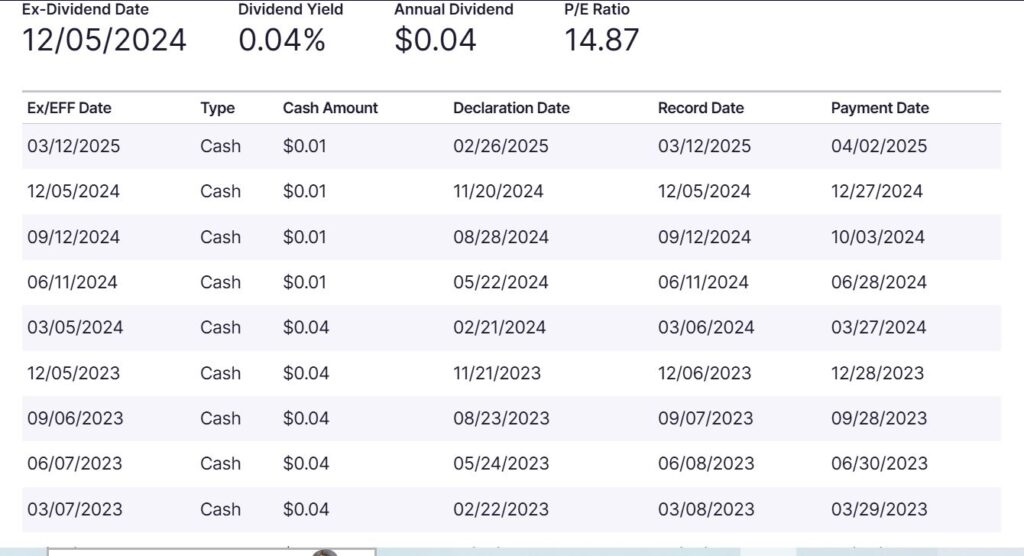
To find NVIDIA’s next expected dividend payment information, investors should regularly check the company’s official investor relations website, financial news outlets, or their brokerage account statements and notifications. These sources will provide the most up-to-date details on any declared dividends, including the upcoming payment date.
Factors Influencing Future Dividend Decisions
While NVIDIA’s current dividend policy is clear, several factors could influence its future decisions regarding shareholder distributions. Companies often review their capital allocation strategies based on internal performance, market conditions, and strategic priorities.
Financial Performance & Free Cash Flow
NVIDIA’s unprecedented growth in recent years, driven by demand for its AI GPUs, has resulted in massive increases in revenue, net income, and, critically, free cash flow. Free cash flow (FCF) is the cash a company generates after accounting for cash outflows to support operations and maintain its capital assets. A robust and growing FCF gives a company significant flexibility in how it allocates capital.
If NVIDIA continues to generate free cash flow far exceeding its internal reinvestment opportunities and strategic acquisition needs, it might consider increasing its dividend or initiating more substantial share buyback programs. However, given the rapid pace of innovation and expansion in the AI and data center markets, NVIDIA likely still sees ample high-return opportunities to reinvest its capital internally.
Reinvestment Opportunities
The core of NVIDIA’s strategy is growth through innovation. The company invests heavily in research and development (R&D) to stay ahead in areas like AI, autonomous vehicles, metaverse technologies, and accelerated computing. Expanding manufacturing capabilities, securing supply chains, and pursuing strategic acquisitions are all critical uses of capital that underpin future growth.
For now, the return on investment from these internal projects likely far exceeds the returns from simply paying out a larger dividend. As long as NVIDIA can identify and execute high-return growth initiatives, a significant increase in its dividend yield is improbable. The company’s management will constantly weigh the benefits of reinvestment versus returning capital to shareholders.
Shareholder Expectations & Capital Allocation
While income investors might desire a higher dividend, a significant portion of NVIDIA’s shareholder base consists of growth-oriented investors who prioritize capital appreciation. Management must balance these differing expectations. A substantial increase in dividends might signal a perceived slowdown in growth opportunities, which could be negatively interpreted by some growth investors. Conversely, a stable or slightly growing dividend, alongside aggressive share buybacks, offers a more flexible way to return capital while not explicitly signaling a shift from growth. NVIDIA has utilized share buybacks as a significant component of its capital return strategy.
Market Conditions & Sector Trends
The broader economic environment, interest rates, and the competitive landscape also play a role. In periods of high market uncertainty or economic downturns, companies might become more conservative with cash, potentially pausing dividend increases or even cutting them to preserve liquidity. Conversely, a stable and robust market environment could provide more confidence for companies to increase shareholder returns. The rapid evolution of the AI sector means that NVIDIA must remain agile and well-capitalized to adapt to new technologies and competitive pressures.
Investor Implications and Strategic Considerations
For individual investors, NVIDIA’s dividend policy carries several implications, particularly when forming a diversified portfolio.
For Income-Focused Investors
NVIDIA is unequivocally not a stock for investors primarily seeking high dividend income. Its yield is negligible, and the company’s strategy is built around growth. Investors looking for substantial dividend payouts should explore other sectors or more mature companies with established dividend histories and higher yields. Attempting to fit NVIDIA into an income-centric portfolio would misalign with the company’s core investment thesis.
For Growth Investors
For those focused on capital appreciation, NVIDIA’s current dividend policy is generally favorable. It signifies that the company is prioritizing reinvestment into its high-growth business, which is precisely what growth investors desire. Any change in this policy, such as a significant increase in the dividend, would warrant careful analysis. While a higher dividend might seem appealing, it could also imply that management sees fewer compelling internal growth opportunities, potentially signaling a shift in the company’s lifecycle.
Tax Implications
Dividends are generally subject to income tax. Qualified dividends receive favorable tax treatment in many jurisdictions, but they are still taxable events. Investors should consult with a financial advisor to understand the tax implications of receiving dividends from NVIDIA or any other stock, particularly when considering portfolio construction and overall investment strategy.

Diversification and Portfolio Strategy
Regardless of NVIDIA’s dividend policy, prudent investors understand the importance of diversification. Even a stellar performer like NVIDIA carries inherent market and company-specific risks. A well-diversified portfolio balances growth stocks, income-generating assets, and other asset classes to mitigate risk and achieve long-term financial goals.
In conclusion, while “When will NVIDIA pay its next dividend?” is a valid question, the answer often reiterates the company’s core identity as a growth engine. Investors should monitor official company announcements for specific dividend dates and remain cognizant of NVIDIA’s overarching strategy to reinvest for future innovation and market leadership, rather than prioritizing large dividend payouts.
aViewFromTheCave is a participant in the Amazon Services LLC Associates Program, an affiliate advertising program designed to provide a means for sites to earn advertising fees by advertising and linking to Amazon.com. Amazon, the Amazon logo, AmazonSupply, and the AmazonSupply logo are trademarks of Amazon.com, Inc. or its affiliates. As an Amazon Associate we earn affiliate commissions from qualifying purchases.