
In traditional finance, the concept of “backing” often refers to a tangible asset or government guarantee that imbues a currency or financial instrument with value. Gold historically backed many fiat currencies, and government bonds are backed by the taxing power of a nation. Cryptocurrencies, however, operate under an entirely different paradigm, leading many to question the fundamental sources of their value and security. Understanding what truly underpins cryptocurrency requires a deep dive into its unique economic, technological, and social architectures, rather than seeking a direct analogy to conventional financial instruments.
The Intangible Foundation: Decentralization and Scarcity
Unlike fiat currencies, which are centrally issued and regulated by governments, most cryptocurrencies are decentralized, operating on distributed ledger technology (DLT) without a central authority. This foundational difference inherently shifts what constitutes “backing.”

The Power of Distributed Ledger Technology
At its core, the backing of a cryptocurrency like Bitcoin stems from the robustness and immutability of its underlying blockchain technology. The blockchain is a distributed, public ledger that records all transactions across a network of computers. Each “block” of transactions is cryptographically linked to the previous one, forming an unbreakable chain. This decentralized nature means there’s no single point of failure and no single entity that can manipulate the ledger. The collective computational power and consensus of thousands of nodes worldwide validate and secure transactions, making the network incredibly resilient to fraud and censorship. The “backing” here is the integrity of the network itself, secured by cryptographic proofs and the distributed agreement of participants.
Capped Supply and Deflationary Mechanics
A critical economic principle backing many cryptocurrencies, especially Bitcoin, is their predetermined and often limited supply. Unlike fiat currencies, which central banks can print at will, Bitcoin has a hard cap of 21 million coins. This scarcity, enforced by its protocol, introduces a deflationary characteristic that contrasts sharply with the inflationary tendencies of fiat money. As demand for a scarce asset grows, its value tends to appreciate. This programmatic scarcity, guaranteed by mathematical algorithms rather than human policy, provides a powerful economic underpinning. Other cryptocurrencies may have different issuance schedules, but the principle of a predictable, algorithmically controlled supply is a common and vital component of their perceived value.
Trust, Utility, and Network Effects
The value of cryptocurrency is not purely an abstract technological construct; it is deeply intertwined with the trust users place in its system, its practical utility, and the network effects that emerge from its adoption.
The Role of Consensus Mechanisms
Trust in a decentralized system is built through its consensus mechanism. Proof-of-Work (PoW), used by Bitcoin and Ethereum (prior to its Merge), requires “miners” to expend significant computational resources to solve complex puzzles, thereby validating transactions and adding new blocks to the chain. The immense energy cost associated with PoW makes it economically unfeasible to rewrite transaction history, thereby securing the network. Proof-of-Stake (PoS), now used by Ethereum, involves “validators” who stake their own cryptocurrency as collateral to participate in transaction validation. This economic incentive aligns validators’ interests with the security and integrity of the network, as malicious behavior results in the forfeiture of their staked assets. These mechanisms are the algorithmic “trust-keepers” that replace central bank oversight in traditional finance, forming a crucial part of what backs the currency.
Practical Applications and Ecosystem Growth
Beyond speculative trading, the utility of a cryptocurrency contributes significantly to its backing. Bitcoin’s utility as a censorship-resistant store of value and a medium for international, permissionless transfers gives it practical value. Ethereum’s utility extends further, serving as the foundational platform for decentralized applications (dApps), smart contracts, and the vast ecosystem of Decentralized Finance (DeFi), Non-Fungible Tokens (NFTs), and Web3 projects. The value of Ether (ETH) is thus intrinsically linked to the demand for using the Ethereum network for these diverse applications. Other cryptocurrencies back various use cases, from facilitating micro-transactions in gaming to powering supply chain management solutions or enabling secure data sharing. The more practical problems a crypto network solves and the more widespread its adoption for these solutions, the stronger its fundamental backing.
The Network Effect: Adoption and Security
The “network effect” is a powerful force in the digital realm, where the value of a network increases exponentially with each new participant. For cryptocurrencies, this means that as more users, developers, businesses, and institutions adopt a particular coin or blockchain, its utility, liquidity, and security are enhanced. A larger network implies greater decentralization, making it harder for any single entity to control or attack the system. Increased adoption also fosters greater developer activity, leading to more innovation and useful applications, further cementing the cryptocurrency’s place in the digital economy. This virtuous cycle of adoption and growth provides a dynamic and ever-strengthening form of backing.
Algorithmic Guarantees and Cryptographic Security
The technological underpinnings of cryptocurrency are not merely abstract concepts; they are codified in algorithms and secured by advanced cryptography, providing a level of transparency and immutability unprecedented in traditional financial systems.
Proof-of-Work vs. Proof-of-Stake
As touched upon, the consensus mechanism dictates how transactions are verified and new blocks are added to the blockchain. In PoW, the economic incentive for miners to participate is the block reward and transaction fees. The immense computational power (hash rate) dedicated to a PoW chain like Bitcoin creates a formidable security barrier; an attacker would need to control over 51% of the network’s total hash rate to successfully execute a double-spend attack, an undertaking so costly it is practically infeasible for major chains. In PoS, validators are chosen based on the amount of cryptocurrency they “stake” and their willingness to participate honestly. Any validator attempting to defraud the system risks losing their staked collateral, making malicious activity economically irrational. These algorithmic guarantees are fundamental to the integrity and trustworthiness—and thus the backing—of the respective cryptocurrencies.
Immutability and Transaction Integrity
Once a transaction is confirmed and added to the blockchain, it is nearly impossible to alter or remove it. This immutability is a cornerstone of cryptographic security and a key component of what backs cryptocurrencies. Each block contains a cryptographic hash of the previous block, creating a tamper-proof chain. Any attempt to alter an old transaction would require recalculating the hashes of all subsequent blocks, an astronomically difficult task. This ensures the integrity of the ledger, preventing fraudulent reversals or manipulations, and providing users with an unprecedented level of confidence in the finality of their transactions. This cryptographic integrity serves as a powerful, non-physical backing.
Economic Incentives and Investor Confidence
While the technical and utility aspects are crucial, the economic behavior of market participants and the confidence they instill are equally vital components of cryptocurrency backing.
Speculation vs. Fundamental Value
A significant portion of cryptocurrency’s market activity is driven by speculation, where investors buy assets hoping their price will increase based on future demand. However, beneath this speculative layer lies a growing recognition of fundamental value. For Bitcoin, this is its role as “digital gold,” a hedge against inflation and a store of value independent of government control. For Ethereum, it’s the platform on which a new decentralized financial system is being built. As more real-world applications emerge and institutional adoption grows, the fundamental value proposition strengthens, attracting more long-term investment and reducing reliance solely on speculative fervor. Investor confidence, therefore, is backed by both the potential for future growth and the tangible utility already being realized.
Market Capitalization and Liquidity
The market capitalization of a cryptocurrency (price per coin multiplied by the circulating supply) reflects the total perceived value of the network by market participants. High market capitalization often correlates with greater liquidity, meaning the asset can be bought and sold quickly without significantly impacting its price. High liquidity is crucial for investor confidence, as it ensures that assets can be converted to fiat or other cryptocurrencies efficiently. A deep, liquid market for a cryptocurrency signifies broad adoption and a robust trading ecosystem, acting as a form of collective backing through the ease with which value can be exchanged.
The Backing of Stablecoins and Asset-Backed Tokens
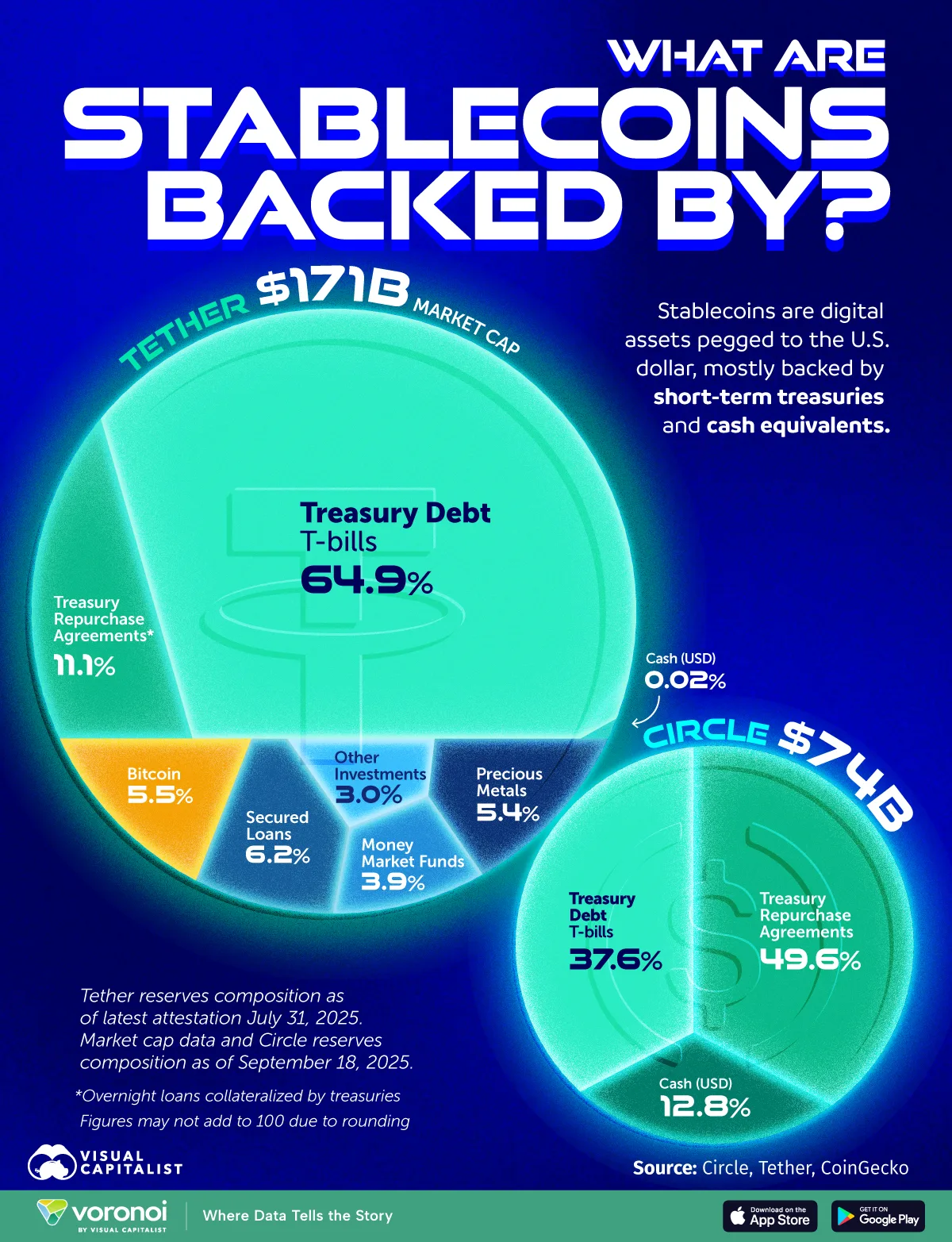
While most cryptocurrencies derive their backing from their network’s integrity, utility, and scarcity, a distinct category called stablecoins and asset-backed tokens directly addresses the “backing” question by pegging their value to external assets.
Fiat-Collateralized Stablecoins
Stablecoins like USDT (Tether), USDC (USD Coin), and BUSD (Binance USD) are designed to maintain a stable value, typically pegged 1:1 with a fiat currency like the US dollar. Their backing comes from reserves of the corresponding fiat currency, or equivalents like commercial paper, held by the issuing entity in traditional bank accounts. The trust here shifts from a decentralized network to the issuer’s transparency and auditing of their reserves. This provides a bridge between the volatile crypto market and the stability of fiat currencies, allowing for easier movement of value and acting as a common trading pair. Their backing is directly analogous to a gold-backed currency, but with fiat reserves.
Crypto-Collateralized Stablecoins
Other stablecoins, such as DAI, maintain their peg through over-collateralization with other cryptocurrencies (e.g., Ether) held in smart contracts. If the value of the collateral falls, the system automatically liquidates a portion of it to maintain the peg. This method offers greater decentralization than fiat-backed stablecoins but introduces different risks related to the volatility of the underlying crypto collateral.

Commodity and Real-World Asset Backing
Beyond fiat, some tokens are designed to be backed by real-world assets, such as gold (e.g., PAX Gold), real estate, or even commodities like oil. These tokens aim to bring the liquidity and fractional ownership benefits of blockchain technology to traditional asset classes. The backing for these tokens is directly tied to the value of the physical assets they represent, often held by third-party custodians, with auditability being key to their credibility.
In summary, “what backs cryptocurrency” is not a singular answer but a multifaceted interplay of decentralized technology, cryptographic security, algorithmic scarcity, network utility, economic incentives, and collective market confidence. For specific tokens, it may also include direct asset collateralization. This complex tapestry forms the robust, albeit often intangible, foundation of the burgeoning digital asset economy.
aViewFromTheCave is a participant in the Amazon Services LLC Associates Program, an affiliate advertising program designed to provide a means for sites to earn advertising fees by advertising and linking to Amazon.com. Amazon, the Amazon logo, AmazonSupply, and the AmazonSupply logo are trademarks of Amazon.com, Inc. or its affiliates. As an Amazon Associate we earn affiliate commissions from qualifying purchases.