
In today’s subscription-driven economy, consumers are constantly evaluating the value they derive from their recurring expenses. Amazon Prime stands as a prominent example, offering a sprawling ecosystem of benefits from expedited shipping to extensive digital content libraries. For many households, a Prime membership has become an indispensable service. However, merely subscribing is only the first step; the real financial acumen lies in understanding how to fully leverage its capabilities, particularly through sharing. Sharing Prime benefits isn’t just about convenience; it’s a strategic personal finance move that can significantly amplify value and reduce redundant expenditures, ultimately leading to smarter household budgeting. This article delves into the financial implications and practical strategies of sharing your Amazon Prime membership, transforming it from a personal luxury into a shared economic asset.

Unlocking the Full Potential of Your Prime Membership
Amazon Prime isn’t a singular service; it’s a bundle designed to embed itself deeply into consumer habits, offering a compelling array of features that, individually, would cost far more than the annual or monthly subscription fee. For the financially savvy, understanding this multifaceted value proposition is crucial for making informed decisions about its utilization.
The Comprehensive Value Proposition of Amazon Prime
At its core, Amazon Prime offers convenience: free, fast shipping on millions of items. This benefit alone can translate into substantial savings on delivery fees, especially for frequent online shoppers. Beyond shipping, the membership unlocks a treasure trove of digital entertainment, including Prime Video (movies and TV shows), Prime Music (ad-free listening), Prime Gaming (free games and in-game content), and Prime Reading (a rotating selection of free books and magazines). These services, if purchased à la carte from competing providers, would easily exceed the Prime subscription cost. Furthermore, Prime members gain access to exclusive deals, early access to lightning deals, and services like Amazon Photos (unlimited photo storage) and Whole Foods Market discounts. From a personal finance perspective, Prime consolidates multiple potential expenses (delivery, streaming, music, cloud storage) into a single, relatively affordable subscription, presenting a clear opportunity for cost-efficiency when managed strategically.
Beyond Individual Use: The Shared Economy of Subscriptions
The concept of a “shared economy” often brings to mind services like ride-sharing or home rentals, but it extends profoundly into digital subscriptions. Many households implicitly operate within a shared economy when it comes to services like Netflix, Spotify, or indeed, Amazon Prime. Rather than each individual paying for their own subscription, a single payment covers multiple users, maximizing the utility of a fixed expense. This approach is particularly potent for Prime because its benefits span across both tangible (shipping) and intangible (digital media) goods and services. By consciously enabling sharing, members transform their Prime subscription from a personal expenditure into a household utility, akin to electricity or internet, where a single bill services multiple beneficiaries. This shift in perspective is fundamental to understanding the financial advantage of sharing, moving beyond mere convenience to active cost management.
Strategies for Smart Prime Sharing: Who, What, and How to Benefit
The cornerstone of intelligent Prime sharing lies in Amazon’s dedicated feature: Amazon Household. This mechanism allows for a structured approach to sharing, ensuring that benefits are distributed effectively while maintaining account security. Navigating this feature requires a clear understanding of its parameters and limitations.
The Amazon Household Feature: A Cornerstone for Sharing
Amazon Household is Amazon’s official platform for sharing Prime benefits. It allows two adults (18 years or older), four teenagers (13-17 years old), and up to four children (under 12 years old) to link their accounts and share certain Prime perks. The key financial advantage here is that a single Prime subscription can effectively serve the needs of an entire family unit without the need for multiple, costly individual subscriptions. The adults maintain separate Amazon accounts, preserving their privacy and purchasing history, but share eligible Prime benefits. Teen accounts offer a degree of independence with parental oversight, while child profiles are geared towards content consumption under parental control. This structure is a direct response to the financial realities of modern families, providing a framework to optimize a significant recurring expense.
Identifying Shareable vs. Non-Shareable Benefits
While Amazon Household is generous, not all Prime benefits are universally shareable. From a financial planning standpoint, it’s crucial to know exactly what can be shared to manage expectations and avoid purchasing redundant services.
Shareable Benefits for Adults:
- Prime Shipping: Free two-day, one-day, same-day, and scheduled delivery options. This is arguably the most financially impactful shared benefit, saving on individual shipping costs.
- Prime Video: Access to the extensive streaming library. This eliminates the need for separate video subscriptions for household members.
- Prime Reading and Amazon First Reads: Access to free e-books and early access to new releases.
- Amazon Photos: Unlimited full-resolution photo storage for both adults, a significant saving compared to standalone cloud storage services.
- Exclusive Deals: Access to Prime-exclusive discounts and early access to Lightning Deals.
- Twitch Prime/Prime Gaming: Select in-game content and free games.
- Whole Foods Market Discounts: Savings at the grocery store.
Non-Shareable Benefits: - Prime Music: While household members can stream music through the Prime Video app on shared devices, the dedicated Prime Music benefit (ad-free streaming, specific library access) is typically tied to the primary account. For individual access, a separate Amazon Music Unlimited Family Plan would be required, which is an additional cost.
- Kindle Owners’ Lending Library: This benefit is usually restricted to the primary Prime account.
- Digital Credits and Gift Cards: These are tied to individual accounts.
- Prime Pantry/Fresh (legacy benefits): Specific benefits often linked to the primary account holder.
Understanding this distinction is vital for accurate budgeting and ensuring each household member’s needs are met without incurring unnecessary additional costs. For instance, if multiple members heavily use music streaming, factoring in an Amazon Music Unlimited Family Plan (an additional but still cost-effective solution) into the overall household budget becomes necessary.
Financial Advantages of a Unified Prime Membership
The financial advantages of sharing Prime benefits are compelling. Firstly, it eliminates redundant subscriptions. Without sharing, multiple individuals in the same household might each subscribe to Prime for shipping or streaming, leading to wasted expenditure. A single, shared membership cuts this down to one annual or monthly fee. Secondly, it maximizes the return on investment (ROI) for the Prime fee. By allowing more people to utilize the services, the per-person cost effectively decreases, making the overall subscription more cost-effective. Thirdly, it fosters centralized financial management of a key household expense. Rather than tracking multiple Prime subscriptions, there’s just one to manage, renew, or cancel. This simplification contributes to better budgeting and financial oversight within the household. Finally, the collective access to discounts and free shipping can lead to cumulative savings on everyday purchases, indirectly boosting the household’s disposable income.
Practical Steps for Setting Up Your Prime Sharing Network
Implementing an Amazon Household is straightforward, yet careful execution ensures both financial benefits and smooth user experience. This section guides you through the process, emphasizing best practices for responsible shared account management.
Navigating Amazon Household Setup
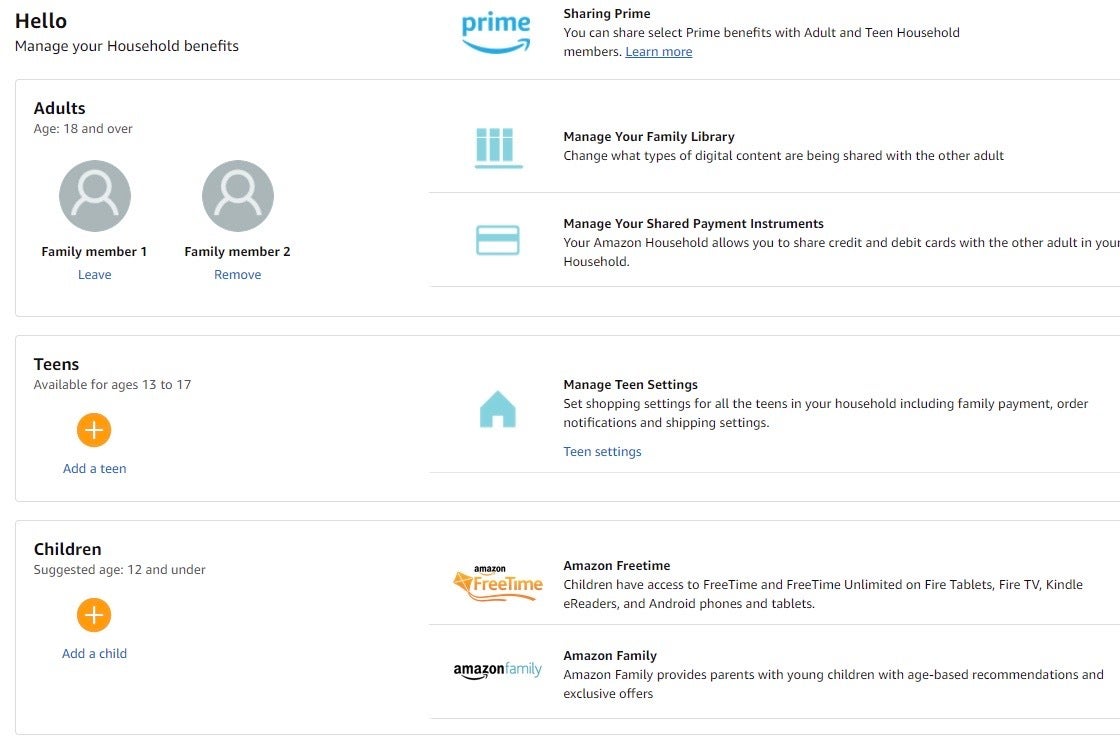
Setting up an Amazon Household is initiated by the primary Prime account holder.
- Visit the Amazon Household Page: Log in to your Amazon account and navigate to “Manage Your Content and Devices,” then “Households and Family Library,” or simply search for “Amazon Household.”
- Invite an Adult: Select the “Add an Adult” option. You will need the email address of the second adult’s Amazon account. An invitation will be sent to them.
- Accept the Invitation: The invited adult must accept the invitation within 14 days and agree to share payment methods. This is a critical step from a financial perspective, as both adults agree to share payment information, meaning each can make purchases using the other’s credit/debit cards stored on file. This necessitates a high degree of trust and financial transparency between the two adults.
- Add Teens and Children (Optional): Once the two adults are linked, they can add up to four teens (aged 13-17) and four children (under 12). Teen accounts allow teens to shop with parental approval, while child profiles are primarily for accessing shared digital content like Prime Video Kids or educational apps.
The setup process is designed to be user-friendly, but the agreement to share payment methods between adults underscores the financial trust required.
Best Practices for Shared Account Management
Once Amazon Household is established, ongoing management is key to maximizing its financial benefits and maintaining harmony.
- Clear Communication on Purchases: Given that payment methods are shared, adults should establish clear communication protocols regarding purchases. Discussing large purchases beforehand or even setting up specific purchasing limits can prevent financial misunderstandings.
- Utilize Separate User Profiles (Where Available): For Prime Video, ensure each adult and teen utilizes their own user profile. This segregates watch history and recommendations, enhancing the personal experience while still sharing the underlying subscription cost.
- Regular Review of Shared Benefits: Periodically review what benefits each member is using. Are certain benefits underutilized? Are there new Prime features that could be beneficial to specific members? This ensures the household is continuously extracting maximum value.
- Security Awareness: While Amazon Household offers distinct accounts, general digital security practices remain paramount. Use strong, unique passwords for each Amazon account within the household.
Monitoring Usage and Maximizing Shared Value
Maximizing shared value extends beyond initial setup to continuous monitoring and adaptation. Track the household’s collective usage of Prime benefits. For instance, how often is free shipping utilized by different members? Is Prime Video a primary entertainment source for everyone, or are alternative streaming services also being paid for? From a financial perspective, if certain Prime benefits (e.g., specific digital content) are consistently ignored by all members, it’s worth questioning if those benefits contribute enough to the overall value proposition for your household. Conversely, if specific members frequently use benefits like Amazon Photos, highlight this as a tangible saving (e.g., avoiding a separate cloud storage subscription). This ongoing audit helps solidify the Prime membership’s place in your household budget as a truly valuable, shared asset.
Broader Financial Implications of Subscription Sharing
The principles learned from sharing Prime benefits extend beyond a single platform, offering a blueprint for intelligent financial management of all recurring subscriptions. This strategy contributes significantly to overall household financial health.
Reducing Household Expenditure Through Smart Sharing
The most immediate financial impact of smart Prime sharing is the reduction in household expenditure. By consolidating multiple potential individual subscriptions into one shared account, families directly save the cost of those additional memberships. This isn’t just theoretical; for a household with two adults, sharing Prime could save the cost of a second Prime membership, a separate cloud storage subscription, and potentially a video streaming service, totaling hundreds of dollars annually. These savings can then be reallocated to other financial goals, such as debt reduction, increasing emergency savings, or investing. Viewing subscriptions through this lens transforms them from passive expenses into active opportunities for savings.
Prime as a Financial Tool: Opportunity Cost and Value
Consider Prime not just as a service, but as a financial tool. The annual fee represents an investment. The opportunity cost of not sharing effectively means that investment is underperforming. By enabling sharing, the return on that investment (in terms of convenience, savings on shipping, and entertainment value) is significantly amplified across multiple users. This perspective elevates Prime from a simple bill to a component of a well-managed personal finance strategy. It encourages consumers to think critically about how their money is spent on recurring services and how to extract the maximum possible utility for every dollar.
Long-Term Savings and Budgeting Benefits
The long-term benefits of adopting a “share to save” mindset for Prime and other subscriptions are substantial. Consistent savings, even seemingly small ones, accumulate over time. This approach cultivates a disciplined budgeting habit, where every subscription is evaluated not just on its individual merit, but on its collective value to the household. It empowers families to build more robust financial plans, identify areas for cost cutting, and direct resources towards more impactful financial objectives. A well-managed subscription portfolio, spearheaded by smart sharing, becomes a quiet but powerful engine for financial resilience and growth.
Beyond Amazon: Extending Smart Sharing Principles to Other Subscriptions
The lessons learned from strategically sharing Amazon Prime benefits are universally applicable to the broader landscape of digital subscriptions, offering a robust framework for continuous financial optimization.
Applying the ‘Share to Save’ Mindset
The “share to save” mindset isn’t exclusive to Amazon Prime. Many other popular subscription services offer family plans or allow for multi-user access. This includes streaming services (Netflix, Disney+, Spotify Family, Apple Music Family), productivity suites (Microsoft 365 Family, Google One family plans), and even news or educational platforms. Adopting the same critical evaluation – “Can this be shared? How many users does it support? What are the financial benefits of consolidating?” – can lead to significant savings across your entire digital footprint. Each instance of shared access eliminates redundant individual subscriptions, contributing to a leaner, more efficient household budget.
Reviewing Your Entire Subscription Ecosystem
A crucial step in financial planning is a periodic audit of all recurring expenses. Apply the Prime sharing framework to your entire subscription ecosystem.
- List All Subscriptions: Create an inventory of every recurring payment, including streaming, software, fitness apps, news, and gaming services.
- Identify Shareable Options: For each subscription, research if a family plan or multi-user access option exists.
- Consolidate Where Possible: Actively migrate individual subscriptions to shared family plans. For instance, if two family members have individual Spotify subscriptions, switch to a Spotify Family plan to save money.
- Evaluate Value vs. Cost: For services that cannot be shared or for which sharing isn’t cost-effective, critically assess if the individual value derived justifies the cost, especially if multiple similar services are being paid for.
By systematically applying the “share to save” principle, households can transform their financial management of digital services from a fragmented, often wasteful process into a streamlined, cost-efficient strategy. Sharing Prime benefits is an excellent starting point, demonstrating how a simple change in approach can yield substantial and lasting financial advantages, empowering consumers to be more proactive and intentional with their money in the digital age.
aViewFromTheCave is a participant in the Amazon Services LLC Associates Program, an affiliate advertising program designed to provide a means for sites to earn advertising fees by advertising and linking to Amazon.com. Amazon, the Amazon logo, AmazonSupply, and the AmazonSupply logo are trademarks of Amazon.com, Inc. or its affiliates. As an Amazon Associate we earn affiliate commissions from qualifying purchases.