
The world of finance often appears as a monolithic entity to the uninitiated, characterized by a singular, all-encompassing “stock market.” Yet, beneath this generalized perception lies a vibrant, complex, and highly fragmented global ecosystem comprising numerous distinct stock markets, or exchanges, each with its unique characteristics, regulations, and participant base. For anyone engaged in or considering personal finance, investing, or business finance, understanding the sheer number and diversity of these markets is not just academic — it’s fundamental to developing robust investment strategies, managing risk, and identifying growth opportunities across borders.
The question “how many stock markets are there?” does not have a simple, definitive numerical answer like counting continents. The total count fluctuates due to new exchanges being established, others merging or shutting down, and the distinction between primary exchanges and alternative trading venues. However, what we can say with certainty is that there are dozens of primary stock exchanges operating globally, facilitating trillions of dollars in transactions daily and reflecting the economic heartbeat of nearly every nation.
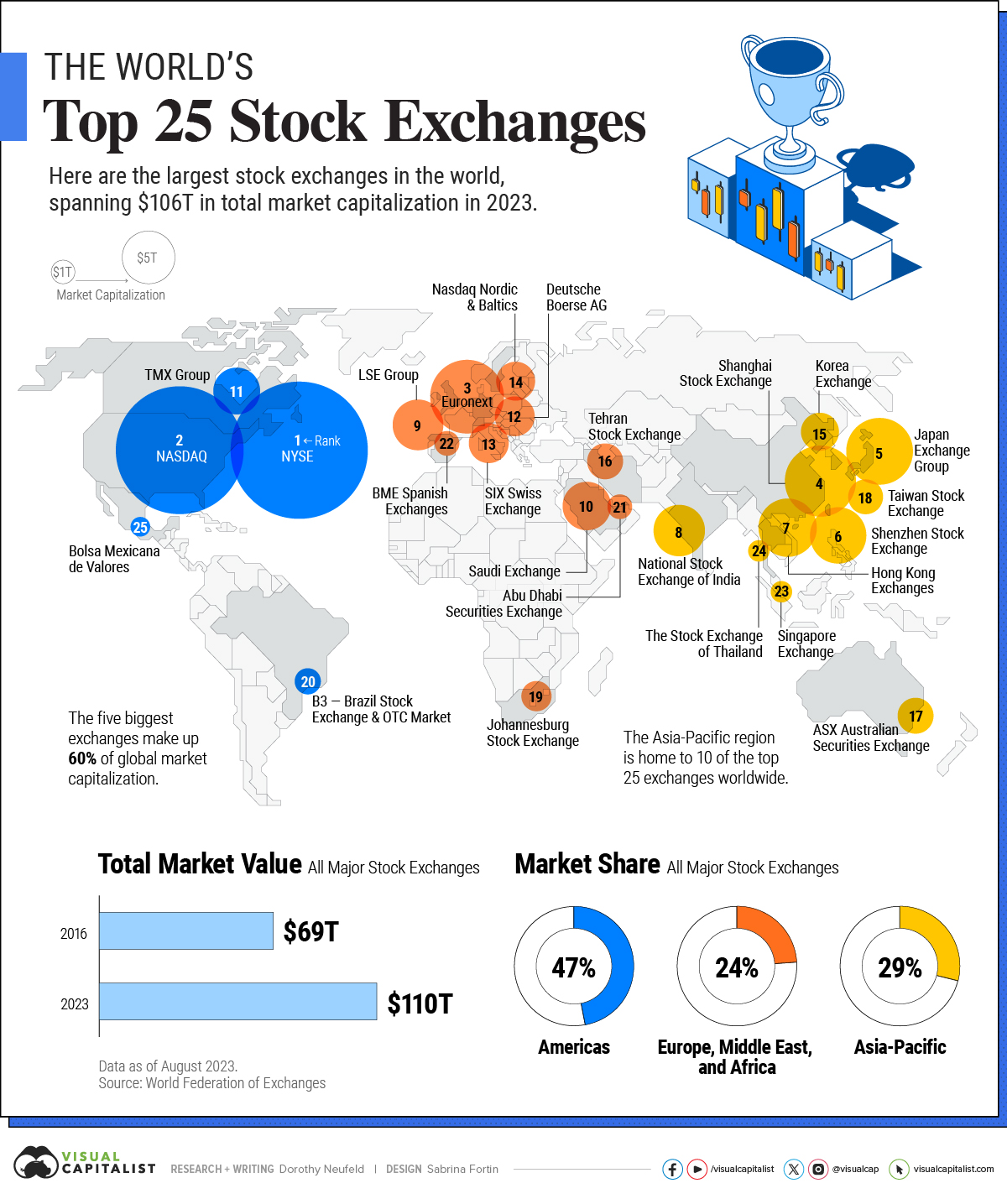
The Global Tapestry of Stock Exchanges
To truly grasp the scope of stock markets, we must first define what constitutes a stock market and then appreciate the vast spectrum from globally recognized giants to smaller, specialized regional platforms.
Defining a Stock Market
At its core, a stock market, or stock exchange, is a marketplace where securities – primarily stocks (equities) – are bought and sold. It provides a regulated and organized environment for companies to raise capital by issuing shares to the public and for investors to trade those shares among themselves. Key functions include:
- Capital Formation: Enabling companies to fund growth and operations by selling ownership stakes.
- Price Discovery: Establishing fair market prices for securities based on supply and demand.
- Liquidity: Providing a ready market for investors to buy or sell shares quickly.
- Regulation: Ensuring transparency, fairness, and investor protection through established rules and oversight.
While the definition seems straightforward, the operational models, technological infrastructure, and regulatory frameworks can vary significantly from one exchange to another, influencing everything from trading hours to listing requirements.
Beyond the Marquee Names: Local and Regional Exchanges
When people think of stock markets, iconic names like the New York Stock Exchange (NYSE) or Nasdaq often come to mind. These are indeed titans, but they represent only a fraction of the global landscape. Almost every country with a developed economy hosts at least one stock exchange. Smaller nations or emerging markets might have a single national exchange, such as the Pakistan Stock Exchange (PSX) or the Nairobi Securities Exchange (NSE). These regional exchanges, while perhaps not dominating global headlines, are crucial for their respective local economies, providing platforms for domestic companies to raise capital and for local investors to participate in their country’s economic growth. Their presence underscores the global reach of capital markets, democratizing investment opportunities and fostering economic development worldwide. Understanding this broader context reveals a truly interconnected yet diverse financial world.
Major Players: A Glimpse at the World’s Largest Stock Exchanges
While dozens of exchanges exist, a handful dominate global trading volume, market capitalization, and influence. These are the financial nerve centers that often dictate global market sentiment and attract the largest multinational corporations.
North America’s Giants: NYSE and Nasdaq
The United States hosts two of the world’s most prominent stock exchanges:
- New York Stock Exchange (NYSE): Often called “The Big Board,” the NYSE is known for its traditional auction market model and its iconic trading floor. It lists many of the world’s oldest, largest, and most established companies, particularly those in industrial, energy, and financial sectors. Its collective market capitalization often makes it the largest stock exchange globally.
- Nasdaq Stock Market: In contrast to the NYSE, Nasdaq is a fully electronic, dealer-based market. It’s famous for listing technology and growth companies, from early-stage innovators to tech giants like Apple, Microsoft, and Amazon. Nasdaq pioneered electronic trading and continues to be at the forefront of market technology.
These two exchanges alone represent a significant portion of global equity trading and serve as benchmarks for the health of the American and, by extension, the global economy.
Europe’s Financial Hubs: Euronext and LSE
Europe’s stock market landscape is characterized by both national exchanges and multi-country platforms:
- Euronext: This is a pan-European exchange operating markets in Amsterdam, Brussels, Dublin, Lisbon, Oslo, and Paris. It is one of the largest exchanges in Europe by market capitalization, offering a diverse range of products including equities, derivatives, and commodities. Euronext exemplifies the trend of cross-border integration within the European financial sector.
- London Stock Exchange (LSE): Based in the UK, the LSE is one of the world’s oldest and most international exchanges. It attracts listings from companies across the globe and is a major center for international equity trading, particularly for mining, financial services, and consumer staples companies. The LSE’s reach extends far beyond the UK, serving as a gateway for global investors into European markets and vice-versa.
Asia’s Powerhouses: TSE, SSE, and HKEX
Asia has emerged as a critical center for global finance, driven by rapid economic growth and increasing integration into the global economy:
- Tokyo Stock Exchange (TSE): The largest exchange in Asia by market capitalization, the TSE is home to many of Japan’s industrial giants and technological innovators. It plays a pivotal role in connecting global investors to the sophisticated Japanese economy.
- Shanghai Stock Exchange (SSE) and Shenzhen Stock Exchange (SZSE): These two exchanges are the primary stock exchanges in mainland China. While they have strict capital controls that limit direct foreign investment in certain ways, their immense size reflects China’s economic power. They are crucial for understanding the dynamics of the Chinese economy and its rapidly expanding domestic capital markets.
- Hong Kong Stock Exchange (HKEX): Positioned as a gateway to mainland China and other Asian markets, HKEX is highly international. It is a major hub for capital raising by Chinese companies and attracts significant foreign investment due to its robust regulatory framework and ease of doing business.
These exchanges, alongside others like the Bombay Stock Exchange (BSE) and the National Stock Exchange of India (NSE), the Korea Exchange (KRX), and the Australian Securities Exchange (ASX), collectively form the backbone of global capital markets, each contributing to the interconnected web of international finance.

Diverse Structures and Operational Models
Beyond the geographical spread and size, stock markets also differ significantly in their operational models and the types of trading systems they employ. These structural differences can impact market efficiency, liquidity, and accessibility for various investors.
Auction Markets vs. Dealer Markets
The most fundamental distinction in trading mechanisms is between auction markets and dealer markets:
- Auction Markets: In an auction market, buyers and sellers congregate, either physically on a trading floor (like the traditional NYSE model) or electronically, and announce their bids (buy prices) and asks (sell prices). Trades occur when a buyer’s bid matches a seller’s ask, or vice versa. Specialists or designated market makers facilitate orderly trading, providing liquidity and ensuring a fair process. This model promotes price transparency as all participants can see the prevailing bids and offers.
- Dealer Markets (Quote-Driven Markets): In a dealer market, like Nasdaq, multiple market makers (dealers) continuously post bid and ask prices for securities. Investors trade directly with these dealers, who hold inventories of stocks. The dealers profit from the spread between their bid and ask prices. This model offers high liquidity, especially for actively traded securities, and can facilitate faster execution. The competition among dealers helps keep spreads tight.
Public vs. Private Exchanges
Most recognized stock markets are “public” in the sense that they are available for general public participation, subject to regulatory oversight. However, there’s also a growing landscape of more specialized or private trading venues:
- Traditional Public Exchanges: These are regulated entities open to all investors (retail and institutional) through brokers. They have established listing requirements for companies and comprehensive rulebooks for trading.
- Private Exchanges/Dark Pools: These are alternative trading systems that allow institutional investors to trade large blocks of securities anonymously, without displaying their orders publicly until after the trade is executed. They are designed to minimize market impact for large trades but offer less transparency than public exchanges. While distinct from traditional exchanges, they form part of the broader trading ecosystem.
The Rise of Alternative Trading Systems (ATS)
The past few decades have seen a proliferation of Alternative Trading Systems (ATS), particularly in developed markets like the US and Europe. These are electronic trading venues that are not traditional stock exchanges but perform similar functions, offering various benefits:
- Specialized Trading: Some ATS focus on specific types of securities or trading strategies.
- Lower Costs: They can offer lower transaction fees than traditional exchanges.
- Innovation: ATS are often incubators for new trading technologies and models.
- Increased Competition: Their presence challenges traditional exchanges, often leading to better pricing and services across the market.
While not typically counted as separate “stock markets” in the primary sense, ATS significantly contribute to the overall liquidity and efficiency of the global equity trading landscape, adding another layer of complexity to the question of “how many markets.”
Why Understanding Global Markets Matters for Investors
For individuals and businesses navigating the financial world, appreciating the existence of multiple stock markets worldwide is not merely an academic exercise; it’s a practical necessity for informed decision-making.
Diversification and Risk Management
Investing in securities listed solely on one’s domestic exchange exposes an investor to concentration risk within that single economy and regulatory environment. By investing across multiple stock markets, investors can achieve geographical and economic diversification. For instance, if one country’s economy enters a recession, investments in a different, booming economy might help offset losses. This global diversification helps mitigate country-specific risks, geopolitical risks, and currency risks, making a portfolio more resilient to localized downturns.
Accessing Growth Opportunities
Different regions and countries lead in various industries at different times. Investing exclusively in developed markets might mean missing out on the higher growth potential often found in emerging markets. Conversely, focusing solely on emerging markets could mean forgoing the stability and established dividend payouts of mature companies in developed economies. Understanding global markets allows investors to seek out the most promising growth sectors, regardless of geographical boundaries, whether it’s technology innovation in the US, manufacturing prowess in Asia, or renewable energy in Europe.
Navigating Market Volatility and Geopolitical Factors
Global stock markets are intrinsically linked, yet they also react uniquely to local and international events. A financial crisis in one region can ripple globally, but its impact may vary depending on the market’s structure, regulatory response, and economic resilience. Similarly, geopolitical developments, trade agreements, or political instability in one part of the world can create opportunities or pose risks for specific markets. A global perspective allows investors to better anticipate these shifts, understand their potential implications, and adjust their portfolios proactively, moving capital to safer havens or seizing undervalued opportunities.
The Future of Stock Markets: Innovation and Integration
The landscape of stock markets is dynamic, constantly evolving in response to technological advancements, regulatory changes, and shifts in global economic power. The future promises further innovation and greater integration.
Technological Advancements: AI and Blockchain
Technology is rapidly reshaping how stock markets operate:
- Artificial Intelligence (AI) and Machine Learning (ML): AI is increasingly used for algorithmic trading, predictive analytics, fraud detection, and enhancing market surveillance. It can process vast amounts of data to identify patterns and execute trades at speeds beyond human capability, leading to greater market efficiency.
- Blockchain and Distributed Ledger Technology (DLT): Blockchain has the potential to revolutionize clearing and settlement processes, making them faster, cheaper, and more transparent. Tokenized securities, smart contracts, and potentially decentralized exchanges (DEXs) could fundamentally alter the traditional exchange model, offering new ways to issue and trade assets.
Cross-Border Listings and Mergers
The trend towards consolidation and cross-border integration among exchanges is likely to continue. Mergers and acquisitions of exchanges can create larger, more liquid trading venues, offer greater economies of scale, and attract a wider array of international listings. Similarly, companies increasingly seek cross-listings on multiple exchanges to access broader pools of capital and enhance their global visibility. This integration blurs the lines between national markets, fostering a more unified global capital market.

The Evolving Regulatory Landscape
As technology and market structures evolve, so too must the regulatory frameworks governing them. Regulators worldwide are grappling with how to oversee new financial instruments, digital assets, and high-frequency trading while ensuring market integrity, stability, and investor protection. International cooperation among regulators will become even more critical to address systemic risks and harmonize rules across different jurisdictions, ensuring that innovation can thrive responsibly within a secure financial ecosystem.
In conclusion, the question “how many stock markets are there?” uncovers a rich and complex global financial tapestry. While there isn’t a single definitive count, the landscape includes dozens of primary exchanges, alongside numerous alternative trading venues, each contributing to the world’s financial circulatory system. From the iconic trading floors of New York to the bustling electronic markets of Asia, these diverse markets offer invaluable opportunities for capital formation, investment, and wealth creation. For any investor or business leader, understanding this multifaceted environment—its players, structures, and ongoing evolution—is not just beneficial, but essential for informed decision-making in a continuously interconnected global economy.
aViewFromTheCave is a participant in the Amazon Services LLC Associates Program, an affiliate advertising program designed to provide a means for sites to earn advertising fees by advertising and linking to Amazon.com. Amazon, the Amazon logo, AmazonSupply, and the AmazonSupply logo are trademarks of Amazon.com, Inc. or its affiliates. As an Amazon Associate we earn affiliate commissions from qualifying purchases.