
In the vast and often complex world of investing, discerning truly valuable assets from fleeting trends can be a significant challenge. For many investors, particularly those new to the market or those seeking a straightforward, diversified approach, the name “VTI” frequently surfaces as a cornerstone investment. VTI, short for the Vanguard Total Stock Market ETF, is not just another ticker symbol; it represents a philosophy of broad market exposure, low cost, and long-term growth that has resonated with millions.
This article aims to demystify VTI, delving into its structure, benefits, and how it can serve as a potent tool within a well-constructed investment portfolio. We will explore why this particular Exchange-Traded Fund (ETF) has become a staple for passive investors, its strategic advantages, and crucial considerations for anyone looking to harness the power of the entire U.S. stock market.
Understanding VTI: The Vanguard Total Stock Market ETF
To truly grasp the significance of VTI, it’s essential to first understand its foundational components and what it aims to achieve for investors. VTI is a product of Vanguard, a company renowned for its investor-friendly, low-cost index funds and ETFs.
What is an ETF?
An Exchange-Traded Fund (ETF) is a type of investment fund that holds a collection of assets, such as stocks, bonds, or commodities. ETFs trade on stock exchanges much like individual stocks throughout the day, meaning their price can fluctuate constantly. This distinguishes them from traditional mutual funds, which are typically priced once at the end of each trading day.
The primary advantages of ETFs include:
- Diversification: A single ETF share provides exposure to numerous underlying assets, reducing risk compared to owning just a few individual stocks.
- Liquidity: Being traded on exchanges, ETFs offer intra-day liquidity, allowing investors to buy and sell shares easily.
- Low Costs: Many ETFs, especially those from providers like Vanguard, are passively managed, tracking an index rather than relying on active stock-picking. This results in significantly lower expense ratios (annual fees) compared to actively managed funds.
- Tax Efficiency: Their structure can offer certain tax advantages, particularly in how capital gains are managed compared to traditional mutual funds.
VTI’s Investment Strategy and Holdings
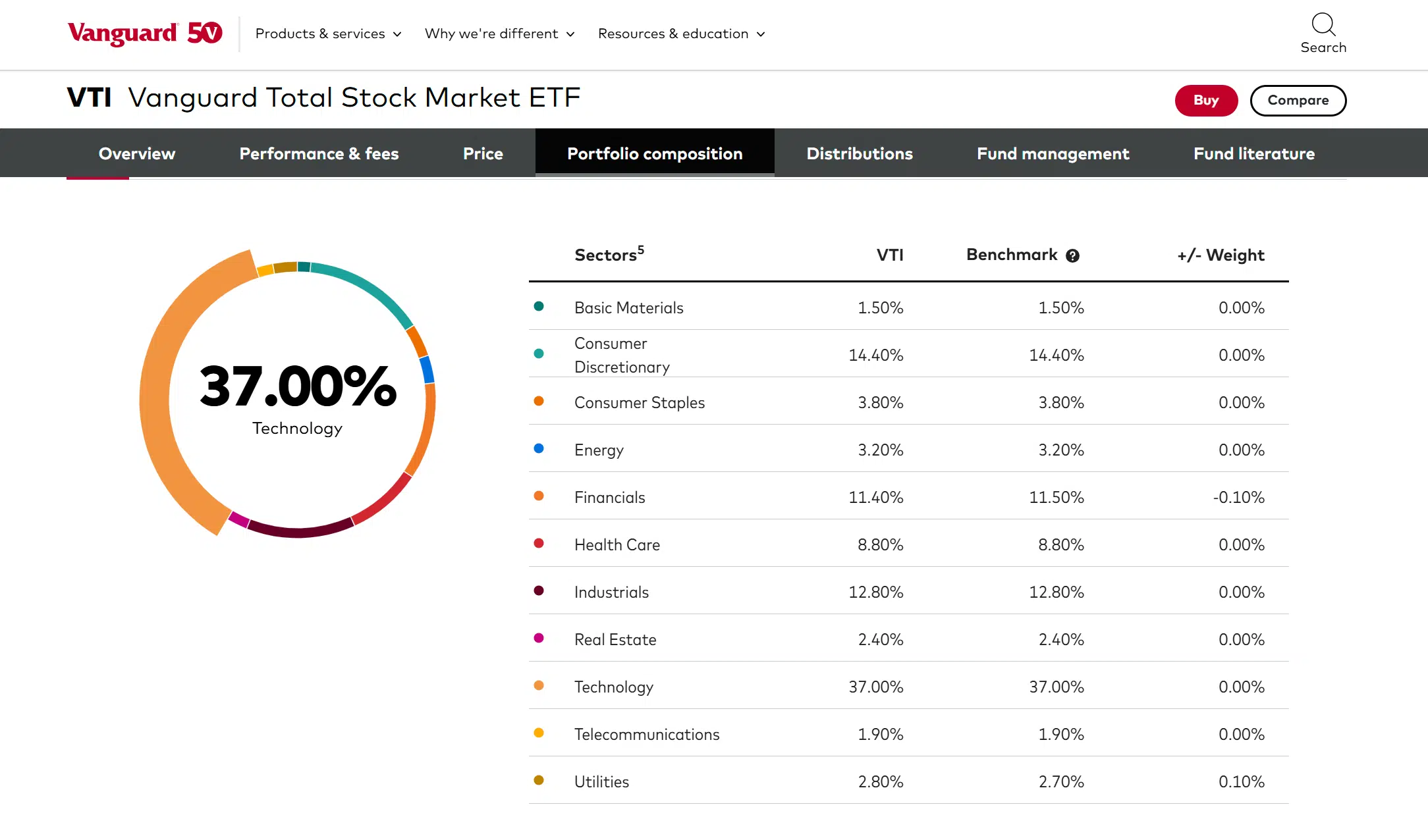
VTI’s core objective is remarkably simple yet incredibly powerful: to provide investors with broad exposure to the entire U.S. equity market. It achieves this by tracking the performance of the CRSP US Total Market Index. This index encompasses virtually all publicly traded U.S. common stocks, ranging from the largest companies (large-cap) to medium-sized (mid-cap) and even small-sized (small-cap) enterprises.
The fund uses a market-capitalization-weighted approach, meaning that companies with larger market values (e.g., Apple, Microsoft, Amazon, Alphabet) have a greater influence on the index’s performance and, consequently, on VTI’s holdings. This approach naturally allocates more capital to the most successful and largest companies, reflecting their proportion of the overall market.
As of its typical composition, VTI holds shares in over 3,700 different companies, representing approximately 98% of the investable U.S. stock market. This extensive reach ensures that investors holding VTI are participating in the collective growth and performance of the vast majority of American businesses. If a sector or company performs well, VTI benefits; if another struggles, its impact is diluted across thousands of others.
Key Characteristics and Metrics
Understanding the nuts and bolts of VTI provides insight into its efficiency and appeal:
- Ticker Symbol: VTI
- Expense Ratio: One of VTI’s most compelling features is its incredibly low expense ratio, typically around 0.03% annually. This means that for every $10,000 invested, you pay only $3 in fees per year. This minuscule cost is a significant advantage over the long term, as high fees can erode substantial portions of an investor’s returns.
- Assets Under Management (AUM): VTI is one of the largest ETFs globally, with hundreds of billions of dollars in AUM. This large size contributes to its liquidity and operational efficiency.
- Dividend Yield: VTI pays dividends to its shareholders, typically on a quarterly basis. These dividends represent a portion of the profits generated by the underlying companies it holds. While VTI is primarily a growth-oriented investment, the dividend stream provides an additional component of return.
Why Invest in VTI? The Advantages for Your Portfolio
The reasons behind VTI’s widespread adoption are multifaceted, rooted in its fundamental design principles that align with sound investment strategies.
Broad Diversification
The most immediate and profound benefit of investing in VTI is the unparalleled diversification it offers within the U.S. equity market. By owning a single share of VTI, you are effectively investing in thousands of American companies across all sectors and market capitalizations.
- Mitigation of Single-Stock Risk: Unlike investing in individual stocks, where the failure of one company can severely impact your portfolio, VTI spreads your investment across a vast array of businesses. This significantly reduces the impact of any single company’s poor performance.
- Exposure to the Entire U.S. Economy: VTI provides a direct link to the overall health and growth of the American economy. As the U.S. economy expands and companies innovate, VTI’s value is designed to appreciate proportionally. This ensures you’re not trying to pick winners but rather participating in the collective success of the market.
Low Cost and Efficiency
Vanguard’s commitment to low-cost investing shines brightly with VTI. The ultra-low expense ratio means that more of your investment capital remains invested and working for you, rather than being siphoned off by management fees.
- Impact on Long-Term Returns: Over decades, even seemingly small differences in expense ratios can translate into hundreds of thousands of dollars in lost returns due to the power of compounding. VTI’s minimal fees ensure that your returns are maximized over the long haul.
- Tax Efficiency: ETFs, particularly index-tracking ones like VTI, are often more tax-efficient than actively managed mutual funds. Their structure minimizes taxable capital gains distributions to shareholders, which can be advantageous in taxable brokerage accounts.
Simplicity and Ease of Use
For many investors, especially those who prefer a “set it and forget it” approach, VTI offers remarkable simplicity.
- Ideal for Passive Investing: VTI is a cornerstone for passive investment strategies, where the goal is to match market returns rather than trying to beat them. This approach has been proven highly effective over long periods.
- Suitable for All Experience Levels: Beginners can easily understand and utilize VTI as a core holding, while experienced investors can integrate it into more complex portfolios. There’s no need for extensive research into individual companies or constant market monitoring.
- Core Portfolio Holding: For many, VTI forms the bedrock of their equity portfolio, providing the essential U.S. stock market exposure that can then be complemented by other assets.
Long-Term Growth Potential
Historically, the U.S. stock market has been a powerful engine for wealth creation over the long term. By tracking virtually the entire market, VTI is positioned to capture this enduring growth.
- Compounding Returns: The consistent reinvestment of dividends and capital appreciation within VTI allows for the powerful effect of compounding, where returns generate further returns over time.
- Alignment with Economic Growth: Investing in VTI is fundamentally an investment in the innovation, productivity, and profitability of American businesses. As the U.S. economy continues to evolve and grow, VTI aims to reflect that expansion.
How VTI Fits into a Diversified Investment Strategy
While VTI offers exceptional diversification within the U.S. market, it’s crucial to understand how it integrates into a broader, well-rounded investment plan. No single investment, however robust, should constitute an entire portfolio.

As a Core Holding
VTI is often recommended as the primary equity component for investors building a diversified portfolio. It can represent a significant percentage of an investor’s stock allocation, providing the foundational exposure to domestic stocks. For instance, an investor might allocate 50-70% of their stock portfolio to VTI, depending on their overall strategy and other holdings. Its wide reach means it often doesn’t need to be paired with other U.S. specific funds.
Complementary Assets
To achieve true global diversification and manage overall portfolio risk, VTI should ideally be combined with other asset classes:
- International Equities: Since VTI is exclusively focused on the U.S., adding an international stock ETF (such as Vanguard’s Total International Stock ETF, VXUS) is critical. This provides exposure to developed and emerging markets worldwide, reducing concentration risk in a single country and capturing global growth opportunities.
- Bonds: For stability, income, and reduced volatility, bonds are an essential complement to equities. Funds like Vanguard Total Bond Market ETF (BND) offer broad exposure to investment-grade U.S. bonds. The allocation between stocks and bonds typically depends on an investor’s age, risk tolerance, and financial goals.
- Other Asset Classes: Depending on individual circumstances, some investors might also consider small allocations to real estate investment trusts (REITs), commodities, or alternative investments for further diversification, though VTI, VXUS, and BND often form the core of a simple, effective portfolio.
Dollar-Cost Averaging with VTI
A highly effective strategy for investing in VTI, especially for long-term goals, is dollar-cost averaging. This involves investing a fixed amount of money at regular intervals (e.g., $200 every month), regardless of market fluctuations.
- Reducing Timing Risk: Dollar-cost averaging mitigates the risk of trying to “time the market” – buying at the peak and selling at the trough. By investing consistently, you buy more shares when prices are low and fewer when prices are high, averaging out your purchase price over time.
- Ideal for Retirement Accounts: This strategy is particularly well-suited for regular contributions to retirement accounts like 401(k)s, IRAs, and Roth IRAs, where contributions are often automated.
Considerations and Potential Drawbacks
While VTI is an excellent investment vehicle, like any financial product, it comes with certain considerations and potential drawbacks that investors should be aware of.
Lack of International Exposure
The most significant limitation of VTI is its exclusive focus on the U.S. market. While the U.S. economy is robust, confining your equity investments solely to one country, even a large one, means you miss out on growth opportunities in other parts of the world and expose yourself to concentrated country-specific risks. A truly diversified portfolio will almost always include international equities.
Market Risk
VTI is an equity ETF, meaning its value is inherently tied to the performance of the stock market. It is not immune to market downturns, recessions, or bear markets. During periods of economic contraction or market corrections, the value of VTI will decline, potentially significantly. While historically the U.S. market has recovered from all downturns, there are no guarantees for future performance, and investors must be prepared for volatility.
No Active Management
For investors who believe in the ability of skilled fund managers to consistently “beat the market” through active stock picking or tactical asset allocation, VTI’s passive indexing approach may seem like a drawback. VTI does not attempt to outperform its benchmark index; it simply aims to match its performance. However, for the vast majority of investors, the evidence strongly suggests that passive index funds like VTI outperform most actively managed funds over the long term, after accounting for fees. Thus, what some see as a drawback, many others consider a core strength.
Getting Started with VTI
Investing in VTI is a straightforward process, accessible to virtually anyone with an investment account.
Opening a Brokerage Account
The first step is to open a brokerage account with a reputable financial institution. Many major brokerage firms offer commission-free trading on ETFs, including VTI. Popular options include:
- Vanguard: As the issuer, Vanguard offers seamless access.
- Fidelity, Charles Schwab, E*TRADE, TD Ameritrade (now Schwab), Robinhood, M1 Finance: These platforms all facilitate the purchase of VTI.
You can choose between a taxable brokerage account or a tax-advantaged retirement account like an IRA (Individual Retirement Arrangement) or Roth IRA, depending on your financial goals and tax situation.
Purchasing Shares
Once your account is set up and funded, you can search for VTI using its ticker symbol and place a buy order. Most brokers allow you to set up recurring investments, making dollar-cost averaging effortless. Some brokers also offer fractional shares, allowing you to invest a specific dollar amount even if it doesn’t equate to a whole number of VTI shares, which is beneficial for smaller, regular contributions.
Monitoring Your Investment
While VTI is a “set it and forget it” investment in many respects, it’s still prudent to periodically review your overall portfolio. This includes:
- Rebalancing: Ensure your asset allocation (e.g., the ratio of stocks to bonds, U.S. to international stocks) remains consistent with your target over time. VTI will likely grow, potentially leading to an overweight position in U.S. equities, necessitating rebalancing.
- Understanding Statements: Review your brokerage statements to track performance, dividends received, and any fees.
- Tax Implications: Be aware of the tax implications of your investments, especially in taxable accounts, including how dividends and potential capital gains are treated.

Conclusion
The Vanguard Total Stock Market ETF (VTI) stands as a testament to the power of simplicity, diversification, and low-cost investing. By offering investors a single, efficient vehicle to gain exposure to virtually the entire U.S. stock market, it eliminates the need for complex stock picking and costly active management. Its ultra-low expense ratio, broad diversification across thousands of companies, and alignment with the long-term growth trajectory of the American economy make it an indispensable tool for building wealth.
While VTI provides exceptional domestic equity exposure, it is most effective when integrated into a well-balanced portfolio that includes international equities and bonds, tailored to an individual’s risk tolerance and financial objectives. For those seeking a foundational, intelligent, and highly effective way to invest in the U.S. stock market, understanding “what is VTI stock” is the first step towards a disciplined and potentially prosperous investment journey. It exemplifies how smart, passive investing can often lead to superior long-term results.
Disclaimer: This article is for informational purposes only and does not constitute financial advice. Investors should conduct their own research or consult with a qualified financial advisor before making any investment decisions.
aViewFromTheCave is a participant in the Amazon Services LLC Associates Program, an affiliate advertising program designed to provide a means for sites to earn advertising fees by advertising and linking to Amazon.com. Amazon, the Amazon logo, AmazonSupply, and the AmazonSupply logo are trademarks of Amazon.com, Inc. or its affiliates. As an Amazon Associate we earn affiliate commissions from qualifying purchases.