
Navigating the world of taxes can often feel like deciphering a complex secret code, leading many to outsource the task to professionals. However, with a bit of understanding and organization, filing your own taxes is not only achievable but can also be a empowering way to take control of your personal finances. This comprehensive guide will demystify the process, providing you with the knowledge and confidence to handle your tax obligations accurately and efficiently, all while potentially saving you money on preparation fees. By understanding your responsibilities, gathering the right documents, choosing the appropriate tools, and following a step-by-step approach, you’ll discover that managing your annual tax return is well within your grasp.

Demystifying Your Tax Obligations
Before diving into the specifics of filing, it’s crucial to understand the fundamental aspects of tax obligations. Knowing who needs to file, when to file, and the basic terminology will lay a solid foundation for a smoother experience.
Who Needs to File?
Not everyone is required to file a federal income tax return. The IRS sets specific income thresholds based on your filing status (single, married filing jointly, head of household, qualifying widow(er)) and age. If your gross income falls below these thresholds, you generally aren’t required to file. However, even if you’re not mandated to file, it might still be beneficial. For instance, if federal income tax was withheld from your paychecks, or if you qualify for refundable tax credits like the Earned Income Tax Credit (EITC) or the Child Tax Credit (CTC), filing a return is the only way to receive your refund. Additionally, individuals with specific circumstances, such as self-employment income over a certain amount ($400 net earnings), certain types of investment income, or those who received advanced payments of the premium tax credit, are typically required to file regardless of their overall income. It’s always wise to check the IRS website for the most current income thresholds and specific filing requirements to ensure you don’t miss out on potential refunds or incur penalties.
Key Deadlines to Remember
Tax deadlines are non-negotiable and missing them can result in penalties and interest. The most significant deadline for most individual filers is April 15th of each year (or the next business day if April 15th falls on a weekend or holiday). This is the date by which you must file your return and pay any taxes you owe for the previous tax year. If you can’t meet the April 15th deadline, you can file for an extension, which typically gives you an additional six months to submit your return, pushing the deadline to October 15th. It’s important to note that an extension to file is not an extension to pay; if you expect to owe taxes, you should still pay an estimate by the April 15th deadline to avoid interest and penalties. For self-employed individuals and those with significant income not subject to withholding, estimated tax payments are due quarterly throughout the year (April 15, June 15, September 15, and January 15 of the following year) to cover their tax liability.
Understanding Basic Tax Terminology
Navigating tax forms and software becomes much simpler when you grasp key terms. Gross income refers to all the income you receive from various sources before any deductions. Your Adjusted Gross Income (AGI) is your gross income minus specific “above-the-line” deductions, such as contributions to traditional IRAs, student loan interest, and health savings account contributions. AGI is a crucial figure as it determines eligibility for many tax credits and deductions. When calculating your taxable income, you have the option of taking either the standard deduction or itemizing deductions. The standard deduction is a fixed dollar amount based on your filing status, while itemizing involves listing out specific deductible expenses like mortgage interest, state and local taxes (SALT) up to a limit, medical expenses exceeding a certain percentage of AGI, and charitable contributions. Finally, understanding the difference between tax credits and tax deductions is vital. Deductions reduce your taxable income, thereby lowering the amount of tax you owe, based on your tax bracket. Credits, on the other hand, directly reduce the amount of tax you owe, dollar-for-dollar. Some credits are even “refundable,” meaning they can result in a refund even if you don’t owe any tax.
Assembling Your Tax Preparation Toolkit
The key to a stress-free tax filing experience lies in thorough preparation. Before you even think about forms or software, dedicate time to gather all the necessary documents. This proactive step prevents last-minute scrambling and ensures accuracy.
Essential Income Documents
Your income documents form the backbone of your tax return. For most employed individuals, the Form W-2, Wage and Tax Statement, from your employer(s) is paramount. This form reports your annual wages and the amount of federal, state, and local taxes withheld. If you have income from other sources, you’ll need various 1099 forms. These include Form 1099-NEC for nonemployee compensation (freelancers, independent contractors), Form 1099-MISC for miscellaneous income (rents, royalties), Form 1099-INT for interest income from banks, Form 1099-DIV for dividends from investments, and Form 1099-B for proceeds from brokerage transactions (stock sales). Additionally, if you have income from partnerships, S corporations, or certain trusts, you may receive a Schedule K-1. Don’t forget any statements for social security benefits (Form SSA-1099), unemployment compensation, or gambling winnings, as these are also considered taxable income. Ensure you collect all these forms, usually received by the end of January, as they meticulously detail your earnings for the tax year.
Documentation for Deductions and Credits
Maximizing your deductions and credits is where you can significantly reduce your tax liability or increase your refund. This requires diligent record-keeping throughout the year. For homeowners, Form 1098, Mortgage Interest Statement, from your lender reports the interest you paid. Students may receive Form 1098-E for student loan interest paid or Form 1098-T for tuition and related expenses. Keep meticulous records of medical expenses (receipts, insurance statements) if you plan to itemize, as well as receipts for charitable contributions to qualified organizations. If you paid for childcare, you’ll need the provider’s name, address, and Taxpayer Identification Number (TIN) to claim the Child and Dependent Care Credit. Contributions to traditional IRAs or other retirement accounts (beyond what’s reported on your W-2) also need documentation. Self-employed individuals should maintain detailed records of all business income and expenses (receipts, mileage logs, home office expenses) to accurately complete Schedule C, Profit or Loss from Business. Being organized here can lead to substantial savings.
Personal Information and Prior Year’s Return
Beyond financial statements, you’ll need specific personal information to complete your return. This includes your Social Security Number (SSN) and the SSNs of your spouse and all dependents. Having your date of birth and those of your dependents readily available is also important. If you plan to receive a direct deposit refund or pay taxes directly from your bank account, gather your bank account and routing numbers. Finally, having a copy of your prior year’s tax return can be incredibly helpful. It serves as a guide for recurring deductions, credits, and helps you locate your prior year’s Adjusted Gross Income (AGI), which is often required to verify your identity when using tax software or e-filing with the IRS. Think of your previous return as a cheat sheet for consistent information and a reminder of your filing status and dependants.
Choosing the Right Filing Pathway
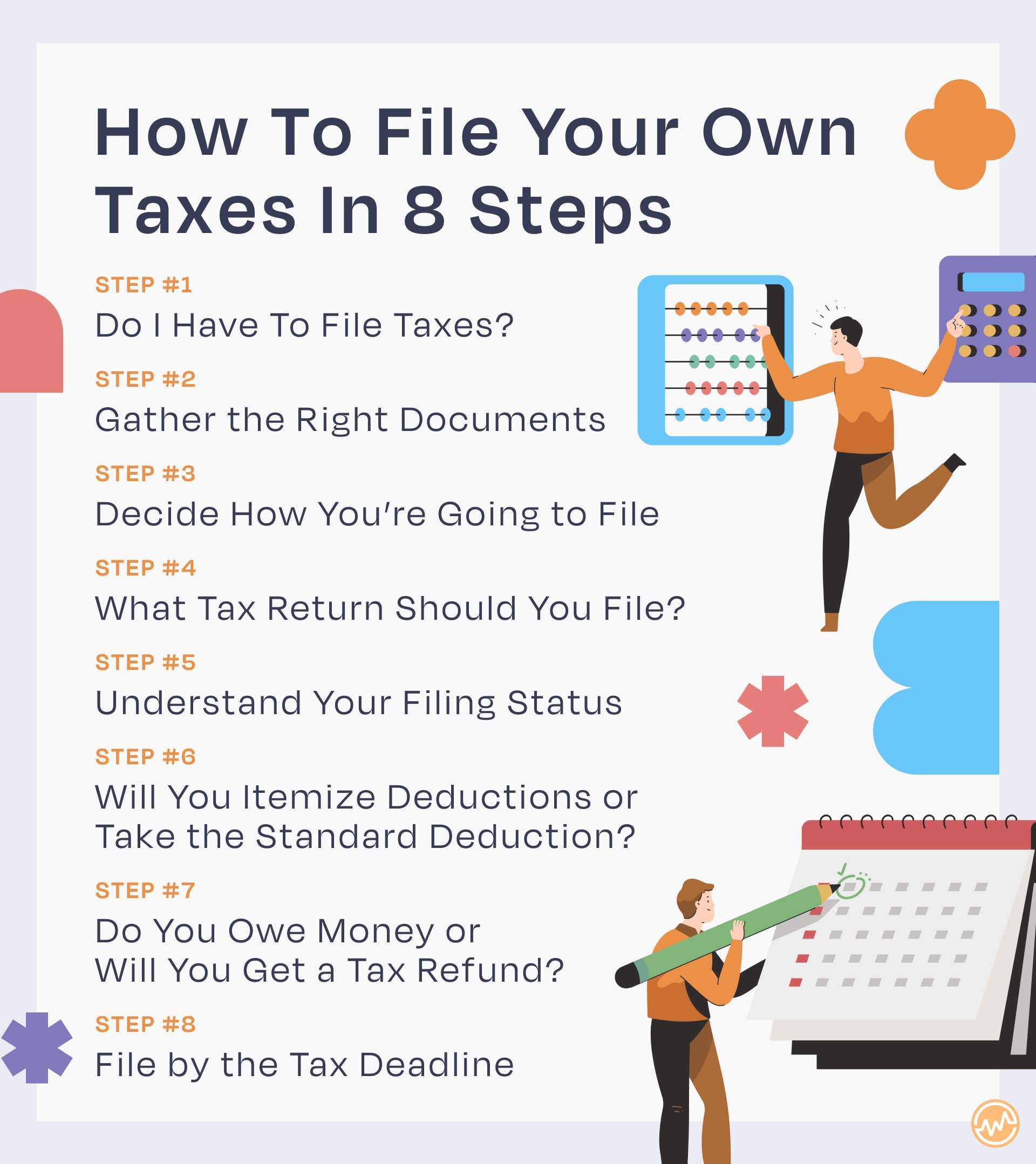
Once your documents are in order, the next step is to select the method you’ll use to prepare and submit your tax return. There are several options available, each with its own advantages, catering to different levels of complexity and comfort with technology.
Tax Software Solutions
Tax preparation software has become the most popular choice for self-filers due to its user-friendly interface and ability to guide you through the process step-by-step. Programs like TurboTax, H&R Block Tax Software, TaxAct, and FreeTaxUSA offer various versions, from free editions for simple returns to premium packages for more complex scenarios involving investments, self-employment, or rental properties. These programs typically use a question-and-answer format, making it easy to input your information and identify potential deductions and credits you might qualify for. They also perform calculations automatically and check for common errors, significantly reducing the chance of mistakes. While paid versions can incur a fee, the cost is often considerably less than hiring a professional, and the peace of mind from accurate filing can be invaluable. Many also offer state tax filing services, either bundled or as an add-on.
IRS Free File Program
For eligible taxpayers, the IRS offers the IRS Free File Program, a partnership with various tax software providers. This program allows individuals with an Adjusted Gross Income (AGI) below a certain threshold (which changes annually, so check the IRS website) to use commercial tax software at no cost. It provides access to guided tax preparation, making it an excellent option for those who qualify and prefer the convenience and accuracy of software without the price tag. The IRS Free File program also includes options for state tax filing in many cases. Additionally, the IRS has been piloting its own Direct File tool in certain states, offering a more direct way for some taxpayers to file federal taxes for free. These free options are fantastic resources for managing your personal finances efficiently and responsibly.
Paper Forms (Manual Filing)
While less common today, filing your taxes using paper forms remains an option, particularly for those who prefer a traditional approach or have very simple tax situations. You can download and print all necessary forms and instructions directly from the IRS website or pick them up at certain post offices or libraries. The main advantage is that it costs nothing for the forms themselves. However, the disadvantages are significant: you must manually calculate all figures, greatly increasing the risk of mathematical errors. There’s no built-in error checking, and mailing can be slower, delaying any potential refund. If you choose this method, be exceptionally meticulous in your calculations and ensure all forms are signed and mailed to the correct IRS address, ideally via certified mail with a return receipt for proof of mailing. For most taxpayers, the time savings and accuracy provided by tax software or the Free File program make them the more practical choice.
Navigating the Filing Process Step-by-Step
With your documents assembled and your filing method chosen, you’re ready to tackle the actual process. Whether using software or paper forms, the fundamental steps remain largely the same.
Reporting Your Income
The first major section of your tax return involves reporting all your income. This is where those W-2s, 1099s, and other income statements come into play. If using software, you’ll be prompted to enter information from each of these forms. For W-2s, simply transfer the numbers from each box directly into the corresponding fields. For 1099s, ensure you categorize the income correctly (e.g., self-employment income on Schedule C, interest on Schedule B). It’s crucial to report all sources of income, even if you didn’t receive a specific form for it, such as cash income from a side hustle or income from peer-to-peer payment apps (though some apps now issue 1099-K if thresholds are met). Omitting income can lead to penalties and potentially an audit. The software will automatically sum up your income and calculate your Adjusted Gross Income (AGI) after factoring in any “above-the-line” deductions.
Claiming Deductions and Credits
This is often where the real magic happens in reducing your tax bill. After your AGI is determined, you’ll decide whether to take the standard deduction or itemize deductions. Most tax software will help you determine which option yields the larger deduction based on the information you provide. If itemizing, you’ll input details for mortgage interest, state and local taxes, charitable contributions, and qualified medical expenses. Next, you’ll look for applicable tax credits. Common credits include the Child Tax Credit, the Earned Income Tax Credit (for low-to-moderate income individuals and families), education credits (like the American Opportunity Tax Credit or Lifetime Learning Credit), and the Saver’s Credit for retirement contributions. Each credit has specific eligibility requirements, which tax software will typically help you navigate. Be thorough here, as credits directly reduce your tax liability, potentially leading to a larger refund.
Review and Double-Check
Before submitting your return, a thorough review is non-negotiable. This is your last chance to catch errors that could lead to delays or issues with the IRS. If using tax software, utilize its built-in error-checking functions. These tools are designed to flag common mistakes like missing Social Security Numbers, incorrect calculations, or incomplete sections. Manually review every figure you entered, especially Social Security Numbers for yourself, your spouse, and dependents, as well as banking information for direct deposit. Compare your current year’s return to your prior year’s return for consistency, ensuring no recurring deductions or credits were overlooked. Pay close attention to your total income, total deductions, and the final tax liability or refund amount. A few extra minutes spent reviewing can save you considerable hassle and potential penalties down the line.
Submitting Your Return
Once you are confident your return is accurate, it’s time to submit. E-filing (electronic filing) is the preferred method for most taxpayers due to its speed, accuracy, and confirmation of receipt. When you e-file, the tax software sends your return directly to the IRS and your state tax agency (if applicable). You’ll typically receive an email confirmation when your return has been accepted, often within 24-48 hours. This confirmation is crucial as proof that your return was successfully submitted. If you choose to mail a paper return, ensure all pages are securely fastened, signed in the appropriate places, and mailed to the correct IRS address for your region. It is highly recommended to send paper returns via certified mail with a return receipt requested, providing documented proof of mailing. Make sure you mail it well before the deadline.
Handling Your Refund or Payment
The final step involves managing the outcome of your filing. If you are due a refund, the quickest and safest way to receive it is via direct deposit into your bank account. Provide your bank routing number and account number, and your refund could be in your account within 7-21 days of acceptance. For paper returns, a check will be mailed, which takes longer. If you owe taxes, you have several payment options. You can authorize a direct debit from your bank account when you e-file, pay by credit or debit card (though typically with a processing fee), or mail a check or money order directly to the IRS. If you cannot pay your full tax bill by the deadline, it’s important to still file your return and explore payment options like an IRS payment plan or an Offer in Compromise, rather than simply not paying. The IRS is generally more lenient with taxpayers who make an effort to communicate and arrange payment.
Beyond Submission: Post-Filing Best Practices
Filing your return is a significant achievement, but your responsibilities don’t end there. Adopting good post-filing habits can protect you in the long run and streamline future tax preparations.
Record Keeping for Future Reference
Once your return is filed, the work isn’t entirely over. It’s critical to maintain thorough records. The IRS generally recommends keeping tax records for at least three years from the date you filed your original return or two years from the date you paid the tax, whichever is later. For certain situations, such as underreporting income, the period can extend to six years. Keep copies of your filed return, all W-2s, 1099s, receipts for deductions and credits, and any correspondence with the IRS. Storing these documents digitally (scanned copies backed up securely) and/or in a physical, organized folder will make it easy to access them if you ever need to refer back to them or respond to an IRS inquiry. This diligent record-keeping is a cornerstone of sound personal financial management.
What to Do If You Made a Mistake
Discovering an error after you’ve filed can be unsettling, but it’s not the end of the world. If you made a mistake on your original return, you can typically correct it by filing an amended return using Form 1040-X, Amended U.S. Individual Income Tax Return. This form allows you to correct errors such as incorrect filing status, overlooked deductions or credits, or unreported income. Generally, you have three years from the date you filed your original return or two years from the date you paid the tax (whichever is later) to file an amended return to claim a refund. If the mistake results in you owing more tax, it’s best to amend and pay as soon as possible to minimize potential penalties and interest. Most tax software can assist with preparing an amended return.
Understanding Your Tax Notices
Receiving a letter from the IRS can be intimidating, but many notices are routine and simply require a response or clarification. Common reasons for IRS letters include requests for additional information, notification of a balance due, or adjustments made to your return. It’s crucial to read any notice carefully, understand what it’s asking for, and respond promptly by the specified deadline. Ignoring IRS correspondence can lead to more serious issues. If you don’t understand the notice, don’t hesitate to consult with a tax professional. Remember to keep copies of all correspondence you send to or receive from the IRS.

Planning for Next Year’s Taxes
The best time to start planning for next year’s taxes is now. Take a moment after filing to reflect on your experience. Did you owe a lot of tax, or receive a surprisingly large refund? This could indicate that your tax withholding from your paycheck (managed via Form W-4) might need adjustment. Owing a lot might mean you should increase your withholdings, while a very large refund means you might have too much withheld, essentially giving the government an interest-free loan throughout the year. You can use the IRS Tax Withholding Estimator tool to help determine the right amount. For those with self-employment or significant investment income, plan for quarterly estimated tax payments. Considering tax-advantaged savings (like retirement accounts) and investment strategies throughout the year can also lead to more favorable tax outcomes and enhance your overall financial health.
By embracing these guidelines, you transform the daunting task of tax filing into a manageable and even empowering aspect of your personal financial journey. Taking charge of your taxes yourself not only saves money but also deepens your understanding of your financial landscape, paving the way for more informed and strategic money management decisions in the future.
aViewFromTheCave is a participant in the Amazon Services LLC Associates Program, an affiliate advertising program designed to provide a means for sites to earn advertising fees by advertising and linking to Amazon.com. Amazon, the Amazon logo, AmazonSupply, and the AmazonSupply logo are trademarks of Amazon.com, Inc. or its affiliates. As an Amazon Associate we earn affiliate commissions from qualifying purchases.