
The question of “who invented AC voltage” is often met with a single, resounding name: Nikola Tesla. While Tesla’s contributions were undeniably pivotal, the true narrative is far more nuanced, encompassing a symphony of intellectual breakthroughs, fierce industrial competition, and the collective efforts of brilliant minds. The development of alternating current (AC) was not a singular Eureka moment but rather a protracted battle of ideas, patents, and practical applications that ultimately transformed human civilization, laying the groundwork for the modern electrical grid and countless technological advancements. This article delves into the technological journey, exploring the key players and the historical context that led to AC’s triumph as the dominant force in global power transmission.

The Dawn of Electrical Innovation: From DC to the Promise of AC
Before the widespread adoption of alternating current, the world tinkered with direct current (DC) systems, primarily championed by the illustrious Thomas Edison. Understanding the limitations of DC is crucial to appreciating the revolutionary nature of AC.
Early Pioneers and the Limits of Direct Current (DC)
The journey into practical electricity began with pioneers like Alessandro Volta, who developed the first electric battery in 1800, and Michael Faraday, whose groundbreaking work in electromagnetic induction in the 1830s demonstrated the principle behind electric generators and motors. Fast forward to the late 19th century, and Thomas Edison emerged as the titan of electrification. His invention of a practical, long-lasting incandescent light bulb in 1879 sparked an insatiable demand for electricity. Edison swiftly moved to establish the world’s first central power station on Pearl Street in New York City in 1882, distributing direct current to customers.
Edison’s DC system was effective for localized power distribution. It was simple to understand and implement, and the direct nature of the current was well-suited for early electrical devices like incandescent lights and simple motors. However, DC suffered from a critical drawback: it was incredibly inefficient for long-distance transmission. To maintain usable voltage levels, the current had to be transmitted at low voltages, necessitating thick, expensive copper cables and requiring power stations to be located every few miles. As a result, the geographical reach of Edison’s DC power was severely limited, restricting electrification to urban centers and preventing the dream of widespread, affordable electricity. This inherent limitation created an urgent need for a more efficient and scalable solution.
Seeds of Alternating Current Theory
While Edison was busy perfecting and commercializing DC, other scientists and engineers were exploring the theoretical underpinnings of alternating current. The concept of periodically reversing current was not entirely new. Early dynamo designs could, in theory, produce AC, but the focus was overwhelmingly on rectifying it to DC. Key insights into the mathematical and physical advantages of AC, particularly regarding voltage transformation, slowly began to emerge. The understanding that AC voltage could be easily “stepped up” for efficient long-distance transmission and then “stepped down” for safe local use via transformers was a game-changer. Figures like Lucien Gaulard and John Dixon Gibbs developed early transformer designs in the 1880s, demonstrating the viability of voltage manipulation with AC. This fundamental characteristic—the ability to change voltage levels with relative ease—was the key differentiator that would eventually propel AC to prominence. These theoretical and early practical explorations set the stage for the genius who would synthesize these ideas into a comprehensive and workable system.
Nikola Tesla: The Unsung Architect of Modern Power Systems
If a single individual must be credited with the invention of the AC system that powers our world, it is undoubtedly Nikola Tesla. His profound theoretical understanding and practical ingenuity transformed the nascent ideas of alternating current into a viable and revolutionary technology.
A Vision for Polyphase Power
Nikola Tesla, a Serbian-American inventor, arrived in the United States in 1884, initially working for Thomas Edison. However, their scientific temperaments and visions for electricity clashed. While Edison was pragmatic and focused on DC, Tesla was a visionary, deeply convinced of the superiority of alternating current, particularly his concept of polyphase AC systems. Tesla’s primary innovation was the invention of the polyphase alternating current induction motor and the entire system for generating, transmitting, and utilizing polyphase AC power.
His breakthrough was not merely a motor but a comprehensive system that included generators, motors, and transformers designed to work seamlessly with multi-phase alternating currents. In a polyphase system (typically two-phase or three-phase), multiple alternating currents are generated simultaneously, with each current having a different phase angle. This creates a rotating magnetic field in an AC motor, eliminating the need for complex and maintenance-intensive commutators and brushes found in DC motors. Tesla’s designs were elegant, efficient, and robust, offering a practical solution to the problem of converting electrical energy into mechanical motion with AC. This was a critical missing piece that made AC not just theoretically superior but practically applicable on a large industrial scale.
Patenting the Future
Recognizing the immense potential of his inventions, Tesla left Edison’s employ and, after facing initial struggles, found a crucial ally in George Westinghouse. From 1887 to 1888, Tesla filed a series of groundbreaking patents that laid the foundation for the entire AC power grid. These patents included designs for polyphase AC motors (induction and synchronous), generators, transformers, and the entire system for the transmission and distribution of alternating current. His U.S. Patent No. 381,968, “Electromagnetic Motor,” filed in 1887, and U.S. Patent No. 381,969, “Electrical Transmission of Power,” were particularly significant. These patents detailed a complete system that could efficiently generate AC power at a central station, step up its voltage for transmission over long distances, step it down for safe use in homes and factories, and convert it into mechanical work using his innovative AC motors. Tesla’s comprehensive patent portfolio essentially outlined the blueprint for the modern electrical power system, a testament to his unparalleled foresight and engineering prowess.
George Westinghouse: The Industrialist Who Championed AC
While Tesla provided the intellectual and engineering blueprints, it took an industrial visionary with immense resources and unwavering conviction to bring AC to the world stage. That visionary was George Westinghouse.
Recognizing Tesla’s Genius

George Westinghouse, an American entrepreneur and engineer, had already made a fortune in railroad air brakes when he turned his attention to electricity. He quickly grasped the inherent advantages of AC, particularly its ability to transmit power over long distances with minimal loss, a feature that Edison’s DC system lacked. Westinghouse had been experimenting with his own AC system, which leveraged the transformer technology developed by Gaulard and Gibbs. However, it was upon encountering Nikola Tesla’s patents and witnessing the elegance and efficiency of Tesla’s polyphase AC motors and system that Westinghouse recognized the future.
In 1888, Westinghouse secured a licensing agreement with Tesla, purchasing his patents for the polyphase AC system for a substantial sum of $60,000 in cash and stock, along with a royalty of $2.50 per horsepower generated. This acquisition was a pivotal moment in electrical history. It paired Tesla’s inventive genius with Westinghouse’s industrial might, financial resources, and commitment to mass production and widespread distribution. Westinghouse’s belief in Tesla’s vision, despite the enormous financial risks and the formidable opposition from Edison, proved to be one of the most impactful decisions in the history of technology.
The Battle for Dominance: The War of the Currents
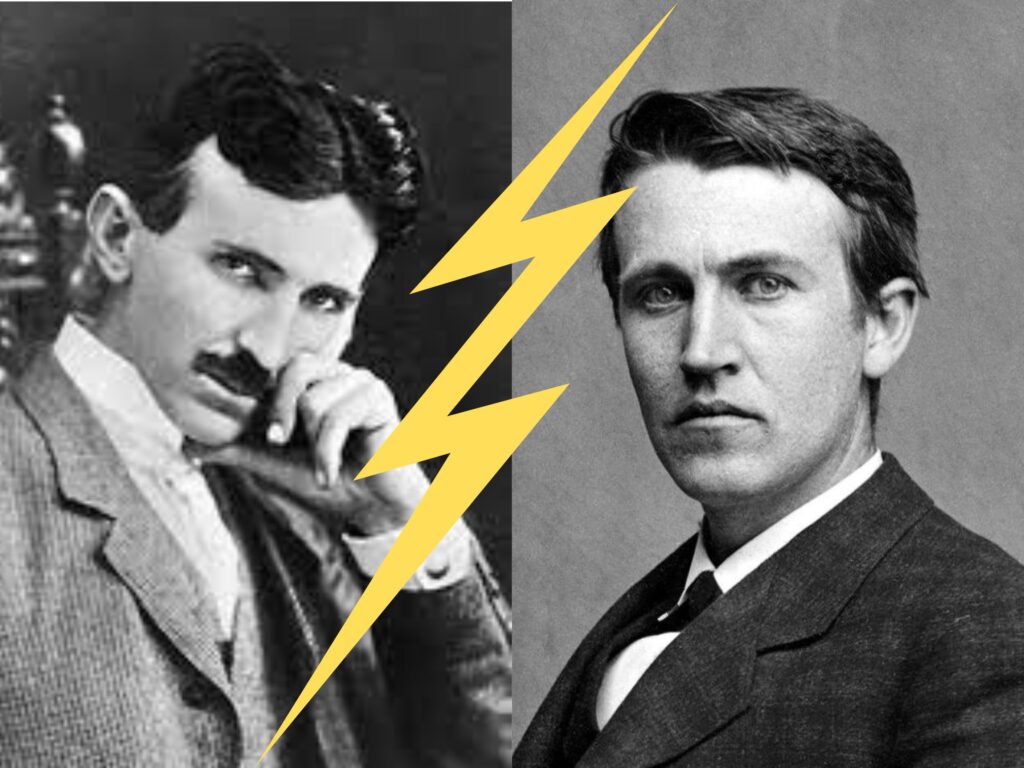
The partnership between Tesla and Westinghouse ignited one of the most infamous technological rivalries in history: “The War of the Currents.” On one side stood Thomas Edison, fiercely defending his established DC system, which he had heavily invested in. On the other side was George Westinghouse, championing Tesla’s AC technology. Edison launched a vigorous, often unethical, public relations campaign to discredit AC, portraying it as inherently dangerous. He funded experiments where animals were publicly electrocuted with AC to demonstrate its lethality, even going so far as to secretly support the development of the electric chair using AC voltage for capital punishment, hoping to associate AC with death.
Edison’s campaign created significant public fear and doubt, but Westinghouse and Tesla steadfastly countered with scientific demonstrations of AC’s safety and superior efficiency. They focused on proving AC’s practical advantages for large-scale power generation and transmission. The war was not just about scientific principles but also about market share, political influence, and public perception. The stakes were incredibly high, with the future of global electrification hanging in the balance. The fierce competition ultimately pushed both sides to innovate and refine their systems, but the inherent technical superiority of AC would eventually become undeniable.
The Triumphant Ascendancy of Alternating Current
Despite Edison’s fervent opposition, the practical advantages of AC, combined with strategic victories, paved its way to becoming the global standard.
Powering the World’s Fairs and Beyond
Two landmark events decisively demonstrated AC’s superiority and marked its triumph over DC. The first was the illumination of the World’s Columbian Exposition in Chicago in 1893. Westinghouse, using Tesla’s AC system, won the bid to light the fair, beating out General Electric (Edison’s company) with a significantly lower and more efficient proposal. The “City of Light,” as the fair became known, was a dazzling spectacle powered entirely by alternating current, showcasing its immense potential for large-scale illumination and power distribution. Millions witnessed firsthand the brilliance and efficiency of an AC-powered city, proving its safety and effectiveness on a grand scale.
The second, even more significant victory, was the project to harness the immense power of Niagara Falls. In 1893, Westinghouse was awarded the contract to build the hydroelectric power plant at Niagara Falls, utilizing Tesla’s polyphase AC system to generate and transmit power. The successful transmission of AC power from Niagara Falls to Buffalo, New York, in 1896, a distance of about 22 miles, was a monumental achievement. It demonstrated that AC could efficiently deliver vast amounts of power over long distances, making centralized power generation and widespread electrification economically feasible. This project cemented AC’s status as the future of power.
Lasting Legacy and Global Impact
Following the success at Niagara Falls and the Chicago Exposition, the adoption of alternating current surged globally. Its ability to transmit power efficiently over hundreds of miles made it possible to locate power plants near fuel sources (like coal mines) or renewable resources (like hydroelectric dams) and distribute electricity to distant cities, factories, and eventually, homes. This eliminated the need for countless localized power stations, drastically reducing costs and expanding the reach of electricity. The standardization on AC facilitated the growth of industries, urban development, and technological innovation across the board. From powering industrial machinery to lighting entire cities and running household appliances, AC became the invisible backbone of modern society, a legacy that continues uninterrupted to this day.
A Collective Masterpiece: Acknowledging Diverse Contributions
While Tesla and Westinghouse rightfully stand at the forefront of the AC revolution, the “invention” of AC voltage and its widespread system was truly a collective human endeavor, built upon the insights and contributions of many.
More Than One Genius
It is crucial to acknowledge that the development of AC technology involved numerous brilliant minds beyond Tesla, Edison, and Westinghouse. For instance, Mikhail Dolivo-Dobrovolsky, a Russian-Polish electrical engineer working for AEG in Germany, independently developed the robust three-phase AC system and the cage-rotor induction motor, which further refined and popularized AC technology in Europe during the same period as Tesla’s work in the US. Charles Proteus Steinmetz, a German-American mathematician and electrical engineer at General Electric, made invaluable contributions to the theoretical understanding of AC circuits, simplifying complex calculations and enabling engineers to design more reliable and efficient AC systems. His work was critical in formalizing AC theory, making it more accessible and predictable for practical application. Many other engineers, scientists, and technicians contributed to the incremental improvements, manufacturing techniques, and installation processes that made the AC system viable and scalable. The evolution of AC was a testament to the collaborative nature of scientific and engineering progress.
The Enduring Relevance of AC
Today, alternating current remains the dominant form of electrical power transmission and distribution worldwide. Our entire power grid, from large-scale generation at power plants to the outlets in our homes, relies almost exclusively on AC. While direct current has seen a resurgence in specific applications like high-voltage direct current (HVDC) transmission for extremely long distances or undersea cables, and in electronics like computers and smartphones (which convert AC to DC internally), AC is fundamental to the global infrastructure. Its inherent efficiency for long-distance transmission and its ease of voltage transformation continue to make it the most practical and economical choice for powering our modern world.
In conclusion, while the question “who invented AC voltage” often points to Nikola Tesla, the complete answer reveals a fascinating chapter in technological history involving multiple inventors, tenacious industrialists, and a fierce “War of the Currents.” Tesla’s groundbreaking work on the polyphase AC system, championed and industrialized by George Westinghouse, ultimately prevailed over Edison’s DC, leading to the electrification of the world. It was a monumental achievement that stands as a testament to human ingenuity and its capacity to transform civilization through relentless innovation in the realm of technology.
aViewFromTheCave is a participant in the Amazon Services LLC Associates Program, an affiliate advertising program designed to provide a means for sites to earn advertising fees by advertising and linking to Amazon.com. Amazon, the Amazon logo, AmazonSupply, and the AmazonSupply logo are trademarks of Amazon.com, Inc. or its affiliates. As an Amazon Associate we earn affiliate commissions from qualifying purchases.