
Costco Wholesale Corporation, the beloved membership-only warehouse club, is a retail behemoth recognized globally for its bulk products, competitive pricing, and Kirkland Signature brand. A frequent question among consumers and business enthusiasts alike is, “who owns Costco?” The answer is more nuanced than a single individual or private entity, reflecting the modern corporate landscape of a publicly traded company. Understanding Costco’s ownership structure provides crucial insights into its operational strategies, financial performance, and commitment to both its members and its shareholders. This exploration delves into the financial intricacies of Costco, illuminating how its ownership model influences its enduring success in the highly competitive retail sector.

The Publicly Traded Nature of Costco Wholesale Corporation
At its core, Costco is owned by its shareholders. As a publicly traded company, its shares are bought and sold on stock exchanges, specifically on the NASDAQ Global Select Market under the ticker symbol “COST.” This means that ownership is distributed among millions of investors, ranging from individual retail investors to massive institutional investment firms, each holding a stake in the company proportional to the number of shares they own. This democratic form of ownership distinguishes publicly traded companies from privately held businesses, where ownership is concentrated in a smaller group of individuals or families.
Understanding Shareholder Ownership
Shareholder ownership implies that anyone who purchases shares of Costco stock legally owns a small piece of the company. These shareholders are not involved in the day-to-day operations but have certain rights, including the right to vote on key corporate matters, such as the election of the board of directors, approval of major mergers or acquisitions, and certain executive compensation plans. The cumulative decisions and investment choices of these shareholders collectively determine the market valuation of Costco, influencing its stock price based on perceived future earnings, growth prospects, and overall market sentiment. For investors, buying Costco shares represents an investment in a stable, well-managed retail giant with a proven track record of profitability and customer loyalty, offering potential for capital appreciation and dividend income.
The Role of the Board of Directors
While shareholders own the company, they delegate the oversight of its management to a Board of Directors. This board is elected by the shareholders and is responsible for setting the company’s strategic direction, overseeing executive management, ensuring financial integrity, and representing the long-term interests of all shareholders. The Board of Directors acts as a critical link between the ownership base and the operational leadership, making high-level decisions that shape Costco’s trajectory. They appoint the CEO and other top executives, monitor performance, and approve major capital expenditures, thereby playing a pivotal role in maintaining the company’s ethical standards and financial health. For a company like Costco, which operates across multiple countries and serves a vast customer base, the board’s strategic guidance is paramount in navigating complex market dynamics and regulatory environments.
How Shares are Traded: NASDAQ and Institutional Investors
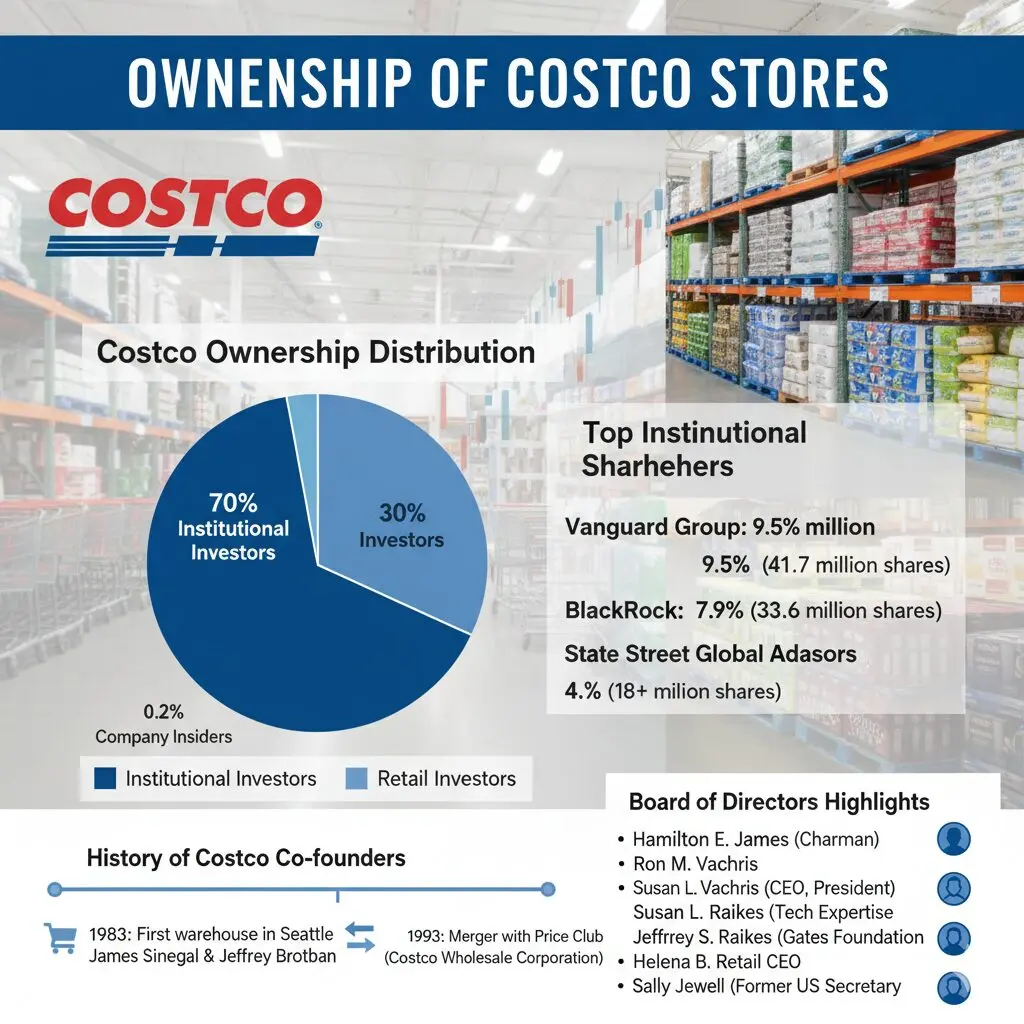
Costco’s shares are actively traded on the NASDAQ, one of the world’s largest stock exchanges. This provides liquidity for investors, allowing them to buy and sell shares easily, thereby determining the company’s market capitalization (share price multiplied by the number of outstanding shares). The vast majority of Costco’s shares are held by institutional investors. These are large organizations that invest on behalf of their clients or members, such as mutual funds, pension funds, hedge funds, and insurance companies. Their investment decisions are typically based on in-depth financial analysis, market trends, and long-term investment strategies. The significant holdings by institutional investors mean that major shifts in ownership or strategic direction often stem from the collective decisions of these financial powerhouses, who scrutinize Costco’s financial statements, management effectiveness, and competitive advantages to ensure their investments deliver strong returns.
Major Stakeholders: Institutional Powerhouses
When we talk about who “owns” a significant portion of Costco, the focus quickly shifts to the institutional investment landscape. These entities often hold multi-billion dollar stakes, making them influential voices in corporate governance and strategic direction. Their investment choices can signal confidence or concern in the market regarding Costco’s future performance.
Identifying Key Institutional Investors
Leading asset management firms and investment groups frequently appear as top shareholders in publicly traded companies like Costco. While specific percentages fluctuate with market activity and portfolio adjustments, major players often include Vanguard Group, BlackRock Inc., State Street Corp., and Fidelity Investments. These firms manage trillions of dollars in assets and hold significant positions across thousands of companies, including a substantial allocation to robust, consumer-staple businesses like Costco. Their presence as major shareholders underscores Costco’s appeal as a stable, growth-oriented investment, often included in diversified portfolios seeking long-term value. These institutional investors are not just passive holders; they engage with company management, often advocating for policies that enhance shareholder value, such as prudent capital allocation, sustainable growth initiatives, and effective risk management.
The Influence of Large Investment Firms
The sheer size of holdings by these institutional investors grants them considerable influence. While they do not run Costco’s day-to-day operations, their collective voting power in shareholder meetings is substantial. They can influence the election of board members, approve or reject major corporate proposals, and pressure management to adopt certain strategies that align with their investment theses. For instance, an institutional investor might advocate for increased share buybacks, higher dividends, or greater transparency in environmental, social, and governance (ESG) practices. This influence ensures that Costco’s executive team remains acutely aware of shareholder interests and consistently strives to deliver financial performance that satisfies these powerful stakeholders, balancing short-term results with long-term strategic vision.
Retail Investors and Employee Stock Plans
Beyond the institutional giants, millions of individual retail investors also own Costco stock. These are everyday people investing through brokerage accounts, either directly or through mutual funds and exchange-traded funds (ETFs) that include Costco. Their collective ownership, while fragmented, represents a broad base of public trust in the company. Furthermore, Costco, like many large corporations, likely offers employee stock purchase plans (ESPPs) or stock options as part of its compensation package. These plans allow employees to acquire company stock, often at a discount, aligning their financial interests with the company’s success. This fosters a sense of shared ownership and loyalty among the workforce, contributing to Costco’s famously positive workplace culture and high retention rates, which in turn support its operational efficiency and profitability.
Financial Implications of Public Ownership
Public ownership brings with it a distinct set of financial implications that profoundly shape a company’s operations, strategic decisions, and accountability. For Costco, being publicly traded impacts everything from its growth strategies to its transparency requirements, ultimately affecting how it delivers value to both members and investors.
Shareholder Value and Business Strategy

A primary mandate for any publicly traded company is to maximize shareholder value. This imperative directly influences Costco’s business strategy. Decisions regarding expansion into new markets, pricing strategies, product assortment, technological investments, and membership fee adjustments are all made with an eye toward enhancing profitability and growth, which in turn drives the stock price. Costco’s unique membership model, for example, is not just a customer loyalty program; it’s a significant, high-margin revenue stream that consistently underpins its profitability, making it attractive to investors. The focus on efficiency, low overhead, and a curated product selection are all geared towards maintaining competitive prices while ensuring robust financial returns for shareholders. This balance is critical: maintaining member satisfaction to ensure recurring membership fees, while simultaneously growing revenue and controlling costs to boost investor confidence and share performance.
Transparency and Regulatory Compliance
Public ownership demands a high degree of transparency and adherence to stringent regulatory requirements. Companies listed on major stock exchanges, like Costco on NASDAQ, must comply with regulations set by bodies such as the Securities and Exchange Commission (SEC) in the U.S. This involves regular and detailed financial reporting, including quarterly and annual reports (10-Q and 10-K filings), which provide comprehensive insights into the company’s financial health, operations, risks, and management discussions. This level of disclosure ensures that investors have access to reliable information to make informed decisions. For Costco, this means meticulous accounting practices, regular audits, and public communication of its financial performance, ensuring accountability to its vast ownership base and fostering trust in its corporate governance.
Dividend Policy and Reinvestment
A key financial decision for any publicly traded company is its dividend policy – whether to distribute a portion of its profits to shareholders as dividends or to reinvest those earnings back into the business for growth. Costco has historically favored a balance, offering regular dividends and occasionally special dividends, while also reinvesting significantly in its expansion and operational improvements. Dividends are attractive to income-focused investors, signaling a company’s financial stability and commitment to returning value. Reinvestment, on the other hand, is crucial for growth-oriented investors, as it funds new warehouse openings, technology upgrades, and supply chain efficiencies, which are vital for long-term expansion and competitive advantage. Costco’s financial management consistently evaluates this trade-off, aiming for an optimal balance that satisfies diverse shareholder expectations while sustaining its strategic growth initiatives.
From Private Venture to Global Public Enterprise
Costco’s journey from its origins to its current status as a global publicly traded enterprise is a testament to its successful business model and strategic evolution. Its history provides context for its current ownership structure and financial standing.
A Brief History of Costco’s Growth and IPO
Costco Wholesale Corporation was formed in 1983 in Seattle, Washington. Its precursor, Price Club, founded by Sol Price in San Diego in 1976, pioneered the warehouse club concept. The two companies merged in 1993 to form Price/Costco, which later became Costco Wholesale Corporation. The decision to go public, often through an Initial Public Offering (IPO), is a monumental step for any company. It allows founders and early investors to cash out some of their equity and, more importantly, raises significant capital for expansion without incurring debt. For Costco, going public facilitated its rapid expansion across the U.S. and internationally, providing the necessary financial resources to build new warehouses, invest in logistics, and scale its unique membership model to a global audience. This transition from a privately held entity to a public company marked a pivot towards broad shareholder ownership and increased financial scrutiny, laying the groundwork for its current ownership structure.
The Evolution of Its Ownership Structure
Over the decades, Costco’s ownership structure has naturally evolved with its growth and market performance. Initially, ownership would have been concentrated among founders, key executives, and early venture capitalists. As the company grew, its shares became more widely distributed through subsequent stock offerings and market trading. Major institutional investors gradually built up their positions, recognizing Costco’s robust business model and consistent profitability. The merger with Price Club was a significant event, consolidating ownership and operations under a unified banner, further strengthening its market position. This evolution reflects a typical trajectory for successful public companies: starting with concentrated ownership and gradually broadening its shareholder base as it matures and gains investor confidence, making its stock a staple in many investment portfolios.
Sustaining Shareholder Trust and Market Performance
Maintaining shareholder trust is paramount for a publicly traded company. This is achieved through consistent financial performance, transparent communication, strong corporate governance, and a clear strategic vision. Costco has excelled in these areas, consistently demonstrating robust sales growth, healthy profit margins, and effective management. Its ability to navigate economic downturns, adapt to changing consumer preferences, and expand its global footprint has cemented its reputation as a reliable investment. The company’s disciplined approach to inventory management, its focus on employee welfare (leading to lower turnover and better service), and its strategic use of membership fees as a recurring revenue stream all contribute to its strong market performance and its ability to continually generate value for its diverse shareholder base, from the largest institutional fund to the smallest individual investor.
The Membership Model: A Financial Masterstroke
Costco’s distinctive membership model is not just a marketing gimmick; it is a financial cornerstone that underpins its entire operation and significantly influences its profitability and appeal to investors. This model fundamentally shapes its financial health and shareholder value proposition.
Membership Fees as a Revenue Stream and Profit Driver
Unlike traditional retailers who rely solely on product markups for profit, Costco generates substantial revenue from its annual membership fees. These fees are nearly pure profit, largely offsetting the company’s operating expenses and allowing Costco to maintain incredibly low markups on its merchandise. This strategy ensures that the vast majority of its gross margin on products can be passed on to members in the form of lower prices, creating a powerful value proposition. For investors, the membership fees represent a stable, predictable, and high-margin revenue stream that provides a robust financial cushion. It offers a consistent source of earnings that is less susceptible to fluctuations in sales volume compared to pure retail profits, making Costco an attractive investment due to its resilient profit base.
Enhancing Customer Loyalty and Shareholder Value
The membership model fosters a high degree of customer loyalty. Members pay an annual fee, incentivizing them to shop frequently at Costco to maximize the value of their membership. This creates a powerful cycle: loyal members drive high sales volume, which allows Costco to negotiate better prices with suppliers due to bulk purchasing. These savings are then passed on to members, reinforcing their loyalty. From an investor’s perspective, this high customer retention and predictable revenue stream translate directly into stable earnings and strong cash flow, which are crucial drivers of shareholder value. The recurring nature of membership fees provides a predictable foundation for financial planning and dividend payments, contributing significantly to Costco’s ability to deliver consistent returns to its shareholders.
Balancing Member Benefits with Investor Returns
Costco’s success lies in its ability to expertly balance member benefits with the imperative of delivering strong investor returns. The company’s philosophy of offering high-quality products at the lowest possible prices directly serves its members, enhancing their perceived value of the membership. Simultaneously, the membership fee structure ensures robust profitability, satisfying shareholders. This symbiotic relationship is key. Happy members renew their memberships and spend more, which boosts revenues and profits. Strong financial performance, in turn, drives up the stock price and allows for potential dividends, rewarding investors. This strategic alignment between customer value and shareholder value is a hallmark of Costco’s business model, making it a compelling case study in sustainable corporate success within the dynamic and financially driven world of publicly traded companies.
aViewFromTheCave is a participant in the Amazon Services LLC Associates Program, an affiliate advertising program designed to provide a means for sites to earn advertising fees by advertising and linking to Amazon.com. Amazon, the Amazon logo, AmazonSupply, and the AmazonSupply logo are trademarks of Amazon.com, Inc. or its affiliates. As an Amazon Associate we earn affiliate commissions from qualifying purchases.