
The question “when was the calculator invented?” isn’t as straightforward as it might seem. The concept of a device designed to aid calculation stretches back millennia, evolving from simple manual tools to the sophisticated electronic gadgets and software applications we use today. This journey is a testament to humanity’s persistent drive to automate and simplify complex mathematical operations, a core pillar of technological advancement. Understanding the calculator’s origins means delving into a rich history of innovation, examining the brilliant minds that conceived these devices, and appreciating the incremental technological leaps that ultimately led to the ubiquitous computational tools of the 21st century. This article will embark on that historical exploration, tracing the calculator’s lineage from ancient counting aids to modern digital marvels, firmly rooted in the narrative of technological progress.
The Dawn of Calculation: Pre-Mechanical Aids
Long before gears whirred or circuits hummed, humanity recognized the need for external aids to perform calculations beyond simple mental arithmetic. The earliest forms of “calculators” were not machines but ingenious systems designed to organize and manipulate numbers.
Ancient Abacus and Counting Boards
The abacus stands as one of the most enduring symbols of early computation. Its exact origin is debated, with versions appearing in ancient Mesopotamia, China, Rome, and Greece. The fundamental principle of the abacus involves beads or counters moved along rods or grooves to represent numbers. Users manipulate these counters according to specific rules to perform addition, subtraction, multiplication, and division. The Chinese suanpan and the Japanese soroban are sophisticated examples, allowing for surprisingly rapid and accurate calculations in the hands of a skilled operator.
The abacus was revolutionary because it externalized the process of calculation, freeing the mind from holding multiple numbers simultaneously and reducing the potential for error. It was a physical representation of place value, enabling calculations involving large numbers. While not “invented” in the singular sense, the various forms of the abacus represent the earliest widespread technological solutions to numerical problems, laying the groundwork for more complex mechanical systems by demonstrating the power of structured physical manipulation for arithmetic.
Parallel to the abacus were counting boards, often grids drawn in sand or on tables, where pebbles or tokens were moved. These simple tools served similar purposes, providing a visual and tactile interface for arithmetic operations. They underscore the universal human need to systematize numerical processes, a need that would continually drive innovation in computational technology.
Napier’s Bones and Logarithms
Moving into the early modern period, the development of sophisticated mathematical concepts paved the way for more specialized calculation aids. John Napier, the Scottish mathematician, introduced two significant innovations in the early 17th century: logarithms and “Napier’s Bones.”
Logarithms, published in 1614, fundamentally transformed multiplication and division into simpler addition and subtraction problems. By converting numbers to their logarithmic equivalents, these complex operations could be performed with far less effort, a monumental leap for astronomers, navigators, and engineers. While logarithms themselves are a mathematical concept, their practical application often involved look-up tables and the subsequent invention of the slide rule, a direct descendant in function.
Napier’s Bones, invented around 1617, were a more direct precursor to mechanical calculators. These were a set of numbered rods, often made of bone or ivory, inscribed with multiplication tables. By arranging the rods appropriately, users could multiply and divide numbers by merely adding digits displayed in specific rows. It was a manual, mechanical aid that significantly sped up multi-digit arithmetic, particularly multiplication. The bones represented an early form of “algorithm” applied to a physical device, automating steps that would otherwise require tedious mental computation and recall. They demonstrated the power of physical design in structuring mathematical operations, anticipating the more complex mechanical systems to follow.
The Mechanical Revolution: Early Calculating Machines
The 17th century marked a pivotal shift from manual aids to genuine mechanical calculating machines. Driven by the need for greater speed, accuracy, and automation, brilliant inventors began conceptualizing and constructing devices powered by gears and levers.
Pascal’s Calculator: The Pascaline (17th Century)
One of the most famous early mechanical calculators was the Pascaline, invented by the French polymath Blaise Pascal in 1642. Pascal, a mere 19 years old at the time, developed the machine to help his father, a tax commissioner, with tedious arithmetic calculations. The Pascaline was an adding machine, using a series of interlocking gears with ten teeth each, representing the digits 0-9. Numbers were entered by rotating dials, and carries from one digit position to the next were automatically handled by a clever mechanism.
While primarily an adding machine, the Pascaline could also perform subtraction through a complementary number system. It was a significant technological achievement, demonstrating the feasibility of fully automating arithmetic operations with mechanical parts. Pascal produced around 50 prototypes and sold a few dozen, making it arguably the first commercially available mechanical calculator. Its intricate gear system and automatic carry mechanism represented a groundbreaking step in computational hardware design, proving that complex arithmetic could be performed with precision without human intervention beyond input.
Leibniz’s Stepped Reckoner (Late 17th Century)
Not long after Pascal, the German polymath Gottfried Wilhelm Leibniz took mechanical calculation a step further with his “Stepped Reckoner” (Staffelwalze). Beginning work in 1672 and completing a prototype in 1694, Leibniz’s machine was more ambitious than the Pascaline, designed to perform all four basic arithmetic operations: addition, subtraction, multiplication, and division.
Leibniz’s key innovation was the “stepped drum,” a cylinder with nine teeth of varying lengths. This ingenious mechanism allowed for direct multiplication by repeatedly adding numbers, a significant improvement over Pascal’s machine which required repeated manual additions for multiplication. The Stepped Reckoner also featured a movable carriage, a precursor to many later calculator designs, enabling multi-digit operations.
Despite its conceptual brilliance, Leibniz’s machine was notoriously complex and mechanically unreliable in its prototypes. Nevertheless, its design principles, particularly the stepped drum and the ability to perform multiplication directly, had a profound influence on subsequent calculator development. It showcased a vision of a truly universal arithmetic machine, pushing the boundaries of mechanical engineering in the service of computation and reinforcing the idea that machines could handle more than just simple addition.
Arithmometers and the Commercialization of Mechanical Calculation (19th Century)

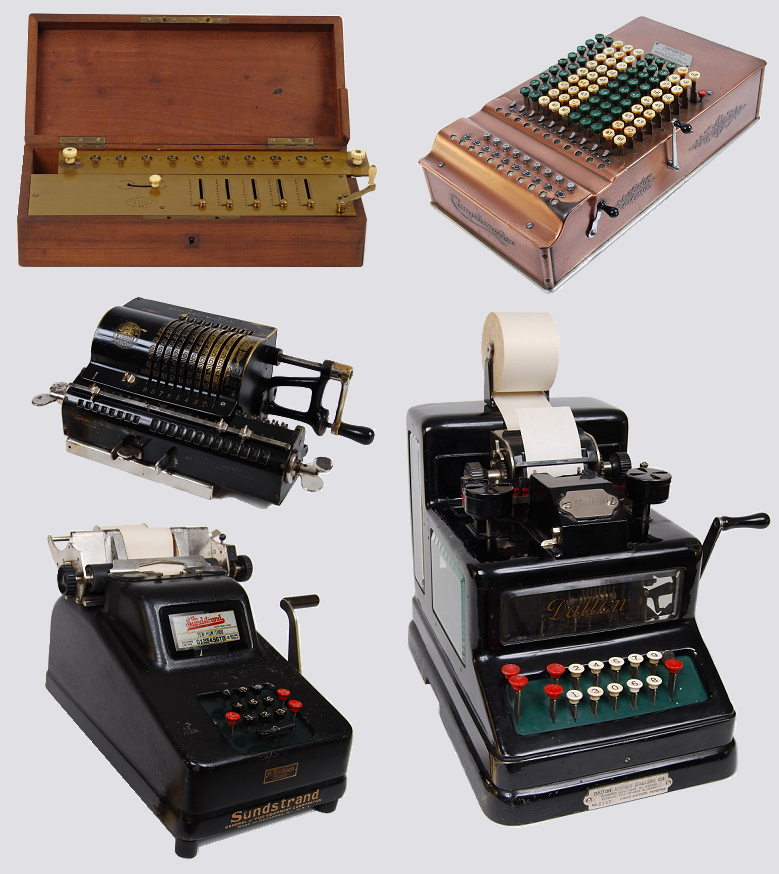
The 19th century saw the refinement and commercialization of mechanical calculators, moving them from experimental curiosities to practical tools for business and science. The “Arithmometer” by Charles Xavier Thomas de Colmar, patented in 1820, was the first mechanical calculator robust enough for daily office use. Building on Leibniz’s stepped drum design, Thomas’s Arithmometer was widely produced and sold for over 90 years, becoming the standard for mechanical calculation throughout the latter half of the 19th century.
The success of the Arithmometer spurred further innovation. Other inventors like Frank S. Baldwin and W.T. Odhner developed different mechanisms, such as the pinwheel design, leading to more compact and efficient machines. These devices found widespread use in accounting, insurance, and scientific research. They were large, hand-cranked, and often expensive, but their ability to perform calculations reliably and more quickly than manual methods made them invaluable. This era cemented the calculator’s role as an essential technological tool, demonstrating the demand for automated computation beyond niche scientific or governmental needs, and solidifying the mechanical calculator’s place in the burgeoning industrial age.
Towards Automation: Electromechanical and Electronic Innovations
The 20th century brought a new paradigm to calculation: electricity. The transition from purely mechanical systems to electromechanical and then fully electronic designs revolutionized speed, capability, and eventually, portability.
From Relays to Vacuum Tubes: The Dawn of Electronic Computation (Mid-20th Century)
The early to mid-20th century witnessed the development of massive, room-sized computers that laid the groundwork for modern electronics. These pioneering machines, like the Atanasoff-Berry Computer (ABC), ENIAC (Electronic Numerical Integrator and Computer), and Colossus, utilized vacuum tubes and relays to perform calculations at unprecedented speeds. While not “calculators” in the handheld sense, they were the ultimate calculating machines, demonstrating the immense potential of electronic components for high-speed, complex computation.
Vacuum tubes, capable of switching electrical signals much faster than mechanical relays, enabled calculations in milliseconds rather than seconds. The sheer volume of tubes, however, made these machines hot, unreliable, and power-hungry. Yet, they proved the concept of electronic digital computation, solving complex problems for wartime efforts and scientific research. This period was crucial because it shifted the foundational technology from moving parts to electrical signals, setting the stage for smaller, more efficient electronic calculators. The principles of digital logic and electronic switching developed here would directly inform the design of dedicated calculating devices.
The First Electronic Desktop Calculators (1960s)
The true birth of the electronic calculator, as a dedicated desktop device, occurred in the 1960s. One of the earliest fully electronic desktop calculators was the Bell Punch ANITA Mark VII, released in 1961 in Europe. It used vacuum tubes (and later transistors) to perform operations and displayed results on a Nixie tube display. Shortly after, in 1964, the United States saw the introduction of the Friden EC-130, which utilized transistors and featured a cathode-ray tube (CRT) display, capable of showing a stack of numbers.
These early electronic calculators were a significant improvement over their mechanical and electromechanical predecessors. They were silent, much faster, and more reliable. However, they were still bulky, expensive, and primarily found in offices and scientific laboratories. The technology was rapidly evolving, with transistors replacing vacuum tubes, leading to smaller, cooler, and more efficient designs. This decade marked the true transition from mechanical to electronic calculation, a critical step towards miniaturization and widespread adoption.
The Microprocessor Revolution and Pocket Calculators (1970s)
The 1970s brought the most dramatic transformation in calculator history: the invention of the microprocessor. The development of integrated circuits (ICs) allowed thousands of transistors to be etched onto a single silicon chip. In 1971, Intel released the 4004, the first commercial microprocessor, which was initially designed for Busicom, a Japanese calculator company. This single chip could perform the functions that previously required numerous discrete components.
This breakthrough led directly to the proliferation of affordable, powerful, and truly pocket-sized electronic calculators. Companies like Texas Instruments, Hewlett-Packard, and Casio rapidly introduced models that could perform basic arithmetic, scientific functions, and even programming. The HP-35 (1972) was the first scientific electronic pocket calculator, replacing slide rules for engineers and scientists. The affordability driven by mass production and miniaturization made calculators accessible to students, businesses, and individuals worldwide. The microprocessor didn’t just shrink the calculator; it democratized powerful computational ability, making it an everyday tool and fundamentally changing how people approached numerical tasks.
The Modern Era: Calculators in the Digital Age
From dedicated hardware to omnipresent software, the calculator’s evolution continues, adapting to the ever-changing landscape of digital technology. Today, its form and function are more diverse than ever.
Scientific, Graphing, and Programmable Calculators
Following the microprocessor revolution, dedicated calculators continued to evolve, catering to specialized needs. Scientific calculators became standard equipment for students and professionals in STEM fields, offering functions for trigonometry, logarithms, statistics, and more. Graphing calculators, pioneered by companies like Casio and Texas Instruments in the 1980s, added the ability to visualize mathematical functions, plot data, and even perform symbolic manipulation, making them indispensable tools for advanced mathematics and physics education. Programmable calculators allowed users to write and store custom routines, further extending their utility. These devices pushed the boundaries of what a standalone calculating device could achieve, becoming powerful mini-computers in their own right, capable of solving complex problems well beyond simple arithmetic.
Calculators as Software: From Desktops to Smartphones
While dedicated hardware calculators remain popular, especially in educational settings, the digital age has also seen the calculator transform into ubiquitous software. Every personal computer operating system comes with a built-in calculator application, offering basic, scientific, and sometimes programmer modes. The advent of smartphones brought a calculator into virtually every pocket, not as a standalone device, but as a core utility within a multi-functional computing platform. App stores offer a vast array of calculator applications, from simple interfaces to highly specialized tools for finance, engineering, and statistics, often surpassing the capabilities of physical calculators. This shift highlights the calculator’s fundamental nature as a function rather than just a device, easily integrated into broader digital ecosystems.

The Enduring Legacy of Calculation
The journey of the calculator, from ancient abacus to sophisticated software, is a testament to humanity’s continuous quest for efficiency and precision in numerical tasks. Each iteration, from Pascal’s gears to Intel’s microprocessors, built upon prior innovations, demonstrating how technological advancement is often an incremental process driven by both theoretical breakthroughs and practical needs.
Today, while dedicated calculators still serve specific niches, the underlying principles of computation they embody are integrated into nearly every digital device we use. From the humble smartphone to powerful supercomputers, the ability to perform rapid, accurate calculations is fundamental. The invention of the calculator, in its various forms, wasn’t a single event but a continuous evolution, profoundly shaping how we interact with numbers, solve problems, and ultimately, advance our technological civilization. The story of the calculator is, in essence, the story of humanity’s ever-expanding computational prowess.
aViewFromTheCave is a participant in the Amazon Services LLC Associates Program, an affiliate advertising program designed to provide a means for sites to earn advertising fees by advertising and linking to Amazon.com. Amazon, the Amazon logo, AmazonSupply, and the AmazonSupply logo are trademarks of Amazon.com, Inc. or its affiliates. As an Amazon Associate we earn affiliate commissions from qualifying purchases.