
In the intricate tapestry of modern finance, few concepts hold as much pervasive importance as the humble percentage. Far from being a mere academic curiosity, understanding “what is percentage of a number” is the bedrock upon which sound financial decisions are built. Whether you’re a student navigating the world of personal budgets, an investor assessing potential returns, or a business owner analyzing profit margins, percentages provide a universal and intuitive language for comparison, proportion, and change. Without a firm grasp of this foundational concept, much of the financial landscape—from interest rates and discounts to investment yields and economic indicators—remains a bewildering maze.

This article delves into the core definition of a percentage, dissects its calculation methods, and, crucially, illustrates its indispensable role across the entire spectrum of financial activities. We will explore how mastering percentages can empower you to make informed decisions, optimize your financial health, and navigate the complexities of the money world with greater confidence and insight.
The Foundational Concept: Demystifying Percentages for Financial Acumen
At its heart, a percentage is a way to express a number as a fraction of 100. The term “percent” derives from the Latin per centum, meaning “by the hundred” or “for every hundred.” It’s a standardized way to describe a part of a whole, making it an incredibly powerful tool for comparison, especially when dealing with different total amounts. In finance, this standardization is critical; it allows us to compare the performance of investments regardless of their initial capital, gauge the proportion of income allocated to various expenses, or understand the impact of taxes and discounts uniformly.
Defining “Per Cent”: A Fraction of 100
Imagine you have a pie, and you’ve eaten a slice. Describing that slice as “10%” of the pie immediately gives a clear sense of its proportion, irrespective of the pie’s original size. Mathematically, 10% is equivalent to the fraction 10/100 or the decimal 0.10. This universality is why percentages are so valuable in financial contexts. A 5% interest rate on a loan means that for every $100 borrowed, $5 will be charged as interest for a specified period. A 20% discount on an item means you save $20 for every $100 of its original price. It simplifies complex ratios into easily digestible figures, enabling quick assessments and comparisons across diverse financial scenarios. It’s the common denominator that allows us to speak fluently about financial proportions.
The Core Calculation: Finding a Percentage of a Whole
The most fundamental application of percentages is to determine what percentage one number is of another. This calculation is essential for everything from evaluating your budget to understanding market share. The formula is straightforward:
Percentage = (Part / Whole) × 100
Let’s illustrate with a common financial example. Suppose your monthly income (the “Whole”) is $4,000, and you spend $1,200 (the “Part”) on rent. To find the percentage of your income that goes to rent:
- Percentage = ($1,200 / $4,000) × 100
- Percentage = 0.30 × 100
- Percentage = 30%
This tells you that 30% of your income is allocated to rent. Such a calculation is vital for budgeting, helping you identify if your housing expenses align with common financial guidelines, such as the 30% rule for housing. Similarly, businesses use this to calculate expenses as a percentage of revenue, and investors use it to determine the percentage gain or loss on an asset.
Reversing the Equation: Calculating the Part from a Percentage
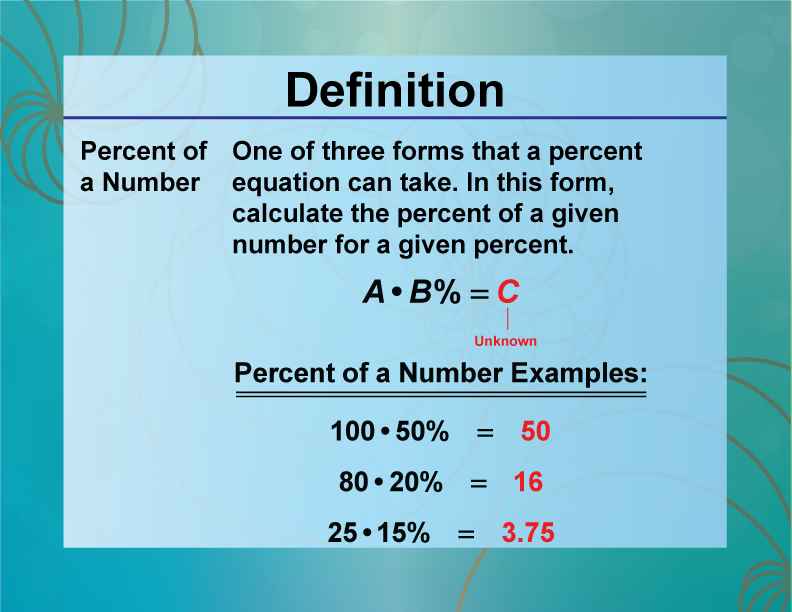
Equally important is the ability to calculate a specific part when you know the percentage and the whole. This skill is critical for figuring out discounts, taxes, interest payments, or the actual amount saved or earned. The formula for this is:
Part = (Percentage / 100) × Whole
Consider a scenario where you’re buying a new appliance priced at $500, and it has a 15% discount. To find out how much you save (the “Part”):
- Part = (15 / 100) × $500
- Part = 0.15 × $500
- Part = $75
You save $75, meaning the final price is $500 – $75 = $425. This calculation is indispensable for smart shopping, understanding your tax obligations, or calculating the interest due on a loan. For instance, if your savings account offers a 2% annual interest rate on a balance of $10,000, you can quickly determine you’ll earn $200 in interest over the year ($10,000 * 0.02). This reverse calculation empowers consumers and businesses alike to anticipate financial outcomes and make informed decisions.
Percentages in Personal Finance: Mastering Your Money
In the realm of personal finance, percentages are not just theoretical constructs; they are practical tools that dictate how we manage, save, spend, and grow our money. From the mundane to the monumental, percentages permeate every aspect of an individual’s financial journey.
Budgeting and Expense Management: Unveiling Spending Patterns
Effective budgeting is fundamentally about allocating percentages of your income to different spending and savings categories. Financial advisors often recommend rules like the 50/30/20 rule: 50% of income for needs (housing, groceries), 30% for wants (entertainment, dining out), and 20% for savings and debt repayment. By calculating what percentage of your income goes to each category, you gain a clear, quantitative understanding of your spending habits and can identify areas for adjustment. For example, if you find that 45% of your income is going towards “wants,” it’s a strong indicator that you might be overspending in non-essential areas and could reallocate funds towards savings or debt reduction goals. This percentage-based view makes budget analysis both insightful and actionable.
Savings and Debt: The Power of Growth and the Cost of Borrowing
Percentages play a pivotal role in understanding both the growth of your savings and the cost of your debt. Savings accounts and investment vehicles advertise their returns as annual percentage rates (APR) or annual percentage yield (APY). A higher percentage indicates faster growth of your principal. Conversely, when borrowing money, whether it’s a mortgage, an auto loan, or credit card debt, the interest rate is expressed as a percentage. Understanding the APR on your credit card, for instance, allows you to calculate the true cost of carrying a balance and highlights the importance of timely payments. Furthermore, a crucial metric like the debt-to-income ratio, expressed as a percentage, determines your borrowing capacity and financial stability, signaling to lenders your ability to manage additional debt.
Taxes and Discounts: Everyday Financial Calculations
Every transaction in the economy is influenced by percentages. Sales tax, for instance, is a percentage added to the price of goods and services. Income tax is calculated based on tax brackets, with different percentages applied to various portions of your income. Understanding your effective tax rate (total tax paid as a percentage of your total income) gives a clearer picture of your overall tax burden. Similarly, discounts are almost universally expressed as percentages. Knowing how to calculate a 25% discount on a $120 item ($120 * 0.25 = $30 saving) allows you to determine the actual price you’ll pay and the real value of the saving. These daily percentage calculations are fundamental to making smart purchasing decisions and accurately managing your financial outflows.
Percentages in Investing and Business: Driving Growth and Assessing Risk
Beyond personal finance, percentages are the lifeblood of investment analysis and business operations. They provide standardized metrics for evaluating performance, profitability, and risk, enabling informed decisions that drive growth and mitigate potential losses.
Investment Returns and Performance: Gauging Success
For investors, percentages are the primary language for assessing the success of their portfolios. Return on Investment (ROI) is typically expressed as a percentage, indicating the profitability of an investment relative to its cost. A 15% ROI on a stock means you’ve earned 15 cents for every dollar invested. Annualized returns allow investors to compare the performance of different assets over different periods, standardizing the time horizon to a single year. Understanding percentage gains and losses is crucial for tracking portfolio growth, rebalancing assets, and making strategic buy or sell decisions. Concepts like volatility, often expressed as a percentage, also help investors gauge the risk associated with an investment, indicating how much its value might fluctuate.
Business Finance and Profitability: Key Metrics for Success
In the business world, percentages are indispensable for measuring operational efficiency and financial health. Key profitability ratios, such as gross profit margin and net profit margin, are expressed as percentages, revealing how much profit a company makes for every dollar of revenue. A company with a 40% gross profit margin means 40 cents of every revenue dollar remains after covering the cost of goods sold. Revenue growth, measured as a percentage year-over-year, indicates the pace of a company’s expansion. Market share, expressed as a percentage, shows a company’s proportion of the total sales in its industry. These percentage-based metrics provide critical insights into a business’s performance, allowing management to identify strengths, weaknesses, and opportunities for strategic adjustments.
Economic Indicators: Shaping Financial Decisions
Macroeconomic data, which profoundly impacts financial markets and individual wealth, is almost exclusively communicated through percentages. Inflation rate, the percentage increase in the price of goods and services, directly affects purchasing power. Unemployment rate, expressed as a percentage of the labor force, indicates economic health. GDP growth rate, a percentage change in a country’s economic output, signals prosperity or contraction. Interest rate changes by central banks, typically a small percentage point shift, can have ripple effects across lending, borrowing, and investment landscapes. Understanding these percentage-based economic indicators is crucial for investors to anticipate market trends, for businesses to plan operations, and for individuals to make informed financial planning decisions in a dynamic economic environment.
Advanced Applications and Avoiding Pitfalls
While percentages are powerful, their correct application requires a nuanced understanding, particularly when dealing with changes over time or interpreting complex financial data. Misinterpretation can lead to flawed conclusions and costly mistakes.
Understanding Percentage Changes: The Nuance of Growth and Decline
Calculating percentage change is fundamental to tracking financial performance over time. The formula for percentage increase or decrease is:
Percentage Change = ((New Value – Old Value) / Old Value) × 100
For example, if a stock price rises from $50 to $60, the percentage increase is (($60 – $50) / $50) × 100 = (10 / 50) × 100 = 20%. This differs significantly from “percentage points.” If an interest rate increases from 5% to 6%, it’s a 1-percentage-point increase, but a 20% percentage increase (from 5 to 6 is (1/5)*100 = 20%). Conflating these two can lead to drastic misjudgments, especially in scenarios involving compound interest or market volatility. Understanding this distinction is crucial for accurately assessing growth, depreciation, or the impact of policy changes.
The Pitfalls of Misinterpretation: Context is King
One of the greatest dangers with percentages lies in their potential for misinterpretation without proper context. A “small percentage” of a very large number can still be a substantial amount, and vice-versa. For instance, a 0.01% error rate in a financial institution processing millions of transactions daily could still represent hundreds or thousands of incorrect transactions. Conversely, a 50% increase in a very small startup’s revenue might look impressive but still be negligible in absolute terms. Media reports, marketing claims, and political rhetoric often use percentages to highlight or downplay statistics, making it imperative for a financially literate individual to always consider the absolute base numbers and the context behind any percentage claim.
Leveraging Financial Tools and Technology
In today’s digital age, numerous financial tools and technologies automate percentage calculations. Spreadsheets, online calculators, budgeting apps, and investment platforms routinely perform these computations for us. While these tools are invaluable for efficiency and accuracy, it’s paramount to understand the underlying mathematical principles. Relying solely on a calculator without comprehending how percentages work can lead to a “black box” mentality, hindering your ability to verify results, spot errors, or adapt calculations to novel situations. A solid grasp of “what is percentage of a number” ensures you can effectively utilize these tools, interpret their outputs correctly, and make truly informed decisions rather than simply accepting figures at face value.

Conclusion
The concept of “what is percentage of a number” might seem basic, but its mastery is anything but trivial within the financial domain. From personal budgeting and debt management to investment analysis, business profitability, and understanding global economic trends, percentages provide the indispensable framework for quantitative financial literacy. They empower us to compare apples to oranges, standardize performance metrics, and translate complex data into actionable insights.
By developing a strong proficiency in understanding and calculating percentages, you equip yourself with a powerful tool for financial empowerment. It enables you to dissect financial reports, critically evaluate investment opportunities, wisely manage your personal expenditures, and make informed decisions that shape your financial future. In a world increasingly driven by data and numbers, a solid grasp of percentages is not just an advantage—it is a fundamental necessity for anyone seeking to navigate and thrive in the ever-evolving landscape of money. Embrace the percentage, and unlock a clearer, more confident path to financial acumen.
aViewFromTheCave is a participant in the Amazon Services LLC Associates Program, an affiliate advertising program designed to provide a means for sites to earn advertising fees by advertising and linking to Amazon.com. Amazon, the Amazon logo, AmazonSupply, and the AmazonSupply logo are trademarks of Amazon.com, Inc. or its affiliates. As an Amazon Associate we earn affiliate commissions from qualifying purchases.