
In the world of finance, numbers tell a story. Whether you’re managing personal budgets, analyzing investment portfolios, or scrutinizing business performance, understanding how values change over time is paramount. One of the most fundamental calculations you’ll encounter is determining the percentage of a decrease. This isn’t just a mathematical exercise; it’s a vital tool that empowers you to identify trends, measure impact, and make informed financial decisions. From noticing a drop in your monthly utility bill to assessing a stock market correction or a dip in quarterly sales, grasping the mechanics of percentage decrease is indispensable for financial literacy and strategic planning. This guide will demystify the process, demonstrating its relevance across various financial contexts and equipping you with the knowledge to apply it confidently.
Understanding the Core Concept: Why It Matters for Your Money
Before diving into formulas and applications, it’s crucial to establish a solid understanding of what percentage decrease represents and why it holds such significance in financial analysis. It’s more than just knowing a number went down; it’s about understanding the proportion of that decline relative to its original state.
Defining Percentage Decrease
Percentage decrease quantifies the relative reduction between two values. Instead of merely stating that a value has dropped by a certain amount, it expresses that drop as a fraction of the original value, multiplied by 100 to convert it into a percentage. For instance, if your grocery bill went from $200 to $180, the absolute decrease is $20. But a 10% decrease ($20/$200 * 100%) provides a more universally understandable context, especially when comparing different scenarios or tracking progress over time. It allows for standardized comparison, making it easier to evaluate the magnitude of change, regardless of the initial values involved. This relative measure is powerful because it normalizes changes, enabling you to compare an investment that dropped $100 from $1,000 (a 10% decrease) to another that dropped $100 from $10,000 (a 1% decrease) and immediately see which experienced a more significant relative downturn.
The Fundamental Formula: Your Financial Compass
The calculation for percentage decrease is straightforward yet incredibly powerful. Mastering this single formula will unlock a deeper understanding of countless financial scenarios.
The formula is:
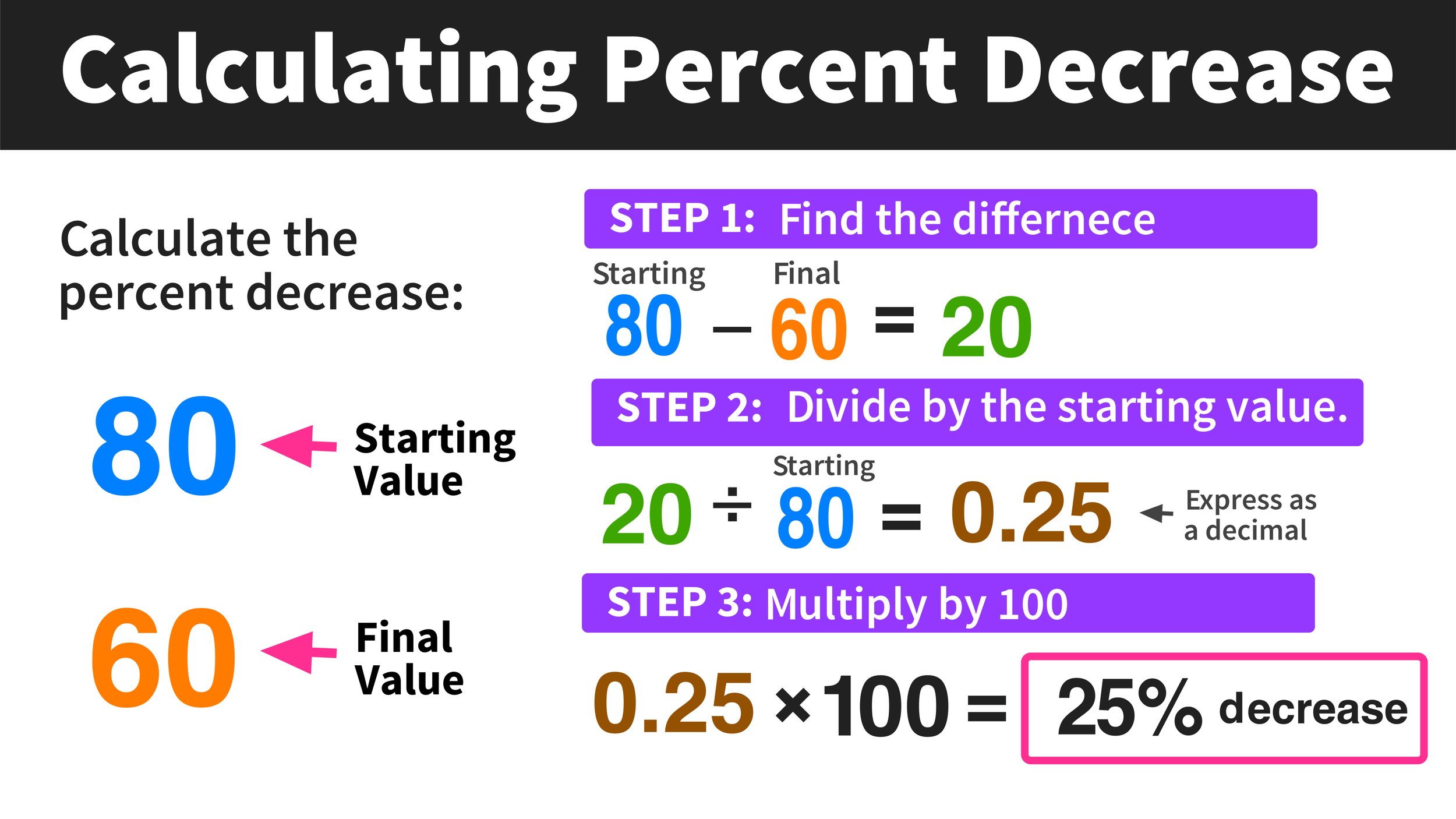
Percentage Decrease = ((Original Value – New Value) / Original Value) * 100
Let’s break down each component:
- Original Value: This is the starting point, the baseline figure before any reduction occurred. It’s crucial to identify this correctly, as it forms the denominator of your fraction.
- New Value: This is the value after the decrease has taken place.
- Original Value – New Value: This first step calculates the absolute amount of the decrease. This difference tells you how much the value has gone down.
- Divide by Original Value: By dividing the absolute decrease by the original value, you convert the absolute change into a decimal representing the proportion of the decrease.
- Multiply by 100: Finally, multiplying by 100 converts that decimal proportion into a percentage, making it easy to understand and compare.
For example, if a stock price fell from $50 (Original Value) to $45 (New Value):
- Absolute Decrease = $50 – $45 = $5
- Proportion = $5 / $50 = 0.10
- Percentage Decrease = 0.10 * 100 = 10%
This formula serves as a reliable compass, guiding you through the fluctuations of your financial journey, whether you’re tracking a drop in market value or an improvement in cost efficiency.
Practical Applications in Personal Finance Management
In personal finance, the percentage decrease isn’t just an abstract concept; it’s a practical tool that can significantly enhance your ability to manage money, save effectively, and make prudent spending decisions.
Budgeting, Spending, and Savings Analysis
One of the most immediate applications is in personal budgeting. By tracking your monthly expenses, you can identify where costs have decreased, perhaps due to conscious effort or external factors. For instance, comparing your utility bills month-over-month or year-over-year allows you to calculate the percentage decrease in energy consumption costs, helping you assess the effectiveness of energy-saving measures. Similarly, if you’ve reduced your discretionary spending, calculating the percentage decrease in categories like dining out or entertainment provides tangible proof of your budgetary discipline. This feedback loop is essential for reinforcing good financial habits and making adjustments where necessary. A 15% decrease in your restaurant spending could free up significant funds for savings or debt repayment.
Tracking Debt Reduction Progress
For anyone working to pay down debt, the percentage decrease is a powerful motivator and analytical tool. As you make payments on a loan or credit card, you can calculate the percentage decrease in your outstanding balance each month or quarter. Seeing a 5% or 10% reduction in your principal balance, rather than just the absolute dollar amount, offers a more impactful view of your progress. This relative measure helps maintain perspective, especially with large debts, where absolute dollar reductions might seem small initially. It visually reinforces that your efforts are paying off, making the arduous journey of debt reduction more tangible and less daunting.
Evaluating Price Changes and Discounts
From grocery shopping to major purchases, being able to quickly calculate percentage decrease helps you assess the true value of discounts and understand price fluctuations. A store advertising “25% off” means something specific, and you can instantly verify the final price. But beyond advertised discounts, you can also track the market value of your assets. If your car’s value dropped from $20,000 to $18,000 after a year, calculating the 10% decrease helps you understand its depreciation rate, which is crucial for insurance considerations or future resale planning. It allows for an informed evaluation of whether a “deal” is truly significant or merely a minor adjustment.
Navigating the Investment Landscape with Percentage Decrease

For investors, understanding percentage decrease is not merely beneficial; it’s fundamental to assessing risk, evaluating performance, and making strategic decisions in volatile markets.
Analyzing Stock Market Volatility and Portfolio Performance
The stock market is characterized by its inherent volatility, with prices constantly fluctuating. When a stock or an entire market sector experiences a downturn, knowing how to calculate the percentage decrease is paramount. If a stock you own drops from $100 to $80, that’s a 20% decrease. This metric allows you to quickly gauge the severity of the correction and compare it against historical data or other assets. For your overall investment portfolio, tracking the percentage decrease in its total value during market downturns provides an essential metric for understanding your exposure to risk and for evaluating the impact on your long-term financial goals. It helps differentiate between a minor dip and a significant correction, informing decisions on whether to hold, buy more, or rebalance.
Strategic Risk Assessment and Loss Understanding
Percentage decrease is a cornerstone of risk management. Before investing, financial analysts often use historical data to project potential percentage decreases an asset might experience under various market conditions. This helps investors set realistic expectations and determine their risk tolerance. For instance, understanding that a particular asset could historically drop by 30% in a bear market helps you prepare psychologically and financially for such an event. Furthermore, in the unfortunate event of realizing a loss, calculating the percentage decrease accurately is vital for tax purposes, particularly when offsetting capital gains. It provides a clear, standardized measure of the actual financial impact, far more insightful than just the absolute dollar amount.
Business Finance and Entrepreneurial Insights
For business owners and entrepreneurs, the ability to calculate and interpret percentage decrease is a cornerstone of operational analysis, strategic planning, and overall financial health monitoring.
Decoding Sales Declines and Revenue Impact
Every business strives for growth, but declines are an inevitable part of the business cycle. When sales figures drop, understanding the percentage decrease is the first step in diagnosing the problem. If monthly sales go from $100,000 to $90,000, that 10% decrease isn’t just a number; it signals a potential issue that requires investigation. Is it due to seasonal factors, increased competition, a change in consumer preferences, or a problem with a specific product line? By calculating the percentage decrease across different products, regions, or customer segments, businesses can pinpoint areas of concern and formulate targeted strategies to mitigate further losses and reverse the trend. This granular analysis is crucial for maintaining competitive advantage and ensuring long-term viability.
Measuring Cost Efficiencies and Profitability Shifts
Cost management is as critical as revenue generation for business profitability. Calculating the percentage decrease in operational costs—such as raw material prices, utility expenses, or even employee turnover—helps businesses identify areas where efficiencies have been gained. For example, if a new manufacturing process reduces production costs by 8%, that’s a significant improvement that directly impacts the bottom line. Conversely, if a critical input cost unexpectedly decreases, knowing the percentage of that drop allows for a quick assessment of potential profit margin expansion. Analyzing the percentage decrease in profit margins themselves (profit margin from 20% to 18%) provides an immediate indicator of overall business health and the effectiveness of cost control or pricing strategies. These insights drive strategic decisions on everything from vendor negotiations to operational re-engineering.
Mastering the Calculation: Tips, Tools, and Common Pitfalls
While the formula for percentage decrease is simple, its effective application requires attention to detail and awareness of common mistakes. Integrating the right tools can also significantly streamline the process.
Step-by-Step Calculation Guide
To ensure accuracy every time, follow these steps:
- Identify the Original Value: This is your starting point. Ensure it’s the correct baseline against which the decrease is being measured.
- Identify the New Value: This is the value after the decrease.
- Calculate the Absolute Decrease: Subtract the New Value from the Original Value (
Original Value - New Value). - Calculate the Proportion of Decrease: Divide the Absolute Decrease by the Original Value (
(Original Value - New Value) / Original Value). This will give you a decimal. - Convert to Percentage: Multiply the decimal proportion by 100 (
(Proportion) * 100). Don’t forget the percentage symbol!
Example: Your investment portfolio was worth $25,000 last quarter and is now $22,500.
- Original Value = $25,000
- New Value = $22,500
- Absolute Decrease = $25,000 – $22,500 = $2,500
- Proportion = $2,500 / $25,000 = 0.10
- Percentage Decrease = 0.10 * 100 = 10%
Your portfolio decreased by 10%.
Leveraging Technology: Spreadsheets and Financial Tools
While manual calculation is good for understanding, for repeated analysis, technology is your best friend:
- Spreadsheets (Excel, Google Sheets): These are indispensable. You can set up columns for “Original Value,” “New Value,” and then a formula column for “Percentage Decrease.” For example, if Original Value is in cell A2 and New Value in B2, the formula in C2 would be
=( (A2-B2) / A2 ) * 100. This allows for quick calculations across large datasets and easy tracking over time. - Online Calculators: Numerous websites offer free percentage decrease calculators. These are handy for quick, one-off calculations without needing to set up a spreadsheet.
- Financial Software: Personal finance apps and business accounting software often have built-in reporting features that automatically calculate percentage changes for various metrics, saving you time and reducing the chance of manual error.
Avoiding Common Errors in Financial Analysis
Even simple calculations can go wrong with common oversights:
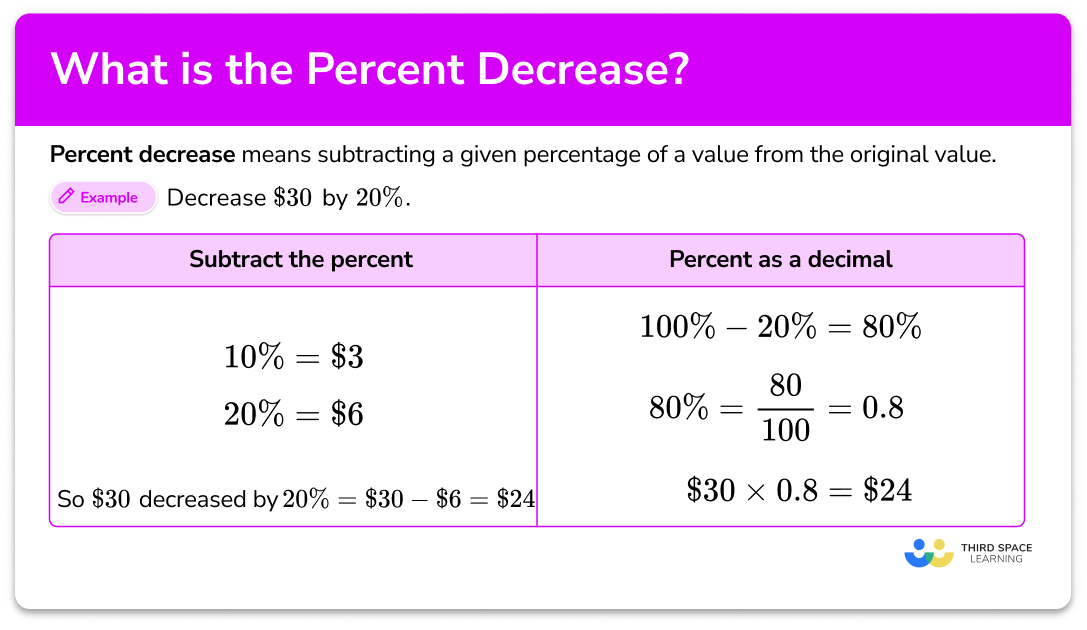
- Confusing Original and New Values: Always double-check that you’re subtracting the new (smaller) value from the original (larger) value, and that you’re dividing by the original value. Reversing these will lead to incorrect results or even calculations for percentage increase.
- Rounding Errors: Be mindful of rounding too early in the calculation, especially for very small changes, as it can skew the final percentage. It’s best to perform calculations to several decimal places and round only the final percentage.
- Ignoring Context: A percentage decrease is just a number. Always consider the context. A 50% decrease in a $10 item is different from a 50% decrease in a $1,000,000 asset. Understanding the absolute dollar amount in conjunction with the percentage provides a complete picture.
- Negative Values: The percentage decrease formula is designed for situations where the original value is positive and the new value is less than or equal to the original. If you encounter negative values (e.g., a debt becoming more negative), you might need to adjust your approach or consider the absolute values of the numbers involved.
In conclusion, the ability to calculate the percentage of a decrease is far more than a basic math skill; it’s a fundamental aspect of financial literacy and a powerful tool for informed decision-making across personal finance, investing, and business management. By understanding its formula, applying it correctly, and leveraging available tools, you gain clarity, track progress, and navigate the financial landscape with greater confidence and insight.
aViewFromTheCave is a participant in the Amazon Services LLC Associates Program, an affiliate advertising program designed to provide a means for sites to earn advertising fees by advertising and linking to Amazon.com. Amazon, the Amazon logo, AmazonSupply, and the AmazonSupply logo are trademarks of Amazon.com, Inc. or its affiliates. As an Amazon Associate we earn affiliate commissions from qualifying purchases.