
In the intricate world of finance, percentages are far more than just mathematical curiosities; they are the bedrock upon which sound financial decisions are built. From understanding the return on your investments and dissecting loan interest rates to optimizing your budget and analyzing business performance, the ability to calculate and interpret percentages is an indispensable skill. This article delves into the fundamental mechanics of percentage calculation, rigorously applying these principles to a diverse array of financial scenarios, empowering you to navigate your personal and business finances with greater clarity and confidence.
The Foundational Importance of Percentages in Financial Literacy
Financial literacy hinges on understanding the relationships between numbers, and percentages provide a universal language for expressing these relationships proportionally. Unlike raw numbers, which can vary wildly in scale, percentages offer a standardized way to compare values, gauge growth, assess risk, and allocate resources across different contexts.
Understanding the Language of Money
When we talk about inflation, interest rates, discounts, profit margins, or even the allocation of a national budget, we are invariably speaking in percentages. A 2% interest rate on a savings account immediately tells you the proportional return, regardless of the principal amount. A 15% discount signals a clear reduction in price relative to the original. This standardized expression allows for quick comparisons and informed decision-making, transcending the absolute values that might otherwise obscure the true impact of a financial event. Without a grasp of percentages, navigating even basic financial transactions becomes a formidable challenge, leaving individuals vulnerable to misinterpretations and suboptimal choices.
Everyday Financial Applications
Consider the myriad ways percentages permeate our daily financial lives: budgeting involves allocating a percentage of income to housing, food, and savings. Shopping requires calculating discounts and sales tax percentages. Loans and credit cards come with Annual Percentage Rates (APRs) that dictate the cost of borrowing. Retirement planning relies on understanding contribution percentages and expected rates of return. Business owners constantly assess profit margins as a percentage of revenue and analyze sales growth in percentage terms. The pervasive nature of percentages underscores their critical role; mastering them is not just an academic exercise but a practical necessity for anyone seeking financial autonomy and success.
Mastering the Core Percentage Formulas for Financial Acumen
At its heart, percentage calculation is a straightforward process, but its application demands precision and a clear understanding of what “part” and “whole” represent in a given financial context. All percentage calculations fundamentally revolve around the basic formula:
Percentage = (Part / Whole) × 100
Let’s break down how this core formula adapts to various financial calculations.
Basic Percentage: Part of a Whole
This is the most direct application. You want to express a component’s share of a total value as a percentage.
- Formula:
(Part / Whole) × 100 - Financial Example: Calculating the percentage of your income allocated to rent.
- If your monthly income (Whole) is $5,000 and your rent (Part) is $1,500.
- Percentage of income spent on rent = ($1,500 / $5,000) × 100 = 0.30 × 100 = 30%.
- Another Example: Determining market share.
- If Company A’s sales (Part) are $2 million in a market with total sales (Whole) of $10 million.
- Company A’s market share = ($2,000,000 / $10,000,000) × 100 = 0.20 × 100 = 20%.
Percentage of a Number: Discounts, Taxes, and Commissions
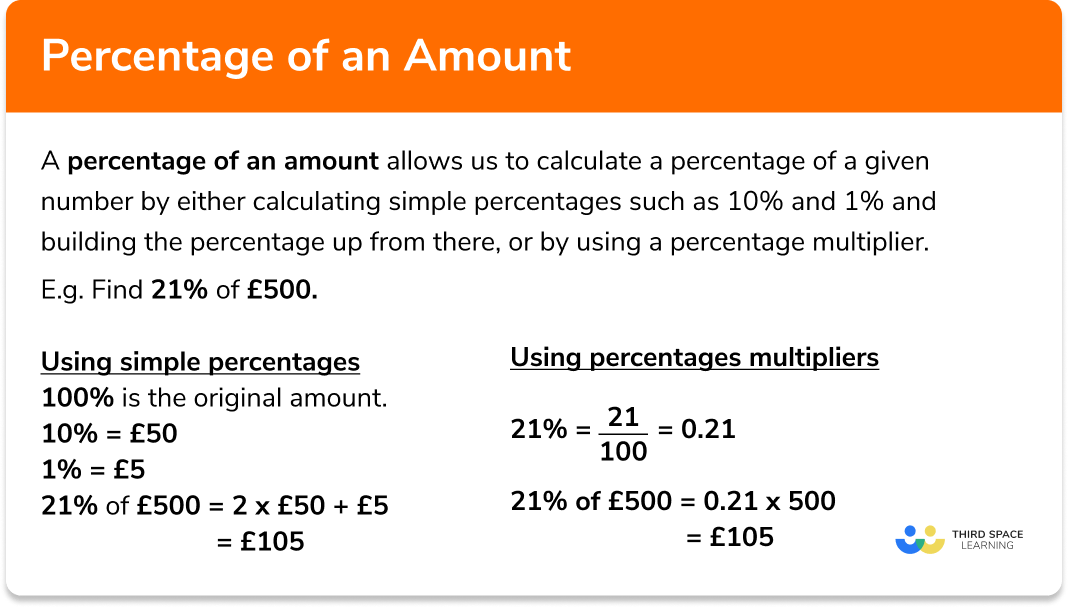
Often, you know the total amount and a percentage, and you need to find the value that percentage represents.
- Formula:
Percentage (as a decimal) × Whole- Note: To convert a percentage to a decimal, divide it by 100 (e.g., 25% = 0.25).
- Financial Example: Calculating a discount amount.
- You see an item priced at $200 (Whole) with a 25% discount.
- Discount amount = 0.25 × $200 = $50.
- Final price = $200 – $50 = $150.
- Another Example: Calculating sales tax.
- An item costs $100 (Whole), and the sales tax is 8%.
- Sales tax amount = 0.08 × $100 = $8.
- Total cost = $100 + $8 = $108.
Percentage Change: Growth, Loss, and Inflation
This calculation is crucial for tracking financial performance over time, whether it’s investment growth, sales decline, or inflation rates.
- Formula:
((New Value - Old Value) / Old Value) × 100 - Financial Example: Calculating investment growth.
- Your investment started at $10,000 (Old Value) and grew to $11,500 (New Value).
- Percentage increase = (($11,500 – $10,000) / $10,000) × 100 = ($1,500 / $10,000) × 100 = 0.15 × 100 = 15%.
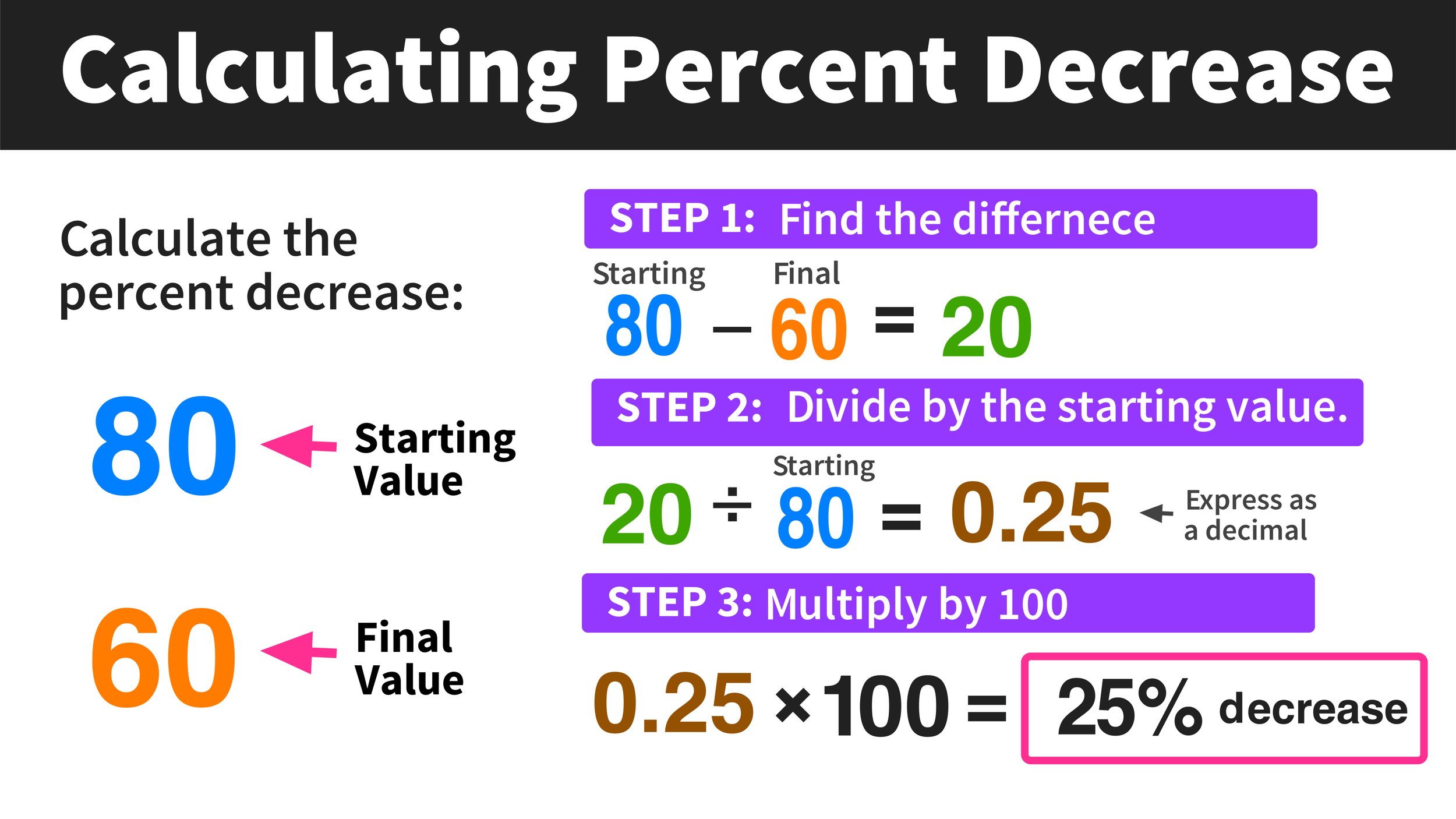
- Another Example: Calculating a sales decrease.
- A company’s quarterly sales dropped from $500,000 (Old Value) to $450,000 (New Value).
- Percentage decrease = (($450,000 – $500,000) / $500,000) × 100 = (-$50,000 / $500,000) × 100 = -0.10 × 100 = -10%. (A negative result indicates a decrease).
Finding the Original Value (Reverse Percentages): Pre-Tax Prices, Investment Baselines
Sometimes you know the final value after a percentage change (e.g., a price after tax or a value after a discount) and need to find the original amount.
- Formula (for increase):
Original Value = New Value / (1 + Percentage Increase as a decimal) - Formula (for decrease):
Original Value = New Value / (1 - Percentage Decrease as a decimal) - Financial Example (increase): Finding a pre-tax price.
- You bought an item for $108 (New Value), including 8% sales tax.
- Original price = $108 / (1 + 0.08) = $108 / 1.08 = $100.
- Financial Example (decrease): Finding the original price before a discount.
- You paid $150 (New Value) for an item after a 25% discount.
- Original price = $150 / (1 – 0.25) = $150 / 0.75 = $200.
Practical Applications of Percentages in Personal Finance
A firm grasp of percentage calculations translates directly into smarter personal financial management. These skills empower individuals to make informed decisions about their earnings, spending, saving, and borrowing.
Budgeting and Saving Goals
Budgeting is fundamentally an exercise in percentage allocation. The widely popular 50/30/20 rule, for instance, suggests dedicating 50% of your income to needs, 30% to wants, and 20% to savings and debt repayment. To apply this, you must be able to calculate these percentages accurately. Similarly, setting savings goals often involves determining what percentage of each paycheck needs to be set aside to reach a target amount within a specific timeframe. Understanding these percentages allows for realistic planning and tracking of progress towards financial milestones like a down payment on a house, a child’s education fund, or retirement.
Understanding Loan Interest and APR
One of the most critical applications of percentages in personal finance is understanding the cost of borrowing. Loan interest rates, expressed as percentages, determine how much extra you’ll pay on top of the principal. The Annual Percentage Rate (APR) provides a more comprehensive view, including not just the interest rate but also other fees associated with the loan, annualized for comparison. Calculating the interest portion of a loan payment, understanding how compound interest works on credit card debt, or comparing different mortgage offers based on their APRs are all percentage-driven tasks essential for avoiding excessive debt and securing favorable borrowing terms.
Calculating Investment Returns (ROI)
For investors, the percentage return on investment (ROI) is the ultimate metric for success. Whether evaluating stocks, bonds, mutual funds, or real estate, ROI allows investors to compare the profitability of different assets. The percentage change formula is directly applicable here, helping you understand how much your portfolio has grown or declined. Beyond simple growth, metrics like annualized returns, dividend yields, and expense ratios (expressed as percentages) are vital for assessing an investment’s true performance and its cost-effectiveness, enabling strategic portfolio adjustments.
Analyzing Discounts and Sales Tax
Every shopping trip involves percentages. Discounts, whether 10% off or a “buy one, get one 50% off” deal, require percentage calculations to determine the actual savings. Sales tax, added as a percentage of the purchase price, impacts the final cost. Being able to quickly calculate these amounts ensures you know the true price you’ll pay and can accurately compare deals, preventing overspending and making the most of sales. This seemingly simple application directly contributes to better consumer spending habits.
Leveraging Percentages for Business and Investment Insights
Beyond personal finances, percentages form the backbone of sound business analysis and strategic investment decisions. They provide a common language for comparing performance, assessing health, and identifying opportunities or risks.
Profit Margins and Markup
For any business, understanding profit margins is paramount. Gross profit margin (Gross Profit / Revenue × 100) indicates how efficiently a company produces its goods or services, while net profit margin (Net Income / Revenue × 100) reveals the overall profitability after all expenses. Markup, often expressed as a percentage, is the amount added to the cost of a product to determine its selling price. Accurately calculating and analyzing these percentages allows businesses to set competitive prices, manage costs, and evaluate their financial viability, directly impacting their bottom line.
Sales Growth and Market Share Analysis
Businesses constantly track sales growth in percentage terms to gauge their expansion and identify trends. A year-over-year sales increase of 10% tells a different story than a 2% increase or a 5% decline. Similarly, market share—a company’s sales as a percentage of total industry sales—is a key indicator of competitive position and industry dominance. These percentage-based metrics are vital for strategic planning, resource allocation, and attracting investors who scrutinize growth potential and market positioning.
Risk Assessment and Portfolio Diversification
In investment, percentages are critical tools for risk management. For instance, understanding the percentage allocation of assets in a portfolio (e.g., 60% stocks, 30% bonds, 10% cash) is fundamental to diversification, which aims to mitigate risk by spreading investments across different asset classes. Investors also use percentages to assess the volatility of an asset (how much its price fluctuates) and its potential downside. For businesses, percentages are used in credit risk assessment, evaluating the likelihood of customers defaulting on payments, or assessing the percentage of debt relative to equity.
Tools and Best Practices for Accurate Percentage Calculations
While the underlying formulas are simple, ensuring accuracy in financial percentage calculations is crucial. Modern tools and careful practices can significantly reduce errors and enhance efficiency.
Financial Calculators and Spreadsheets
For quick, everyday calculations, a basic calculator with a percentage function is invaluable. For more complex or recurring financial analyses, spreadsheets like Microsoft Excel or Google Sheets are indispensable. They allow you to set up formulas once and apply them to vast datasets, automating calculations and providing instant updates when numbers change. Functions like PERCENTAGE, RATE, PV, FV, PMT, and NPER are specifically designed for financial calculations, making it easier to determine things like loan payments, future values of investments, or required savings rates. Learning basic spreadsheet functions can significantly boost your financial analytical capabilities.
Avoiding Common Pitfalls
Even seasoned professionals can make simple errors. A common pitfall is incorrectly converting percentages to decimals—always remember to divide by 100 (e.g., 5% is 0.05, not 0.5). Another mistake is misidentifying the “whole” or “old value” in percentage change calculations, leading to an incorrect base for comparison. Always double-check your inputs and understand what each number represents within the context of the formula. For sequential percentage changes (e.g., a 10% increase followed by a 10% decrease), remember that you cannot simply add or subtract the percentages; you must apply them sequentially to the current value.

Developing Your Financial Intuition
Beyond rote calculation, developing a strong financial intuition is about understanding what a percentage means in a given situation. This comes from consistent practice and an eagerness to apply percentage thinking to every financial interaction. Ask yourself: “What percentage of my income is this expense?” “What percentage return do I need to reach my goal?” “How does this discount percentage compare to others?” Over time, you’ll develop a quick mental estimation ability, allowing you to spot anomalies, identify good deals, and make faster, more confident financial decisions, all underpinned by a deep-seated understanding of proportional relationships.
In conclusion, the ability to calculate percentages is not merely a mathematical skill but a vital component of financial literacy. By mastering the core formulas and applying them diligently across personal and business finance, you gain an indispensable tool for informed decision-making, strategic planning, and ultimately, achieving your financial goals.
aViewFromTheCave is a participant in the Amazon Services LLC Associates Program, an affiliate advertising program designed to provide a means for sites to earn advertising fees by advertising and linking to Amazon.com. Amazon, the Amazon logo, AmazonSupply, and the AmazonSupply logo are trademarks of Amazon.com, Inc. or its affiliates. As an Amazon Associate we earn affiliate commissions from qualifying purchases.