
In the intricate world of finance, percentages are far more than just mathematical curiosities; they are the universal language that translates complex financial data into digestible, comparable, and actionable insights. From tracking personal spending and calculating investment returns to analyzing market trends and understanding tax implications, a firm grasp of how to “get percentages” isn’t merely advantageous—it’s absolutely essential. This guide will demystify percentages, providing you with the knowledge and tools to confidently navigate your financial journey, whether you’re a budding investor, a meticulous budgeter, or a seasoned business owner.
The Foundational Role of Percentages in Finance
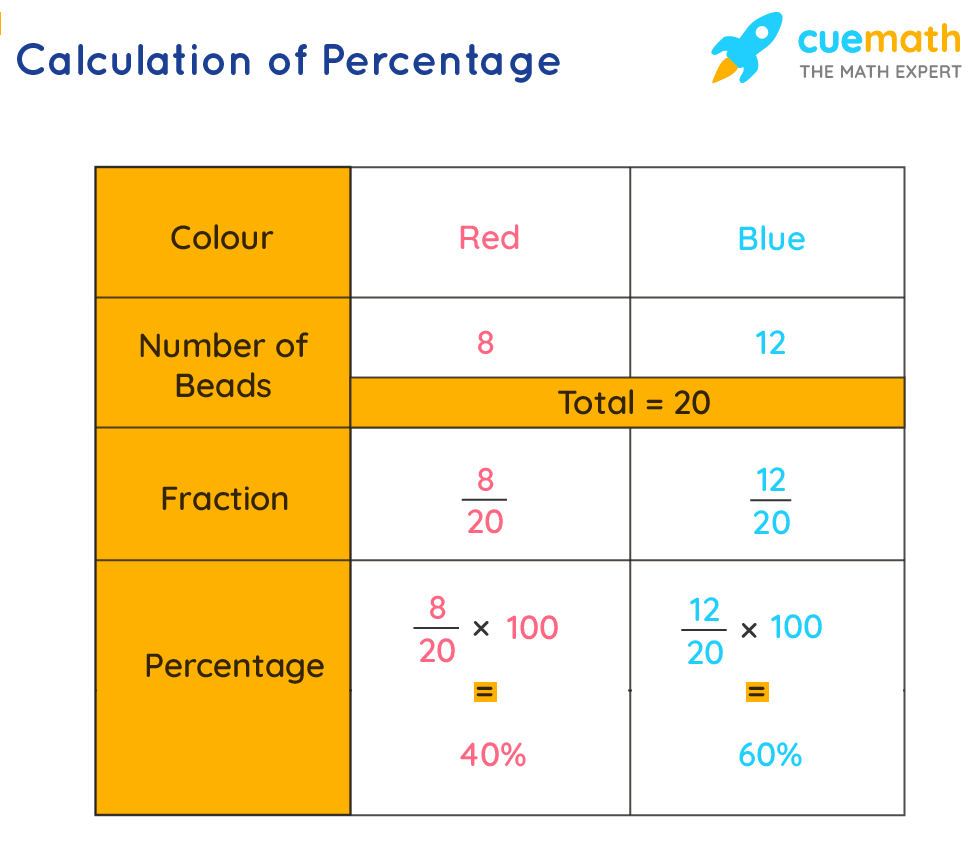
At its core, a percentage is simply a way of expressing a number as a fraction of 100. The term “percent” derives from the Latin “per centum,” meaning “by the hundred.” This standardized representation makes percentages an invaluable tool for comparison and analysis, particularly in financial contexts where diverse figures need to be understood in relation to a whole or against each other.
Defining Percentages: More Than Just a Number
Imagine trying to compare the performance of two different investments. One returned $500 on an initial investment of $5,000, while another returned $1,200 on an initial investment of $20,000. Without percentages, simply looking at the raw dollar amounts ($500 vs. $1,200) can be misleading. However, when we express these as percentages (10% and 6% respectively), the true comparative performance becomes immediately clear. This ability to normalize data is what makes percentages indispensable.
Why Percentages Matter in Your Financial Life
From the moment you earn your first paycheck to planning for retirement, percentages are omnipresent:
- Personal Finance: Budgeting your income and expenses, understanding loan interest rates, calculating savings growth, and analyzing credit card APRs.
- Investing: Gauging return on investment (ROI), tracking portfolio performance, understanding dividend yields, and evaluating stock price changes.
- Business Finance: Determining profit margins, calculating sales growth, analyzing market share, managing discounts, and assessing operational efficiency.
- Economic Analysis: Interpreting inflation rates, unemployment figures, GDP growth, and interest rate adjustments by central banks.
Without the ability to correctly calculate and interpret percentages, individuals and businesses alike would struggle to make informed decisions, identify opportunities, or mitigate risks. They provide context, clarity, and comparability, transforming raw data into meaningful financial intelligence.
Mastering Core Percentage Calculations for Financial Acumen
Understanding the fundamental methods of percentage calculation is the bedrock of financial literacy. While calculators and software simplify the process, knowing the underlying mechanics empowers you to verify results and apply these principles across various financial scenarios.
Calculating a Percentage of a Number
This is perhaps the most common percentage calculation you’ll encounter. It answers questions like: “What is 15% of my $3,000 salary?” or “How much is a 20% discount on a $250 item?”
Formula: Percentage (as a decimal) x Whole Number
To convert a percentage to a decimal, divide it by 100 (or move the decimal point two places to the left).
- Example 1: Discount
- Item price: $250
- Discount: 20%
- Discount amount: 0.20 * $250 = $50
- Final price: $250 – $50 = $200
- Example 2: Sales Tax
- Purchase price: $100
- Sales tax rate: 7%
- Tax amount: 0.07 * $100 = $7
- Total cost: $100 + $7 = $107
Finding the Whole from a Part and a Percentage
Sometimes, you know a part of a number and what percentage it represents, and you need to find the original whole. This is useful when you know the discount amount and the discount percentage, and want to find the original price, or if you know how much a commission was and the commission rate, to find the total sales.
Formula: Part / Percentage (as a decimal)
- Example 1: Original Price
- You received a $30 discount, which was 15% off the original price.
- Original price: $30 / 0.15 = $200
- Example 2: Total Sales from Commission
- Your commission was $500, and your commission rate is 10%.
- Total sales: $500 / 0.10 = $5,000
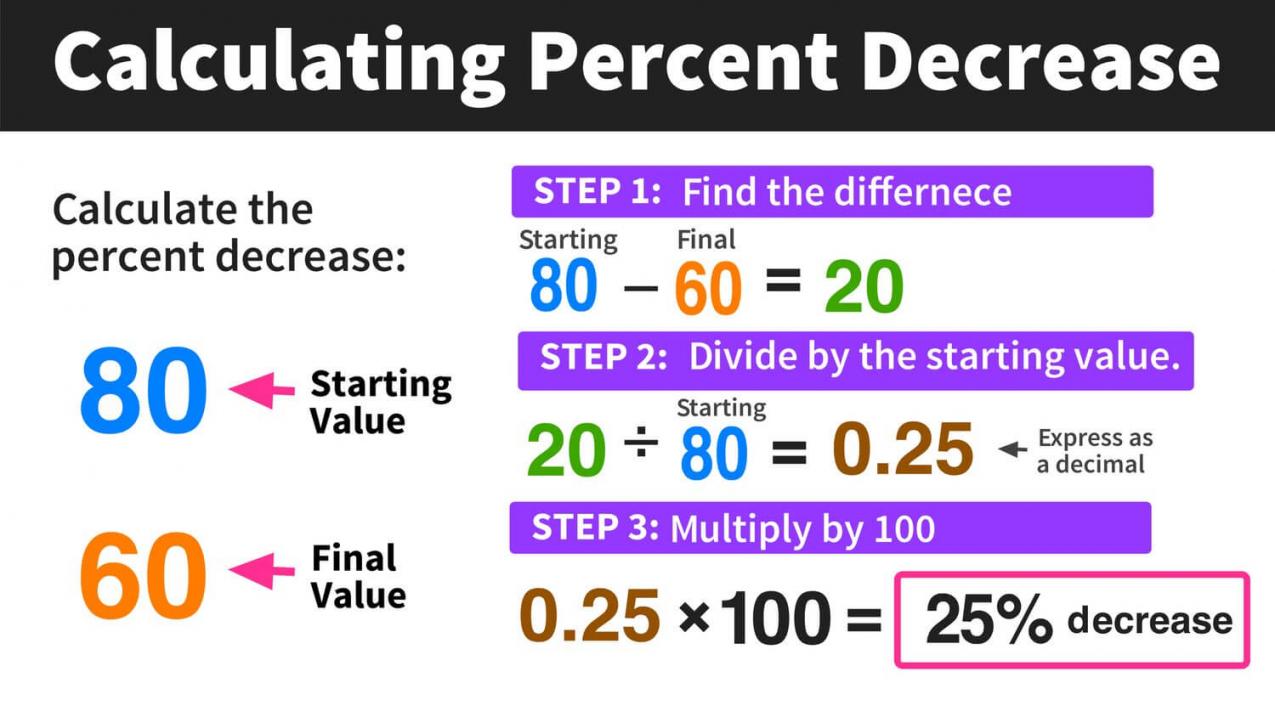
Understanding Percentage Change (Increase/Decrease)
Percentage change is crucial for analyzing growth, decline, and performance over time. It tells you how much something has increased or decreased relative to its initial value.
Formula: ((New Value - Old Value) / Old Value) x 100
- Example 1: Investment Growth
- Initial investment: $10,000
- Current value: $12,500
- Percentage increase: ((12,500 – 10,000) / 10,000) * 100 = (2,500 / 10,000) * 100 = 0.25 * 100 = 25%
- Example 2: Expense Reduction
- Last month’s utility bill: $150
- This month’s utility bill: $120
- Percentage decrease: ((120 – 150) / 150) * 100 = (-30 / 150) * 100 = -0.20 * 100 = -20% (a 20% decrease)
Real-World Financial Applications of Percentages
Once you’ve mastered the basic calculations, you’ll find percentages applied in virtually every corner of the financial landscape. Understanding these specific applications deepens your financial intelligence and enables better decision-making.
Discounts and Savings
Every time you see a “25% Off” sign, you’re dealing with percentages. Knowing how to calculate the actual savings and the final price allows you to budget effectively and identify true value. This also extends to early payment discounts offered by suppliers in business.
Interest Rates (Simple vs. Compound)
Interest rates are perhaps the most pervasive financial application of percentages.
- Simple Interest: Calculated only on the principal amount.
Principal x Rate x Time. - Compound Interest: The “eighth wonder of the world,” where interest is calculated on the initial principal and also on the accumulated interest from previous periods. This is how investments grow significantly over time and how debt can spiral. Understanding the power of compound interest (and how to calculate it using percentages) is critical for wealth creation and debt management.
Investment Returns (ROI)
The return on investment (ROI) is a performance measure used to evaluate the efficiency of an investment or compare the efficiency of several different investments. ROI = ((Net Profit / Cost of Investment) x 100). This metric, expressed as a percentage, helps investors determine which investments are worth pursuing and how well their existing portfolios are performing.
Budgeting and Expense Analysis
Percentages are invaluable for creating and maintaining a personal or business budget. You might allocate a certain percentage of your income to housing, another to savings, and another to discretionary spending. This allows for flexible budgeting regardless of income fluctuations and provides a clear picture of where your money is going relative to your total income. For businesses, expense percentages against revenue help identify areas for cost control.
Profit Margins and Business Growth
Businesses use percentages to measure profitability and growth.
- Gross Profit Margin:
((Revenue - Cost of Goods Sold) / Revenue) x 100. - Net Profit Margin:
((Net Income / Revenue) x 100).
These percentages indicate how much profit a company makes for every dollar of sales. Tracking percentage growth in sales, customer acquisition, or market share provides vital insights into a company’s health and trajectory.
Taxation and Deductions
Tax rates are almost always expressed as percentages. Understanding how these percentages apply to different income brackets, sales, or assets allows for accurate tax planning and ensures compliance. Deductions, also often percentage-based, can significantly impact your final tax liability.
Leveraging Tools for Precision and Efficiency
While mental math can be useful for quick estimates, financial decisions often require precision. Fortunately, various tools can help you calculate percentages quickly and accurately.
The Power of Spreadsheets
Microsoft Excel, Google Sheets, and similar spreadsheet programs are incredibly powerful for financial calculations. They allow you to set up complex formulas once and apply them to vast datasets. For example, you can create a budget spreadsheet that automatically calculates percentage allocations of your income or track investment performance with dynamic ROI percentages that update as values change.
Using Financial Calculators
Dedicated financial calculators (both physical and online versions) are designed to handle complex percentage-based calculations, especially those involving time value of money, such as compound interest, loan amortizations, and future value projections. Apps on smartphones also provide accessible tools for quick calculations.
Quick Mental Math Techniques
For everyday scenarios, developing some mental math shortcuts can be incredibly useful.
- Finding 10%: Move the decimal one place to the left (e.g., 10% of $500 is $50).
- Finding 5%: Find 10% and divide by two (e.g., 5% of $500 is $25).
- Finding 1%: Move the decimal two places to the left (e.g., 1% of $500 is $5).
These techniques allow for rapid estimations of discounts, tips, or quick budget checks without needing a device.
Avoiding Common Percentage Pitfalls in Financial Decisions
Even with a solid understanding, percentages can sometimes be misinterpreted, leading to flawed financial decisions. Awareness of these common pitfalls is key to avoiding costly mistakes.
The Base Value Trap
A common mistake is to change the base value for successive percentage calculations without realizing it. For example, if an investment loses 10% one year and gains 10% the next, it does not break even.
- Initial Investment: $100
- Loss of 10%: $100 – (0.10 * $100) = $90
- Gain of 10% (on new base): $90 + (0.10 * $90) = $90 + $9 = $99
The final value is $99, not $100. Always be mindful of the base from which a percentage is being calculated.
Confusing Percentage Points with Percentage Change
This is a critical distinction, especially in discussions about interest rates or market share.
- Percentage Change: Expresses the proportional change relative to the original value.
- Percentage Points: Refers to the absolute difference between two percentages.
If an interest rate increases from 5% to 7%, it’s an increase of 2 percentage points. However, it’s a((7-5)/5)*100 = 40%percentage increase in the interest rate itself. Misunderstanding this can lead to vastly different perceptions of financial impact.
Misinterpreting Annualized vs. Actual Returns
Investment returns are often quoted as “annualized” percentages, meaning the average yearly return over a period. However, this doesn’t mean you earned that exact percentage each year, nor does it necessarily reflect your actual return if you invested for a period shorter or longer than a full year, especially if contributions or withdrawals were made. Always ensure you understand the period over which a percentage return is calculated and whether it represents an average or an actual return on your specific investment timeline.

Conclusion
Percentages are the bedrock of financial understanding, transforming raw numbers into meaningful insights that drive informed decisions. From managing your daily budget and optimizing investments to analyzing business performance and navigating tax implications, the ability to correctly “get percentages” is an indispensable skill. By mastering the core calculations, understanding their diverse applications in finance, leveraging efficient tools, and being aware of common pitfalls, you equip yourself with the financial acumen necessary to achieve your monetary goals and secure your financial future. Embrace the power of percentages, and watch your financial clarity grow.
aViewFromTheCave is a participant in the Amazon Services LLC Associates Program, an affiliate advertising program designed to provide a means for sites to earn advertising fees by advertising and linking to Amazon.com. Amazon, the Amazon logo, AmazonSupply, and the AmazonSupply logo are trademarks of Amazon.com, Inc. or its affiliates. As an Amazon Associate we earn affiliate commissions from qualifying purchases.