
In the intricate world of finance, numbers speak volumes, but their true meaning often comes alive through percentages. From understanding the discount on a new purchase to dissecting the interest rate on a loan, or evaluating the return on an investment, percentages are the universal language that helps us contextualize figures and make informed decisions. Far from being a mere academic exercise, calculating the percentage of a number is a vital financial skill, empowering individuals and businesses alike to navigate their monetary landscapes with precision and confidence.
This comprehensive guide will demystify percentage calculations, breaking down the core concepts and illustrating their myriad applications across personal finance, investing, and business operations. By the end, you’ll not only know how to calculate a percentage but also why it’s such a critical tool in your financial arsenal.
The Fundamental Formula: Understanding the Core Mechanics
At its heart, a percentage represents a portion of a whole, expressed as a fraction of 100. The term “percent” literally means “per hundred.” This foundational understanding is the key to unlocking all other percentage-related calculations.
What is a Percentage, Really?
Imagine a pie cut into 100 slices. If you take 25 slices, you have 25 out of 100, or 25%. If you spent $30 out of your $100 budget, you spent 30% of your budget. It’s a standardized way to compare parts to a whole, regardless of the actual size of the whole. This standardization makes percentages incredibly powerful for comparative analysis in finance—for example, comparing profit margins across companies of different sizes.
The Core Calculation: Unveiling the Formula
The most basic formula for calculating a percentage is straightforward:
Percentage = (Part / Whole) × 100
Let’s break this down with a financial example:
Suppose you have a total budget of $2,000 for the month (Whole). You spent $500 on groceries (Part).
To find out what percentage of your budget went to groceries:
- Step 1: Divide the Part by the Whole: $500 / $2,000 = 0.25
- Step 2: Multiply by 100 to express as a percentage: 0.25 × 100 = 25%
So, 25% of your monthly budget was allocated to groceries. This simple calculation forms the basis for nearly every financial application of percentages.
Converting Decimals to Percentages and Vice Versa
Understanding the relationship between decimals and percentages is crucial for swift calculations, especially when using calculators or spreadsheets.
- Decimal to Percentage: Simply multiply the decimal by 100.
- Example: An interest rate of 0.05 (decimal) is 0.05 × 100 = 5%.
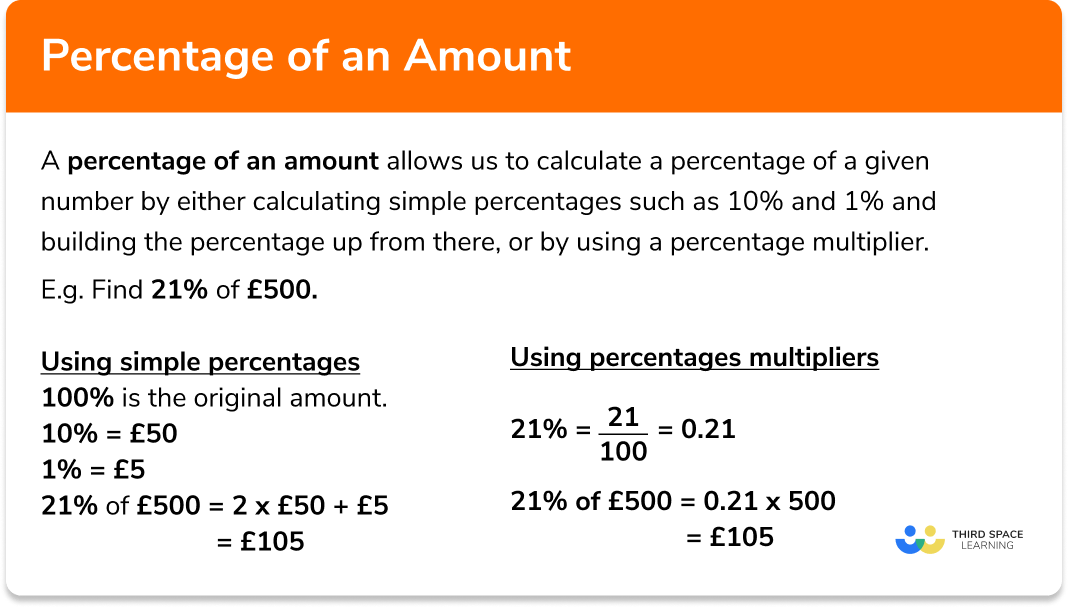
- Percentage to Decimal: Divide the percentage by 100.
- Example: A 20% discount needs to be entered as 20 / 100 = 0.20 in a calculation. If an item costs $100, a 20% discount means you pay $100 * (1 – 0.20) = $80.
This conversion skill is fundamental for working with financial formulas where percentages are often input as decimals.
Practical Applications in Personal Finance
Percentages are not abstract mathematical concepts; they are the bedrock of sound personal financial management. From daily spending to long-term savings, understanding how to apply percentage calculations is key to making your money work smarter.
Calculating Discounts and Sales Tax
One of the most common encounters with percentages is during shopping. Knowing how to calculate discounts and sales tax ensures you understand the true cost of an item.
- Discounts: If an item costs $150 and has a 20% discount:
- Discount amount = $150 × (20 / 100) = $150 × 0.20 = $30
- Final price = $150 – $30 = $120
- Sales Tax: If an item costs $120 and the sales tax is 7%:
- Tax amount = $120 × (7 / 100) = $120 × 0.07 = $8.40
- Total cost = $120 + $8.40 = $128.40
Being able to perform these calculations quickly helps you budget accurately and identify genuine savings.
Understanding Interest Rates: Savings, Loans, and Credit Cards
Interest rates are percentages that determine the cost of borrowing money or the return on saving it.
- Savings Account Interest: If you have $1,000 in a savings account with a 2% annual interest rate, after one year you’d earn:
- Interest = $1,000 × 0.02 = $20
- New balance = $1,000 + $20 = $1,020
- Loan Interest: For a $10,000 loan with a 5% annual interest rate, the annual interest payment (assuming simple interest) would be:
- Interest = $10,000 × 0.05 = $500
Understanding the exact percentage allows you to compare different financial products and choose the most advantageous options.
Budgeting and Expense Tracking
Effective budgeting relies heavily on percentages to allocate income and track spending.
- Allocating Income: The popular 50/30/20 rule (50% needs, 30% wants, 20% savings/debt) is a prime example. If your monthly income is $4,000 after tax:
- Needs = $4,000 × 0.50 = $2,000
- Wants = $4,000 × 0.30 = $1,200
- Savings/Debt = $4,000 × 0.20 = $800
- Tracking Expenses: By calculating the percentage of your income spent on various categories (e.g., 20% on housing, 15% on food), you gain a clear picture of your financial habits and can identify areas for adjustment.
Investment Returns and Growth
For investors, percentages are indispensable for measuring performance and growth.
- Return on Investment (ROI): If you invested $5,000 and it grew to $5,500:
- Gain = $5,500 – $5,000 = $500
- ROI = ($500 / $5,000) × 100 = 10%
- Portfolio Allocation: Managing risk often involves allocating your investments across different asset classes (e.g., 60% stocks, 40% bonds). These are typically expressed as percentages.
Mastering Percentage Changes: Increases and Decreases
Beyond calculating a simple part of a whole, percentages are crucial for understanding how values change over time—a common occurrence in economics and personal finance.

Calculating Percentage Increase
A percentage increase tells you how much a value has grown relative to its original amount.
Percentage Increase = ((New Value – Old Value) / Old Value) × 100
- Example: Salary Raise: Your old salary was $50,000. Your new salary is $53,000.
- Increase = ($53,000 – $50,000) / $50,000 = $3,000 / $50,000 = 0.06
- Percentage Increase = 0.06 × 100 = 6%
Calculating Percentage Decrease
Conversely, a percentage decrease shows how much a value has fallen relative to its original amount.
Percentage Decrease = ((Old Value – New Value) / Old Value) × 100
- Example: Stock Price Drop: A stock was valued at $100 and dropped to $90.
- Decrease = ($100 – $90) / $100 = $10 / $100 = 0.10
- Percentage Decrease = 0.10 × 100 = 10%
Real-World Scenarios: Inflation, Salary Raises, Market Fluctuations
These calculations are vital for interpreting financial news and personal financial planning:
- Inflation: If the cost of living increases by 3% annually, your purchasing power diminishes unless your income increases by at least that much.
- Investment Performance: Tracking monthly or annual percentage changes in your investment portfolio helps you assess performance and make adjustments.
- Business Growth: Companies use percentage growth rates in sales, profits, and market share to evaluate their success and project future performance.
Advanced Financial Scenarios Requiring Percentage Acumen
While the basics are fundamental, percentages play an increasingly sophisticated role in more complex financial planning and analysis.
Loan Repayments and Amortization
Understanding the interest portion of your loan payments is a complex percentage application. Amortization schedules break down how much of each payment goes towards interest (a percentage of the outstanding principal) versus the principal itself. A higher interest percentage means more of your early payments go to the lender, highlighting the importance of securing lower rates.
Tax Calculations and Deductions
Taxes are inherently percentage-based. Income tax brackets, effective tax rates, and tax deductions all involve percentage calculations.
- Marginal Tax Rates: You pay different percentages of your income based on which bracket it falls into.
- Effective Tax Rate: This is the total tax paid as a percentage of your total income, a critical figure for overall financial planning.
- Deductions and Credits: These reduce your taxable income or your tax liability, and their impact is often understood best in percentage terms relative to your overall tax burden.
Analyzing Financial Statements (Briefly)
While delving deep into business finance is beyond this scope, it’s worth noting that financial ratios derived from statements (e.g., profit margins, debt-to-equity ratios) are expressed as percentages. These percentages allow investors and analysts to gauge a company’s health, profitability, and risk, regardless of its absolute size.
Compound Interest and Future Value: The Power of Compounding
Perhaps one of the most powerful financial concepts involving percentages is compound interest. This is when interest earned is added to the principal, and then the next period’s interest is calculated on this new, larger principal.
- Formula (Simplified): A = P (1 + r/n)^(nt)
- Where A = final amount, P = principal, r = annual interest rate (as a decimal), n = number of times interest is compounded per year, t = number of years.
- Example: $1,000 at 5% interest compounded annually for 10 years.
- Year 1: $1,000 * 1.05 = $1,050
- Year 2: $1,050 * 1.05 = $1,102.50
- …and so on.
The percentage growth accelerates over time, demonstrating how small percentage gains, when compounded, can lead to substantial wealth accumulation over the long term.
Tools and Resources for Effortless Calculation
While understanding the manual calculations is crucial, modern financial life offers numerous tools to make percentage calculations effortless and error-free.
Everyday Calculators
Your smartphone’s calculator, a basic scientific calculator, or even the calculator widget on your computer can handle all fundamental percentage calculations. Just remember the order of operations and how to convert percentages to decimals.
Spreadsheet Software (Excel, Google Sheets)
For managing budgets, tracking investments, or performing complex financial analysis, spreadsheet software like Microsoft Excel or Google Sheets is invaluable. They allow you to set up formulas once and apply them to vast datasets, making recalculations instant.
- To calculate 20% of a number in Excel:
=A1*0.20(if the number is in cell A1) - To calculate a percentage increase:
=(B1-A1)/A1(if old value is A1, new is B1)
Online Percentage Calculators
Numerous websites offer free, easy-to-use percentage calculators. These are great for quick checks or when you need a specific type of percentage calculation (e.g., reverse percentage to find the original number after a discount).
Financial Calculators and Apps
For more specialized tasks, such as loan amortization, mortgage calculations, or future value projections with compound interest, dedicated financial calculators (like the HP 12c or specialized apps) are highly beneficial. They often have built-in functions for complex percentage-based scenarios, saving you time and reducing the risk of manual errors.

Conclusion: Your Financial Empowerment Through Percentages
Mastering the calculation of percentages is far more than a mathematical exercise; it’s a cornerstone of financial literacy. From the moment you compare prices at a store to the long-term planning of your retirement, percentages provide clarity, enable comparison, and empower you to make intelligent financial decisions.
By understanding the fundamental formula, applying it to real-world financial scenarios, and leveraging available tools, you transform complex financial figures into actionable insights. This skill will not only enhance your personal wealth management but also equip you to better understand economic trends, investment opportunities, and the financial health of businesses. Embrace the power of percentages, and unlock a more confident and competent financial future.
aViewFromTheCave is a participant in the Amazon Services LLC Associates Program, an affiliate advertising program designed to provide a means for sites to earn advertising fees by advertising and linking to Amazon.com. Amazon, the Amazon logo, AmazonSupply, and the AmazonSupply logo are trademarks of Amazon.com, Inc. or its affiliates. As an Amazon Associate we earn affiliate commissions from qualifying purchases.