
For anyone looking to step into the dynamic world of financial markets, understanding when trading starts—and stops—is fundamental. It’s not a single answer but a complex tapestry woven across different asset classes, geographical locations, and market structures. While the image of bustling trading floors might conjure fixed opening and closing bells, the reality in today’s digital age is far more nuanced, offering opportunities around the clock depending on what you trade and where you are. This guide delves into the specifics, helping both novice and seasoned investors navigate the intricate timelines of global financial markets.
Understanding trading hours is not merely about knowing when to place an order; it’s about grasping the rhythm of the market, identifying periods of high liquidity and volatility, and aligning your trading strategy with market realities. From traditional stock exchanges operating within defined business hours to the ceaseless hum of cryptocurrency markets, each segment presents its unique schedule and implications for participants.
The Clockwork of Traditional Stock Markets: A Deeper Dive
Traditional stock exchanges, such as the New York Stock Exchange (NYSE) and NASDAQ, operate on a more structured schedule, largely adhering to conventional business hours. However, the concept of “trading hours” extends beyond the main session to include pre-market and after-hours activities, which offer distinct opportunities and challenges.
Regular Trading Sessions: The Core Hours
In the United States, the primary trading session for equities on the NYSE and NASDAQ runs from 9:30 AM to 4:00 PM Eastern Time (ET), Monday through Friday. These are the hours when the majority of trading volume occurs, characterized by high liquidity and generally tighter bid-ask spreads. This consistency provides a predictable environment for most investors and institutions. The opening bell often sees increased volatility as overnight news is digested, and the closing bell can also be quite active as traders make last-minute adjustments or attempt to fulfill orders before the market closes.
Outside the U.S., major exchanges follow similar patterns, aligning with their local time zones and business days. For instance, the London Stock Exchange (LSE) operates from 8:00 AM to 4:30 PM GMT, while the Tokyo Stock Exchange (TSE) typically runs from 9:00 AM to 11:30 AM and 12:30 PM to 3:00 PM JST (with a lunch break). Each exchange’s operating hours are critical for traders focusing on specific regional markets.
Pre-Market Trading: Getting an Early Start
Before the official opening bell, there’s a window for pre-market trading, typically starting as early as 4:00 AM ET for U.S. markets and extending until the 9:30 AM ET open. During this period, investors can place orders for stocks that will be executed before the regular session begins. Pre-market trading is primarily facilitated by electronic communication networks (ECNs) rather than the traditional exchange floor.
The key characteristics of pre-market trading include:
- Lower Volume and Liquidity: Fewer participants mean lower trading volume compared to regular hours, which can lead to wider bid-ask spreads.
- Increased Volatility: News releases, earnings reports, or significant global market movements occurring overnight can trigger substantial price swings in individual stocks during pre-market.
- Institutional Dominance: Historically, pre-market trading was more prevalent among institutional investors, but retail access has become increasingly common through online brokers.
While pre-market trading offers the advantage of reacting quickly to news, the reduced liquidity and higher volatility also present increased risks.
After-Hours Trading: Extending the Day
Similarly, after-hours trading extends the trading day beyond the 4:00 PM ET close, often running until 8:00 PM ET or even later, depending on the brokerage and ECNs used. Like pre-market trading, this session is characterized by lower liquidity and potentially higher volatility. After-hours trading allows investors to react to company announcements, economic data, or global events that occur after the regular market closes.
Key aspects of after-hours trading:
- Post-Market News Impact: Many companies release earnings reports or significant news after the market closes, making after-hours trading crucial for price discovery related to these announcements.
- Limited Order Types: Certain advanced order types might not be available or function differently during extended hours.
- Risk of Price Disparity: Due to lower liquidity, prices can move sharply on relatively small volumes, and the prices seen after hours may not accurately reflect the stock’s opening price the next day.
Both pre-market and after-hours trading require a heightened awareness of risk due to their unique market dynamics.
Weekends and Holidays: When the Markets Rest
Stock markets observe weekends and a number of national holidays throughout the year. On these days, the primary exchanges are closed, and no regular trading occurs. Major U.S. holidays include New Year’s Day, Martin Luther King, Jr. Day, Presidents’ Day, Good Friday, Memorial Day, Juneteenth, Independence Day, Labor Day, Thanksgiving Day, and Christmas Day. It’s crucial for traders to be aware of these closures, as they can impact market sentiment and lead to gaps in price action when markets reopen. Some holidays may also see early closures.
The 24/5 Rhythm of Global and Forex Markets
While stock exchanges take breaks, certain markets operate almost continuously, leveraging the staggered business hours across different time zones.
The Always-On Forex Market (FX)
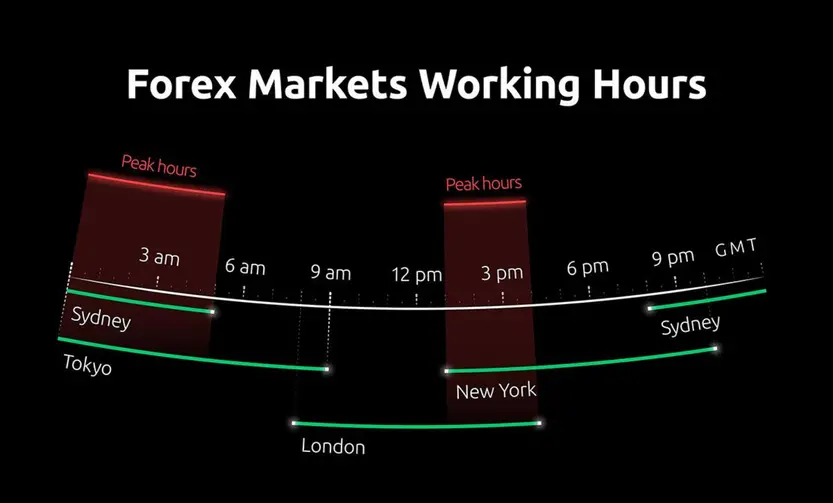
The foreign exchange (Forex or FX) market is the epitome of continuous trading. It operates 24 hours a day, five days a week, from Sunday evening ET to Friday afternoon ET. This ceaseless activity is possible because the market is decentralized and global, flowing from one major financial center to another as business hours overlap around the world.
The trading day in Forex typically begins with the opening of the Asian session (e.g., Tokyo), followed by the European session (e.g., London), and then the North American session (e.g., New York). The most liquid periods occur when these major sessions overlap, for example, when the London and New York markets are both open (roughly 8:00 AM to 12:00 PM ET). These overlap periods often present the best opportunities for active traders due to increased liquidity and tighter spreads.
The 24/5 nature of Forex means traders can react to news and economic data releases almost immediately, regardless of their local time zone. However, it also demands robust risk management strategies, as market events can unfold at any hour.
Global Stock Exchange Overlaps
While individual stock exchanges have fixed hours, the collective global equity market offers a near-continuous trading experience if you consider all major exchanges. An investor could, theoretically, trade during Tokyo hours, then transition to London, and finally to New York, following the sun across the financial world. However, directly trading on foreign exchanges typically involves specific international brokerage accounts and a deep understanding of local market regulations and currencies.

Key global exchanges and their approximate local trading hours:
- Tokyo Stock Exchange (TSE): 9:00 AM – 11:30 AM & 12:30 PM – 3:00 PM JST
- London Stock Exchange (LSE): 8:00 AM – 4:30 PM GMT
- Frankfurt Stock Exchange (FWB): 8:00 AM – 10:00 PM CET (Xetra system)
- Shanghai Stock Exchange (SSE): 9:30 AM – 11:30 AM & 1:00 PM – 3:00 PM CST
- Australian Securities Exchange (ASX): 10:00 AM – 4:00 PM AEST
Understanding these global timings is crucial for traders who deal with international equities or seek to understand the global drivers influencing their local market.
The Uninterrupted Flow of Cryptocurrency Trading
Perhaps the most significant departure from traditional trading schedules comes from the cryptocurrency market. Bitcoin, Ethereum, and thousands of altcoins trade on various exchanges globally, around the clock.
24/7/365 Accessibility
The cryptocurrency market is truly 24 hours a day, 7 days a week, 365 days a year. There are no opening or closing bells, no weekends off, and very few, if any, official holidays that completely halt trading. This perpetual accessibility is a core feature of decentralized digital assets and blockchain technology. Trades can be executed at any moment, driven by global demand, news, and technological developments.
Implications of 24/7 crypto trading:
- Constant Opportunity and Risk: The market never sleeps, meaning opportunities and risks are always present. Significant price movements can occur at any time, requiring traders to remain vigilant or employ automated strategies.
- Liquidity Variations: While always open, liquidity can vary significantly depending on the time of day, with more active periods often coinciding with peak trading hours in major financial hubs.
- Global Price Discovery: Prices are continuously discovered across a multitude of exchanges worldwide, creating a highly interconnected but sometimes fragmented market.
This constant availability makes crypto trading appealing to many but also demands a different level of engagement and risk management discipline than traditional markets.
Other Asset Classes: Commodities, Bonds, and Derivatives
Beyond stocks, Forex, and crypto, other financial instruments also have their distinct trading hours.
Commodities: Futures and Options
Commodities, such as oil, gold, silver, agricultural products, and natural gas, are primarily traded through futures and options contracts on specialized exchanges like the Chicago Mercantile Exchange (CME) Group. While not strictly 24/7, many commodity futures markets offer extended trading hours, often starting Sunday evening and running through Friday evening with short daily breaks.
For example, crude oil (WTI) futures on the NYMEX (part of CME Group) trade electronically from 6:00 PM ET Sunday to 5:00 PM ET Friday, with a daily one-hour break from 5:00 PM to 6:00 PM ET. This extensive schedule allows traders to react to global supply and demand dynamics, geopolitical events, and economic data released at any time.
Bonds
Government and corporate bonds primarily trade in over-the-counter (OTC) markets, meaning transactions occur directly between parties rather than on a centralized exchange. While there isn’t a single official opening or closing bell, bond trading generally follows the business hours of major financial centers, typically 8:00 AM to 5:00 PM local time. Electronic platforms facilitate much of this trading, and liquidity can fluctuate based on dealer availability and market interest.
Options and Futures on Equities
Derivative products like options and futures contracts on individual stocks or stock indices typically follow the trading hours of their underlying assets. For example, options on NYSE or NASDAQ stocks can be traded during regular market hours (9:30 AM – 4:00 PM ET) and sometimes during limited extended hours, though liquidity is significantly lower outside the main session. Index futures (like E-mini S&P 500 futures) often have much longer trading hours, mirroring those of commodity futures, extending across multiple time zones.
Why Trading Hours Matter: Strategies and Risks
Understanding the specific trading hours for each asset class is more than just a logistical detail; it has profound implications for a trader’s strategy, risk management, and potential for success.
Volatility and Liquidity during Different Sessions
Trading hours directly correlate with market characteristics:
- High Liquidity Periods: Regular stock market hours and overlapping Forex sessions are typically the most liquid. High liquidity means more buyers and sellers, resulting in tighter bid-ask spreads and easier entry/exit from positions without significant price impact.
- Increased Volatility: News releases, earnings reports, or major economic announcements often occur during specific windows (pre-market, after-hours, or during session overlaps). These events can trigger rapid price movements and increased volatility, presenting both opportunities for quick profits and significant risks.
- Reduced Liquidity Periods: Pre-market, after-hours, and overnight sessions (for non-24/7 markets) often suffer from lower liquidity. This can lead to wider spreads, difficulty in executing large orders, and “slippage,” where the execution price differs significantly from the desired price.
Impact on Trading Strategies
Different trading strategies are optimized for specific market conditions and times:
- Day Trading: Relies heavily on the high liquidity and volatility of regular market hours, often focusing on the opening and closing hours for significant price action.
- Swing Trading: Can take advantage of trends that develop over days or weeks, making knowledge of market closures and overnight news important for managing positions.
- Algorithmic Trading: Automated systems can operate 24/7 in markets like crypto or Forex, executing trades based on predefined criteria, but still need to account for liquidity fluctuations.
- Long-Term Investing: Less concerned with hourly or daily fluctuations, but still impacted by market closures and holidays that might delay order execution.
Risk Management Considerations
Awareness of trading times is a critical component of risk management:
- Gap Risk: Markets closed overnight or over a weekend can “gap” upon reopening if significant news has occurred, meaning the opening price is substantially different from the closing price.
- Liquidity Risk: Trading in low-liquidity periods can lead to poor execution prices and difficulty in exiting positions quickly, potentially exacerbating losses.
- News Impact: Being aware of when key economic data or company announcements are scheduled helps traders prepare for potential volatility and adjust their positions accordingly.
- Time Zone Management: For global traders, accurately managing positions across different time zones is essential to avoid missing critical market movements or unexpected events.
In conclusion, “when does trading start” is a question with a multi-faceted answer, reflecting the diverse and interconnected nature of global financial markets. From the structured hours of traditional stock exchanges to the perpetual motion of the crypto world, each market segment offers unique timelines. A thorough understanding of these schedules is not just academic; it’s a practical necessity for informed decision-making, effective strategy implementation, and robust risk management for anyone participating in the financial markets. Mastery of market timing is a powerful tool in the arsenal of any serious investor or trader.
aViewFromTheCave is a participant in the Amazon Services LLC Associates Program, an affiliate advertising program designed to provide a means for sites to earn advertising fees by advertising and linking to Amazon.com. Amazon, the Amazon logo, AmazonSupply, and the AmazonSupply logo are trademarks of Amazon.com, Inc. or its affiliates. As an Amazon Associate we earn affiliate commissions from qualifying purchases.